
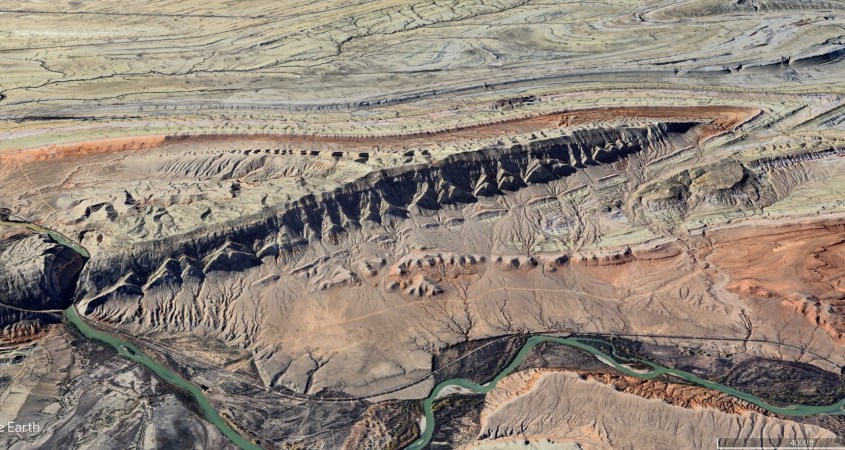
Proving that plasma winds electrically scoured the Earth, built mountains and carved canyons, is a tall order in the face of more than a century of consensus science saying otherwise. In prior times, Electric Universe theories might have been readily accepted, since religions and mythologies explicitly state the gods of creation were storms, lightning and thunder.
Modern science, however, came along and discounted myths and religions as useless for understanding Nature. Scientists said ancient myths express the superstitious anxienties of people ignorant of cause and effect. They displaced any notions about cycles of catastrophe by insisting geology is an exceedingly slow process of change due primarily to chemistry and erosion. They didn’t prove it, by the way, they just insisted that time itself is the proof – billions of years – so, who can argue with that? And except for the chemistry, which is the work of electricity, they excluded any role for Earth’s, or the Solar System’s electric circuitry in their causes and effects.
The Electric Universe view is that the Earth, Sun, Solar System, and in fact, the entire Universe, is a composition of connected electric circuits, and electricity is the cause of all the effects. The weather did actually shape the land, much as mythologies say, during highly kinetic plasma storms. The landscape is electrically carved and the mountains are wind-blown dunes.
Our theories have evidence. They present cause and effect mechanisms that make perfect sense in terms of classical physics. The evidence and the mechanisms comport with what can be seen with the naked eye. And some of the theories have been confirmed by experiment.
To show how our theories explain a mountain much different than the consensus, a comparison is in order. The consensus analysis is this Myron Cook video examining the Sheep Mountain anticline in Wyoming. With the title: “Explain This!”, he presents a challenge. I’ll take it. You can compare his explanations to mine and determine which fits best.
Cook’s video covers classic geological theory that I will provide an alternate, Electric Universe explanation for. What I hope this will show is that Plasma Orogeny is a theory of verifiable simplicity, elegance and classic physics, whereas the consensus requires a narrative built of dogmas and unverified assumptions.
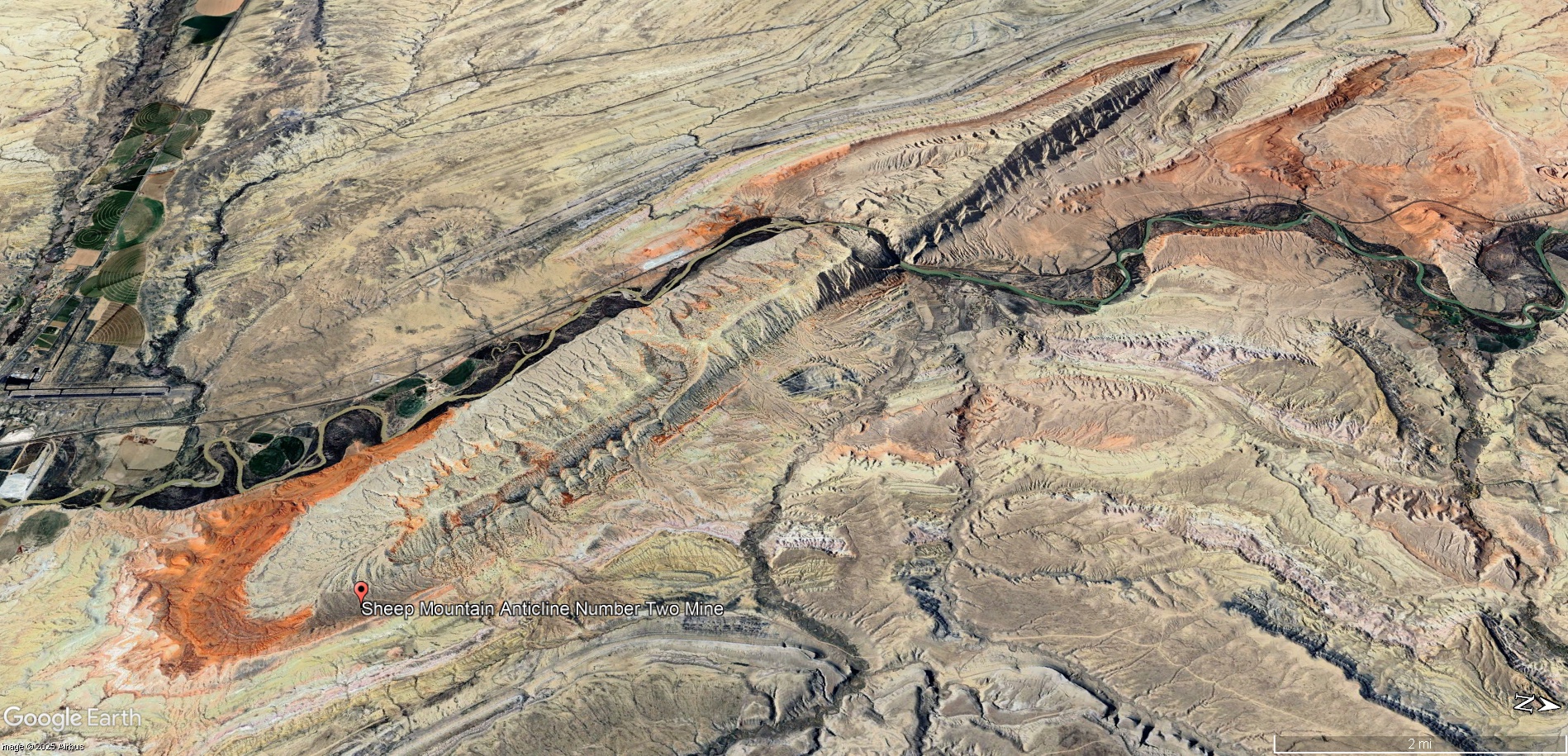
I mean no offense to Myron Cook. He knows what he’s been taught. He authentically believes the theories of his predecessors are confirmed by his own observations. Unfortuntely, his predecessors were wrong and he suffers confirmation bias, because if one squints hard enough, a million years of erosion can be imagined to do almost anything.
I chose his video because I think it is excellent. He communicates his knowledge in plain language, and explains technical concepts without hubris, or condescension. He obviously loves Nature and is curious and enthusiastic. He presents excellent footage of the mountains – much better imagery than I can provide. I like him. Maybe he will see this article and become curious about the Electric Universe.
I’m linking his video because it allows a convenient comparison of particular features and explanations. He gives a textbook explanation most mainstream geologists would substantially agree with. I hope you enjoy his video, as I did, and give him a thumbs-up and only positive comments.




The Plasma Orogeny of Sheep Mountain
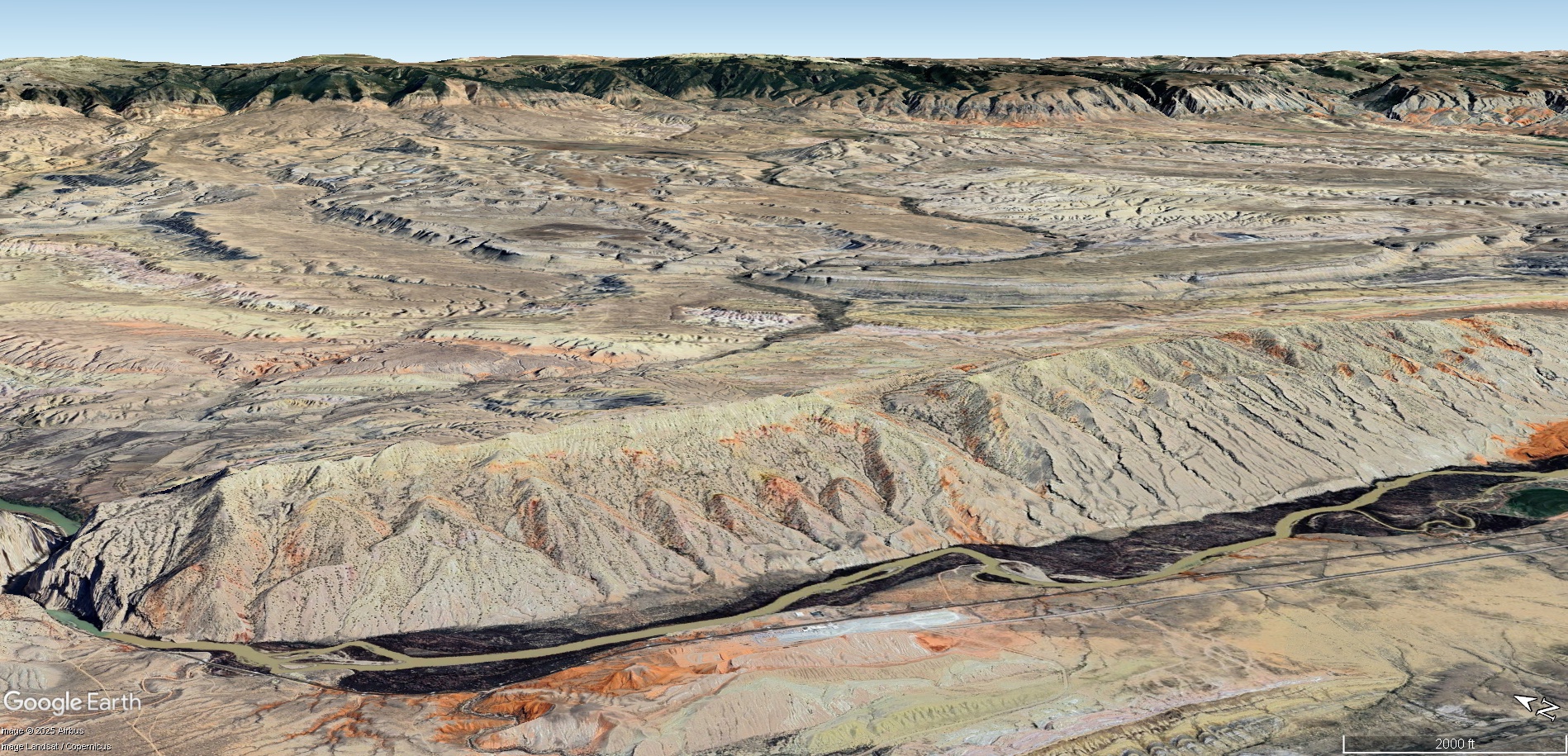
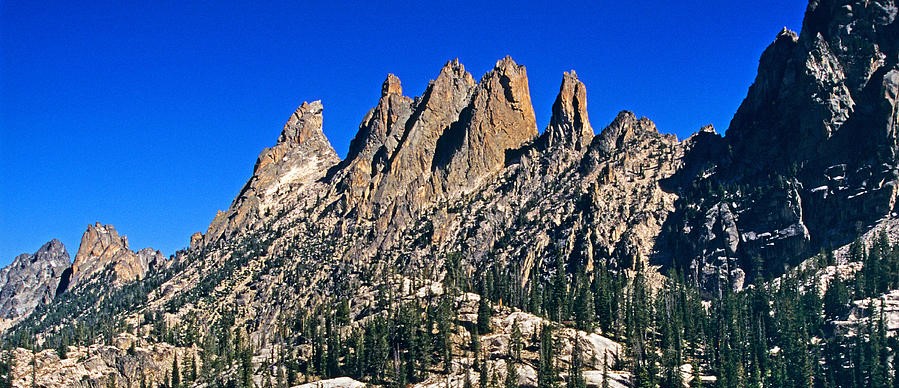
The triangular shape and planar face of the fins, or flat-irons, was made by sonic shockwaves. That is why they appear as repeating harmonic forms. What you will notice in several examples we’ll look at later, is that flat-irons and related mountain features are shaped like shock-waves, down to the finest detail. However, before looking at the finer detail, higher fidelity innerstanding will be achieved by starting with a broader contextual view.
Sheep Mountain Anticline is a dune raised beneath a giant, updrafting wind that fed an even larger plasma storm system. The swirling patterns of topography immediately surrounding the anticline tell the story. These patterns were literally blowtorched into the earth by downbursting plasma winds from the same storm system.
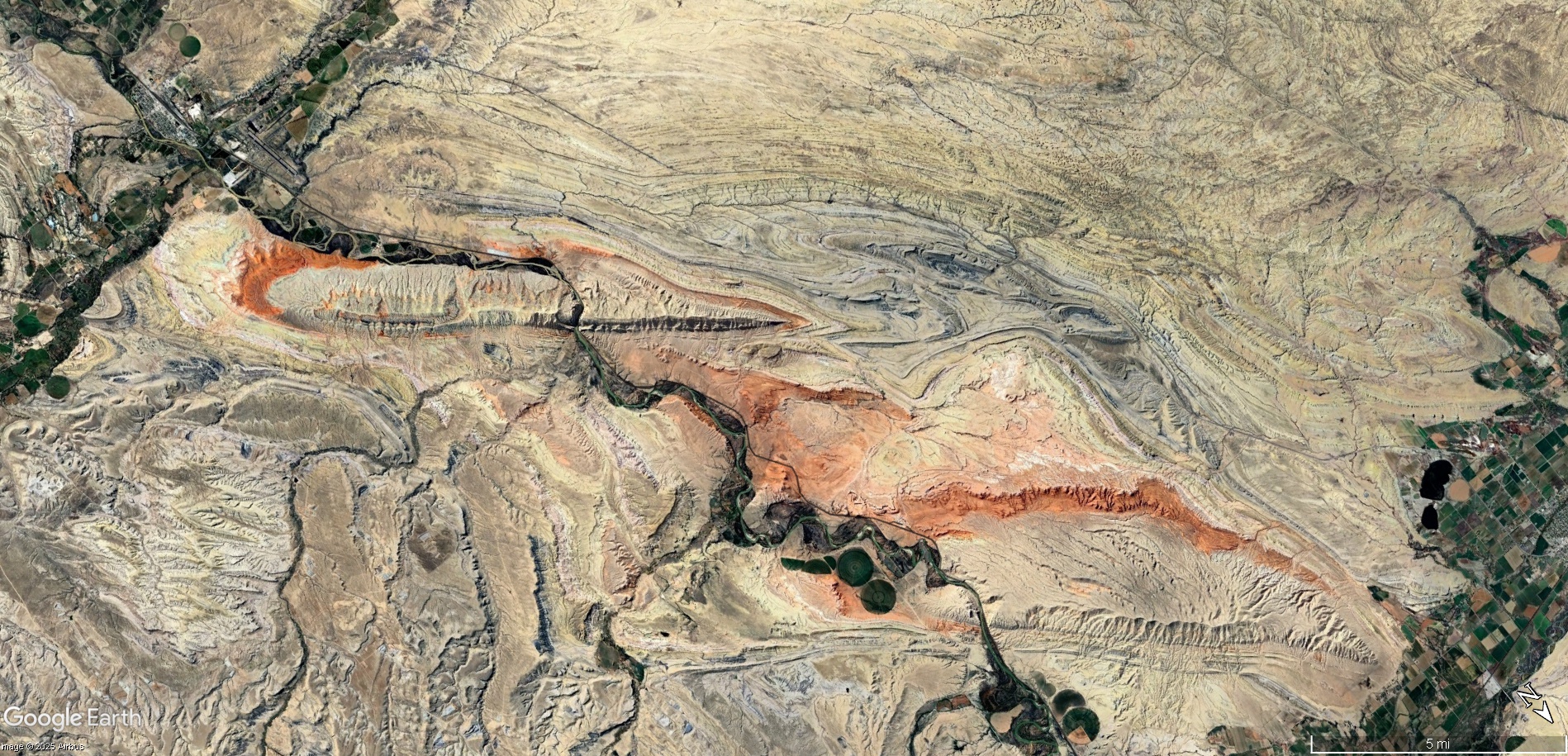
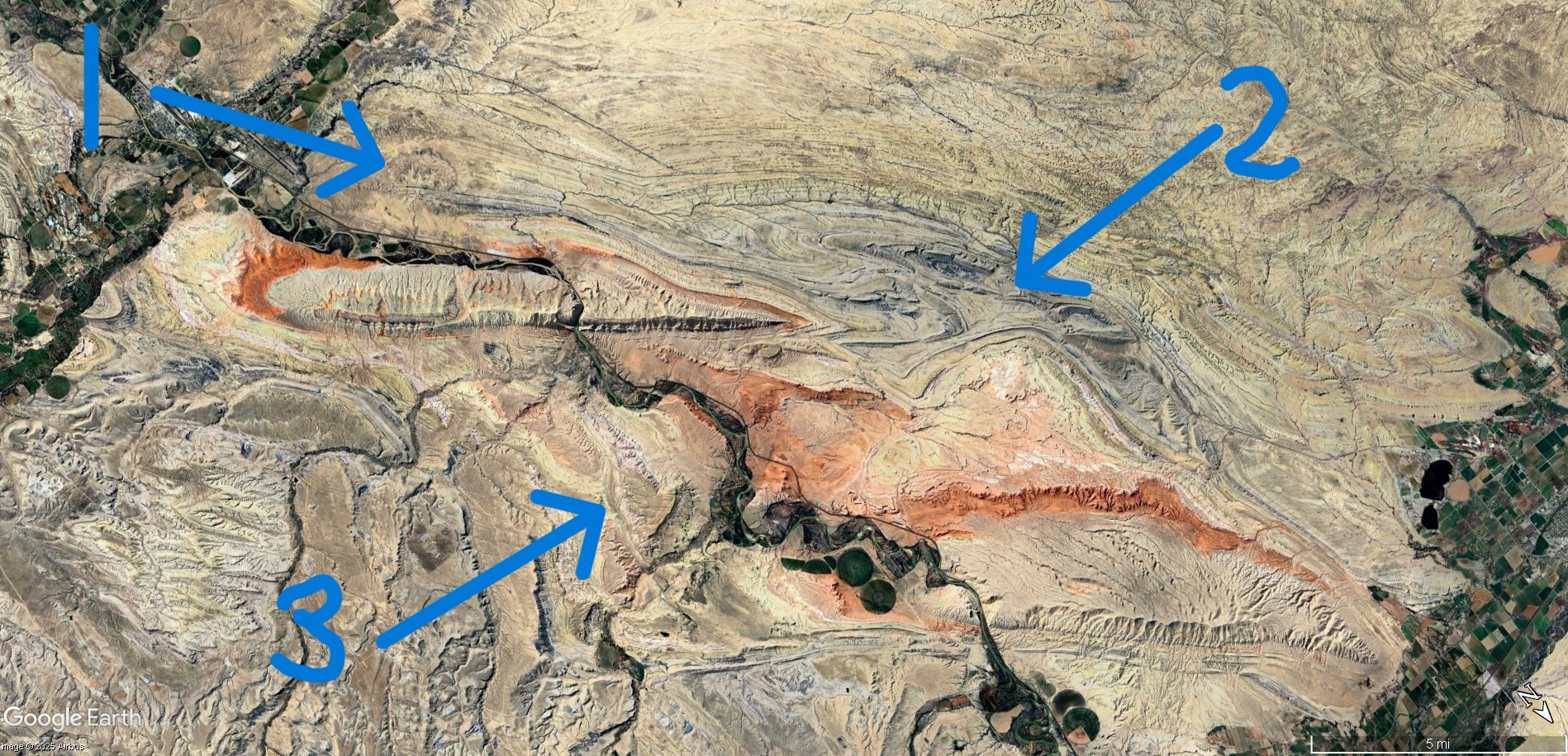
Figure 3 is annotated to highlight points of discussion, but the slider can be moved to see the raw image without annotations. Sheep Mountain is the snail-track shaped mountain outlined by a rust colored layer of earth sitting center-left in the image. Please expand images to examine the intricate patterns closely and note the following:
Area 1, directly above Sheep Mountain shows a slightly oval crater pattern. Area 2 shows two almost cojoined oval craters. Both of these features are surrounded by a pattern of hills and dales that looks like a figure-eight racetrack. The figure-eight pattern mates with the contours of Sheep Mountain perfectly, as if they were molded together. Area 3, below Sheep Mountain has a more paisley pattern of craters, but these are oriented lengthwise almost perpendicular to the mountain.
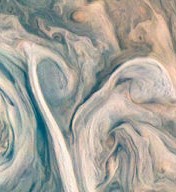
Plasma storm systems capable of producing the same windforms at ground level are found on Jupiter, at a much larger scale, but in the same fractal, paisley patterns that created Sheep Mountain and many other similar mountains found around the world.
In Figure 4 is an image of a storm system on Jupiter that is very close to the pattern of storm that made Sheep Mountain. Again, it is annotated to compare with the areas noted in Figure 3, but the slider will remove the annotations.
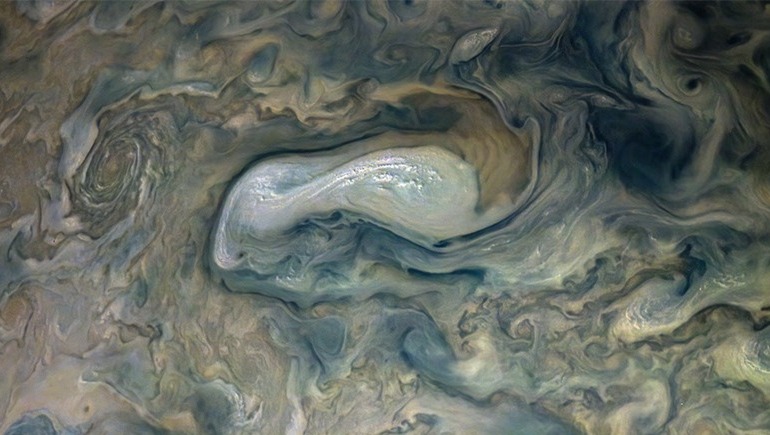
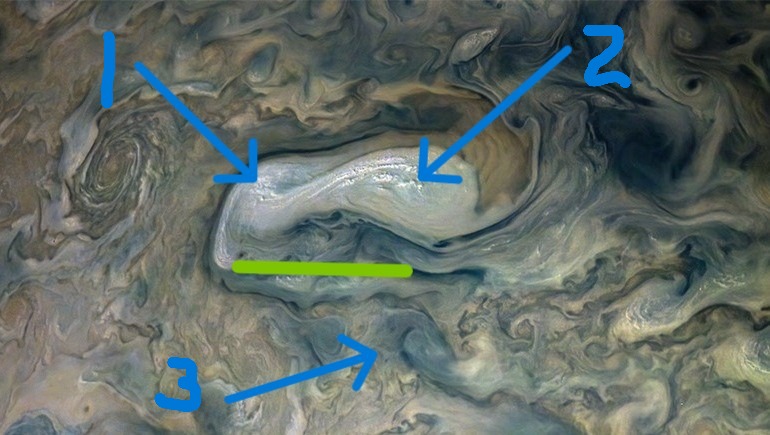
Area 1 on Jupiter clearly shows a hook shape indicative of a tornadic rotation. Area 2 appears to have two counter-rotating cyclones. They are embedded in a storm cloud shaped like a figure-eight in an identical configuration to the figure-eight racetrack by Sheep Mountain. There is even a squared-off shelf-cloud on Jupiter configured exactly like the squared-off top of the racetrack. Below the white figure-eight cloud are paisley shaped storms in Area 3 oriented exactly like the paisley craters in Wyoming.
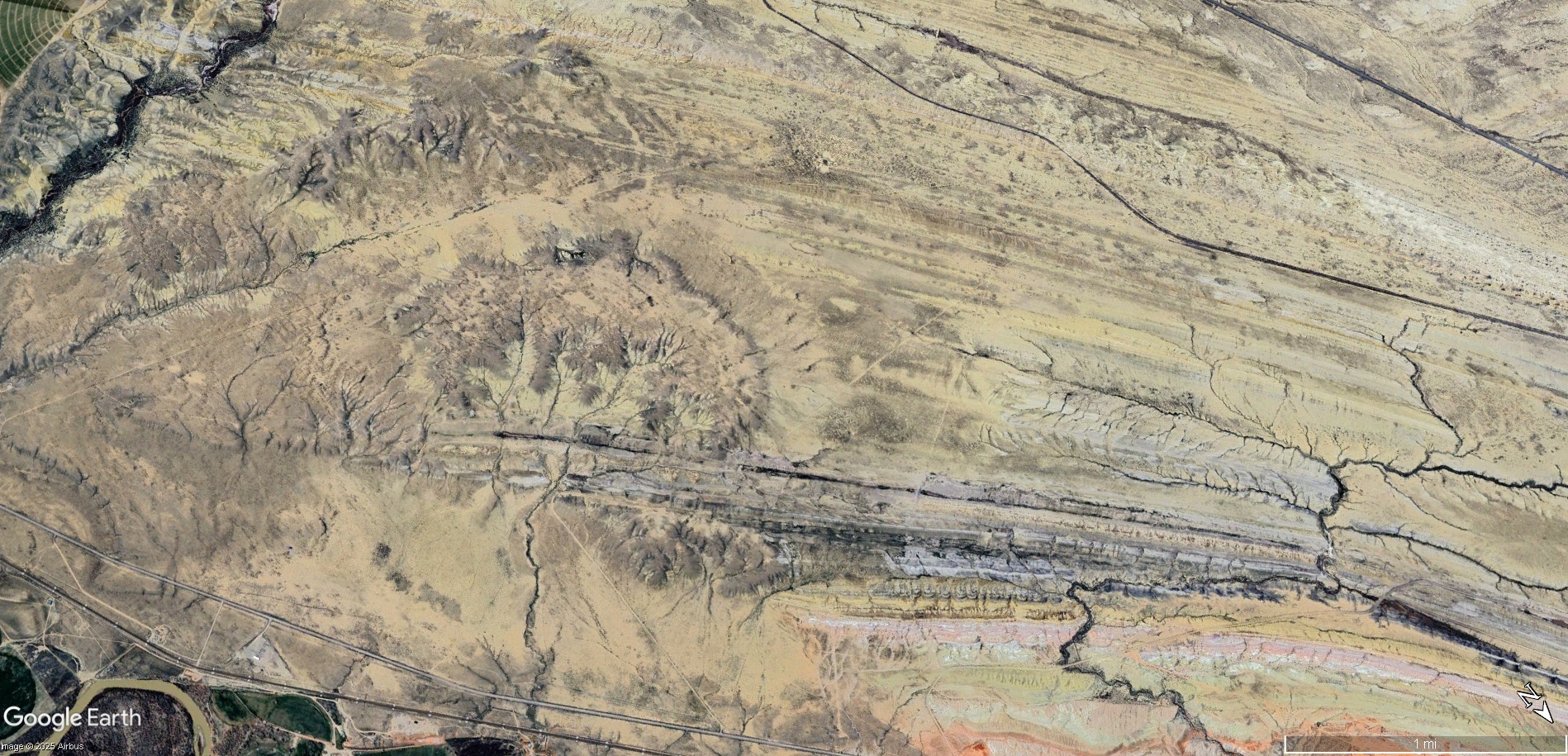
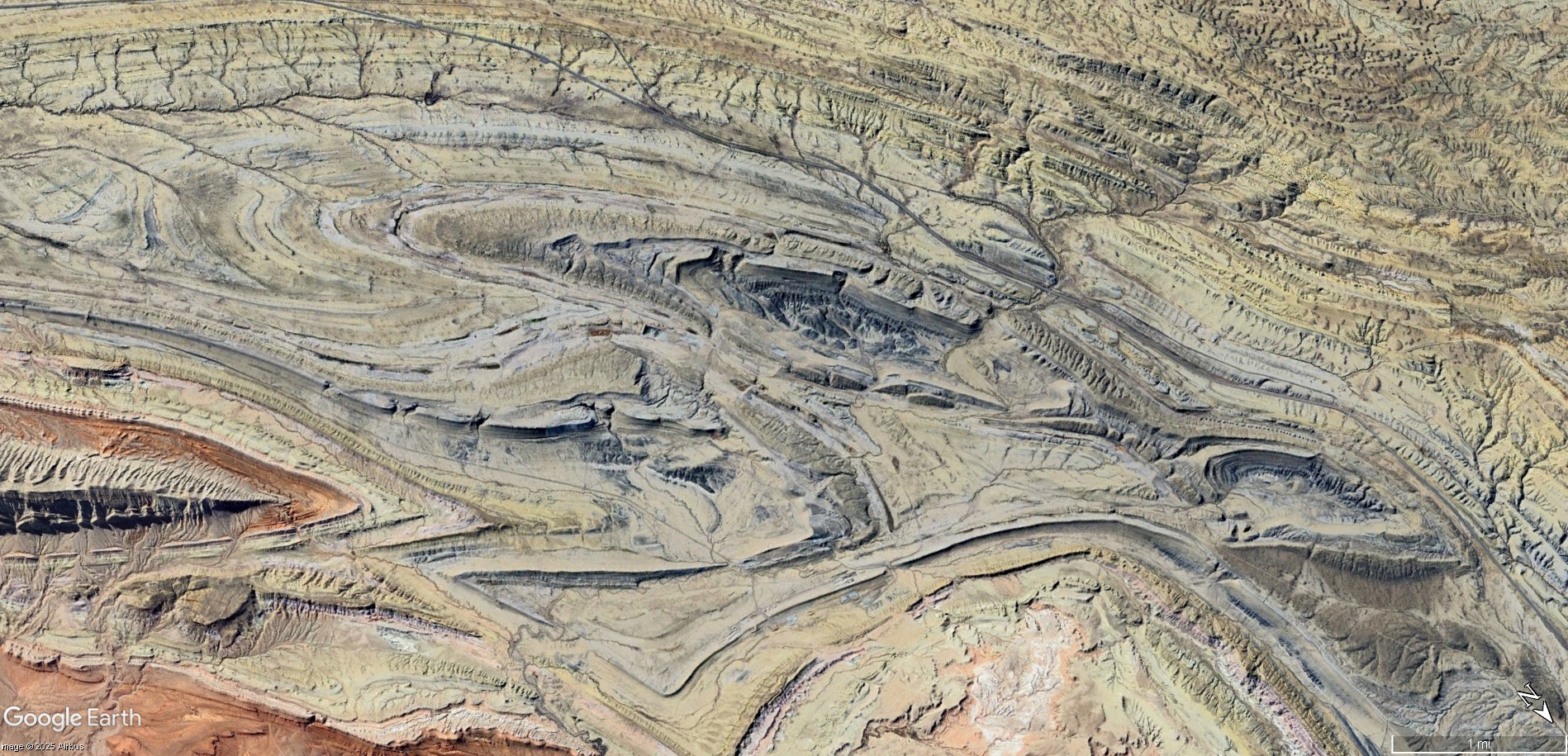

Between these is a linear bar of angry looking clouds. This is the updrafting inflow wind to the giant thunderstorm, where dusty plasma winds reached supersonic speeds as they lifted, leaving a pile of dust behind, removed from the wind electrostatically, to form Sheep Mountain and it’s fins. Where Sheep Mountain formed is indicated by the green bar. Chevron shapes appear in the clouds where the inflow occurs. At least that is what a similar storm did in Earth’s formative years, when cold, dusty plasma engulfed the planet. What is taking place beneath the storms of Jupiter is hard to say since we can’t see the surface. I will only say, it’s not what NASA tells us.
Why, one should ask, would the top of the clouds on Jupiter, or anywhere else tell anything about the ground below? Because the most electrically charged, fast moving winds are vertical winds in updrafts and downbursts. This is true on Earth and Jupiter. So, what you see looking at the top of Jupiter’s clouds are primarily the tops of towering updraft columns and cyclonic downdrafts. Just like meso-cyclones and cyclones on Earth are built around central updraft and downdraft columns.
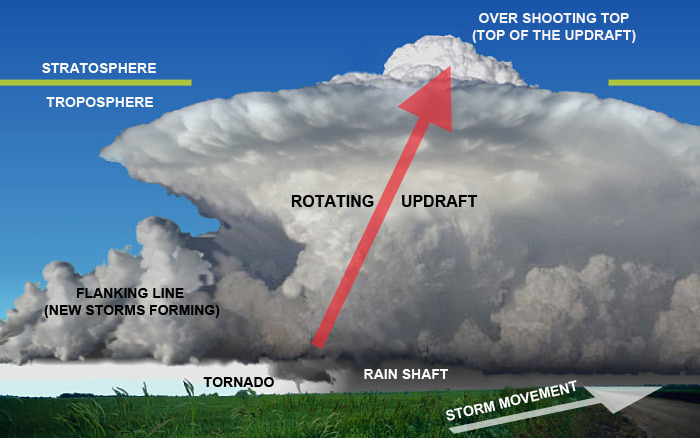
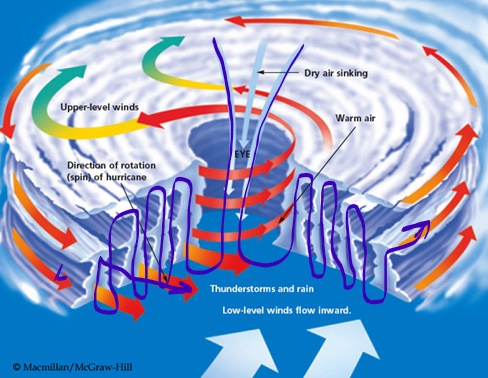
The updrafts are building mountains. As the wind lifts from horizontal to vertical flow, it accelerates, creating a shockwave. Dusty plasma wind passing through the shockwave releases its dust electrostatically and deposits it into a region behind the shockwave called the separation bubble.
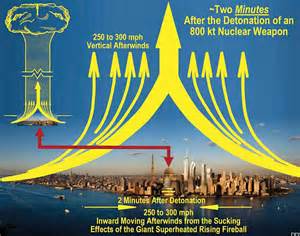
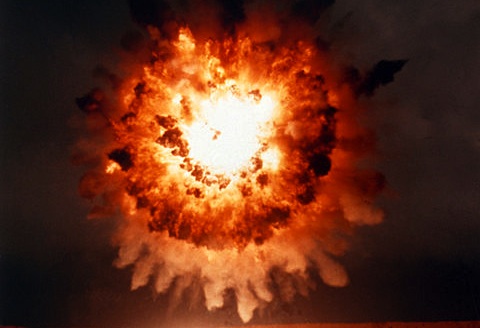
The storm is creating the same effect that air-burst nuclear detonations cause: an explosively fast updraft that draws a supersonic ground wind in it’s suction. Harmonic shockwaves form at the inflow to the updraft where the wind deflects and accelerates upward. This has been simulated by airburst models.
Flat-irons are found in almost every mountain range on Earth. They can be limestone, sandstone, or granite; sedimentary, metamorphic, or igneous. They can form an entire tetrahedral mountain, a harmonic series like an anticline, or flatirons on a mountain flank, and they will perfectly match the shape of shock-waves. That is one hell of a coincidence.
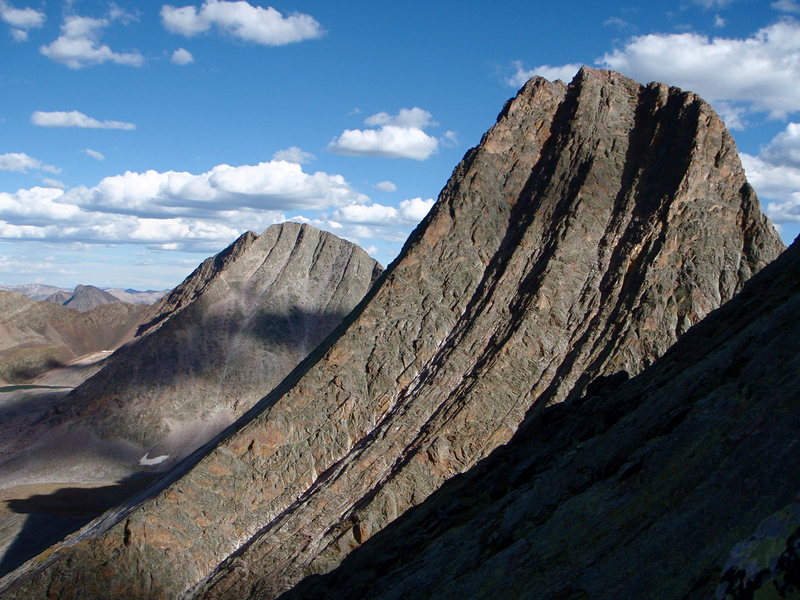


How random seismic forces and erosion create such geometric perfection without leaving everything crumbled is a mystery, because geologists can’t make this happen in a lab. They can shake, tumble, stretch and squeeze earth and rock all day long, or even a billion years, and they will only make a pile of rubble. Erosion softens edges, it does not make them sharp and straight. They can never form tetrahedrons of such crystalline form because these are products of creation, not destruction.
However, engineers do it in wind tunnels all the time. When a supersonic wind hits a surface, it deflects, accelerating the wind, creating a shockwave. Behind the shockwave, in the boundary layer beneath the fast moving wind, a compressed, dead air space is created called a separation bubble. The shape of the separation bubble, under ideal conditions, is a perfect tetrahedron.
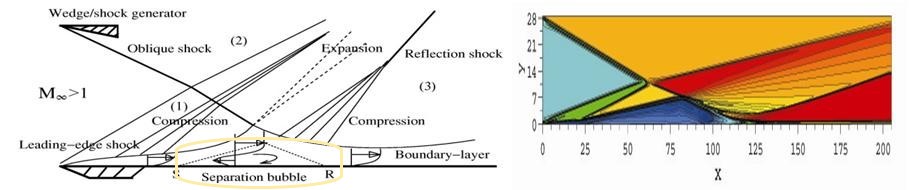
Analogous to an ocean wave forced to rise, curl and break onto a beach, it’s shape defined by Fibonnacci; when a supersonic wind is forced to rise, curl and break, it’s shape is defined by Pathagoras. One can see the flat triangular face of such tetrahedrons on iron meteors. Because they entered the Earth’s atmosphere at supersonic speeds and began to melt from the heat, shockwaves sheared across the meteor’s surface as it tumbled through the atmosphere and left triangular shapes of molten iron in the separation bubbles. These are “flat irons”, or “fins”, created by shockwaves and they are identical in shape and porportion to those on the flanks of the mountain shown in Figure 10.
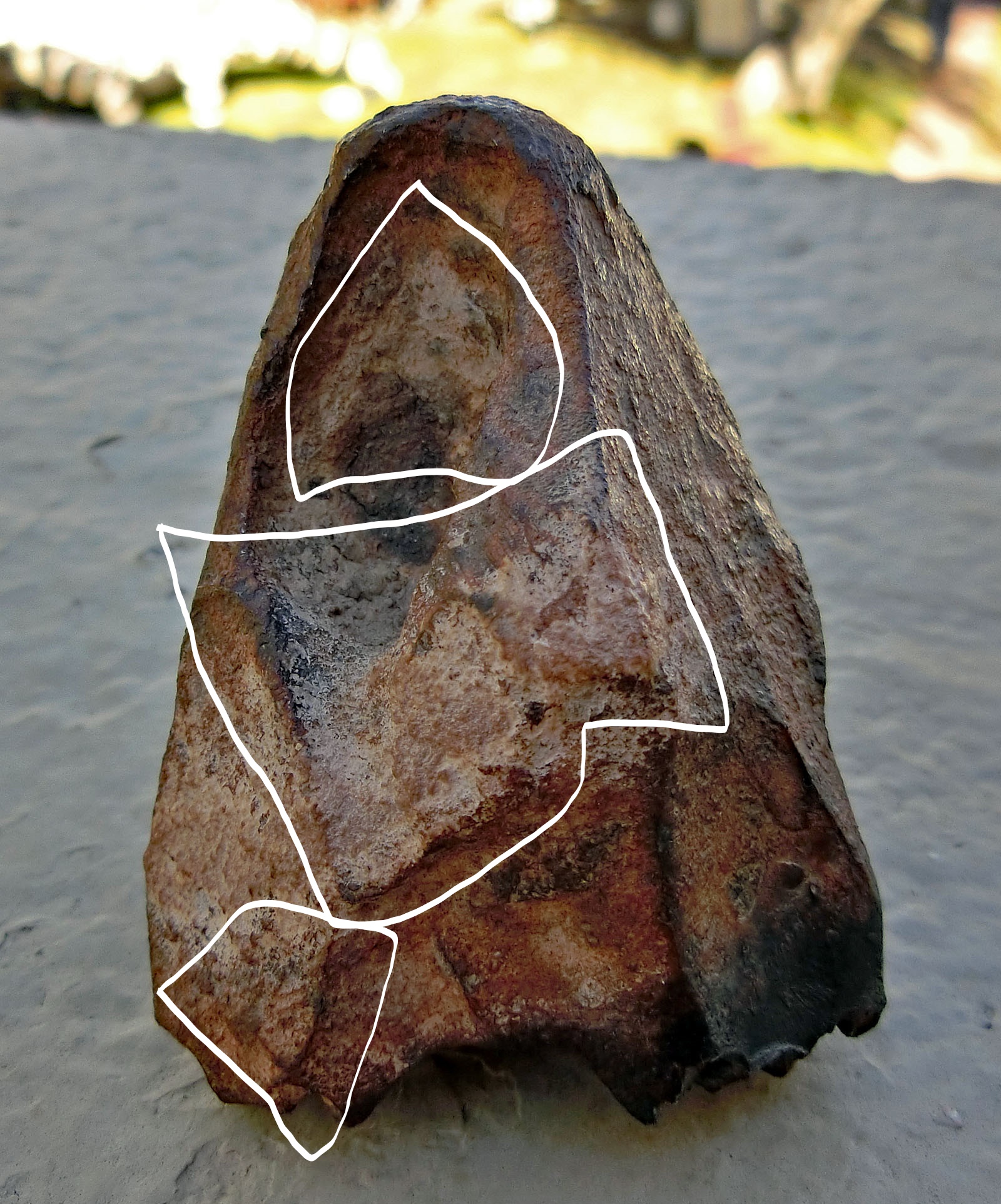

It is not coincidence this meteor has triangles on it. Every iron meteor develops shockwave separation bubbles as they ablate at supersonic speeds falling through the atmosphere. Here are more in Figure 11.
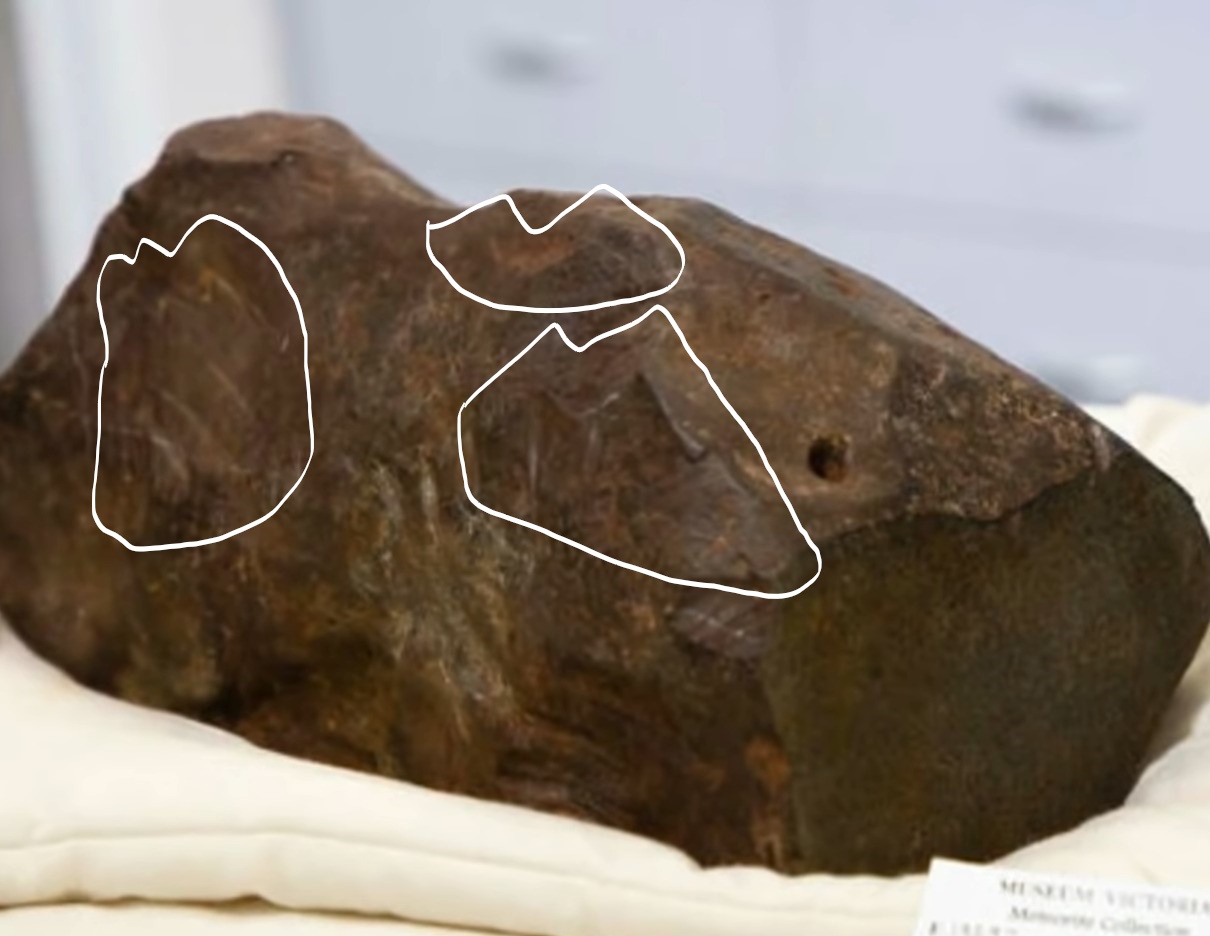
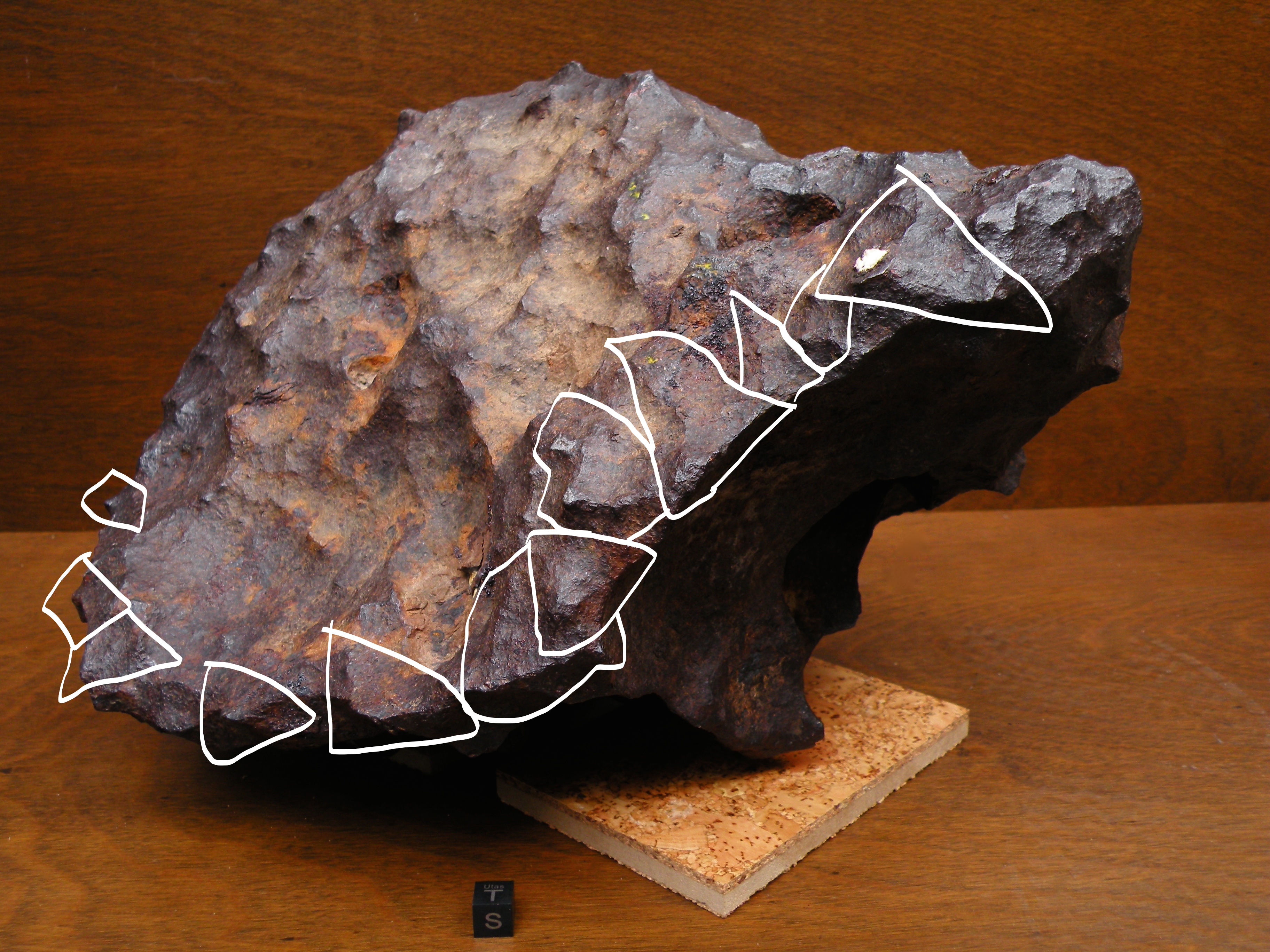
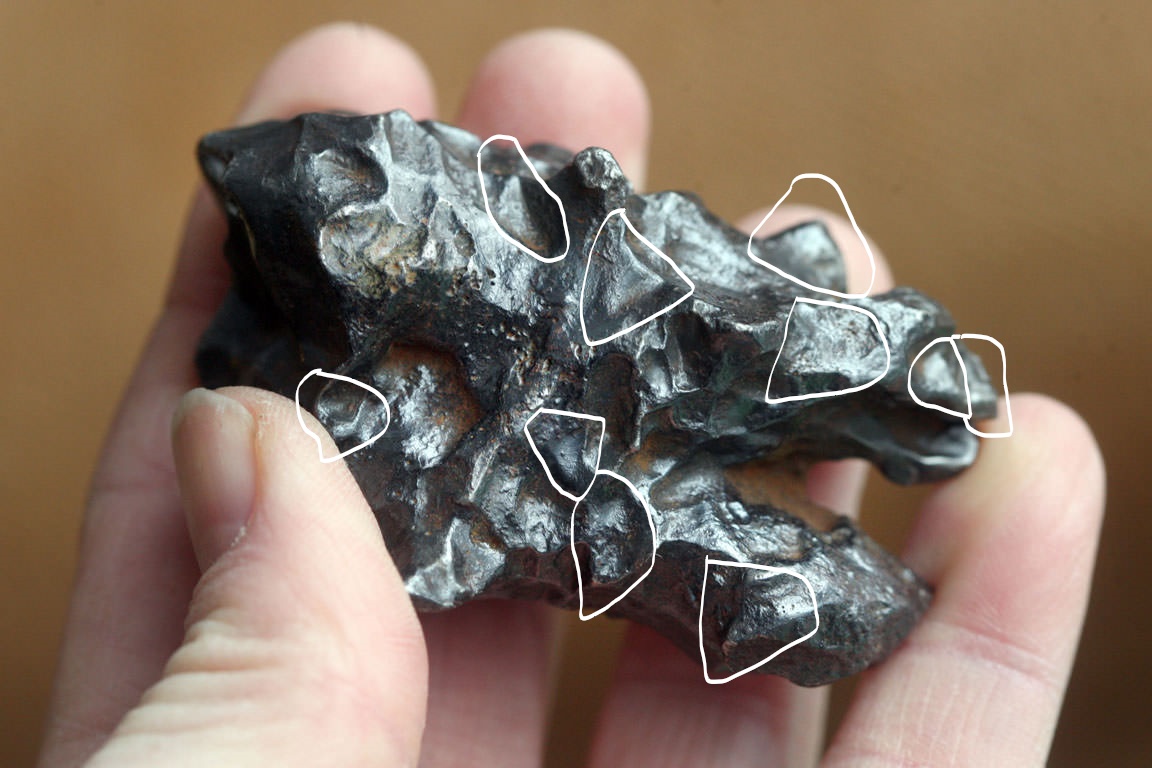
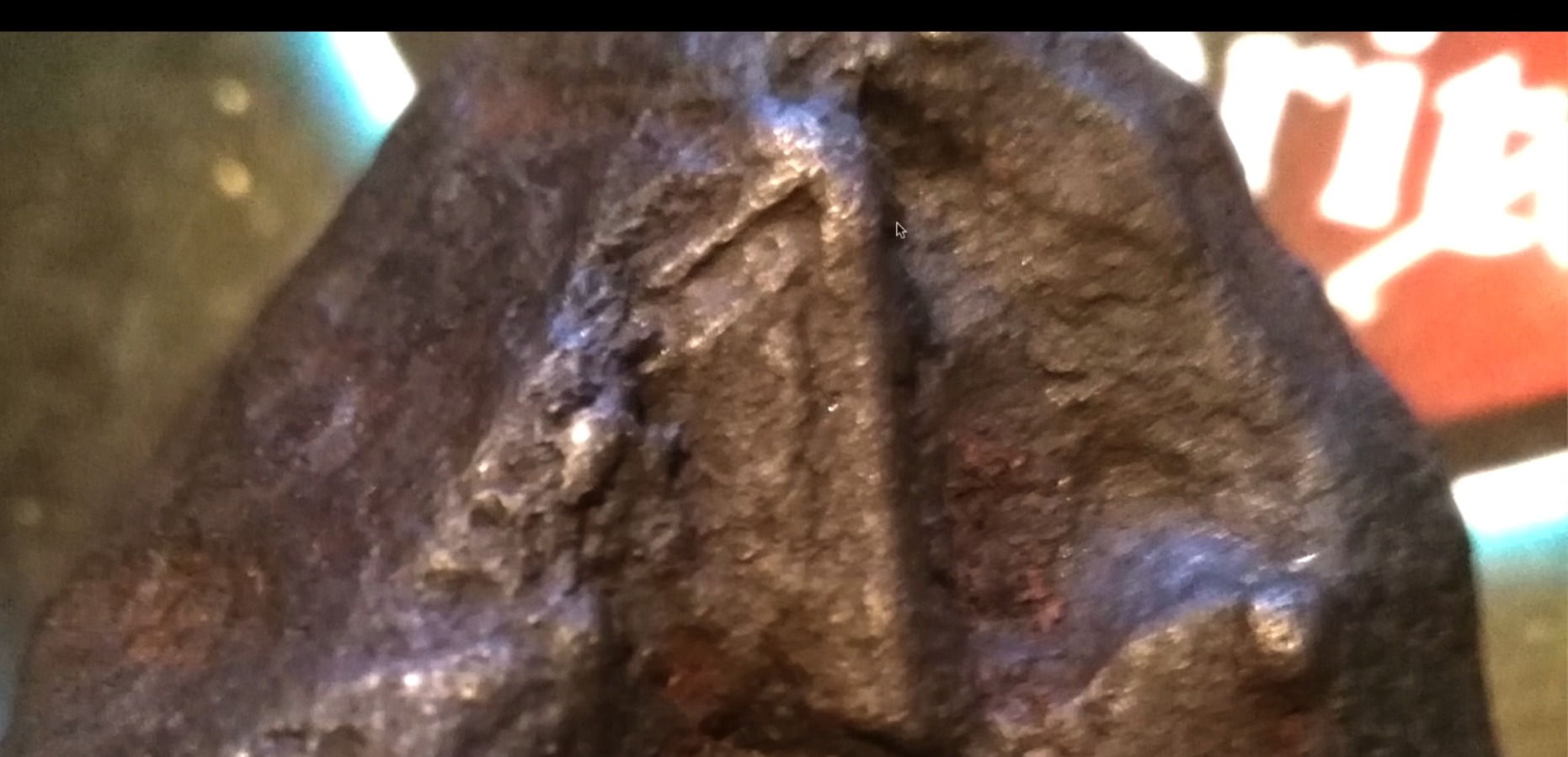
How wind shaped flatirons on the mountain is no different than the flatirons on meteors. High speed wind pushed material into triangular pockets of still air shaped by shock waves. How the wind makes a mountain in the wake of a supersonic shockwave is no different than making sand dunes. Sand fills-in slow moving compression waves that form pockets of still air that faster wind rides over. The mountains are different only in that the wind was supersonic, so the bumps were sharpley defined tetrahedrons, and the wind was dusty plasma, not just sand.

Proof is the harmonic repetition of forms found in both sand dunes and mountains, because they are both produced by sonic pressure waves. Erosion doesn’t harmonize. Erosion is entirely dependent on a watershed being available to collect adequate rain to erode things below the watershed. What you see in the mountains are impossibly eroded peaks, box canyons and repeating geometric shapes that have no watershed above them to begin the erosion process.
Geologists invented something called “mass wasting”, which means the parts of the mountain they can’t explain just disappear, presumably sand-grain by sand-grain over millions of years. They don’t know where it disappears to, or what carries it away, or how it magically produces repeating harmonic forms. They cannot demonstrate it happening by any means. It’s the geologists version of dark matter. They say things to explain it like, “nature rhymes”, that don’t explain anything, but sound very eloquent.



A cold, dusty plasma differs from a plasma of noble gases used in electronics and neon signs. It is not fully ionized and has dust, sand, or even rock entrained that is not ionic, but carries a surface charge. Surface charge on the dust polarizes to align with the electric field, so the dust drifts like a charged particle with the plasma. It is “cold” because the bulk temperature of the plasma is reduced by the non-ionic matter.
Cold, dusty plasma is not well understood. The entrainment of matter makes it more like a foam than atmosphere. Particles of dust suspend like bubbles of foam, bouyed by electromagnetic forces. When those particles come in proximity to a surface of opposite charge, they stick electrostatically. That is how a plasma wind deposits a mountain, because it blows over land that has been electrically charged, either from the ground below, or from lightning above. Shockwaves act as waveguides for lightning, which charges the land in their shadow.
The limestone Sheep Mountain is composed of was sucked out of a sea somewhere else and blown to Wyoming by the wind. Different materials blew in before and after, sandwiching the limestone between. Myron notes it is “fine-grained”. It is most likely the water, fish, fossils and all, were lifted from a sea-bed by subsurface electrical discharge and delivered as an electrified slug of limestone mud by plasma winds. Existing sub-sea canyons are the remnants of those events. They are the deepest places on Earth and, as usual, a mystery to consensus science.
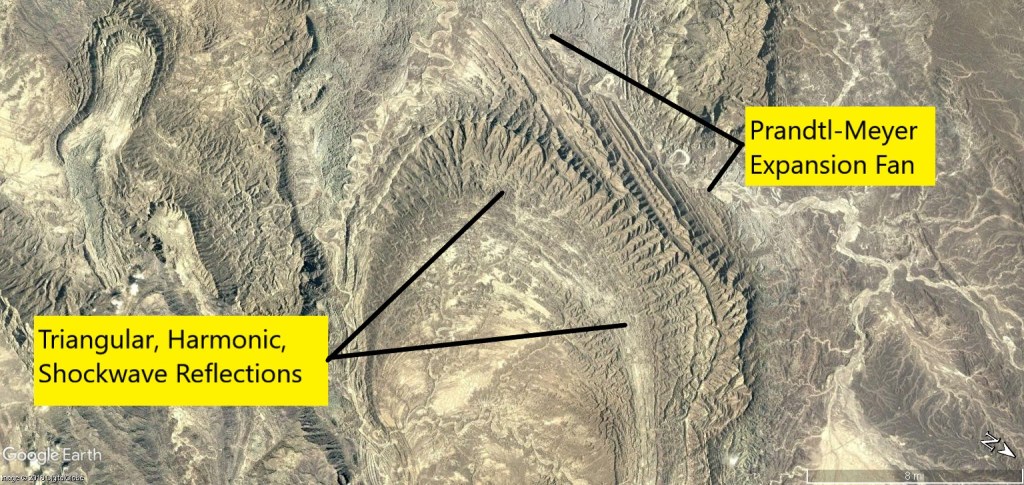
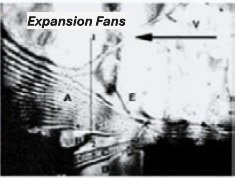
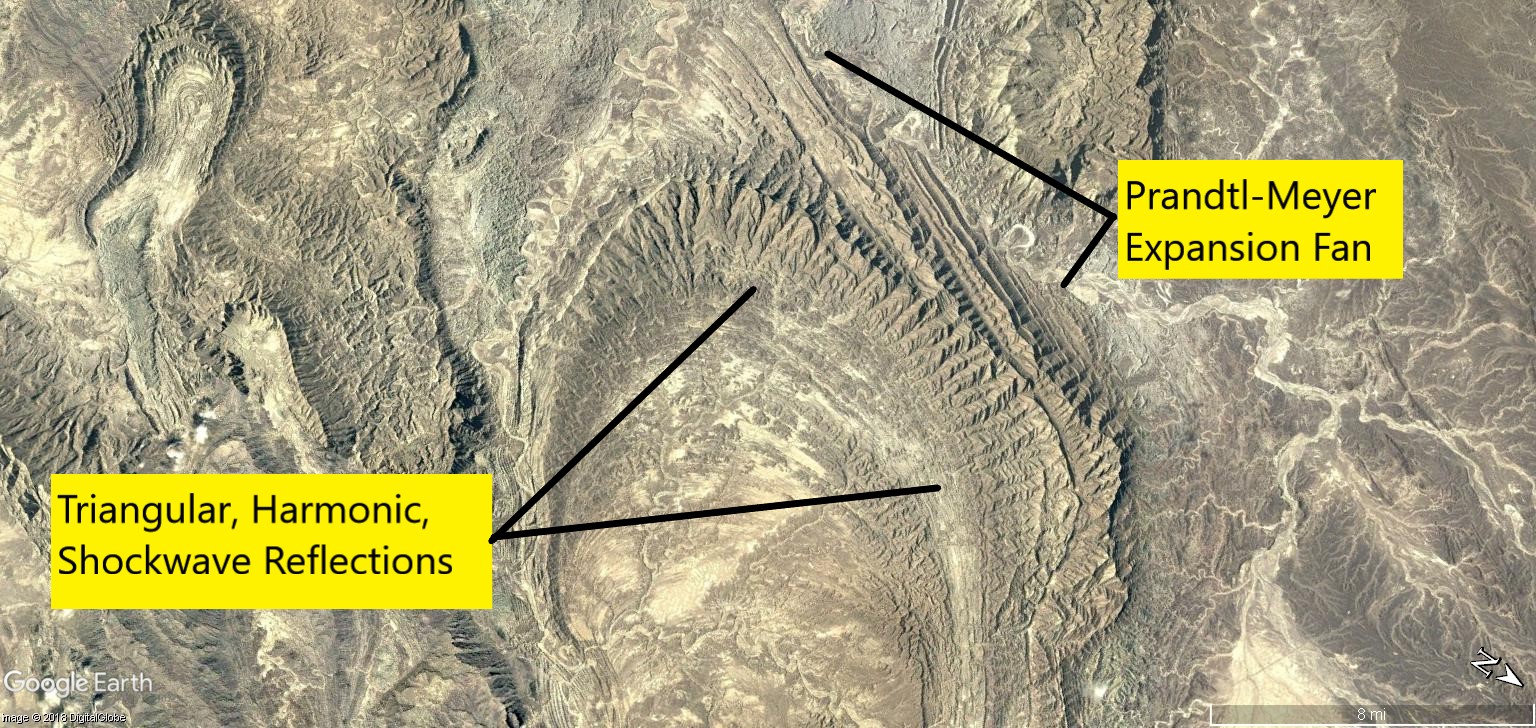
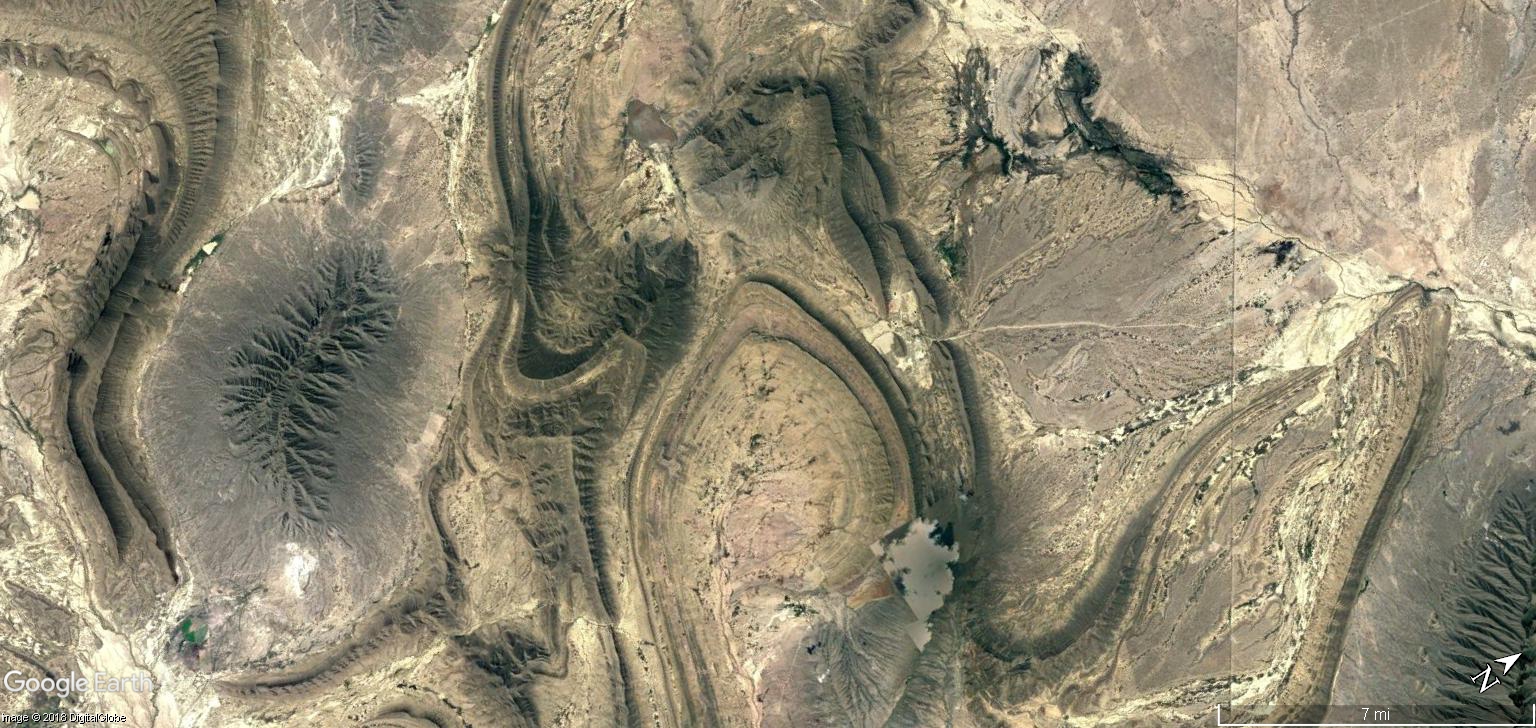
If triangular flatirons and tetrahedral mountains were the only similarity to shockwaves, that could be called coincidence, but there are complex details that are precisely replicated. Figure 14a shows a ring of mountains in Pakistan similar to those near Sheep Mountain. They are patterned with harmonic, tetrahedral fins and another feature particular to supersonic shockwaves called a Prandtl-Meyer expansion fan. A wind tunnel image of an expansion fan is shown in Figure 14b.
Erosion creating an expansion fan is beyond coincidence. All of the features in this mountain, it’s bootprint shape, it’s fins, the linear hills that make the expansion fan, the crater and shockwave blasted rim are exactly shaped and positioned as they should be if caused by a supersonic downburst wind.
It isn’t a one-time anomaly either. Figure 15 is a comparison of the crater in Pakistan with another in Mexico, halfway around the world. Downdrafts blast these types of craters like a plasma blowtorch. This one also has a rim the shape of a bootprint lined with tetrahedral fins, and an expansion fan of linear hills, also with fins on the windward side. The crater in Mexico indicates a clockwise rotation, the Pakistan crater is counter-clockwise.
Also shown is a storm on Jupiter with the same bootprint shape and the dark eye of a hurricane in the center, rotating clockwise, shown for comparison. The thin, white rim of clouds shaped in a hook are formed by updrafts, while the dark cyclone in the center is the blowtorch. The expansion fan is in the clouds sweeping gracefully off-image to the left.
The parallel rows of linear hills in expansion fans are made like the ‘figure eight’ racetrack next to Sheep Mountain. The wind blew perpendicular to the rows of hills and dales beneath higher altitude up-and down-drafts, creating an interference pattern of high and low pressures on the ground. The narrow, linear, parallel hills are pressure ridges, where wind speed was slowed and dust deposited, while low pressure, fast moving air swept the lanes between.
Updrafts and downdrafts are convection currents, but they aren’t only thermal currents, they are driven by the planet’s electric field. In a plasma storm, there are heavy charge concentrations in the clouds inducting charge concentrations on the ground below, and in the layer of aerosols and dust that lays over the ground, amplifying the electric field.
Condensate is a charge carrier. Where there are clouds there is higher charge density and a stronger electric field. Dust and aerosols carrying a positive charge are lifted by the electric field, generating updrafts. Paragliders and hang-gliders know this as “cloud suck”. It’s extremely dangerous because it can trap them in a cloud and even lift them into a thunderstorm.
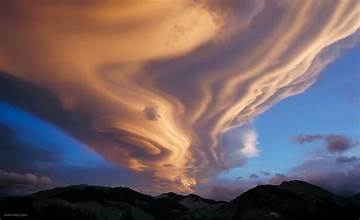
The ground charge must reflect the sky, and vice versa, because of capacitance. It’s as if the pattern of striated clouds shown in Figure 16 were a mold that was pressed to the ground to create the racetrack. Electricity makes the pattern and wind does the rest, molding the pattern of dust being deposited the same way it molds the cloud condensation – by voltage. As above, so below. The explanation is capacitance.
It is capacitance between Earth and sky that causes lightning and tornadoes in the first place, as both are examples of coaxial currents generated by capacitance. This is simple physics that can and has been reproduced in tabletop experiments. It’s the electric field and it’s constant feedback with magnetic fields that twists plasma winds into electric currents that segregate into vertical jetstreams that create incredible bootprints, figure eights, horseshoes and paisley patterns in Jupiter’s clouds and the matching fractal shapes on Earth.
Updrafts leave “sedimentary” deposits behind, as charged dust is electrostatically precipitated by shockwaves, which act as lightning rods. The sudden compression and expansion of a shockwave causes ionization and the formation of a double-layer, making the shockwave a plasma conduit. The shockwave touches ground at the separation bubble, making it the charged hot spot where the dust collects anodically, layer upon layer, in the exact shape of the pressure ridges and shockwaves formed by the wind.
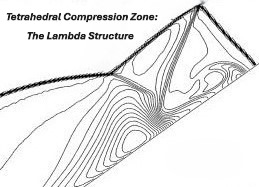
Figure 17 shows a textbook diagram of a feature called the “Lambda Foot”, with some examples found in Nature. It is a compression wave created at the boundary layer contact between a shockwave and it’s reflection. It causes a sudden step-shift in pressure regimes between the incident shockwave and it’s reflection, which can clearly be seen where the sediments are offset. They are difficult to find as they are embedded into the base of mountains, but clear examples can be found at roadcuts and cliff faces. Consensus geology calls these “slip faults”, as if the ground just fell into this slot. They are not “faults” at all and have nothing to do with “tectonics”. They are 100% caused by shock waves.


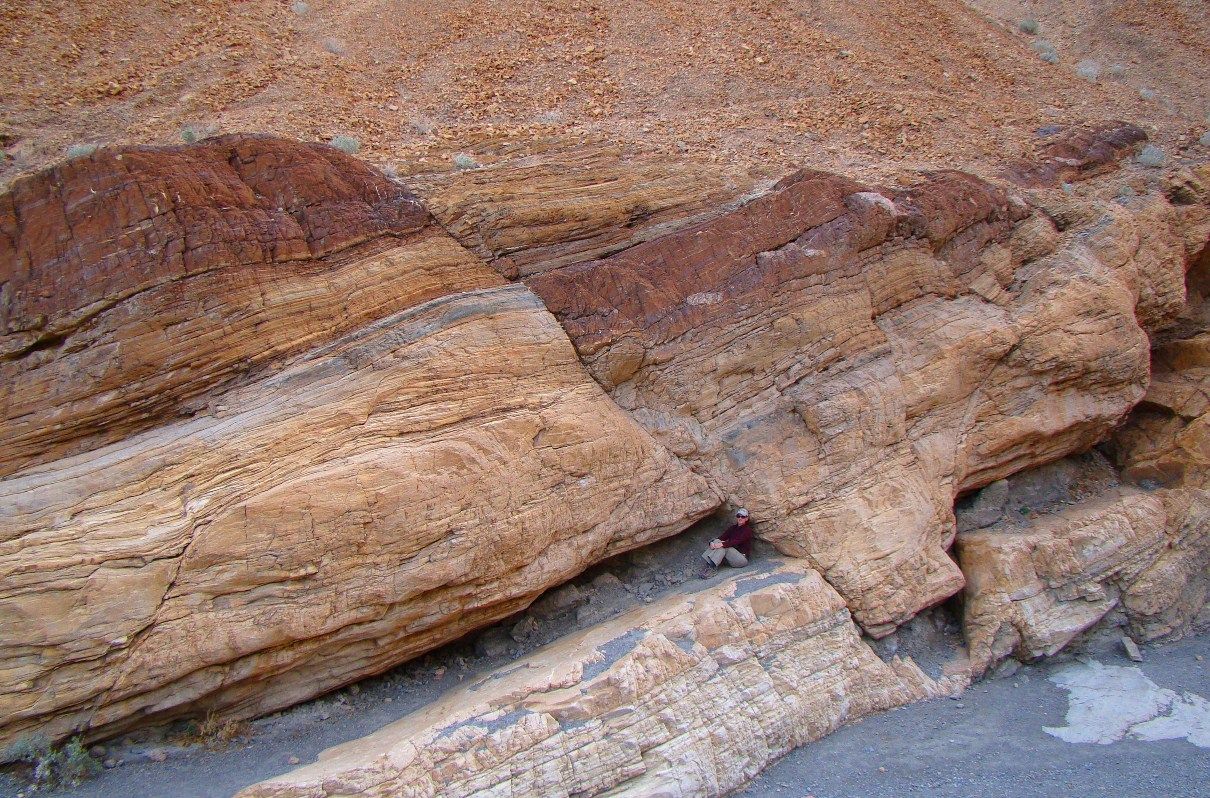
Most telling is in the difference between the center image labeled “laminar flow” and the right image labeled “turbulent flow”. Turbulent flow happens in fluids, not solid rock.
Each layer of sediment was plasma-borne dust, carried in the wind, segregated into step-voltage regimes in harmony with pressure regimes, stacked vertically by capacitance. Higher pressure, means higher density, means higher dielectric effect in an electric field. Plasma layered wind followed the voltage and pressure profile as it carried charged dust into the lambda foot. That dust, suspended like bubbles in a foam, electrostatically connected with the ground and adhered in the exact same profile as the wind that carried it.
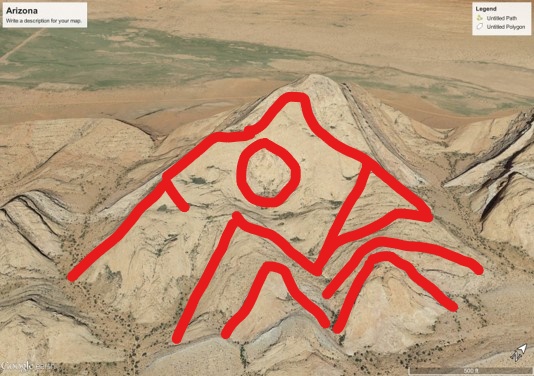
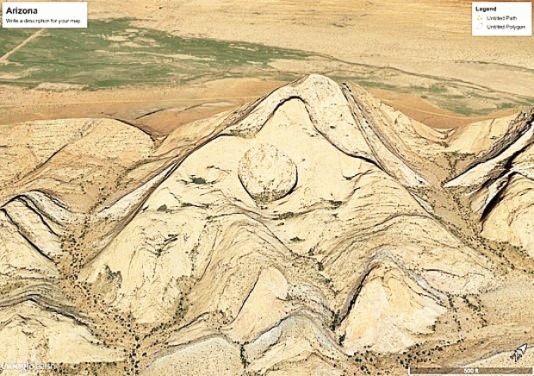
Another shockwave feature easy to find in Nature is a hole in the center of tetrahedral fins. Figure 18 shows a flatiron in Comb Ridge, Arizona produced by an unstable shockwave. The instability causes a low pressure zone on the face of the separation bubble that will eat away a hole, like this one. I have highlighted the face of an unstable separation bubble, produced in a wind tunnel, that shows the hole forming, as well as smaller harmonic tetrahedrons. The entire shape of the shockwave is almost identical to the flatiron in Comb Ridge.
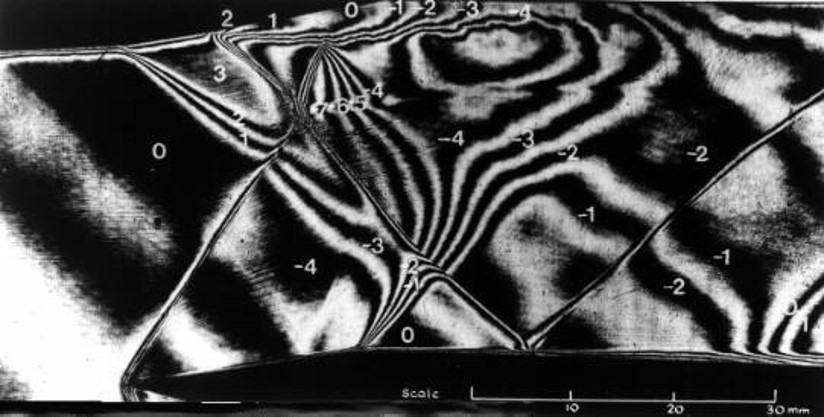
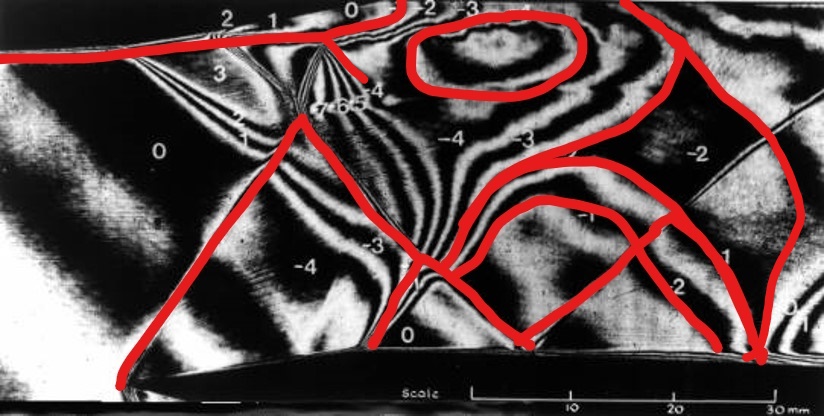
Even geology of highest order strangeness can easily be identified with shockwaves. In Figure 19 are several examples of what I term “sawblades”. Also shown are Schlieren images of where in a shockwave ‘sawblades’ form along the top of the separation bubble, highlighted in yellow among other features within the shockwave structure. Please take time to zoom in to the unannotated version of the shockwave to see the sawblades clearly, they are very tiny in the image.


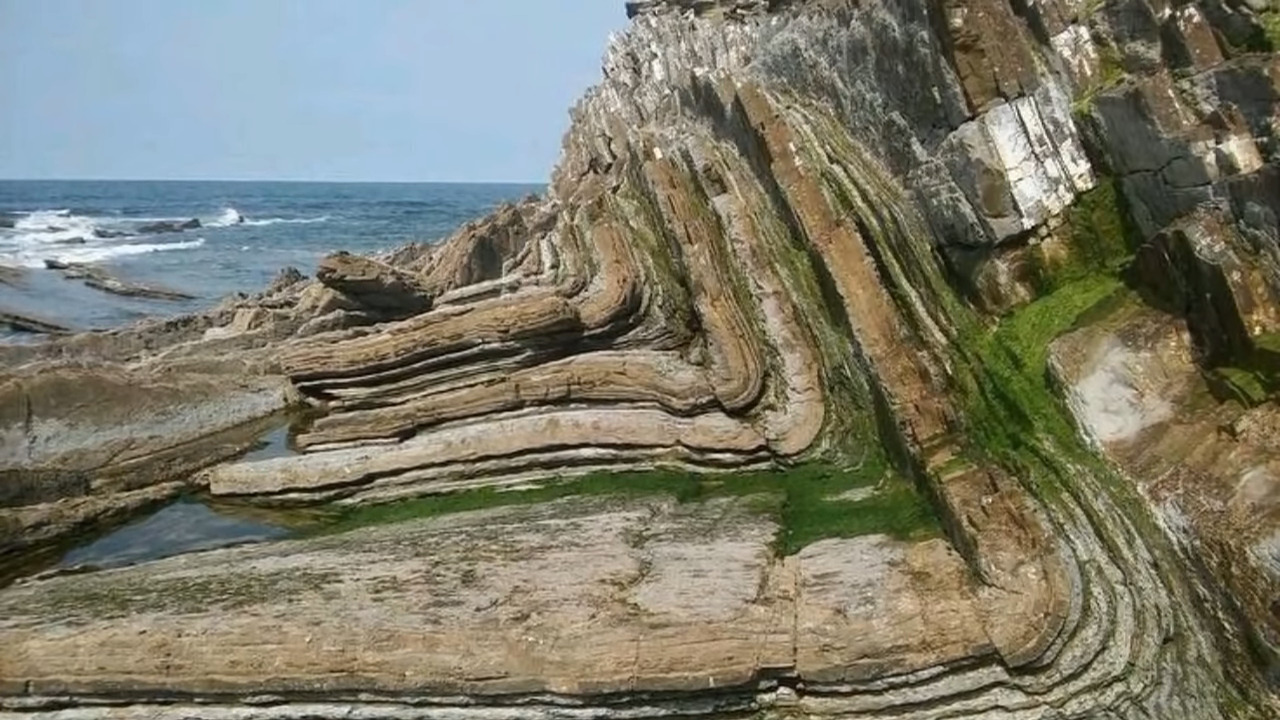
In the turbulent backdraft of a supersonic shockwave, horizontal tornadoes form. Figure 20 highlights these rotating winds and shows examples of the result when such winds are composed of dusty plasma.
Dense dust rotating in the tornado that connected to ground, electro-statically adhered, freezing in-place, while un-grounded plasma remained suspended in the wind and blew away, leaving half, or a quarter of a petrified tornado.


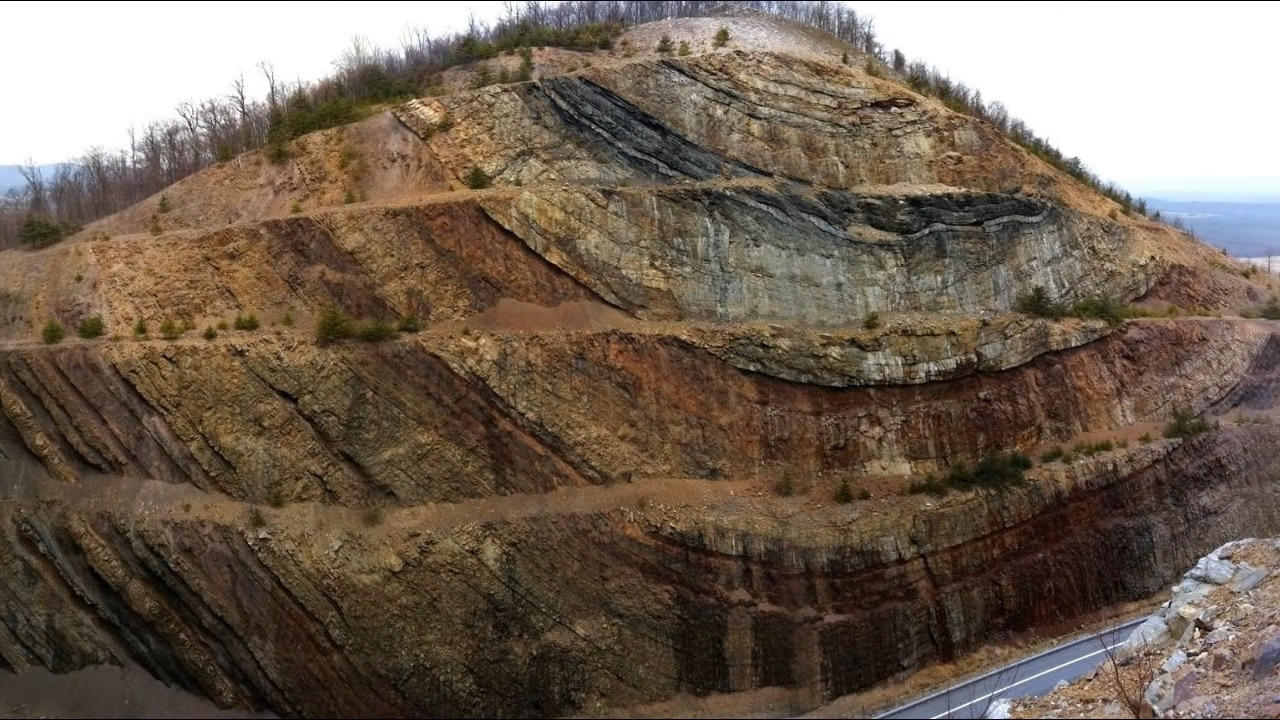
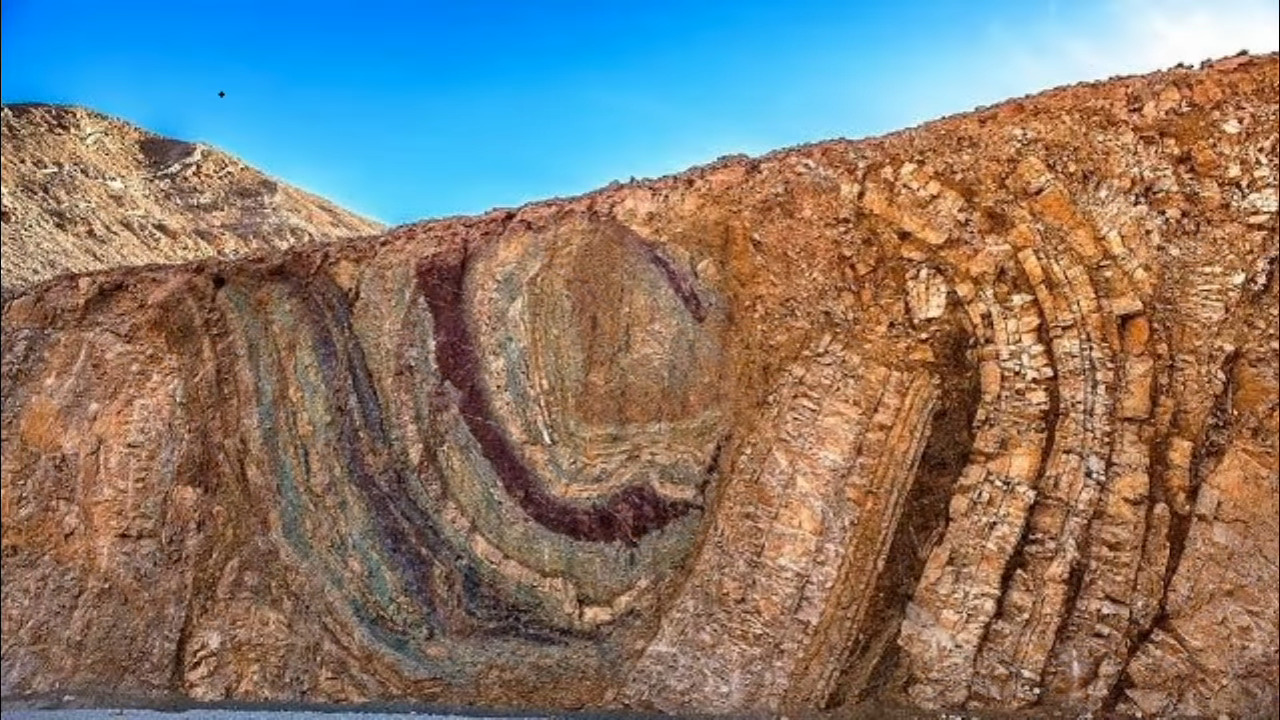
Consensus explanations require this rock to bend into a jelly roll deep underground by some unknown process, and then rise to the surface by another unknown process, plus a few million years of unknown things happening that cause half the jelly roll to disappear. None of their processes can be demonstrated, but they give it a name anyway to make it sound real: “tectonics”. Our explanation is a two step process with electric wind and dust and can be reproduced – the process is already used everyday in manufacturing.
How windborne dust was compacted and seemingly flash frozen into place tells us it had to be electric. Only a dusty plasma could be so thick and still act as a fluid. Only ionic matter and charge bearing dust could instantly recombine and chemically bond to a crystalline form, in situ, in this manner. It just stretches the imagination to consider entire mountains being blown into place and almost instantly formed like they were made of whipped cream, but that is what electricity and a dusty plasma can do.
Scientists sorely need to be challenged to rethink everything they’ve done in the past century. Gravity has trapped theoretical science inside a black hole, looking for dark matter, dark energy, unicorns and multiverses in all the wrong dimensions. Science needs to study Nature as it’s actually experienced instead of moving space and time to suit the scientists’ career path.
Thunderbolts.info has dozens of articles and videos explaining how geologic phenomena like flat irons, craters, canyons and mountains were formed by Earth’s electric circuitry and plasma winds. We show how the winds of Jupiter are a living example of it happening. It comes down to recognizing the fractal patterns of charge diffusion on a spherical capacitor, because it’s the electric field of a spherical capacitor that shapes the wind. On a side note: it’s how the weather can be, and perhaps is, manipulated electrically.
In his video, Myron illicits the “rhythms of nature” as the cause of repeating harmonic forms, like Sheep Mountain’s fins. “Rhythms of nature” is a poetic observation, not an explanation. Consensus science is full of them: “The butterfly effect”, “billions and billions of years”, singularity, infinity, duality, monopole, black hole, worm hole and “space-time”. It’s all a load of crap.
The Electric Universe is about finding answers to the greatest mysteries in Nature. One has to start by asking the right questions. Materialism in science leads to the wrong questions, because they are predicated on the wrong theories.
Energy, frequency and vibration, my friends. Energy makes the hologram; matter doesn’t matter. It’s just energy having a rest inside it’s own magnetic nest.
Cheers,
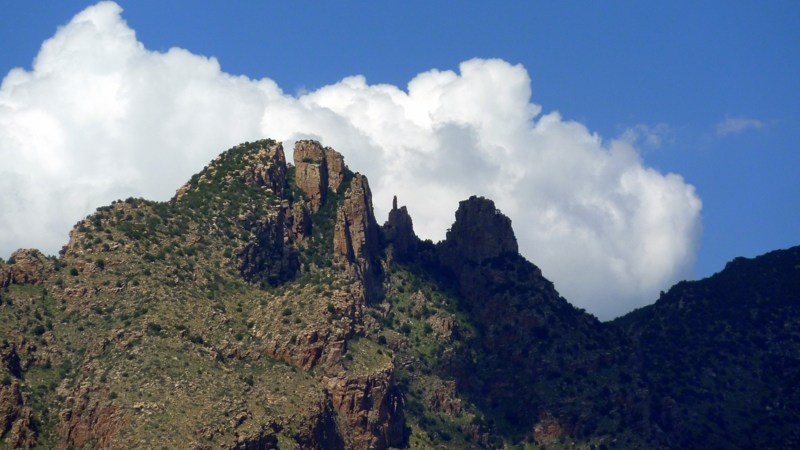
 The eastern sea is the Chihuahua Desert. I liken it to the Sargasso Sea – grasses on swells of rolling land with volcanic protrusions scattered here and there. It’s breezy and bucolic, an extension of the plains where antelope and buffalo once thrived. From West Texas to Arizona, and deep into Mexico, Chihuahua steams with thunderstorms in the summer, glazes with frost in the winter, and is a crystal cocoon of green grass and warmth in the Spring and Fall.
 The western sea is the Sonoran. It’s an overgrown jungle of desert, if there ever was one. Wetter than a desert should be, it teems with botanical danger. Cholla, Prickly Pear, Barrel, Occatillo, and the most grand succulent of all, Saguaro, wear cloaks of surgically sharp needles. Even the trees, Palo Verde and Mesquite, have thorns.
 The mountains are the thing, though. They are the way birds and mammals hopscotch the way across dry, desert seas from the Sierra Madre in Mexico, to the Colorado Plateau. They are islands, where summits rise to ten thousand feet, covered in Ponderosa Pine, Douglas Fir and Aspen. Between the peaks and desert floor, environments layer by elevation. Chihuahuan grasslands overlay foothills of Saguaro forests. Canyons sprout sycamore and cottonwood groves. Juniper, Oak and Pinion stand in mid-layers with caps of forested woods with Canadian winters.
 There are deep cuts in its stacked layers of rock that bear the signature of lightning. Sharp angled, lightning-bolt crevasses shoot up rock faces, their floors exposing dykes of quartz veined rock with a grain at cross pattern to the surrounding cliffs. In other areas, features of precisely the same shape form on soil, the quartz rock replaced with sediments of starkly different color where plants won’t grow.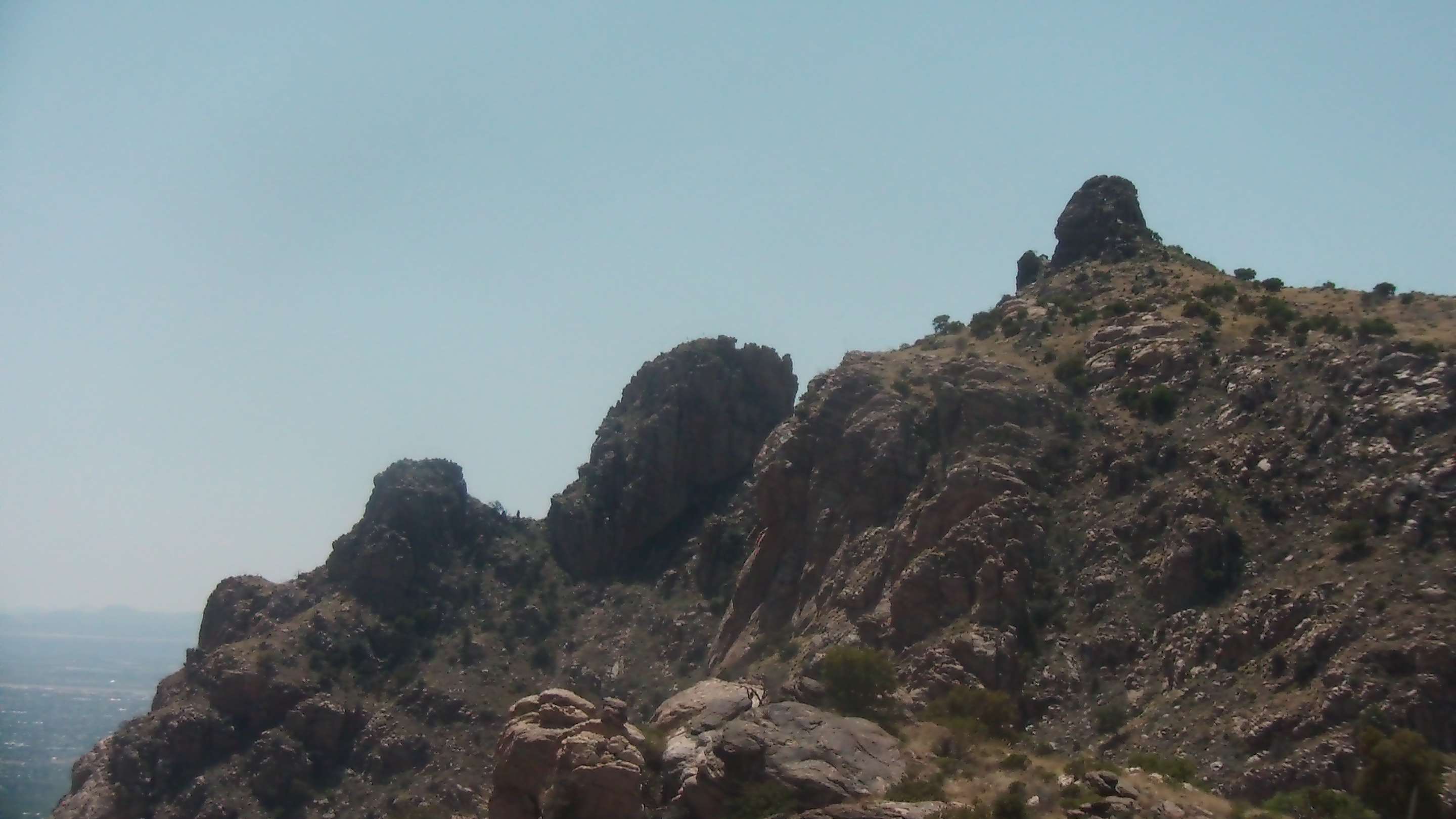
 The hike is in the Chihuahua ecological zone. It’s spring and the grasses blossom with color. It’s also warm and more buggy than normal. You’ll hear me spitting and swatting gnats quite a bit.
 The Daily Plasma