DeDunked! How about a ReDunk?

A monumental shift in ‘critical thinking’ is taking place. People no longer accept scientific claims as scientific fact. They are questioning the “experts”, because thousands of peer-reviewed scientific studies, and the journals that publish them, have been exposed as frauds. Technocrats have used untested theories and their own wishful thinking to portray a version of the “truth” they want us to believe. People are finally awake to the fact that the “reality” they’ve been taught is built on fake narratives.

This is nothing new in the Electric Universe. We have watched the Big Bang cult take control of the narrative for decades, not with proof of their theories, but by hiding their flaws with magical math and closing ranks around a narrated consensus. They then bully outsider’s who suggest alternate theories. It’s been a tactic serially repeated since they vilified Immanuel Velikovsky.

One area this is particularily so is ancient history, where academic interpretations have always been challenged by knowledgable people who see gaps and inconsistencies in the narratives. The academics defend their turf almost as if they are hiding something. Especially regarding theories for past civilizations in a pre-flood era, and the mythologies surrounding the “flood” event itself.

Chief among today’s alternative history theorists is Graham Hancock, who anyone interested in alternative theories certainly knows. He’s hit a nerve with the consensus, so he’s become the latest to be ‘Velikovskied’.

DeDunking” is Dan Richards’ YouTube channel devoted to “alternative history from the perspective of a skeptic.” For those who follow, you’ll know his channel typically uses science and reason to evaluate, and sometimes defend alternative history theories, like those of Graham Hancock, against the onslaught of consensus-science ‘Karens’, gatekeepers and debunkers.

I compliment his courage and style, as he calls out the many flaws, lies and ad hominem attacks served up by the consensus in defense of their narrative. He seems to be a sincere truth seeker and an influential one at that. He is a credible voice because he is savvy to the powers in control of disinformation. However, his credibility will suffer if he ignores the most competent alternative theories regarding science and ancient history – the ones the consensus was invented to hide. Those would be ours, of course, in the Electric Universe.

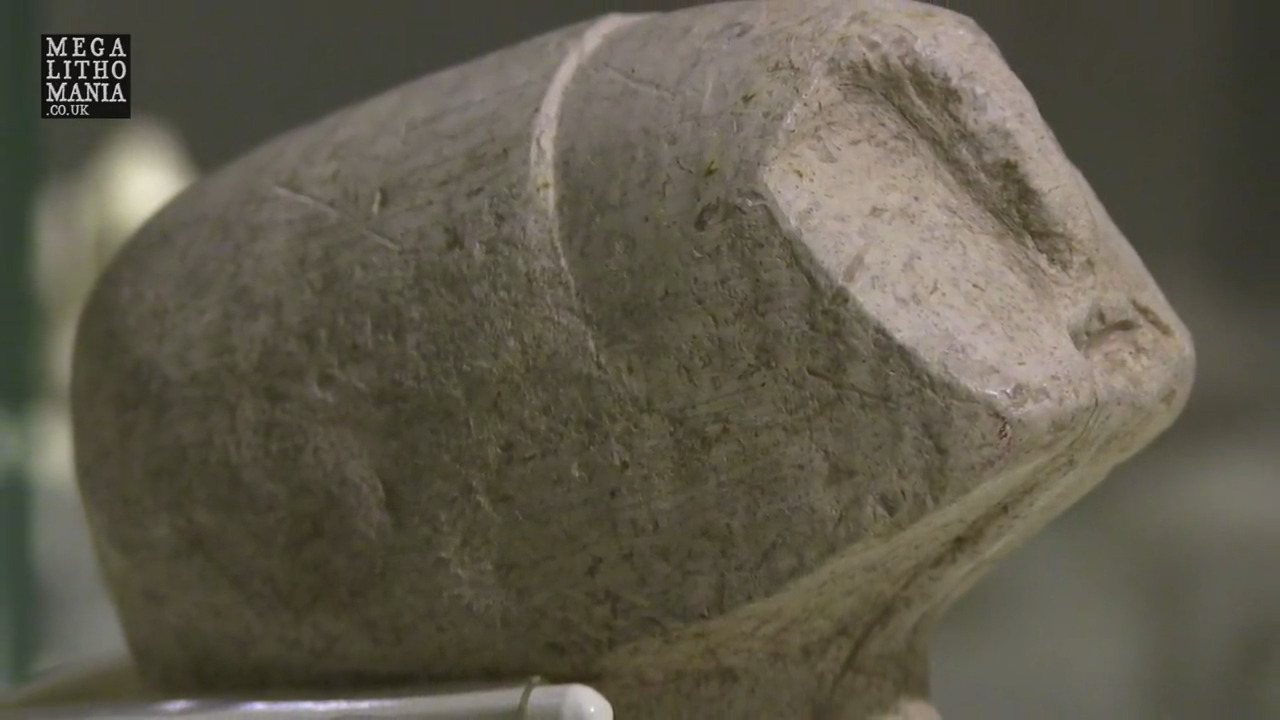
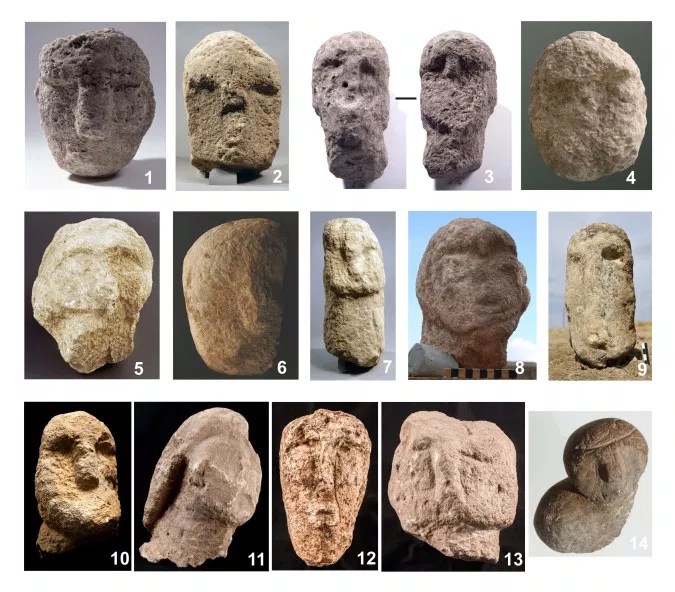
Otherwise, he should have considered it in his video: “New human face carving discovered at Karahan Tepe “T” pillar.” The “T” pillars found at both Karahan Tepe and Gobekli Tepe, I will argue, tell the most significant story of all time. It’s vital to set the record straight about these oldest of all relics, from a time twelve-thousand years ago when the Earth experienced a catastrophic shift in climate. “T” pillars have a story to tell about the very beginning of human society and religion, based upon what people saw in the sky. It is the greatest story of all time. It is the story told in myths. It’s also a story about today, and the battle of narratives vying for everyone’s attention.
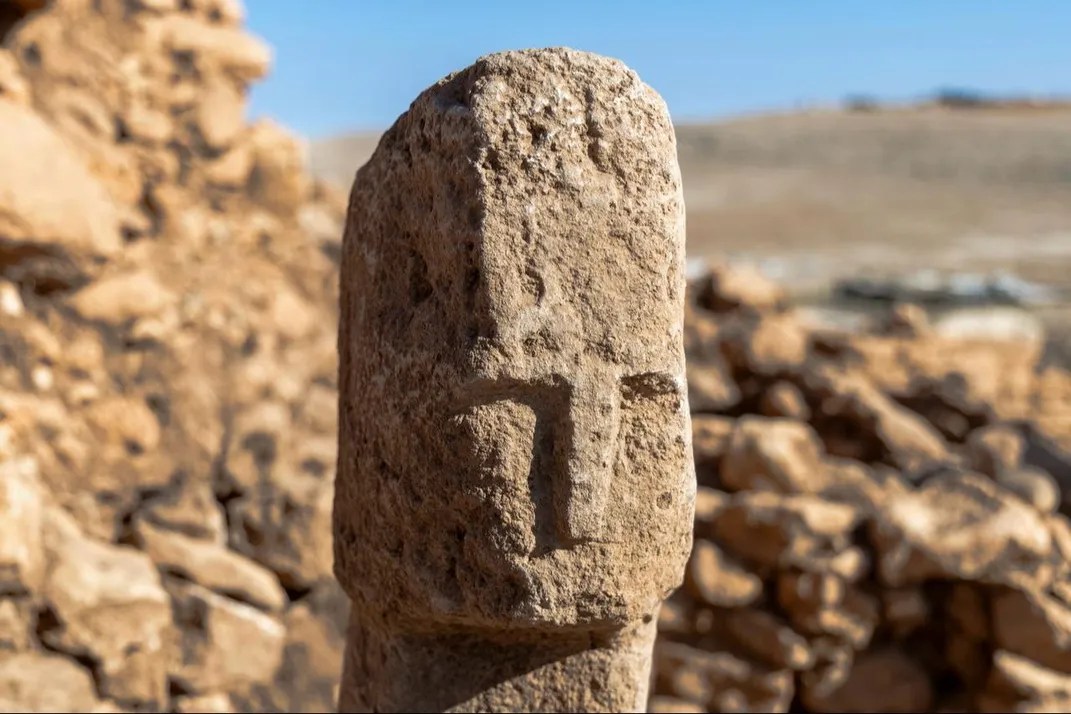
Figure 1. The “Human Face” at Karahan Tepe.

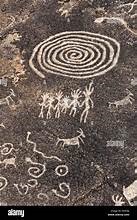
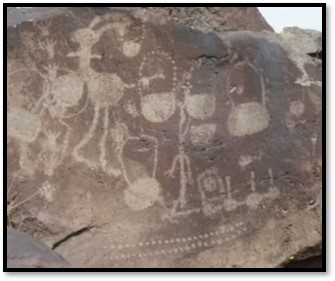
The subject of “T” pillars strikes at the heart of Electric Universe theory. Like the “Squatterman” petroglyphs that Anthony Peratt proved depict a high intensity space storm besieging the Earth, the pillars also depict a plasma phenomena. Dan, being a voice of agnostic moderation, sorting actual fact from the fictions of the consensus and open-mindedly considering alternatives in the way science should, needs to consider our theories.

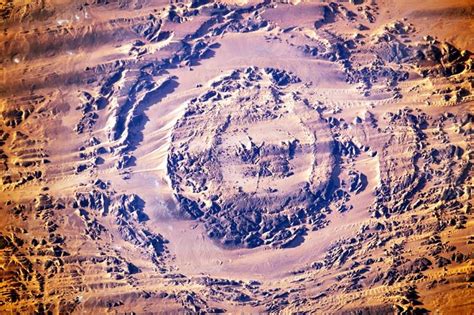
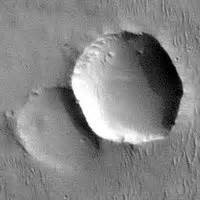
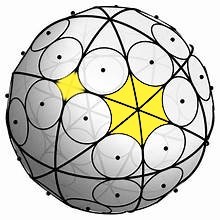
In his video, he only considers the typical geological catch-all called impact theory. Catastrophists jump to this conclusion because they are brainwashed by consensus science to believe craters are made by meteor impacts. I don’t think he knows impact theory is based on scientist’s say so, not repeatable tests that prove it. The only crater feature an impact can make is a hole. The only way to make craters in a lab with the features we actually see on the Moon, Earth and elsewhere; like doublets, rim craters, crater chains, rilles and hexagons, is with electricity. That is why scientists never find the actual meteors that made purported craters. They are from sparks, not meteors.

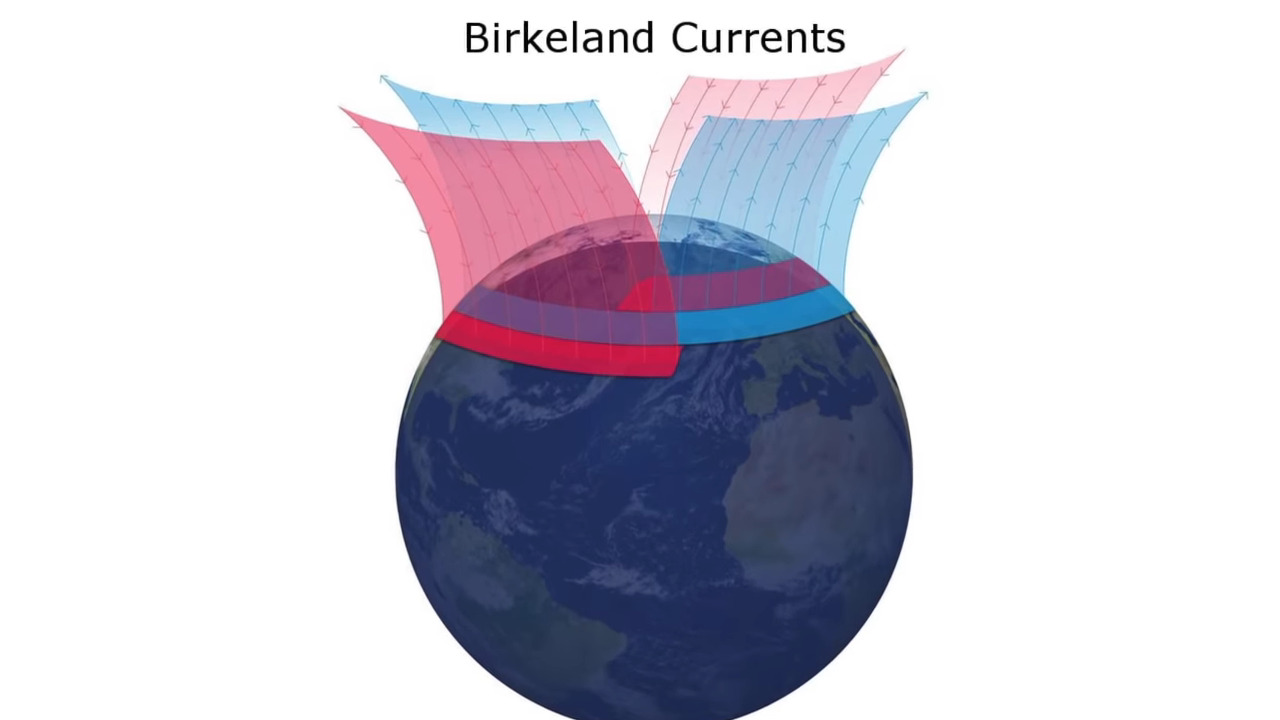
It’s my hope he will be made aware of Kristian Birkeland’s currents, Hannes Alfven’s magnetohydrodynamics, Anthony Peratt’s Plasma Universe, Robert Schoch’s Solar Storm theory and the Electric Universe body of work and ReDunk his Dedunk with more electricity. Turn the lights on, Dan.

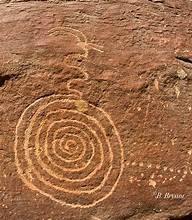
Dr. Peratt, a world leading nuclear plasma engineer, documented the petroglyphs around the planet, verified the imagery matched with high energy plasma instabilities and proved they were consistently oriented with a view to the sky where such aurora would appear in Earth’s magnetic field. His work is compelling evidence – no, actually it’s proof – that ancient humans witnessed severe space weather due to a high energy event in the Solar System, which lit-up Earth’s magnetic field with induced electric currents, creating glowing plasma figures in the sky.

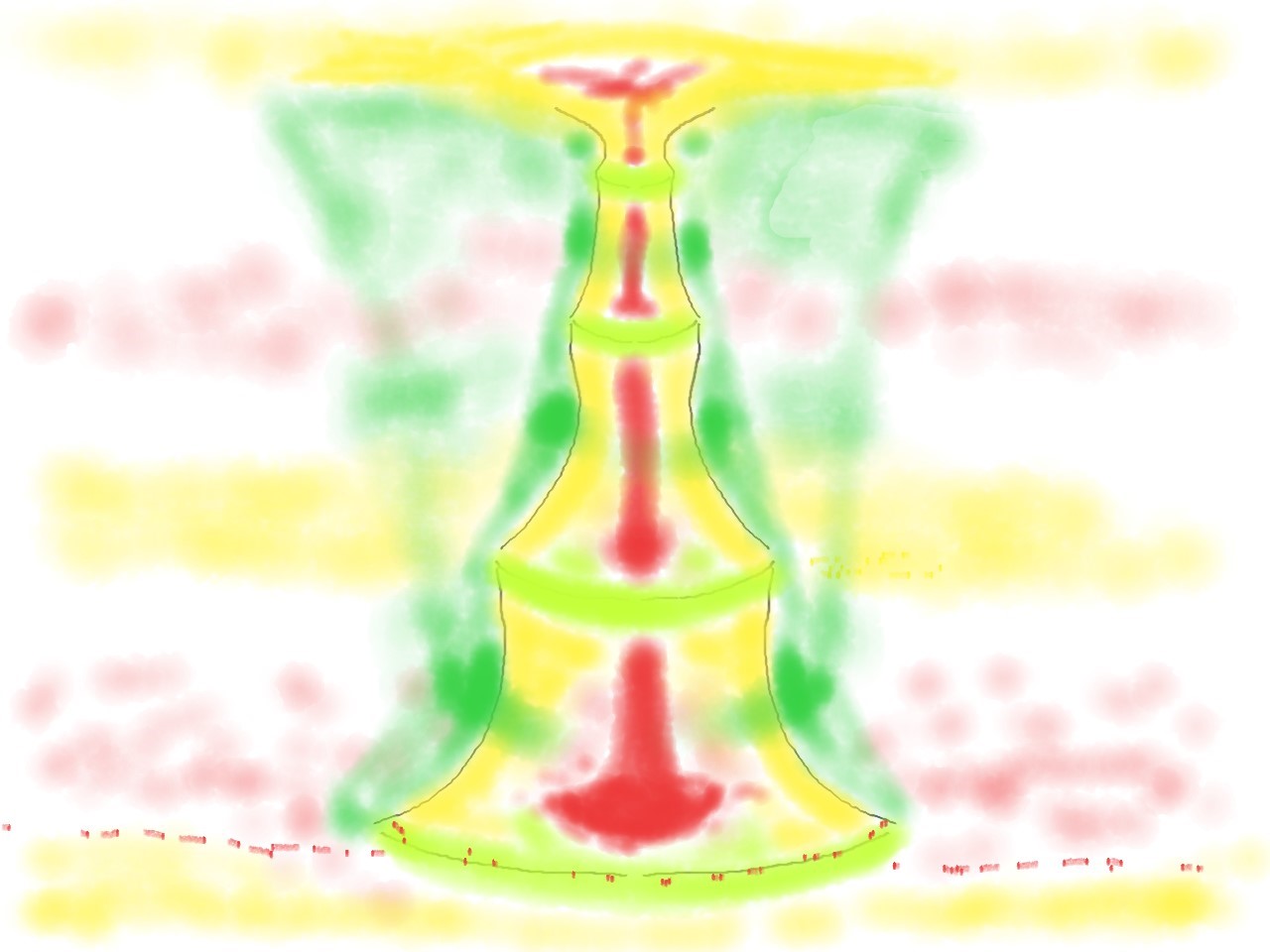
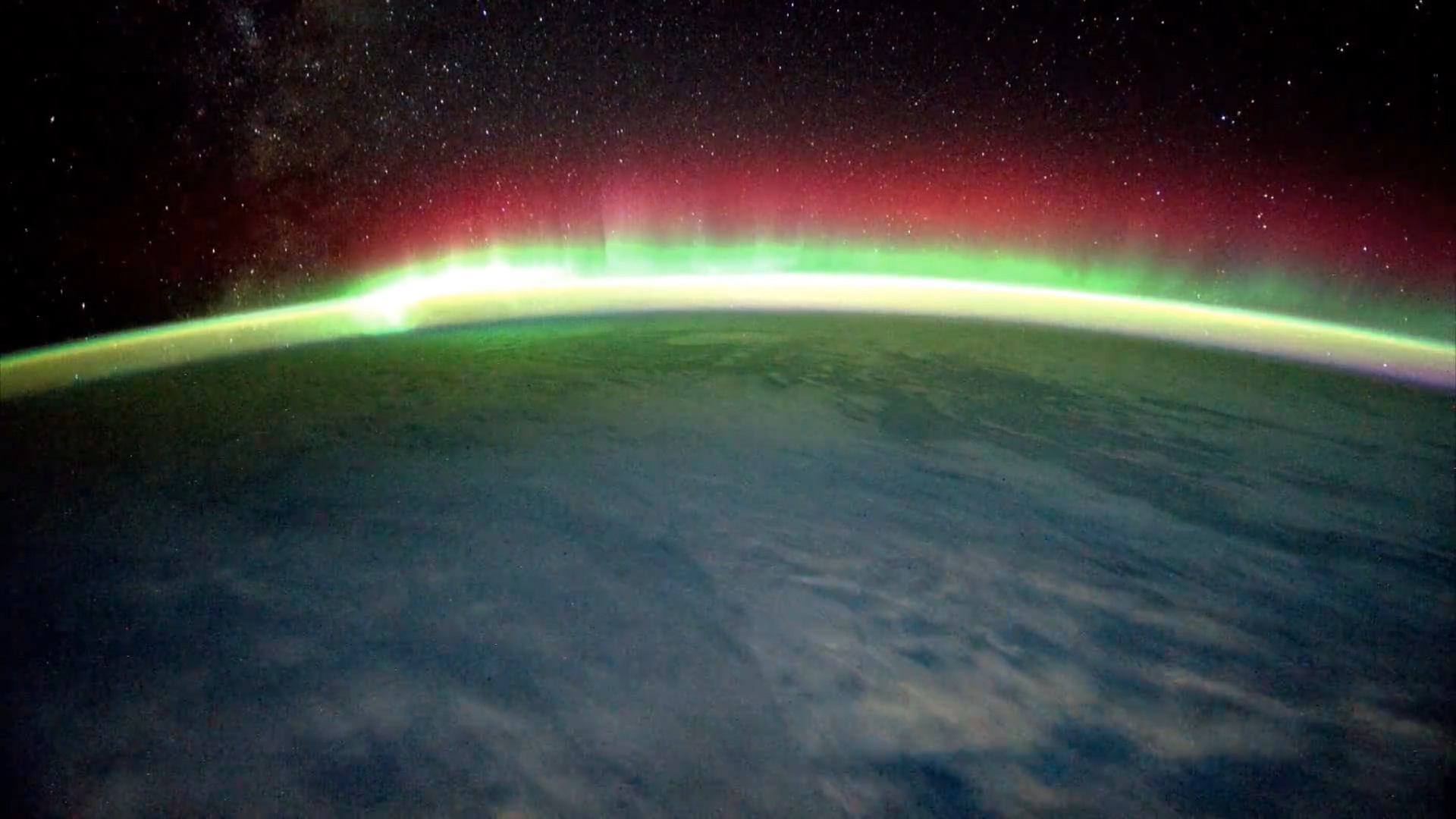
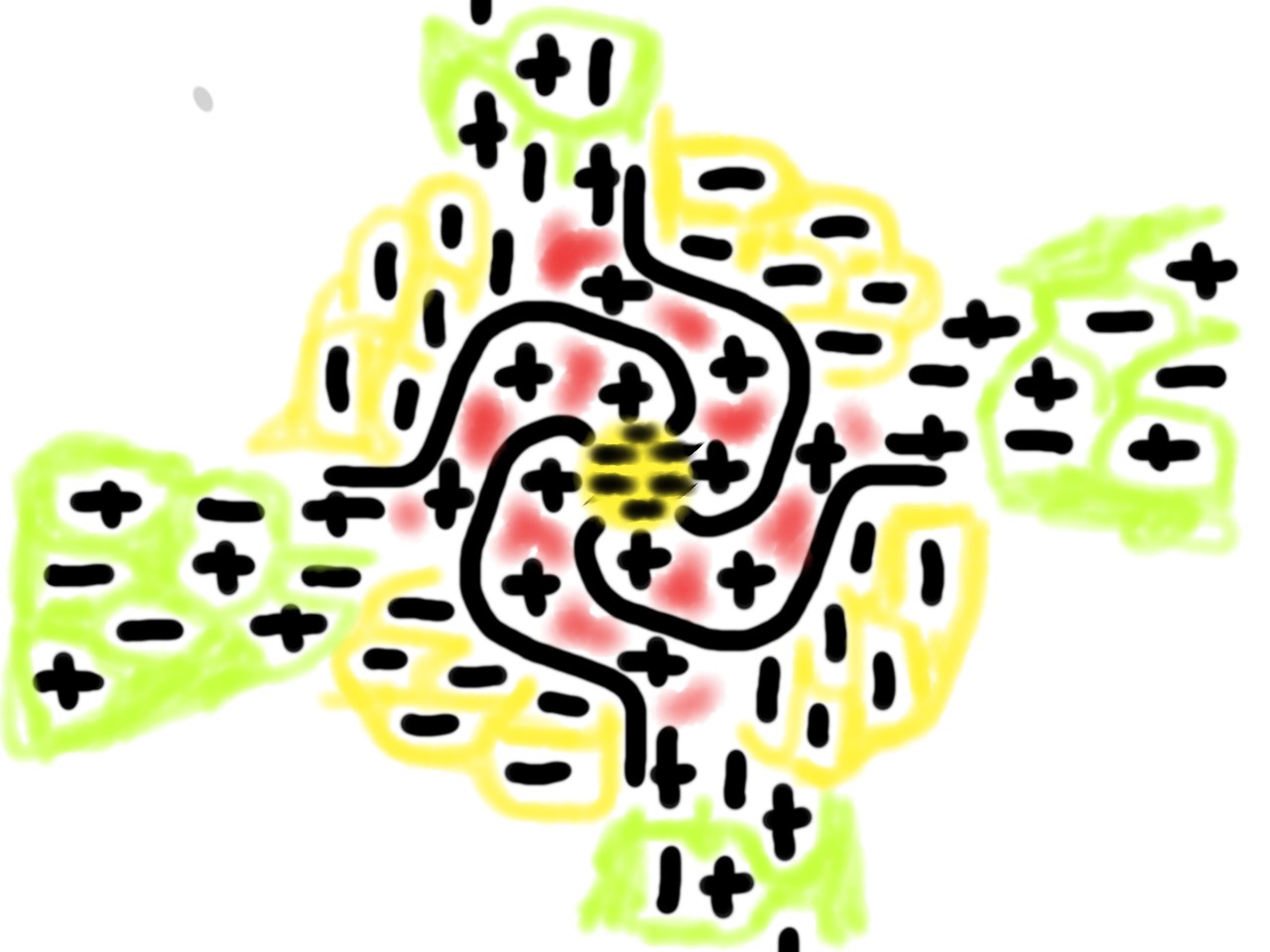
They were aurora, like the multi-colored Northern Lights, only farther from the Earth and ghostly white, since the gases that make the colors would not be present that deep in space. However, the same magnetic field that lit-up in space also connected with the Earth, not only at the poles, but all around the globe. Whatever occurred in space sent huge amounts of energy into Earth’s magnetic field, amping it up to a scale we can only imagine. Parts of it lit, because ions and electrons gathered to form coaxial circuits of plasma along magnetic field lines aimed at the Earth.
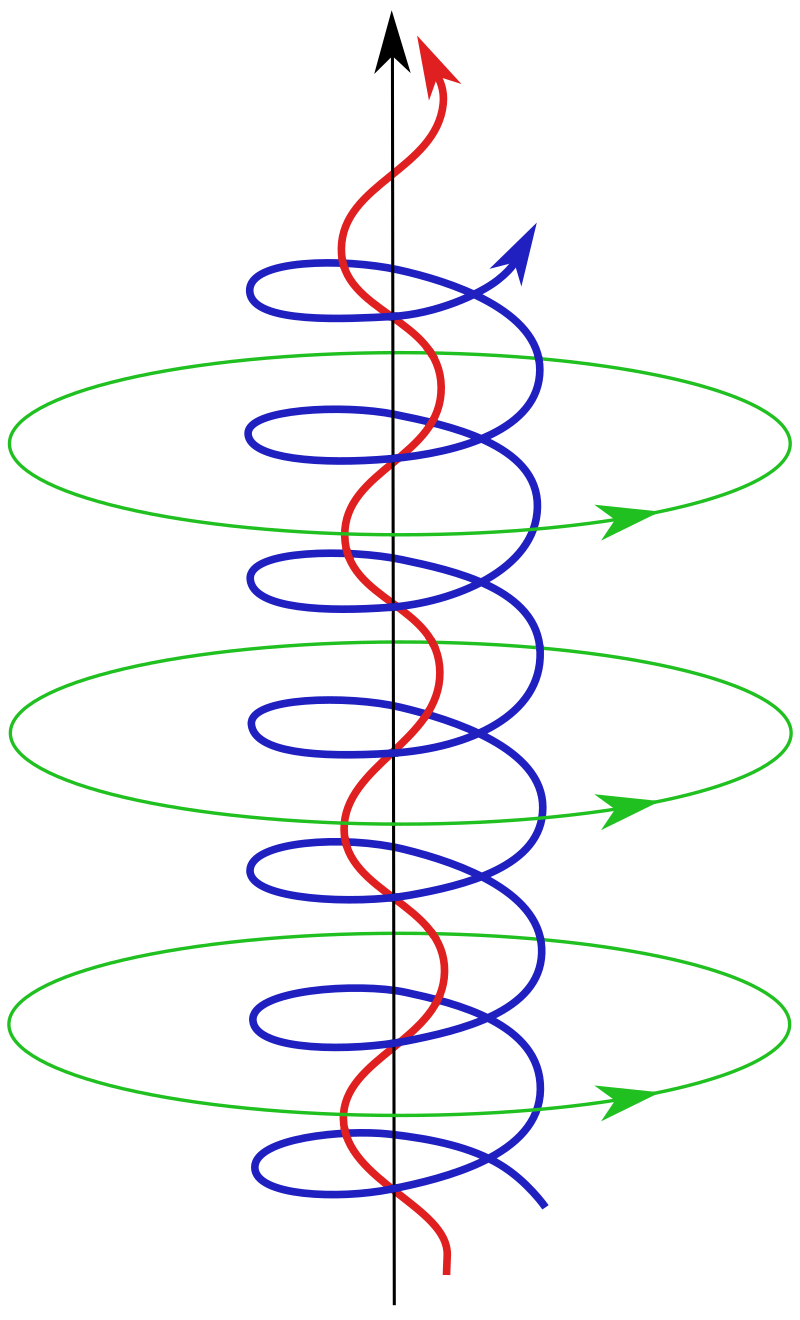
Figure 3. Coaxial Birkeland Current structure.

Earth’s magnetic field begins and ends inside the Earth, so current gathered in it’s outer shells is inducted internally. Physics says so. Who would know better than Nobel Prize winner Hannes Alfven, the one person on the planet who best understood plasma, and insisted this must be so in his electrical model of stars. The scientific community pretends that didn’t happen.

The model applies to stars and “living” planets with an active magnetic field. This is electrically how the magnetic field is generated for all stars and planets. The consensus idea that Earth has a core of iron spinning like a frictionless ball-bearing inside a matrix of molten rock for billions of years generating it’s magnetic field – while other planets and stars generate their magnetic field by some other means – is absurd when physics tells us magnetic fields require an electric current.

If they rely on “science”, why don’t scientists admit that, according to physics, the magnetic field must have an electric current generating it, and look for that inside the Earth. Instead they say it’s an impossible, frictionless, spinning iron ball and neglect electricity altogether. It’s even more absurd since aurora allow us to see electric currents feeding massive energy to the planet!
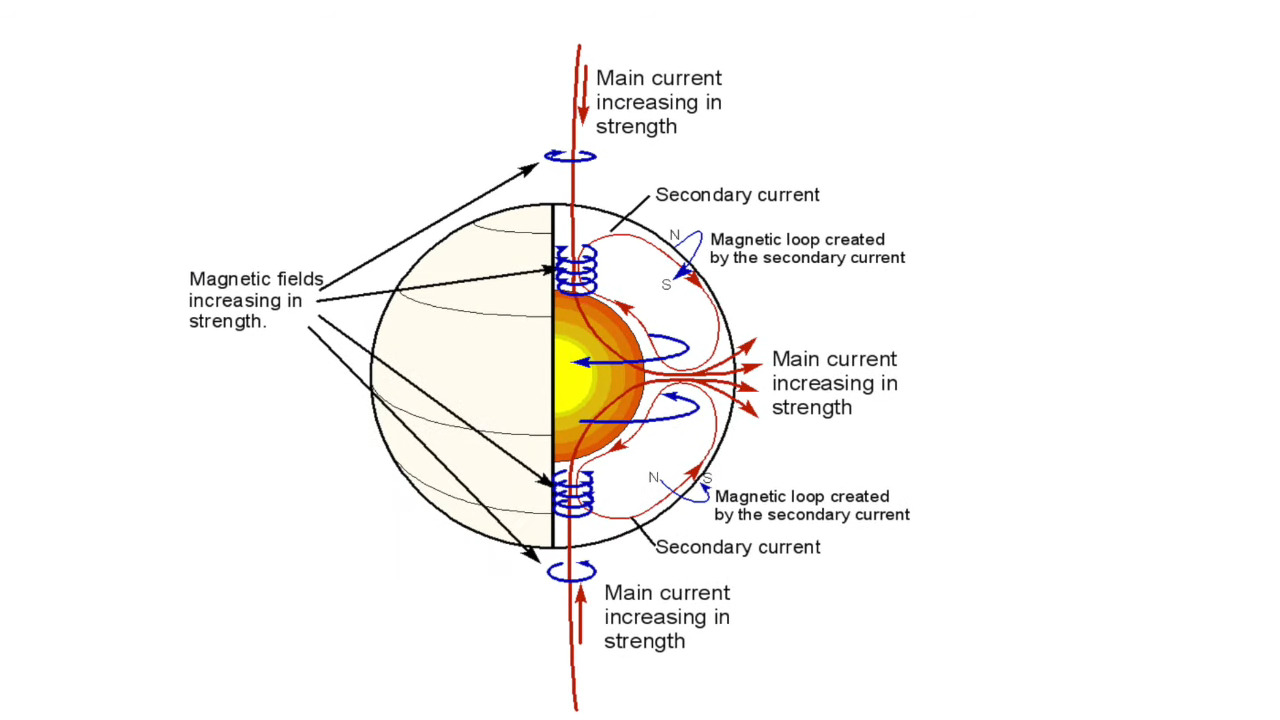
Petroglyphs tell us the Earth’s magnetic field was glowing with current and “z-pinching”, which means incredibly high energies were involved. The amped-up magnetic field had to strengthen and constrict around the Earth like Leviathan, ionizing atmosphere and inducing surface charge on the ground beneath.

Where the energy passed through the atmosphere, storms of biblical proportion raged. How we know is that the Bible says so, and so does every other mythology from ancient times. In fact, the myths talk of storms so much, so explicitly, in so many ways that it’s absurd we don’t get the message. The earliest gods of myth and religion were storm gods.

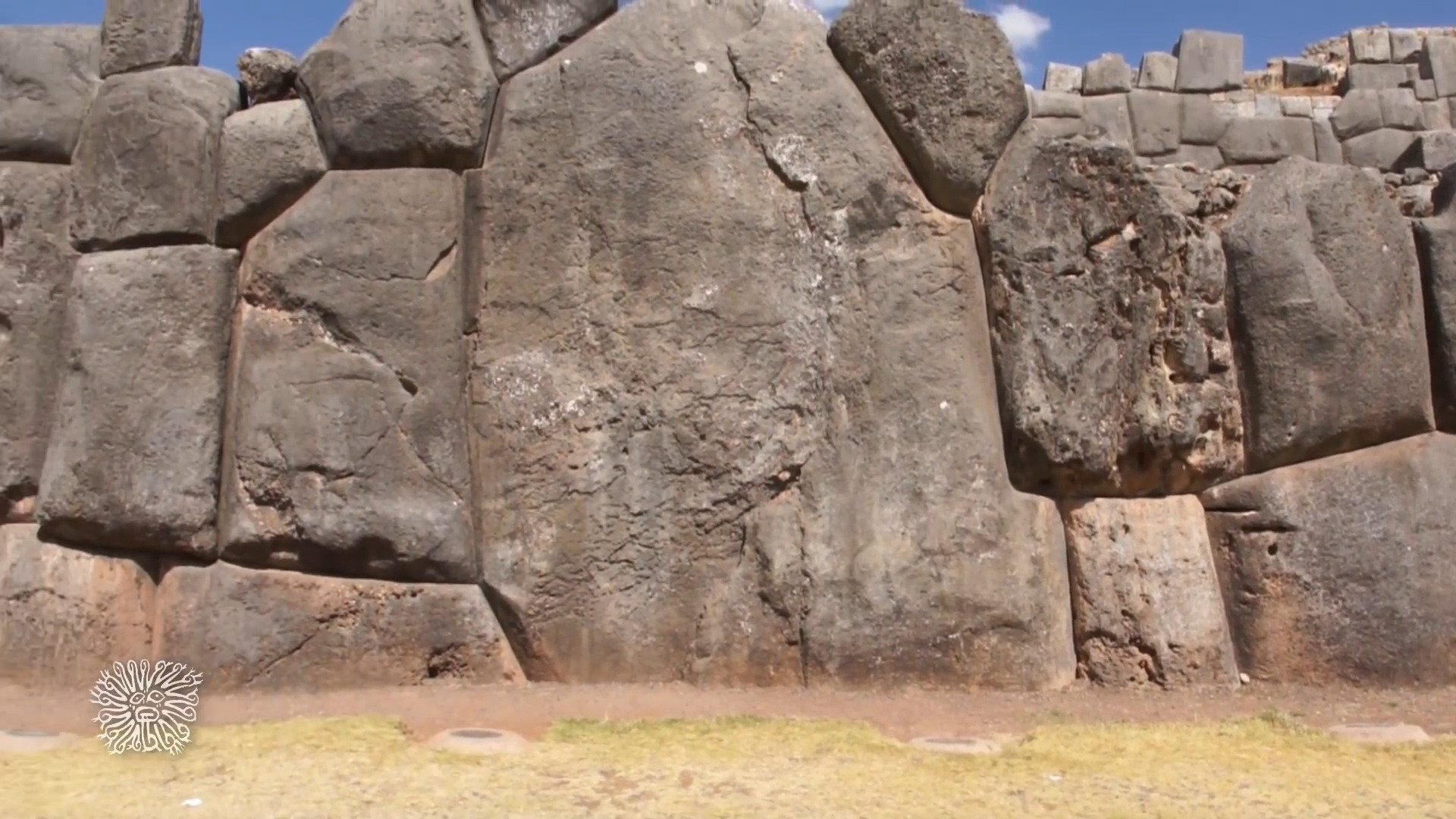
Megalithic structures many believe to be prediluvian tell a tale of a different environment. If one examines their extreme construction it becomes evident they were built to withstand plasma storms, and it explains why they are found with remnant magnetism, lightning scars and vitrification.

Ancient myths do not say a comet hit the Earth, or anything to indicate an impact. They say storms raged, the Earth erupted with water, dragons set fire to the land, Leviathan circled the Earth and Vimana flew in the sky. Many strange and complex visions were witnessed involving angels, demons and gods. They were in the skies and inside the Earth itself, as the mythologies say, because the entire planet’s circuitry was heating-up.

An impact would be hard not to notice. I think they would have made a note of that somehow on a petroglyph. They were witnessing plasma storms. Plasma storms shook the Earth and erupted the guts out of it by raising it’s internal potential, while cyclones formed at the feet of giant columns of auroral light. The visions they saw are what is recorded in myths, glyphs, columns and statues.

According to several dating methods, many petroglyphs were created around 12,000 years ago. That was the period of the “Younger Dryas“. Roughly a thousand-year period when the climate of half the Earth suddenly cooled, allowing the arctic flower, Dryas Octopetala to thrive everywhere. It also caused mass extinction of megafauna that could not adapt to the changing conditions.
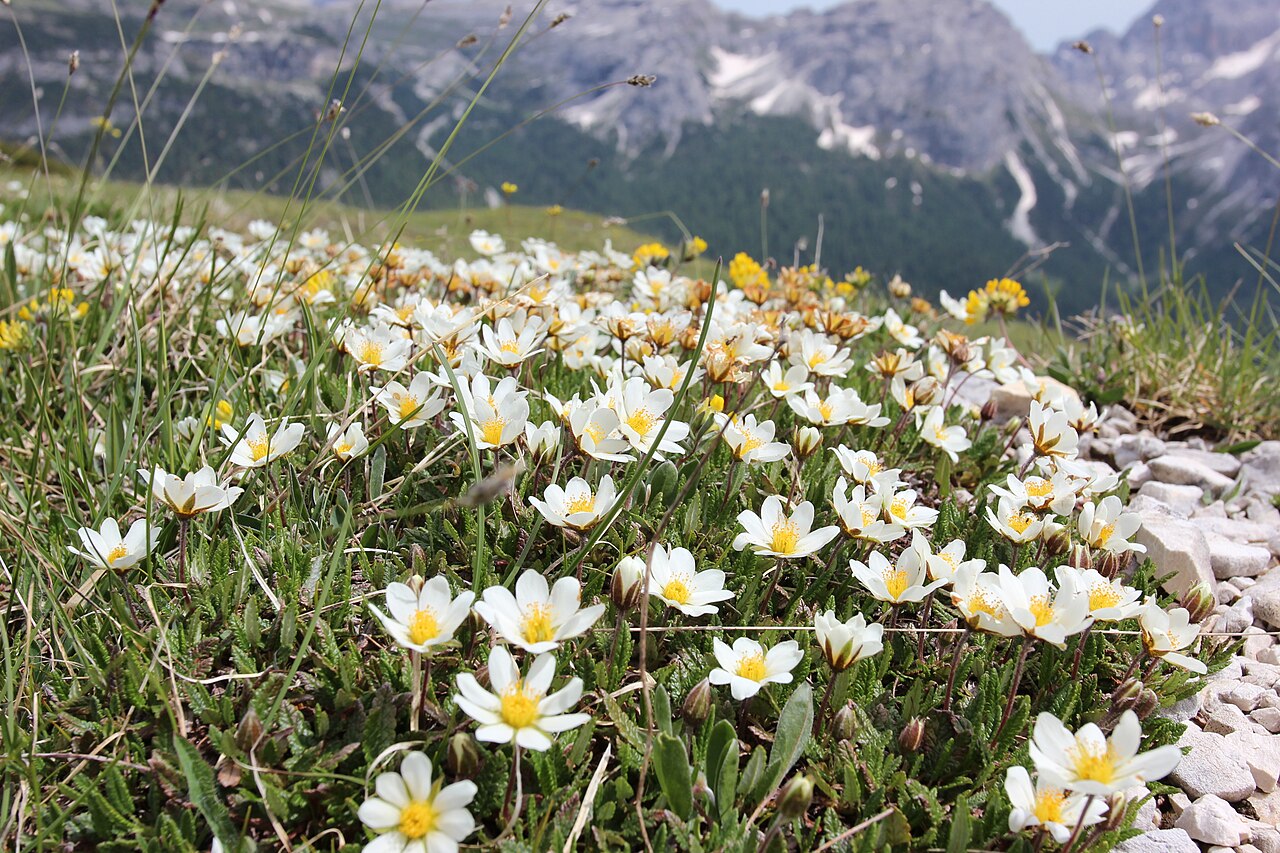
Figure 5. Dryas Octopetala

Though climate scientists have tried to blame Mammoth farts, there is no evidence greenhouse gases were the cause, which has left the scientific community flummoxed. The Younger-Dryas is a mystery. It may have been a comet, the Sun flaring, cosmic rays from a supernova, or some event we haven’t imagined. It could have been Earth’s escape from Kronos, the ancient first Sun. Whatever it was, it happened very suddenly, flash freezing animals as they grazed, then burying them in mud. The period is marked by a mat of charred matter across the Americas and parts of Eurasia.

Taken in context, petroglyphs are substantial proof that the Younger Dryas was a plasma storm event. As is the geology and the condition of frozen remains of animals caught in the maelstrom. Even mainstream geophysicists like Dr. Robert Schoch have come to this conclusion, as he wrote about in “Forgotten Civilization: The Role of Solar Outbursts in our Past and Future“. Dr. Schoch recognized the significance of Peratt’s work. He suggests an extreme Solar Storm fits the Younger Dryas evidence very well.

Following this event the world changed. Megafauna were nearly wiped-out. The landscape made desolate, raised by fire and flood. Humans who survived the cataclysm did so together in Anatolia, part of the fertile crescent of land between the Tigris and Euphrates rivers. The earliest constructions of an organized society discovered so far, are several Neolithic megaliths dated to the Younger Dryas period.

Best known are Gobekli Tepe and Karahan Tepe, in Turkey, which have been dated to 9,700 B.C., at the end of the Younger Dryas. But new sites continue to be uncovered with earlier dates, indicating some of them were occupied during, or even before, the Younger Dryas event. Which brings us to the ReDunk information I hope Dan considers.

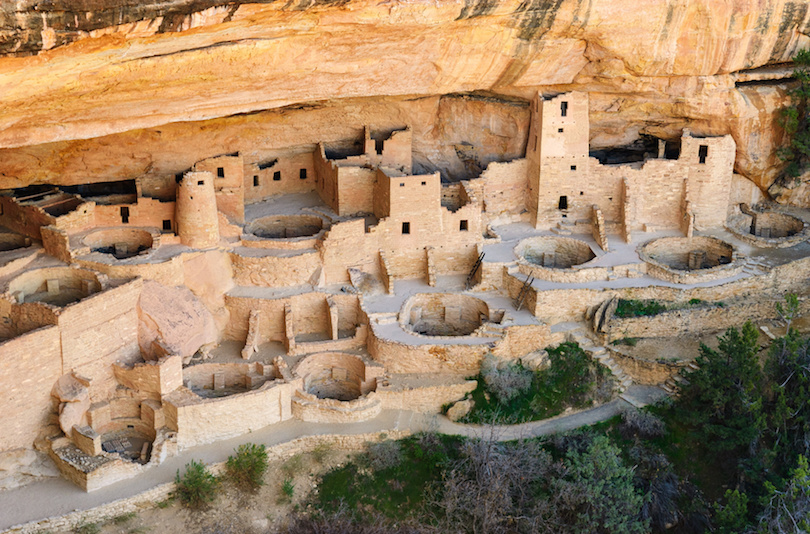
A common feature found at these sites is the “T” pillar. Their meaning is apparently significant, but remains a mystery. There is no discernible structural purpose for the shape. They seem to be more for a spiritual tradition given how some are decorated with carvings, and how they are used in ringed enclosures reminiscent of Ancient Pueblo Kivas of the American Southwest.

What is unusual about this “T” pillar found with a human face carved into it, is that “T” pillars don’t usually have faces. They do often display arms and hands carved into the pillars, as well as other imagery, but not faces. Also, there are similarly pillar-like stone statues found at these sites with heads similar to this “T” pillar. So, the question is: what does this all mean?
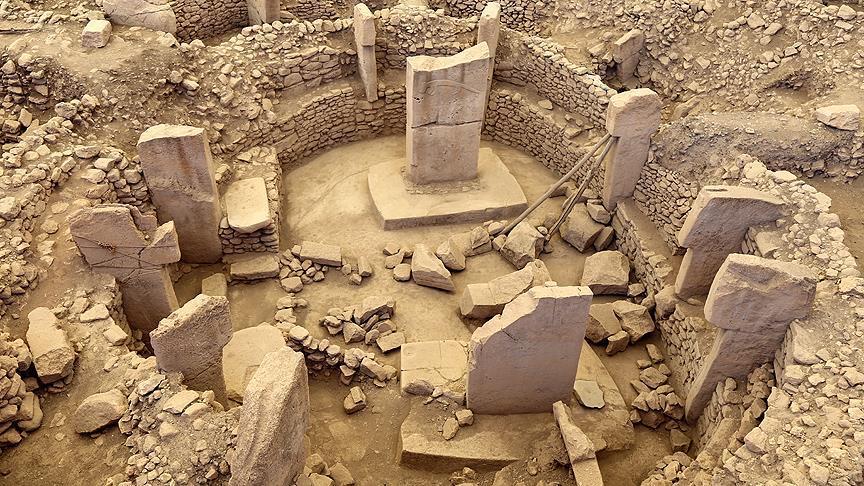
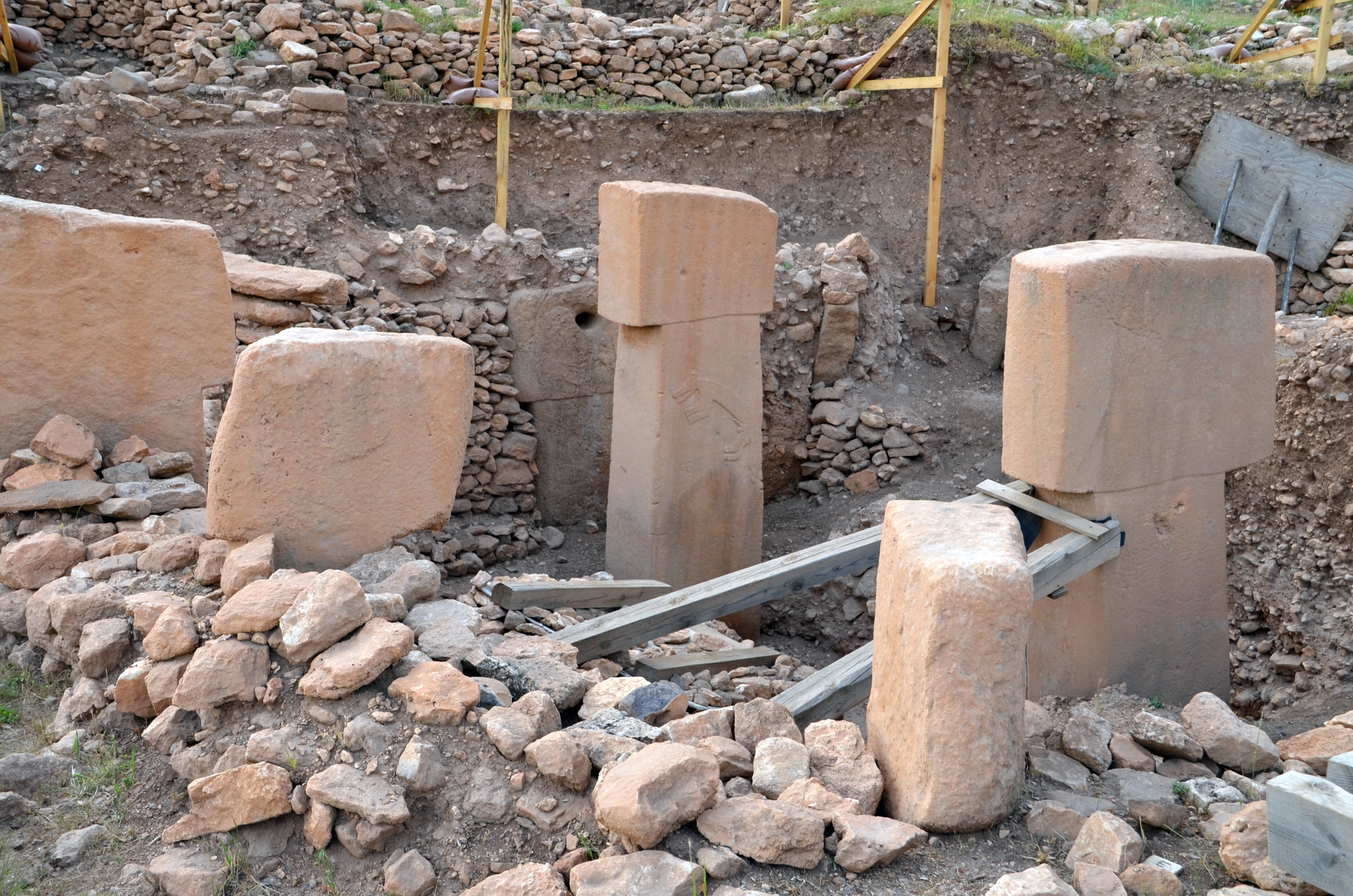
It is my opinion the “T” pillars represent the Earth’s magnetic field lines, fired-up with glow-mode currents. The pillars, like squatterman and other petroglyphs, are a physical record of what was witnessed as a space-storm brewed over the Earth’s poles.
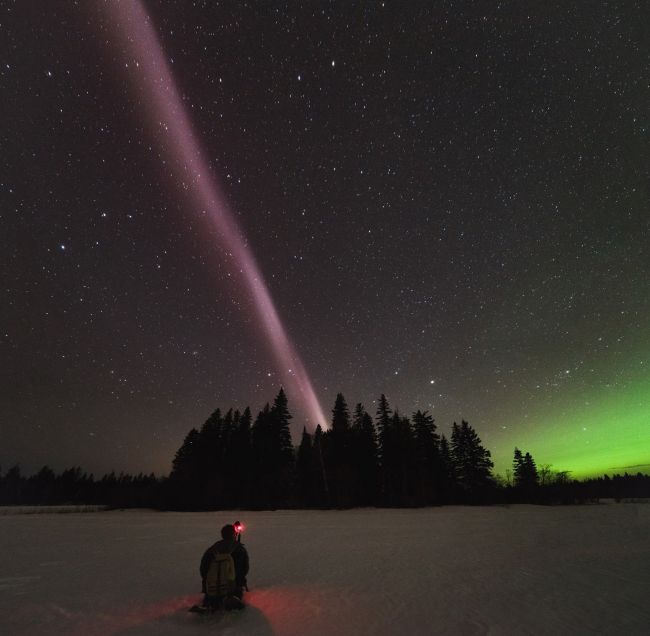
Figure 7. An actual columnar aurora

Columnar rays of light, grouped in a ring with two prominent rays in the center. The prominent pillars represent Birkeland currents, delivering energy from an unknown extraterrestrial source. The ring of pillars surrounding them represent magnetic field lines glowing with induction currents, embedded in the encircling walls representing auroral curtains of light.

Note that in the artist’s rendition of Gobekli Tepe in Figure 8, the walls appear as one full ring, surrounded by two partial rings that don’t meet, but overlap. This is how counter-rotating curtains of auroral lights actually appear in the sky. The central pillars, the surrounding pillars and the ring walls are all structured the same as polar aurora.
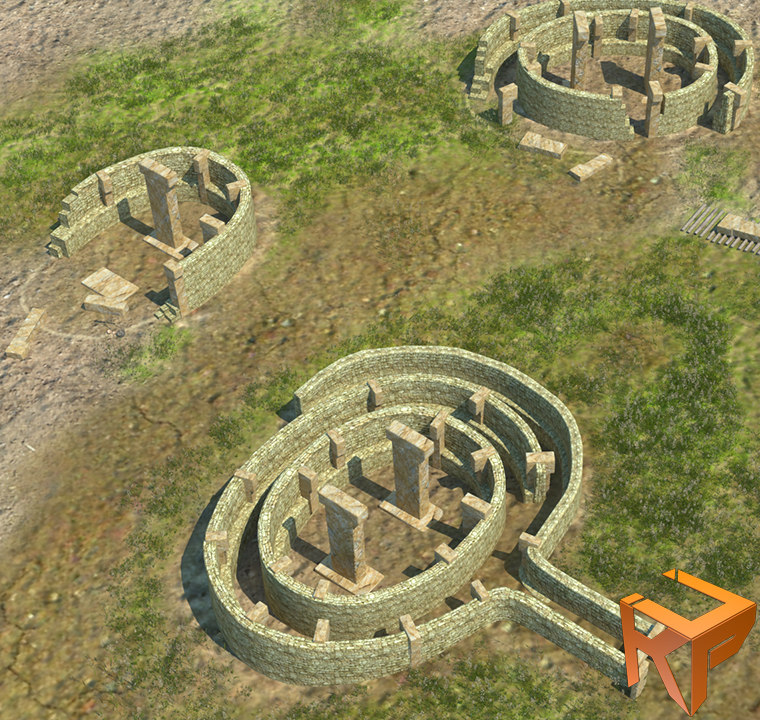
Figure 8. “T” pillar enclosure displays the same configuration as high intensity polar aurora, with two columns representing Berkeland currents and outer rings representing magnetic field lines encircled with counter-rotating auroral curtains.

Astro-archaeologists have noted the enclosures appear to have certain solar alignments, which also makes sense if the enclosures represent the Earth’s magnetic field. Specific regions of the sky where images appeared, when they appeared, and how they appeared would correlate with Earth’s orientation with respect to the Sun, Moon and any other external influences on the magnetic field.
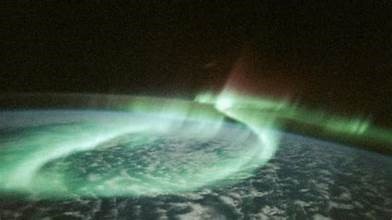
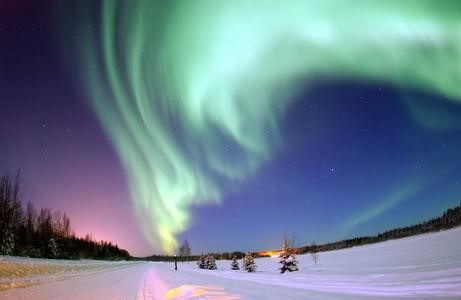
The heads, I believe, were shapes made of light radiating from energized plasma. They were transient effects that made different shapes, some that looked like faces with a little imagination. Sometimes they looked like just a big pair of eyes, bird heads, or fish heads, too.

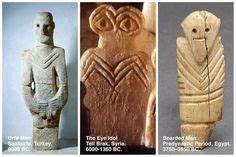
The first pillars were simple “T” structures. The first heads, found at the same sites on pillar-like sculptures, were not much more. A projecting brow and vertical bar that gives an impression of eyes and a nose. There is a consistent design language and it isn’t very human-like. A long bar-like nose, hollow eyes and no mouth, or just the hint of one, lantern jaw and sometimes a skull cap, hair, or helmet feature.
It’s more like the template for a face, like the stylized, vacant-eyed statuary department stores use to display clothing. Nothing is there to distinguish them as individual human beings. And since these are the earliest sculptures, they are likely the most true to what was actually witnessed. It was enough for fear and shock to stimulate the imagination into believing they were Gods supervising Earth’s destruction.
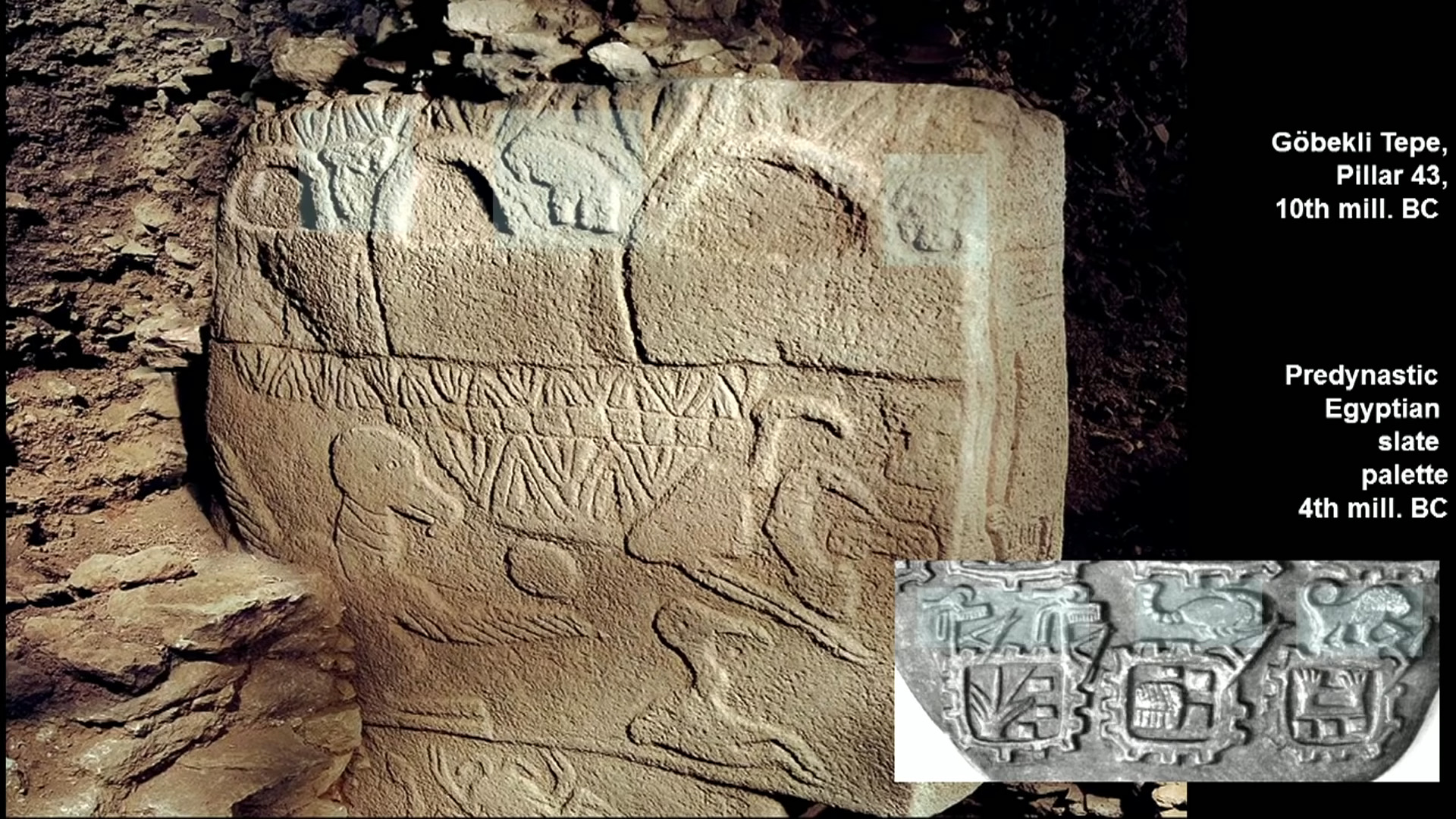
The most compelling evidence the “T” pillar represents plasma aurora aren’t the heads, but the iconography on the pillars. For one thing, some of it matches petroglyphs, proving the link with plasma discharge. But the main evidence this depicts plasma discharge is their match with excited hydrogen.

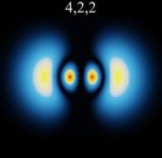
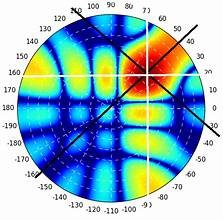
Figure 12. Hydrogen energy densities at 1st to 4th order spherical frequencies.

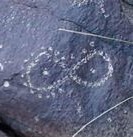
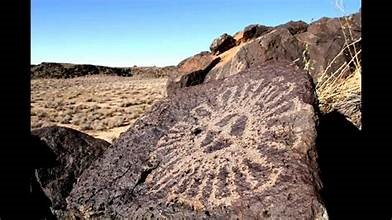
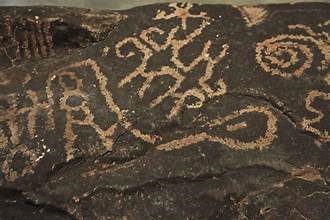
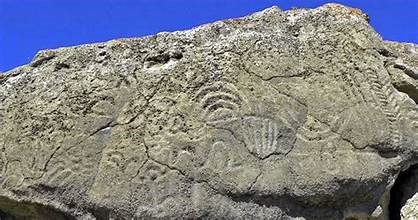
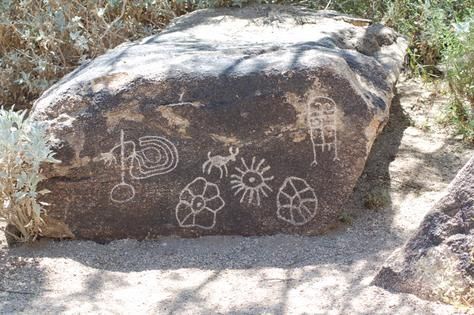
Excited hydrogen atoms vibrate in spherical harmonic frequencies which make the patterns shown in figure 12. These same patterns appear in petroglyphs, as well as the pillars at Gobekli Tepe and other ancient iconography. For example, concentric rings are a common petroglyph found in the same panels with squatterman. Hydrogen makes concentric rings in four different spherical frequencies, shown on the far left in Figure 12, and in Figure 13 alongside sample petroglyphs.
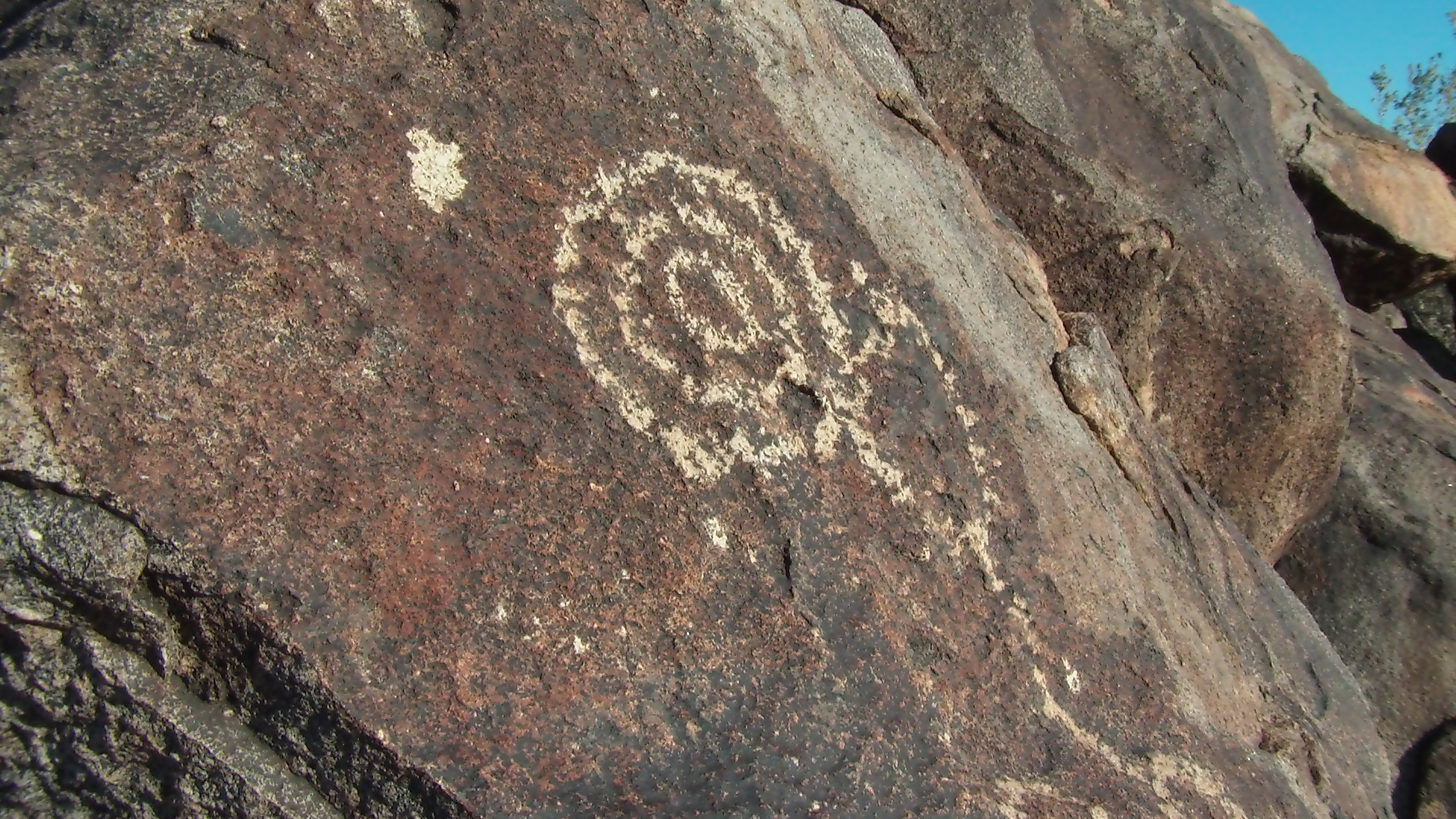
As energy poured into the thin plasma outer reaches of the atmosphere, it met layers of hydrogen. In a plasma storm, hydrogen would be produced in large quantities by electrolysis of surface water. An energized layer of plasma composed of hydrogen resonating at this particular frequency will holographically portray this signature form, at scale across the whole energized region.

Coherent light structures are observed in the sky all the time, even though there is no lens, or prism involved, only tiny particles of water vapor acting holographically to form large structures, like rainbows, moon rings and other atmospheric phenomena. Hydrogen in a plasma will do the same thing.

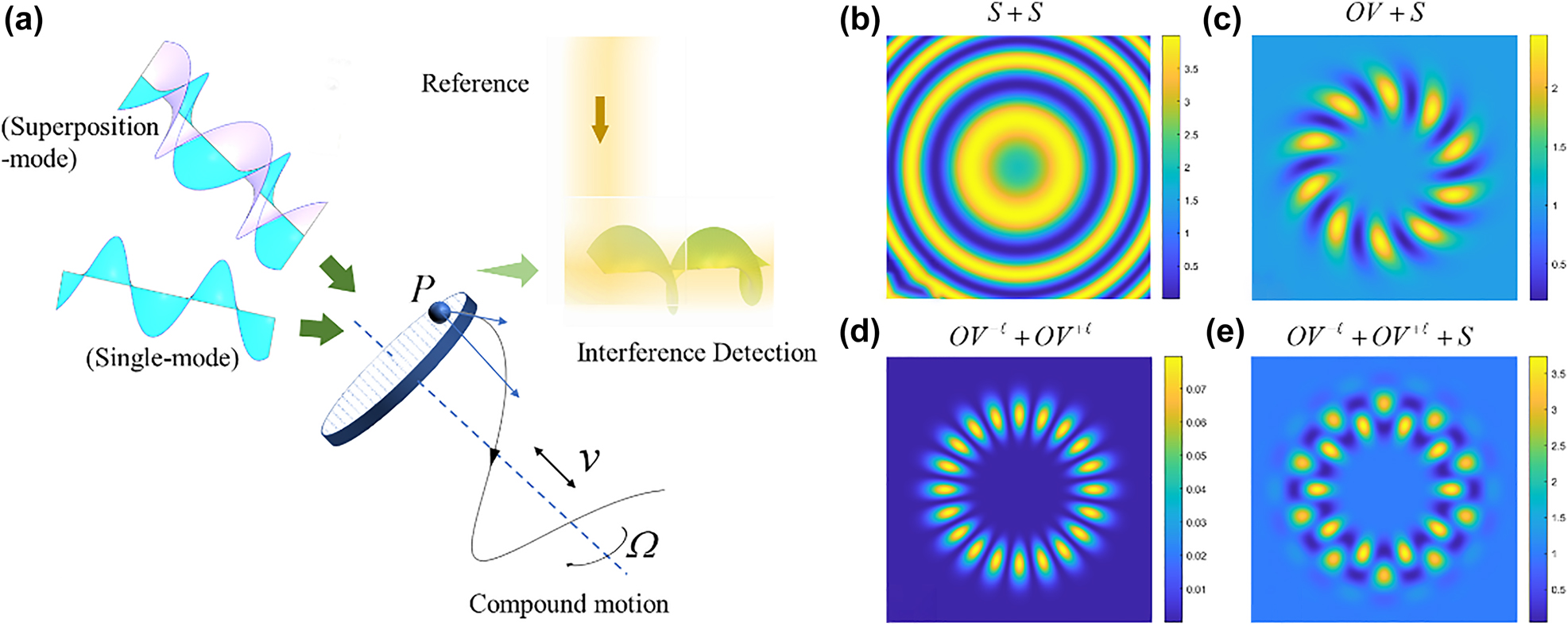
There is structure to the plasma because the electric field is vertical and perpendicular to the layer of hydrogen, creating a standing wave interference pattern. Each standing wave forms a cell, like a bubble of charge density that tessellates into spherical nodes vibrating at spherical frequencies.
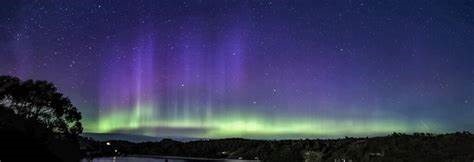
Figure 14. Aurora Australis – tesselation in the plasmasphere causes auroral light to appear as shafts and curtains.

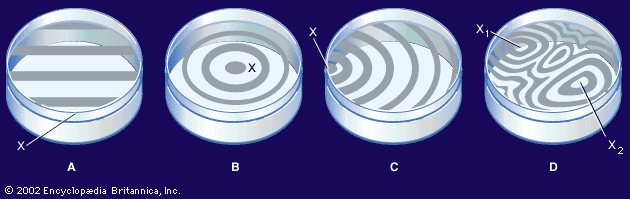
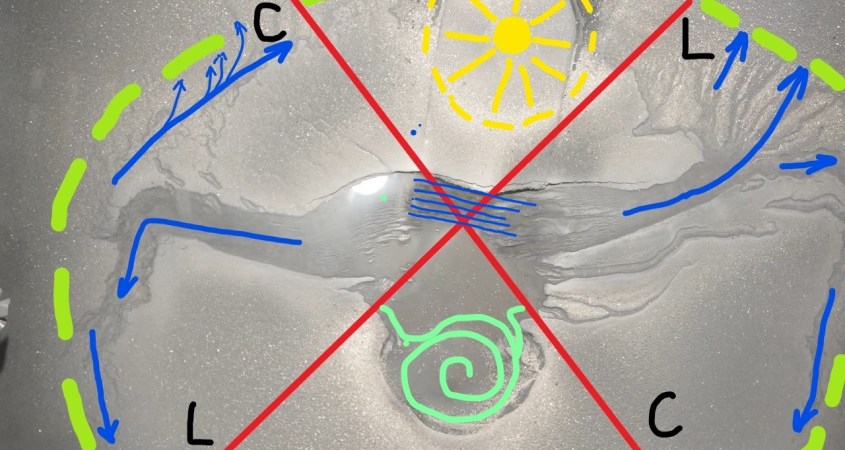
Tessellation of standing waves is also why some common aurora appear as columns of light, like in Figure 14. It is the same phenomena that makes the patterns of light beneath the waves in this pool in Figure 15. The wave structure itself focuses light, defining the wave troughs and peaks in light and shadow. Petroglyph images are also tessellated wave patterns. They were made by glowing waves of plasma instead of sunlight and water.

Figure 15. Waves bending light to display tessellated structure.

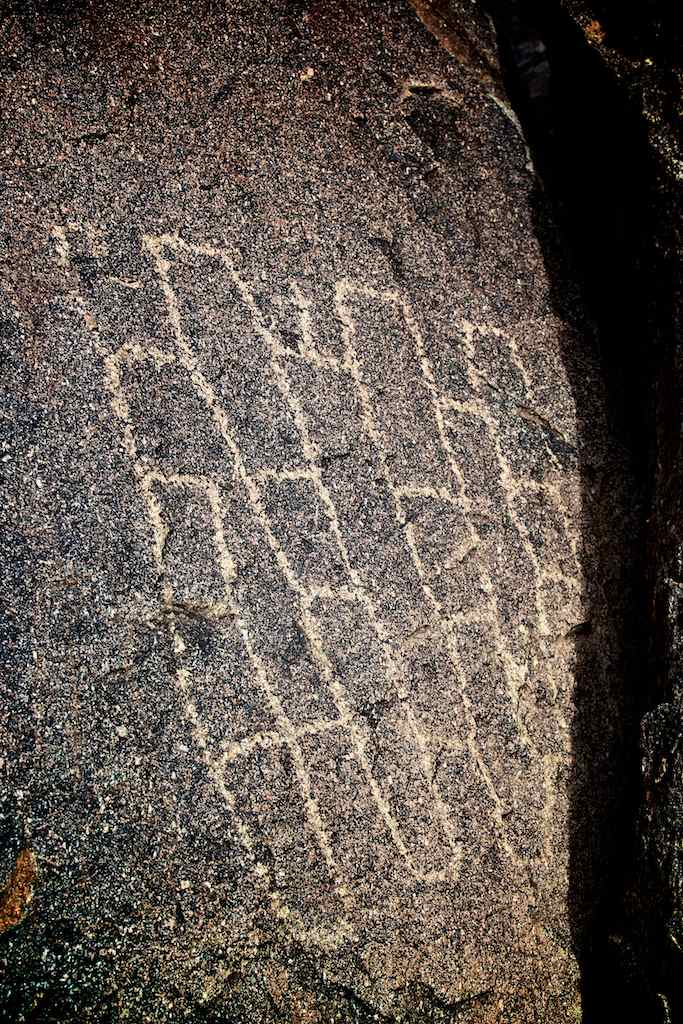
In fact, not all petroglyphs display animals, or anything recognizable. Many petroglyphs display cellular patterns like the pool water, as shown in Figure 16.

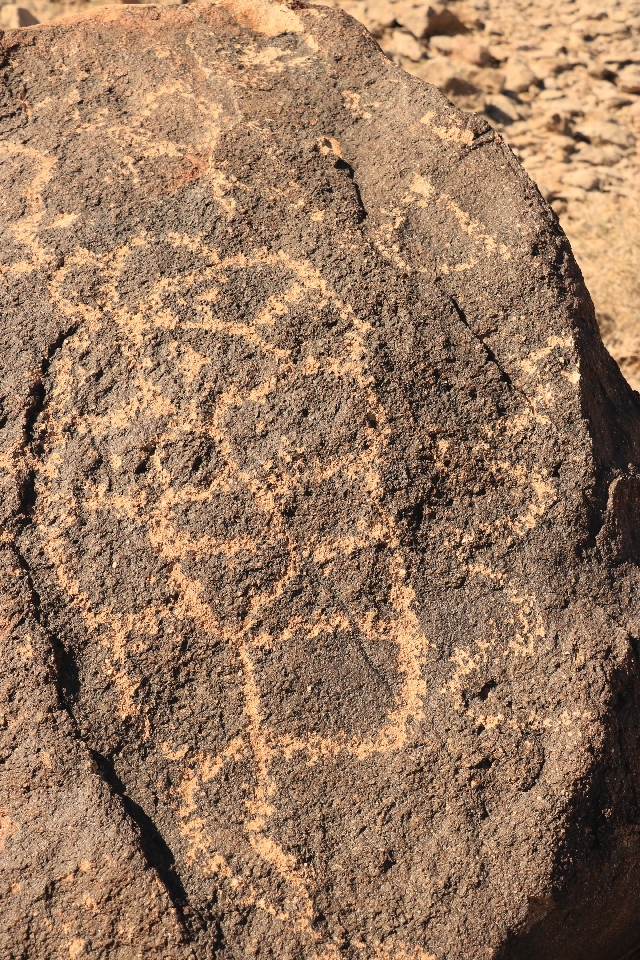
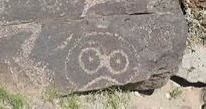
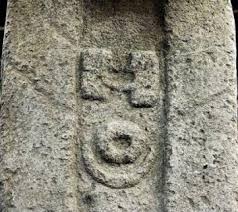
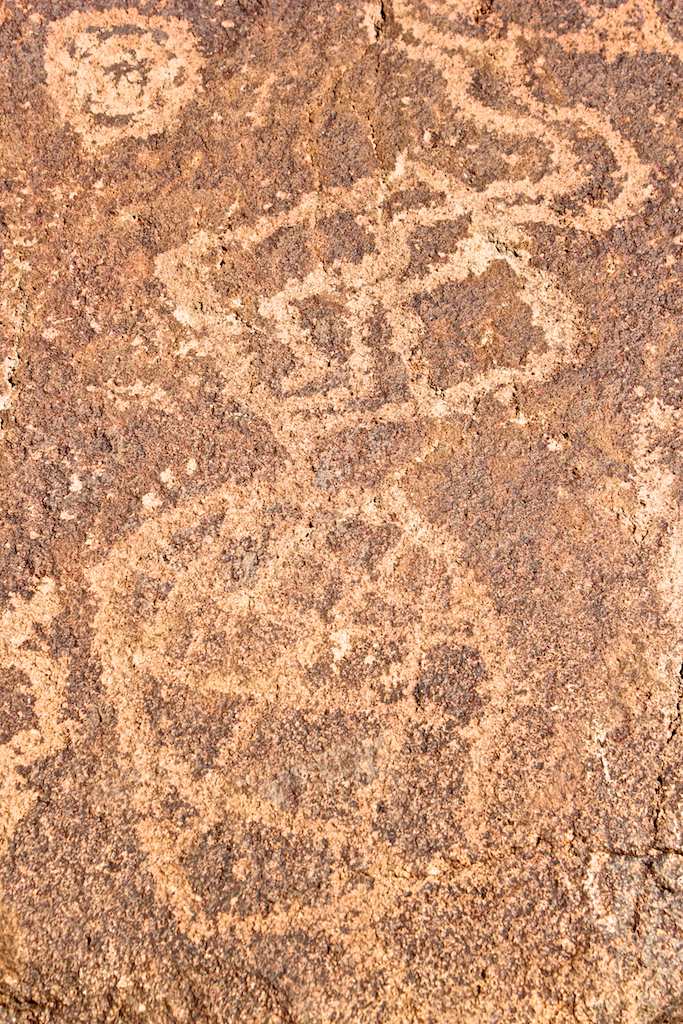
A common image recorded in petroglyphs and elsewhere is known as “goggle-eyes”. As you can see in Figure 17, goggle-eyes are sometimes portrayed alone and sometimes incorporated into a face, or pillar-like anthropomorphic statues. Goggle-eyes are found in petroglyphs alongside squatterman and concentric rings. Goggle-eyes are formed by hydrogen.

At other spherical frequencies, hydrogen forms other patterns similar to ones found on Gobekli Tepe pillars, and elsewhere, proving these were being witnessed in the heavens from around the world. Certain designs that look like dumbbells, or horseshoe magnets facing each other are found on the pillars in Turkey, as well as indigenous African art, thousands of miles and centuries away. They are also patterns created by excited hydrogen that resemble the letters “H”, “I” and “U”, shown in Figure 18.

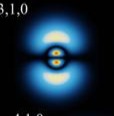
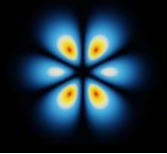
Stars and flowers are another common theme seen in petroglyphs and ancient iconography that auroral hydrogen is responsible for. The star is the inverse of the flower, and both were portrayed as light emissions oscillated from the flower-shaped outer boundary to the star-like inner filamentary structure of the tessellated plasma cell.

Other forms made by plasma, not necessarily hydrogen, include certain animals, like birds, often shown as a sequence of repeating patterns. They are on pillars as well as petroglyphs, again proving the link as something universally seen around the world.

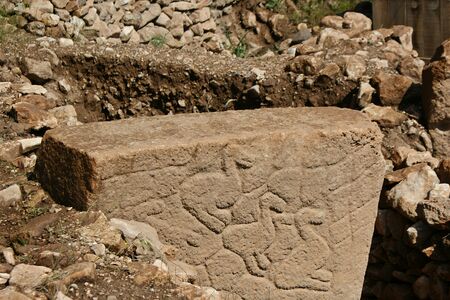
Repeating forms, especially in rows and columns, is a feature unique to high energy plasma. They are another effect caused by tessellated interference patterns in energized plasma. Instead of one tessellated cell lighting, charge diffuses through a patch of identical standing waves, lighting-up repeating features in each.

Figure 21. Tessellated interference patterns in plasma produce repeating forms resembling a bipedal bull in a flock of bighorn sheep.

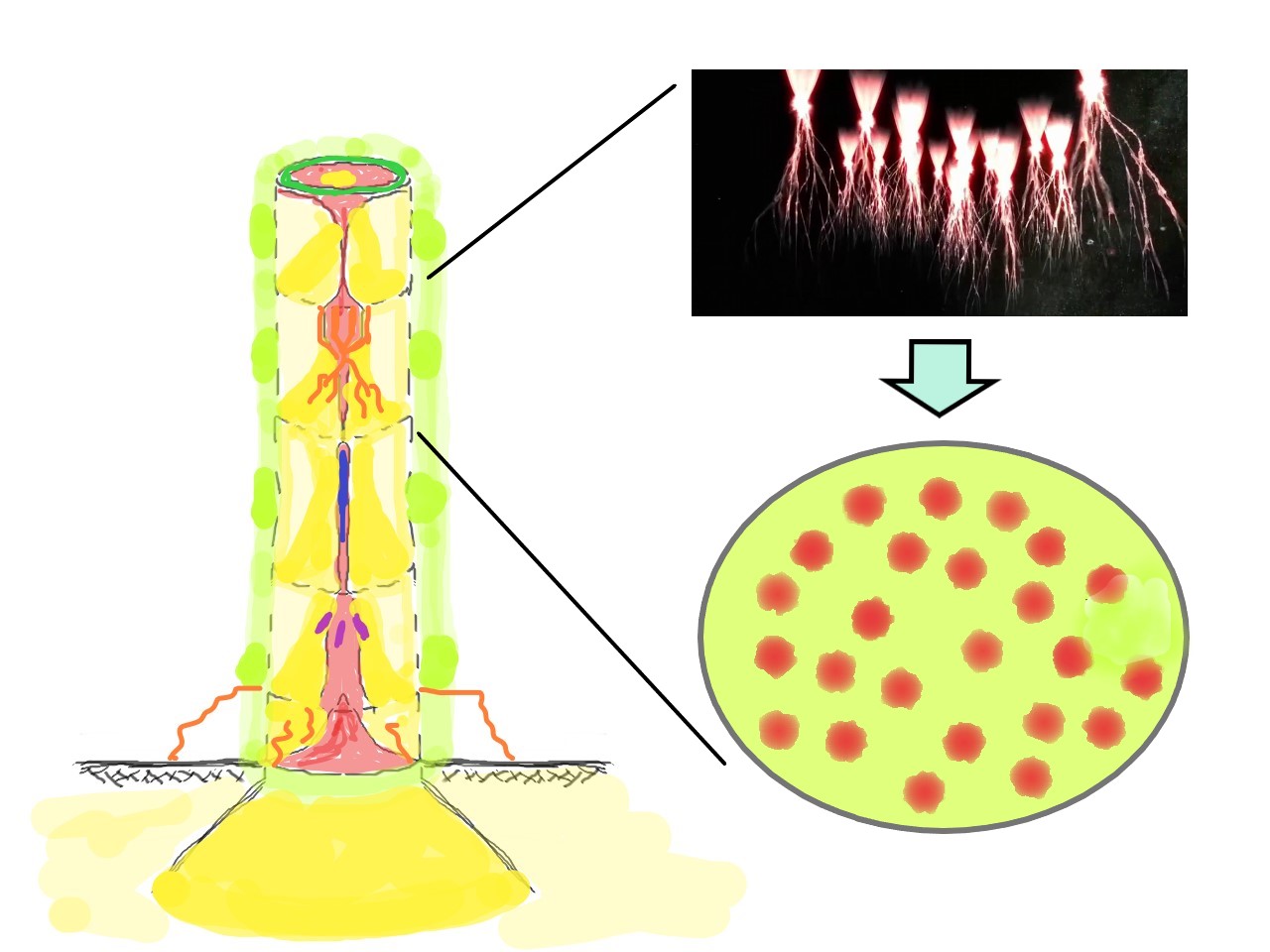
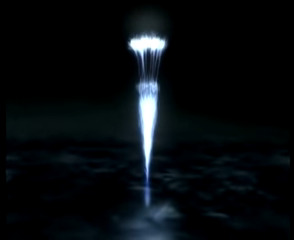
We can see the same thing above thunderstorms with high speed cameras. Figure 22 shows self-similar plasma sprites appear like a school of jellyfish as multiple high altitude tessellated cells discharge in-phase.
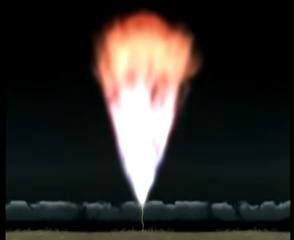
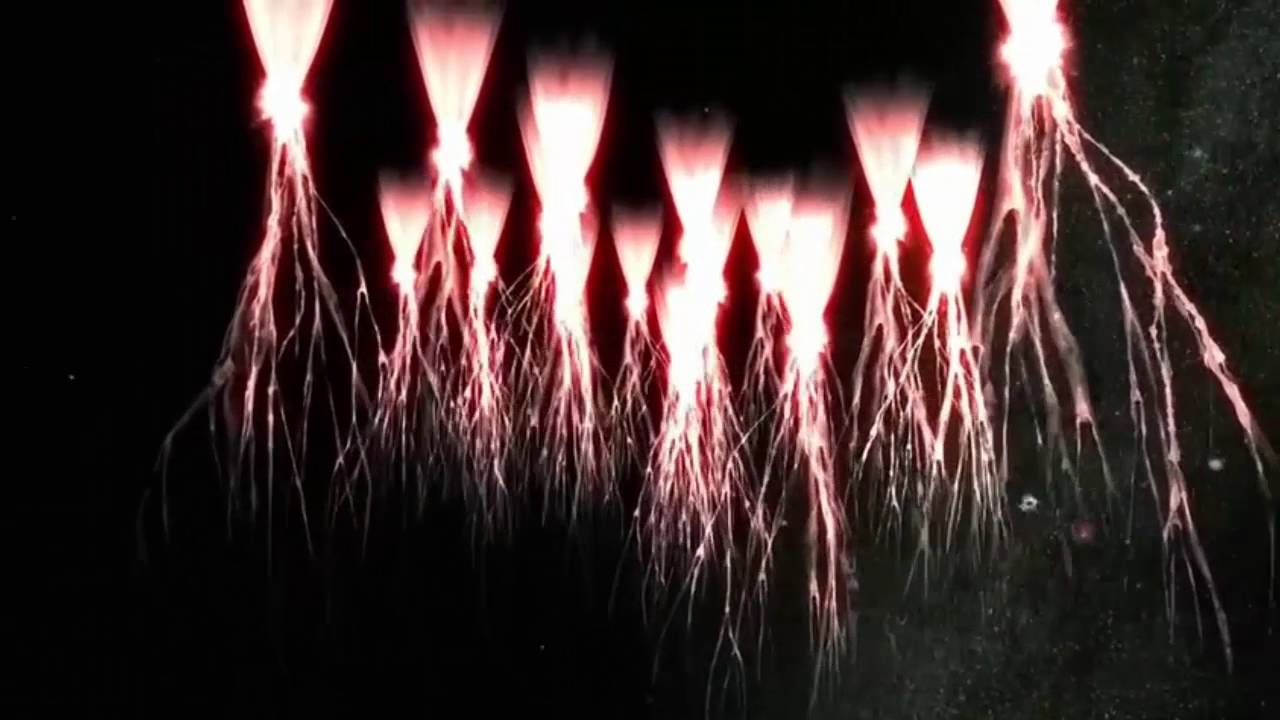
It is no coincidence that high energy plasma “Z-pinch” creates a human form, or that interference patterns in a plasma makes forms that resemble living organisms. The universe is holographic with a fabric of pure aetheric energy, so every form is a fractal harmony of wave patterns. Repeating forms in Nature is the rule, not the exception.

Science says petroglyphs and pictographs depict local fauna, scenery and normal activities, like people hunting and dancing. Please, take note of the images and see if things look normal to you. For once, we have a clear example of scientists suffering pareidolia.

There is continuity of images and themes in the artwork of ancient Anatolia that is repeated in rock art around the world. “T” pillars are an example of this and present an astonishing implication. “T” pillars are not exclusive to these sites in Turkey. They are found in all ancient cradles of civilization. Like ‘squatterman’ and “Jacob’s Ladder’ which are found in petroglyphs around the world, a form of the ‘T-pillar is found at megalithic sites around the world.

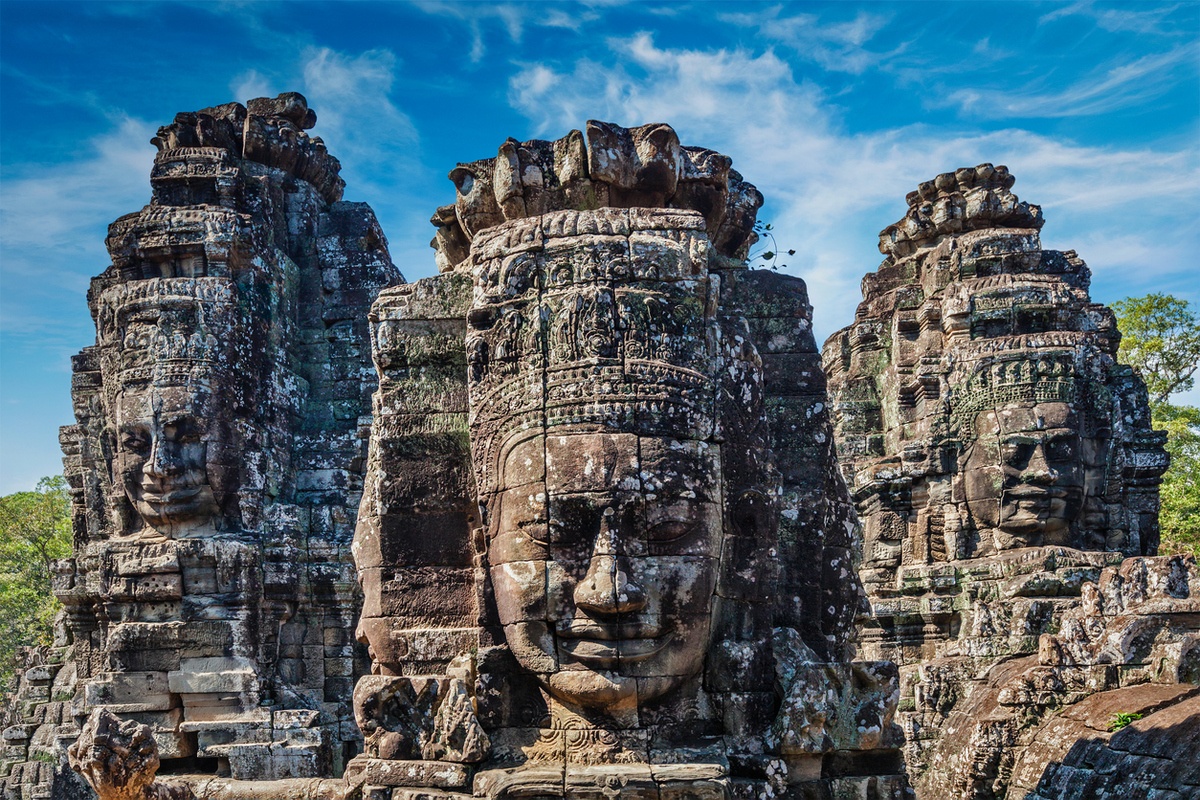
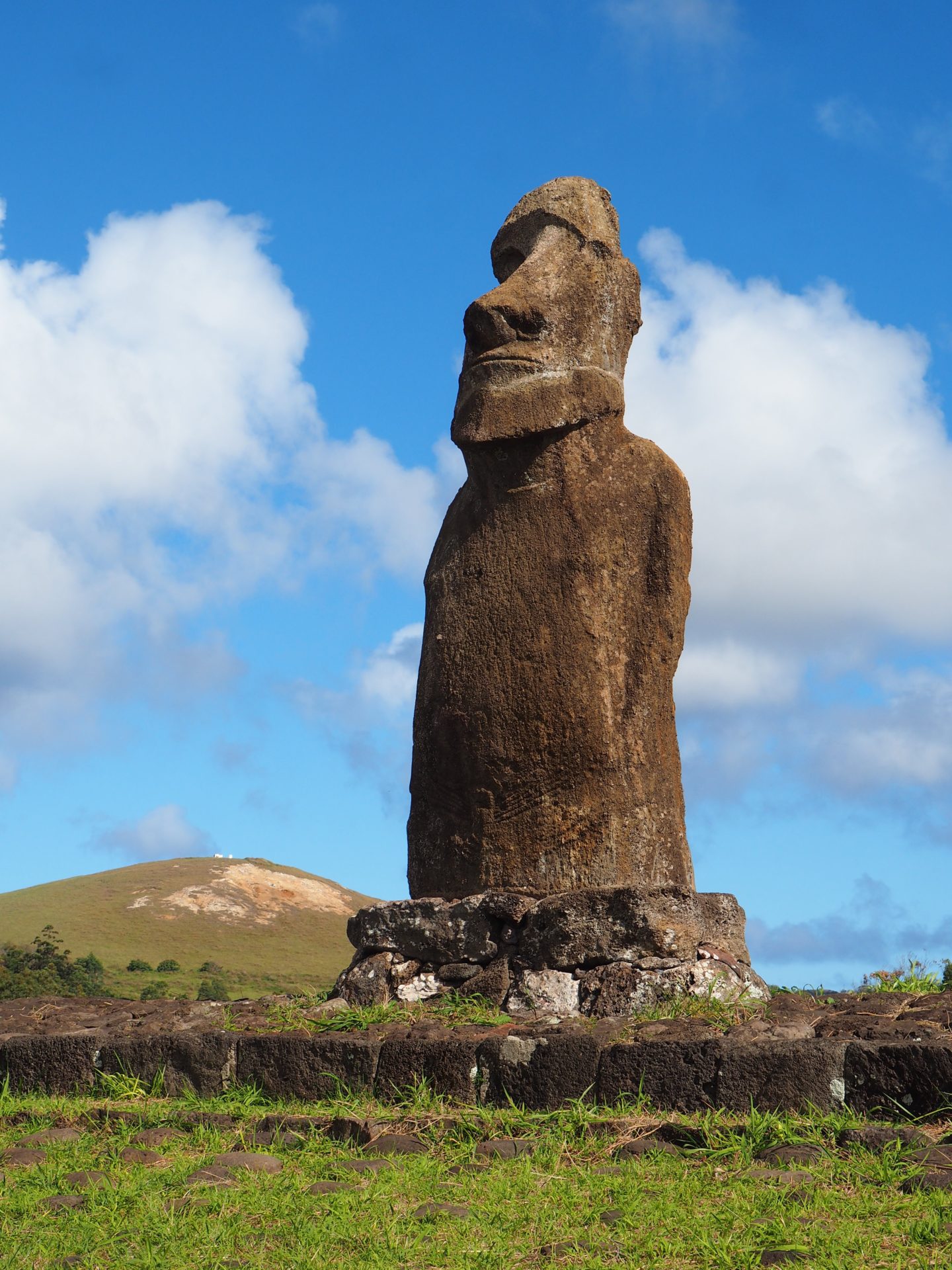
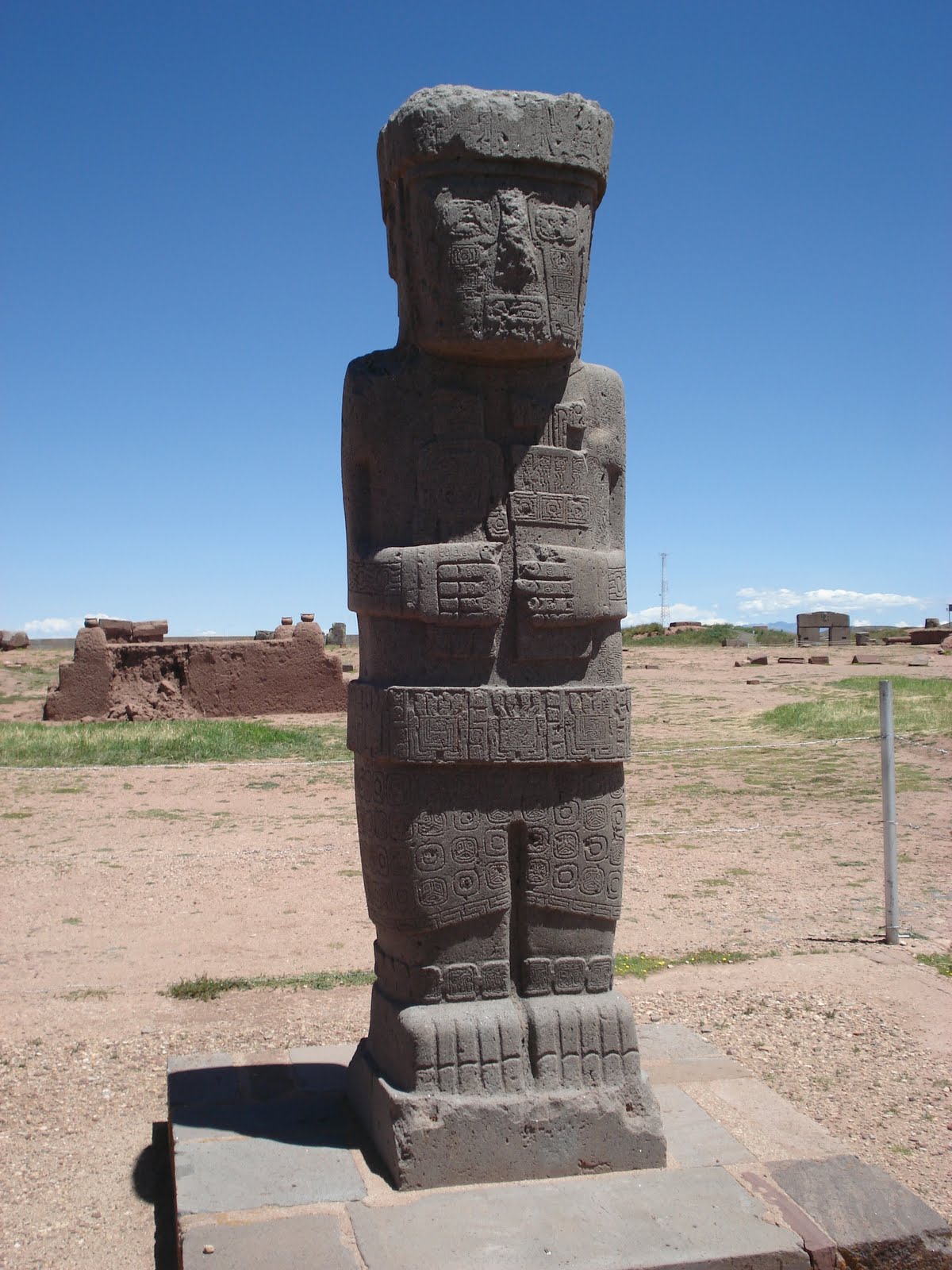
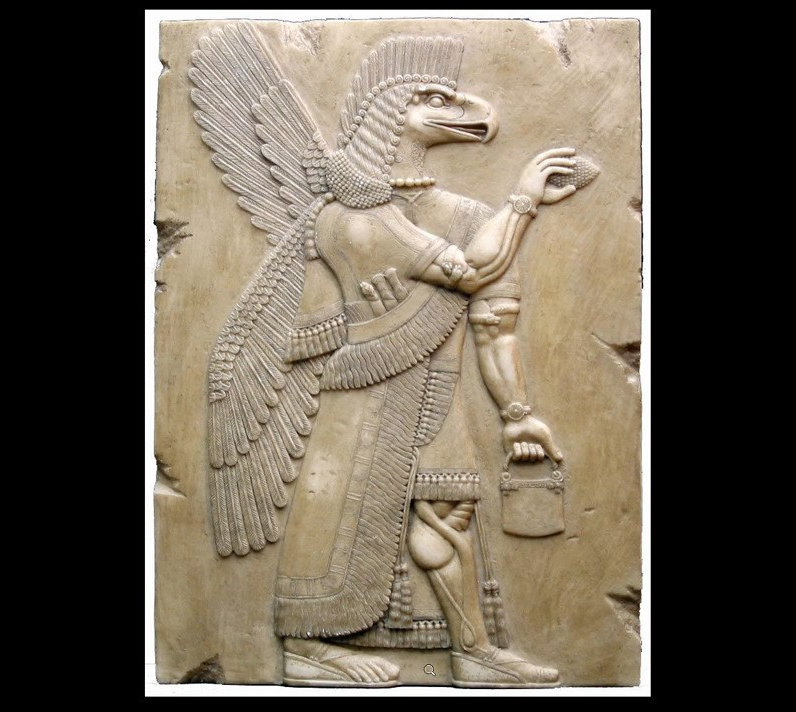
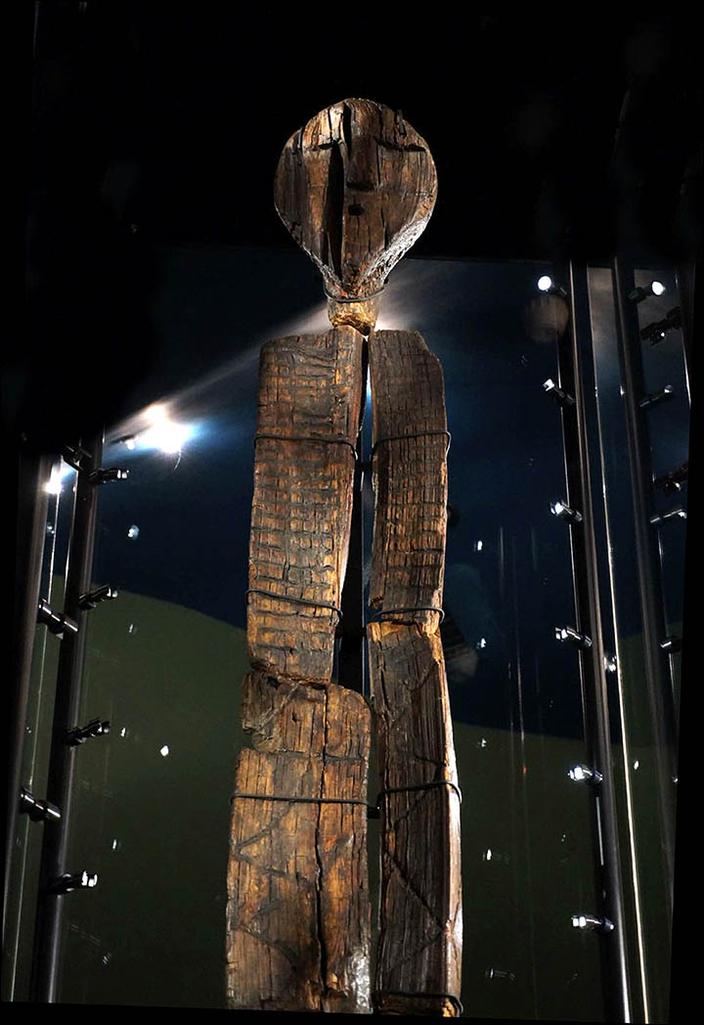
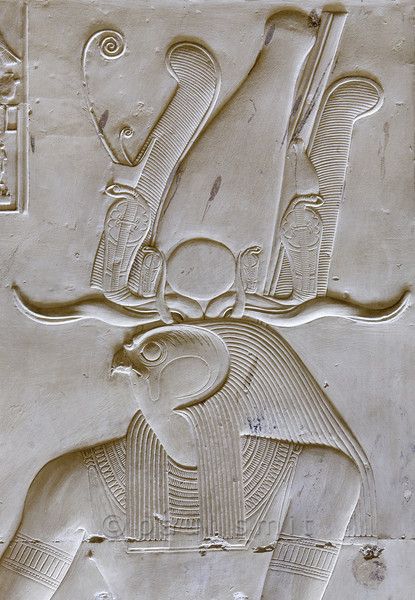
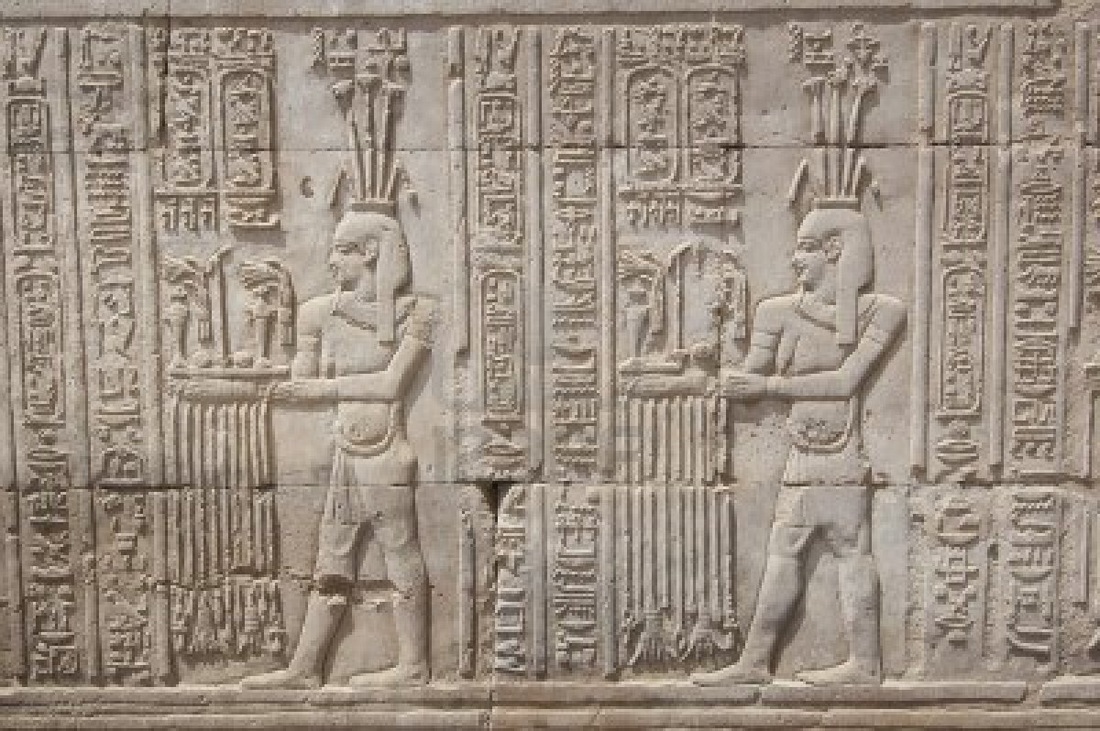
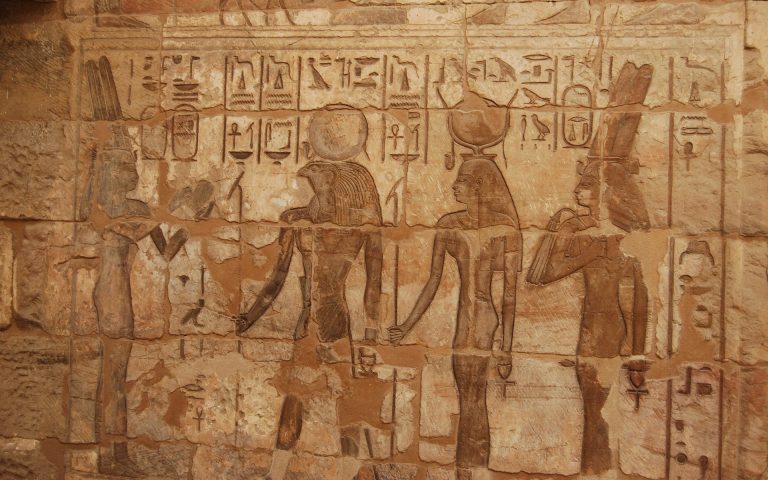
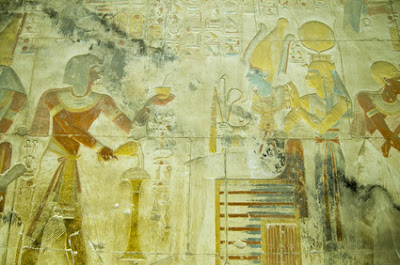
We just don’t call them “T” pillars elsewhere, because the “T”‘s have been replaced with anthromorphic figures with faces. Like Urfa Man in Turkey, they have the same blank faces, striking the same patient pose. They are the Moi in Easter Island, the pre-Incan gods of Meso-America, the Buddha of Asia, the Egyptian pantheon and the Annunaki. Similarities include a long, lantern-jawed head, ski-slope nose, no mouth, or only the suggestion of a mouth and often no feet, or legs. Heads appear wearing a boxy hat, headdress, or helmet.

They simply evolved over time, from columnar structures with simple features, to elaborately featured anthropomorphism with faces, bodies, stories and personalities.
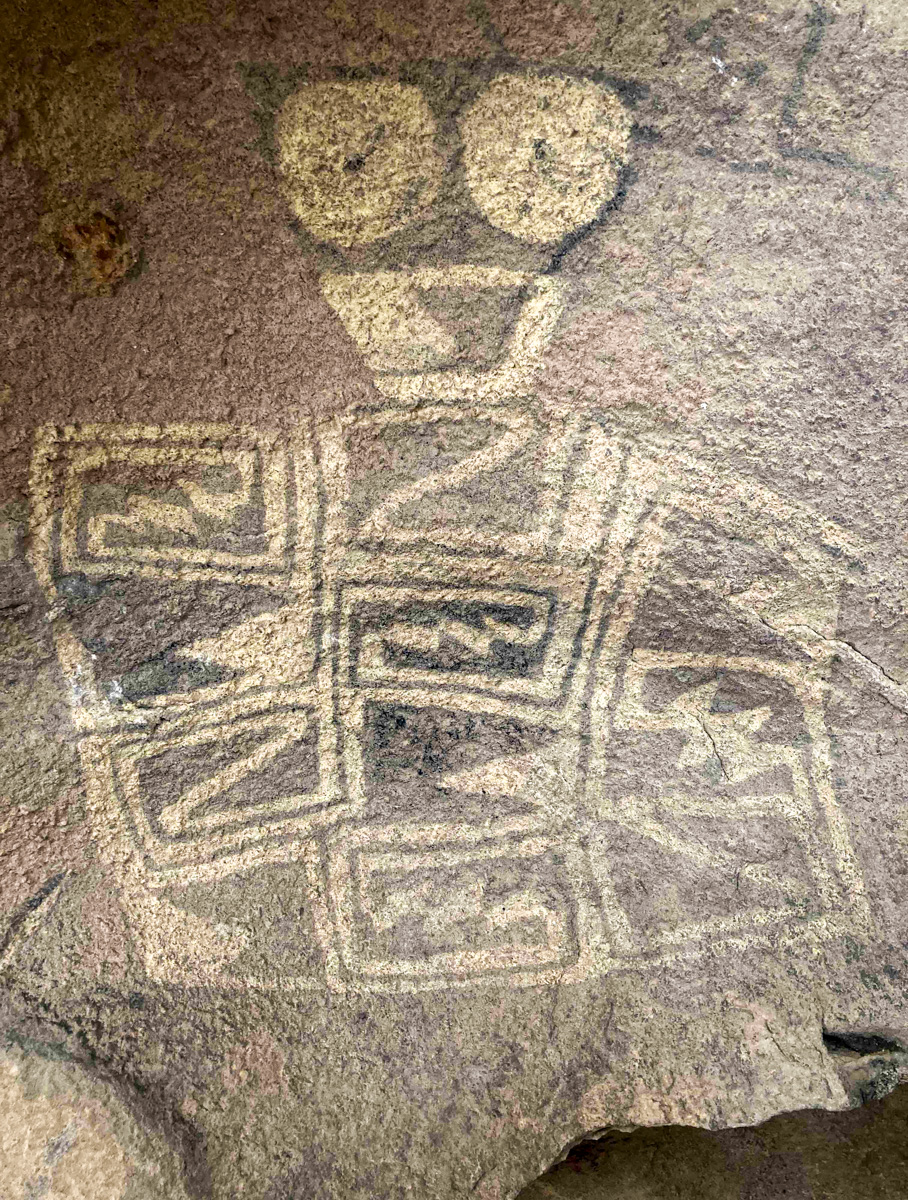
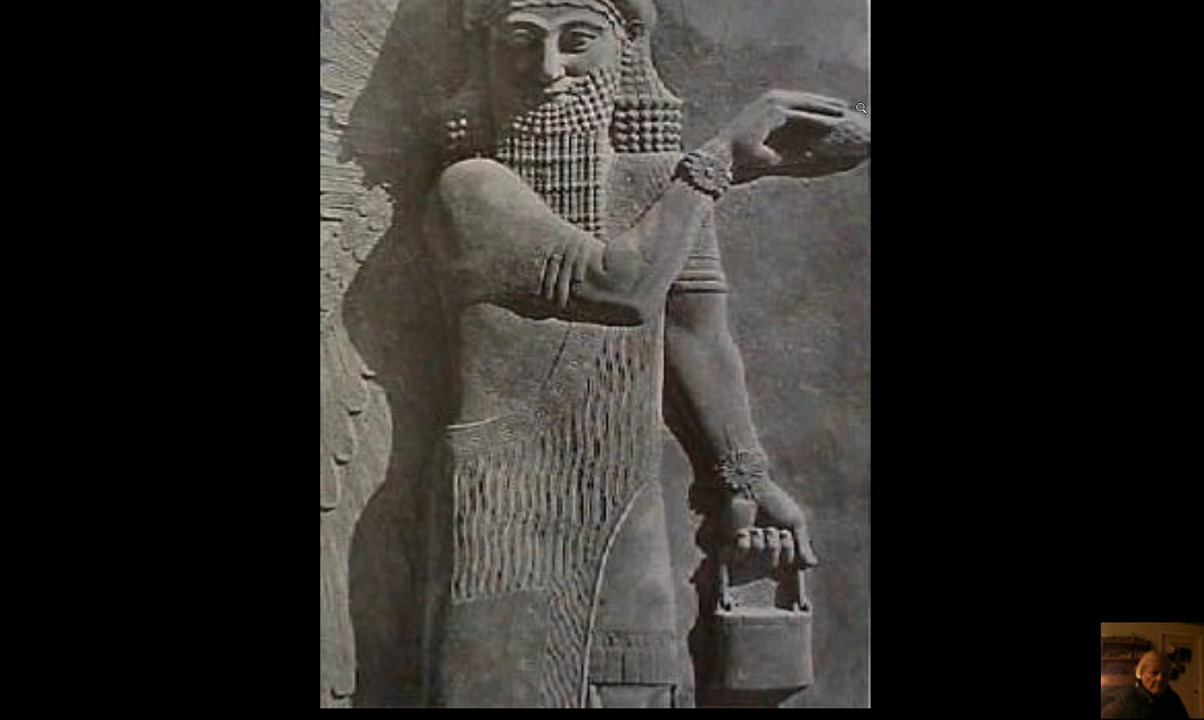
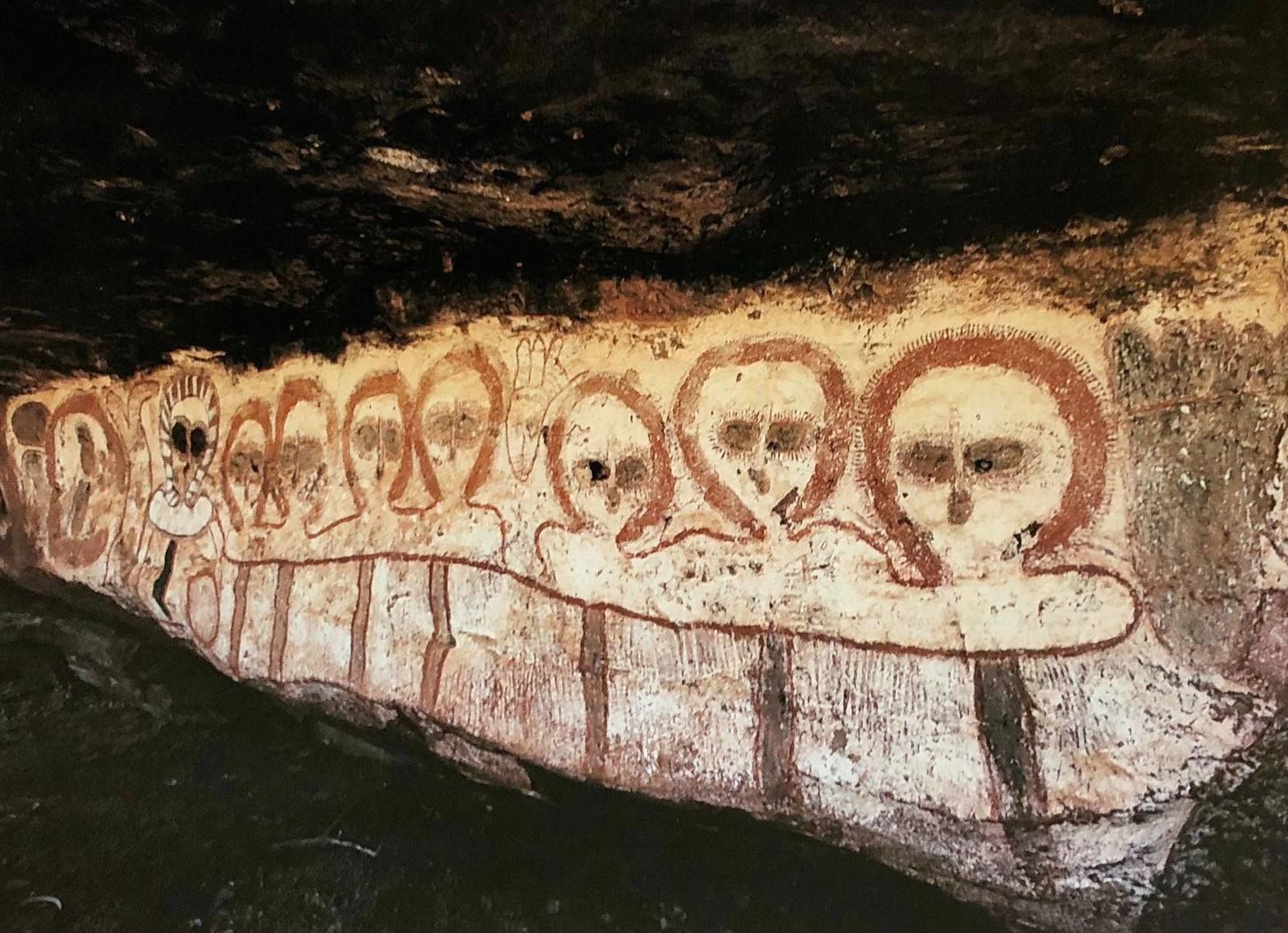
Even more compelling proof the “T” pillars are the archetype for subsequent gods are the goggle-eyed figures mixed with fish found in Australia and shown in Figure 25. You can see how the context of the fish morphs from individual fish, to goggle-eyed fish, to fish with human-like, goggle-eyed heads. Centuries later, fish gods appear among the Annunaki, holding handbags and stories of creation.

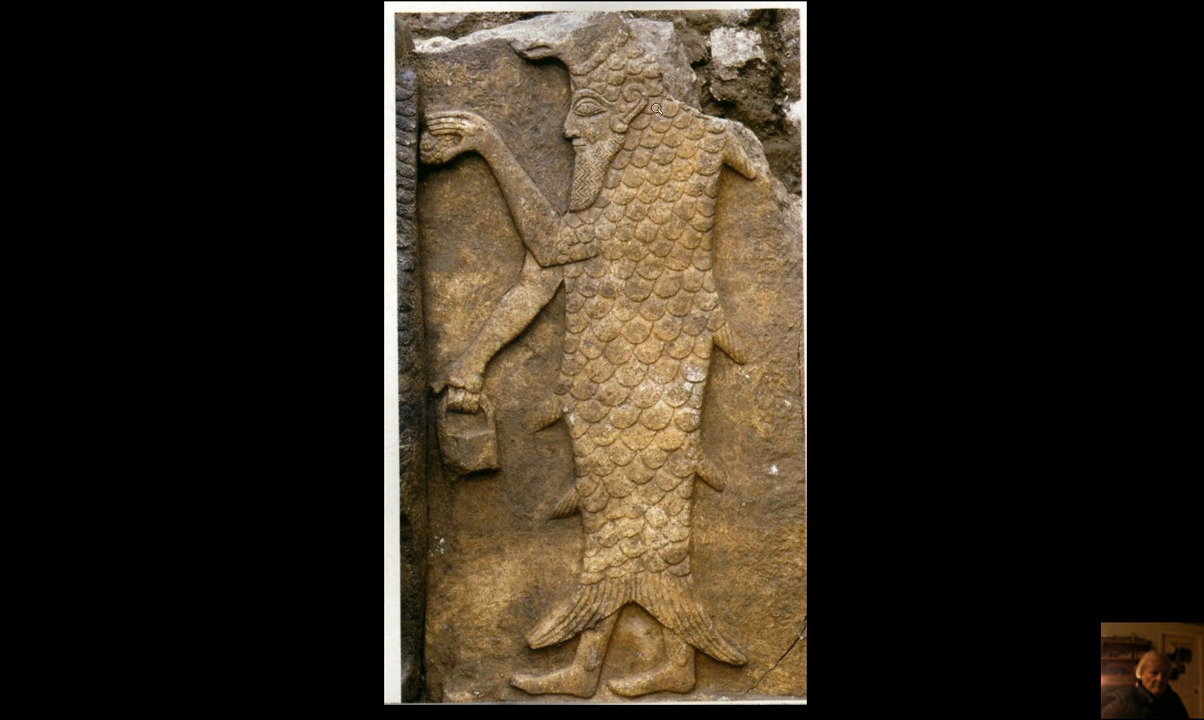
There is a simple, direct continuity of themes in the lineage of religions that links a space weather event to auroral lights, catastrophic climate change and shared emotional trauma. The Annunaki, Egyptian, Greek, Roman and every other pantheon of gods were fashioned on the “T” pillar, because ancient man saw electricity in the sky.

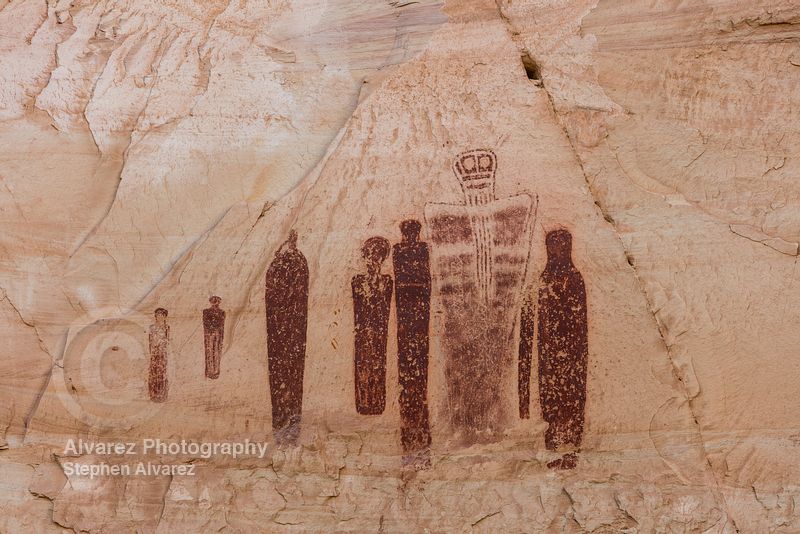
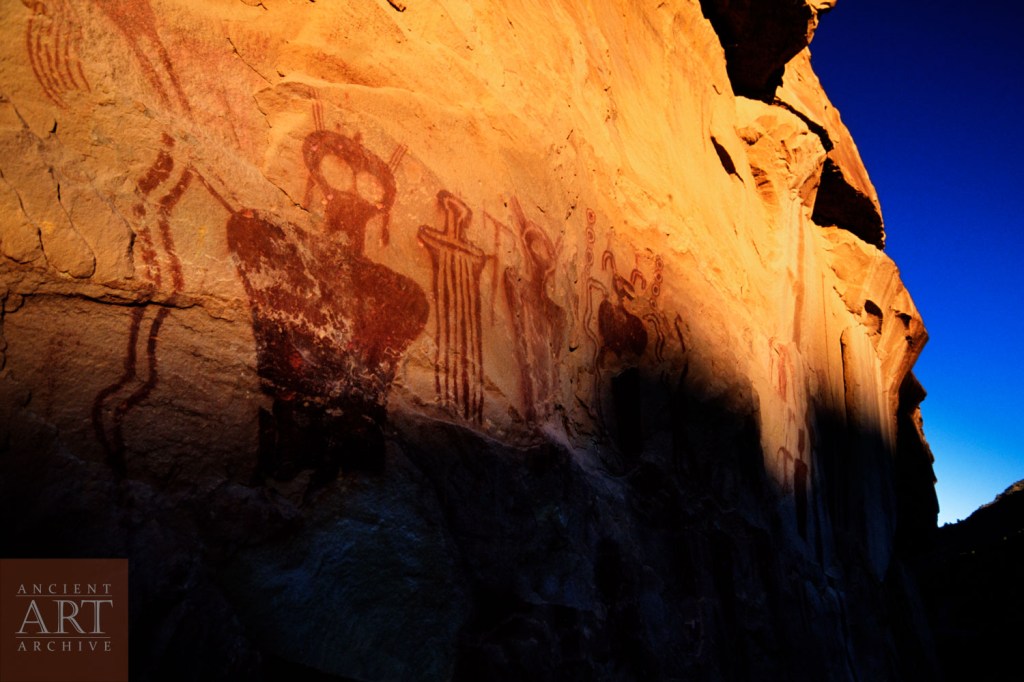
In Figure 26, the Kuntillet Ajrud inscription, discovered on pottery found buried in the Sinai desert and dated to the 9th century BC, portrays the Egyptian god Bess. Barrier style pictographs of unknown age found in Utah’s canyons depict the same goggle-eyed, jug-headed figures without the anthropomorphisms of arms, legs and other appendages.
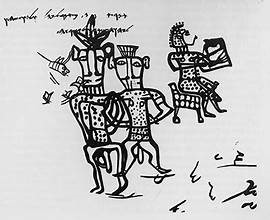
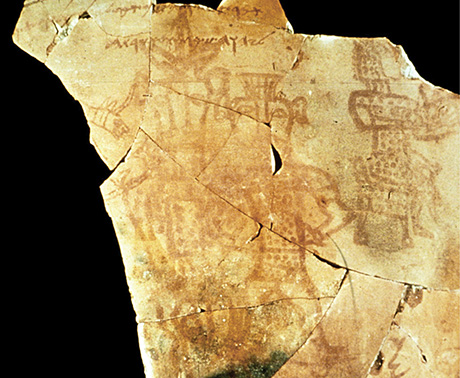
The Kuntillet Arjud artwork was originally inscribed with the names of Yaweh and a female diety named Ashera, before the images were added. There is controversy whether the images have any connection with Yaweh of the old testament. It is certain that the images represent gods of Egypt, however, linking the rock art, and therefore plasma aurora, to belief in gods.

I contend the “T” pillars represent the “Elohim” of Genesis. They are what the myths are about – storm gods. They are the trauma for which we collectively suffer amnesia. Beings of light from the heavens beaming to mountaintops where lightning and thunder reigned. The notion that Man is made in God’s image is a result of ancient man seeing his image in the sky. What we call “squatterman” today, and imagery like the Barrier Style rock art of Utah, were the creator gods of yore.

I also contend it was people turning away from this pagan pantheon to acknowledge the one true God of the cosmos that began monotheism. A more sophisticated understanding that energy lit the cosmos, and the storm gods were just light fixtures, had to appeal to those who stopped to think. Perhaps that is why so many statues of these storm gods are found headless and why sites like Gobekli Tepe were intentionally buried. They were deemed to be false gods, and rightfully so. They were just lights in the sky and bad weather.

What makes this relevant today is the new/old narrative that Annunaki and other mythological characters were reptilian visitors from another star system who seeded human life on Earth. People are being led into a revival of this ancient pantheon to fill the knowledge void left by the failures of academic science. It’s similar to the “flat earth” phenomena, where a malicious psi-op attempts to gain traction with vulnerable people who just want answers. There was an ancient alien energy that caused plenty of aerial phenomena, but no little green men were involved – at least not with respect to the Annunaki. The Annunaki, like the “T” pillars, represent a ‘Category 5’ space storm and the resultant chaos on Earth.

Also, a course correction is needed for the new-age “catastrophists” who believe an impact is the only possible way Earth’s climate could have been disrupted so severely, so quickly. Not that a meteor, or comet isn’t a possibility. In fact, that is exactly what Emmanuel Velikovsky originally presented in “Worlds in Collision” and the concepts that gave rise to the Electric Universe. A cometary visitor of sufficient size could have caused all of the magnetic field effects recorded in the petroglyphs. However, not by impact, or even airburst.
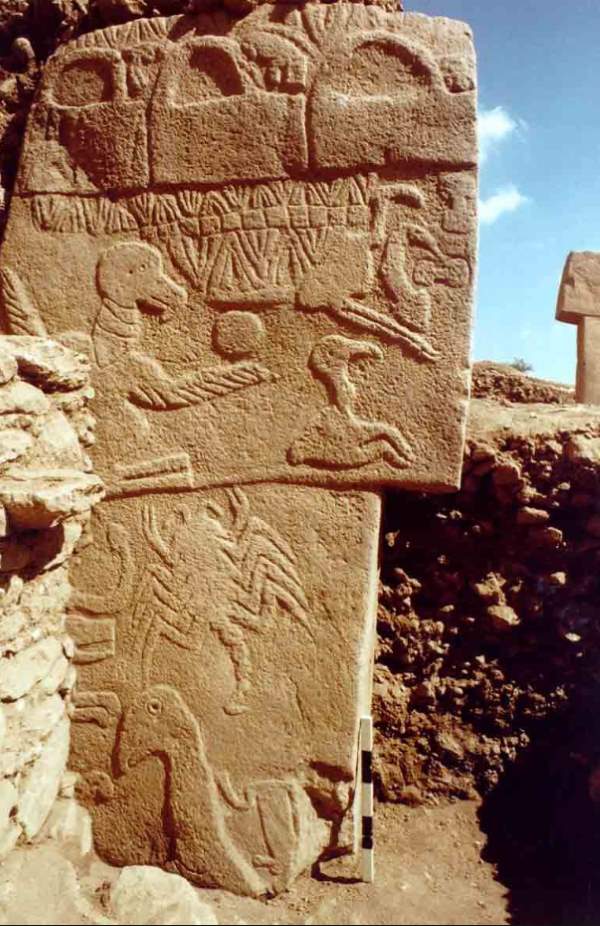
Figure 27. The Vulture Stone at Gobekli Tepe

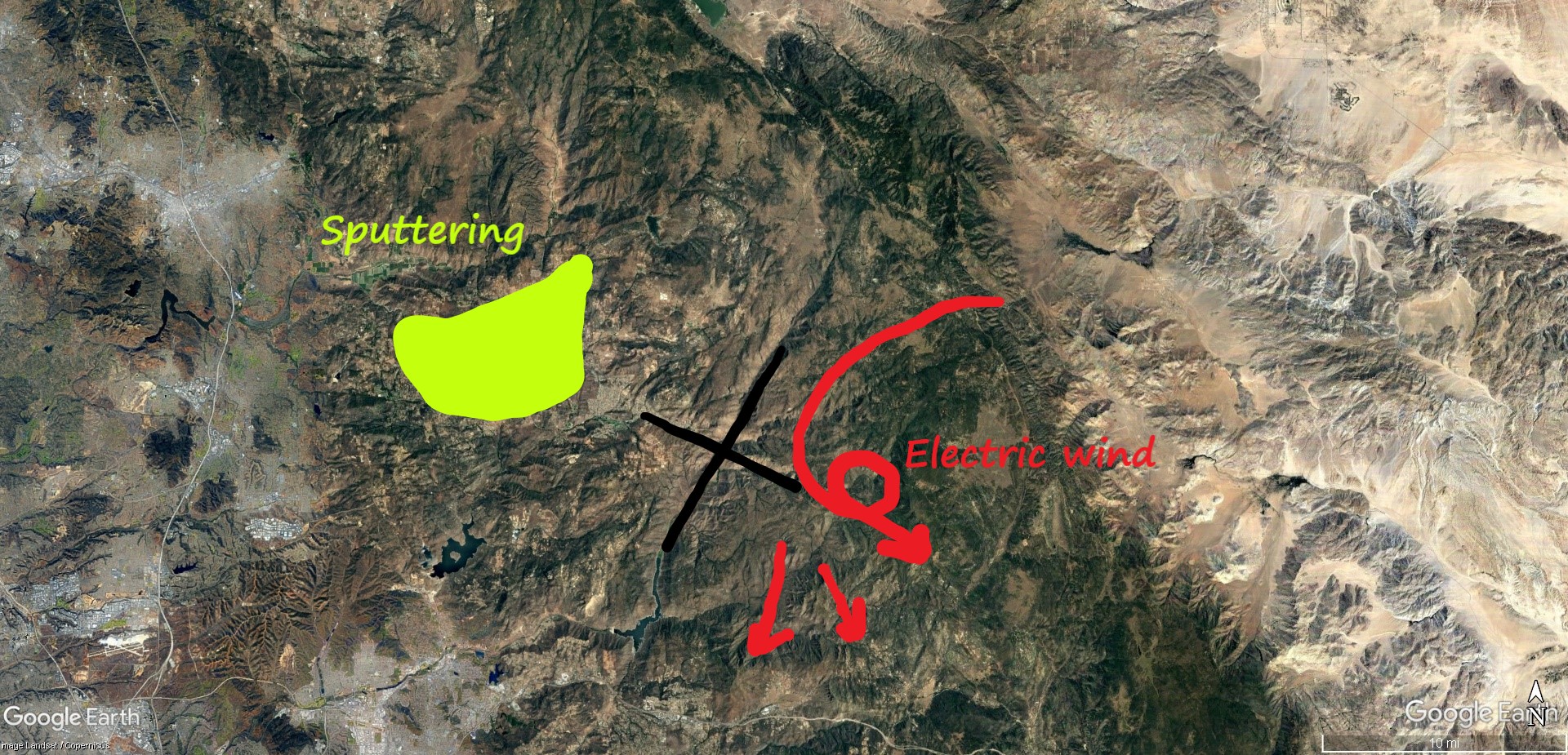
Simply coming close was enough. Differential potential between Earth and a large invading body would generate an electrical wind to amp the magnetic field. So, it could have been a comet, or the Sun, or another planet. It could even have been the Moon, or the Earth itself adjusting it’s orbit.

Whatever the cause, it generated plasma storms. They were long lasting and probably recurring. They shook the Earth and erupted the guts out of it, while cyclones formed at the feet of giant columns of auroral light. We know this because the storms are also recorded.

The famous “Vulture Stone” at Gobekli Tepe tells this part of the story. The handbags represent the storm clouds. I’ll refer to “Handbag of the Gods” where I decode the Vulture Stone.

Nature is circuitry. Our bodies work on circuitry. So does every plant and animal on Earth. Inside Earth is circuitry generating a magnetic field that reaches to the Moon and makes a bubble of circuitry so powerful it lights the polar skies. The Earth’s electric bubble lives inside the Sun’s electric bubble, called the heliosphere, making circuitry between Earth and Sun.

Nested spheres of circuitry repeat at the galactic and cosmic scales. Repeating forms in Nature is the rule, not the exception, because it’s all made of circuitry. Everything is electric.

Figure 28. Polar Aurora – Earth recieving electricity from space

So, what do you think, Dan. Are you beginning to see, with electric eyes and your electrician background, how things are wired?

Cheers,
Explain This? … Well, Okay.

Proving that plasma winds electrically scoured the Earth, built mountains and carved canyons, is a tall order in the face of more than a century of consensus science saying otherwise. In prior times, Electric Universe theories might have been readily accepted, since religions and mythologies explicitly state the gods of creation were storms, lightning and thunder.

Modern science, however, came along and discounted myths and religions as useless for understanding Nature. Scientists said ancient myths express the superstitious anxienties of people ignorant of cause and effect. They displaced any notions about cycles of catastrophe by insisting geology is an exceedingly slow process of change due primarily to chemistry and erosion. They didn’t prove it, by the way, they just insisted that time itself is the proof – billions of years – so, who can argue with that? And except for the chemistry, which is the work of electricity, they excluded any role for Earth’s, or the Solar System’s electric circuitry in their causes and effects.

The Electric Universe view is that the Earth, Sun, Solar System, and in fact, the entire Universe, is a composition of connected electric circuits, and electricity is the cause of all the effects. The weather did actually shape the land, much as mythologies say, during highly kinetic plasma storms. The landscape is electrically carved and the mountains are wind-blown dunes.

Our theories have evidence. They present cause and effect mechanisms that make perfect sense in terms of classical physics. The evidence and the mechanisms comport with what can be seen with the naked eye. And some of the theories have been confirmed by experiment.

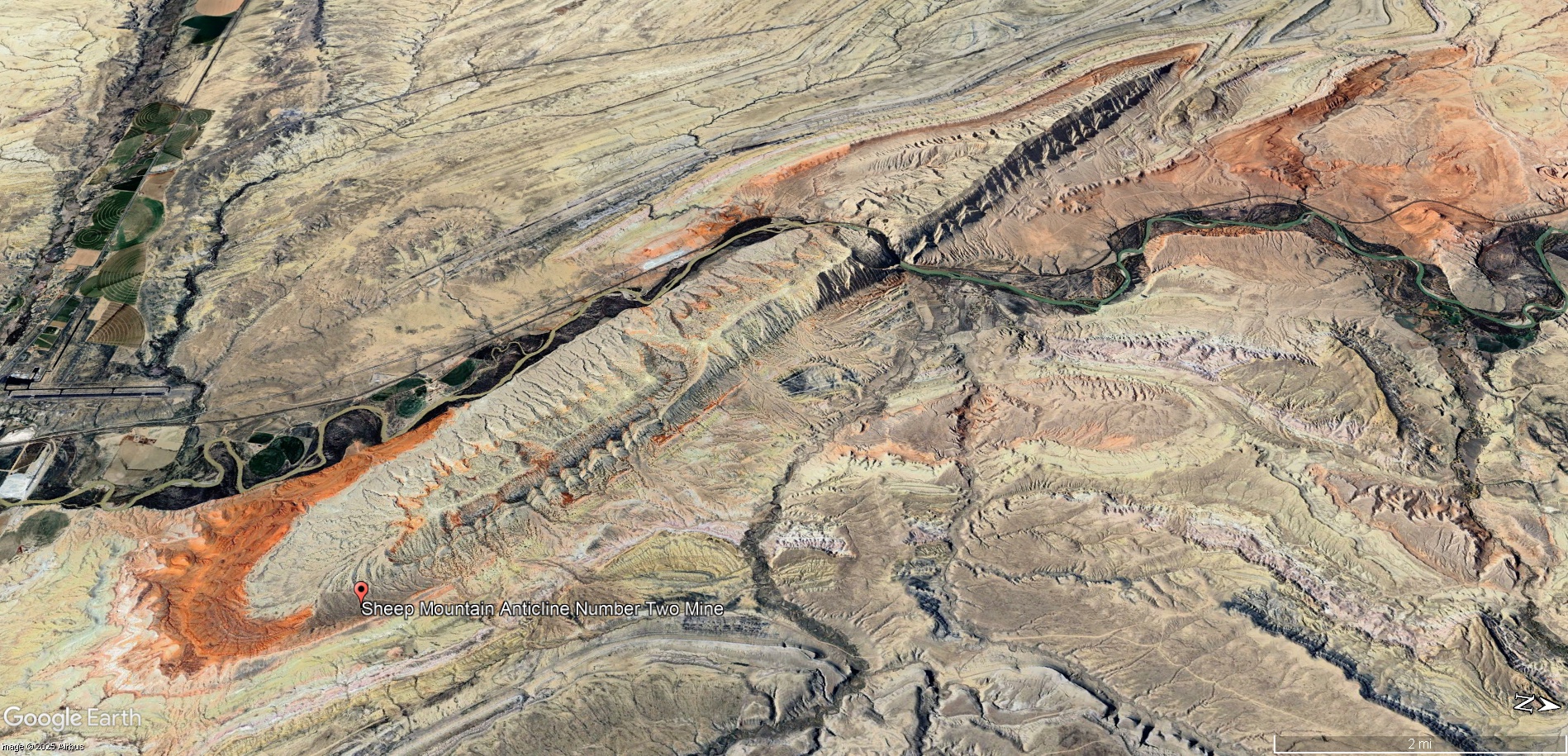
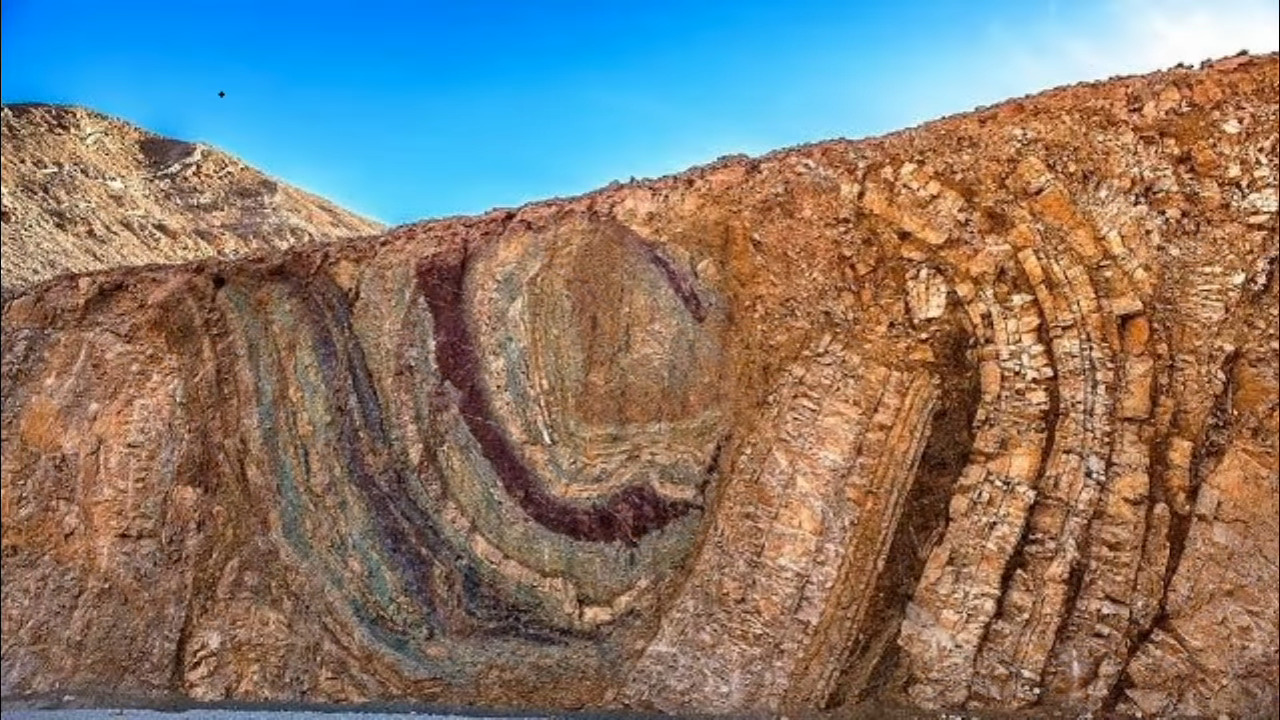
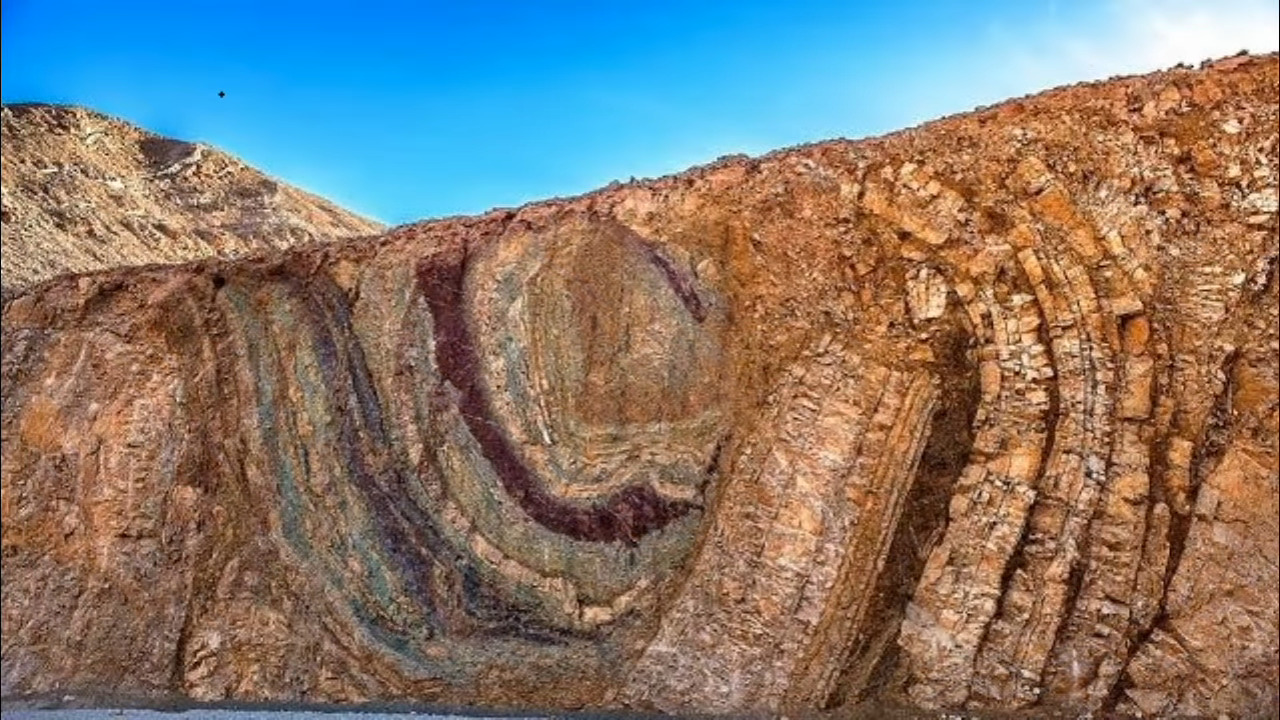
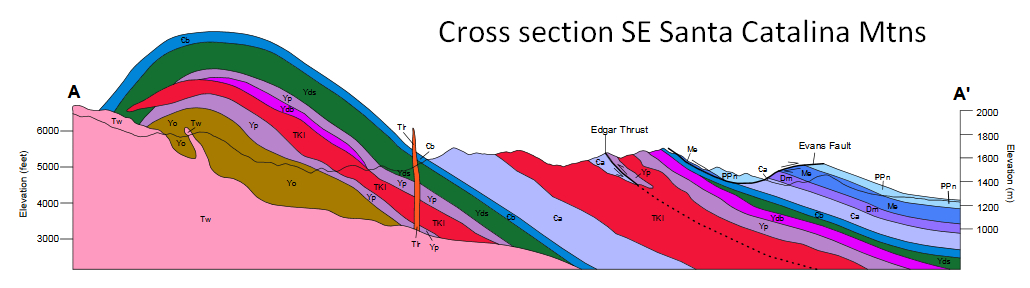
To show how our theories explain a mountain much different than the consensus, a comparison is in order. The consensus analysis is this Myron Cook video examining the Sheep Mountain anticline in Wyoming. With the title: “Explain This!”, he presents a challenge. I’ll take it. You can compare his explanations to mine and determine which fits best.

Cook’s video covers classic geological theory that I will provide an alternate, Electric Universe explanation for. What I hope this will show is that Plasma Orogeny is a theory of verifiable simplicity, elegance and classic physics, whereas the consensus requires a narrative built of dogmas and unverified assumptions.

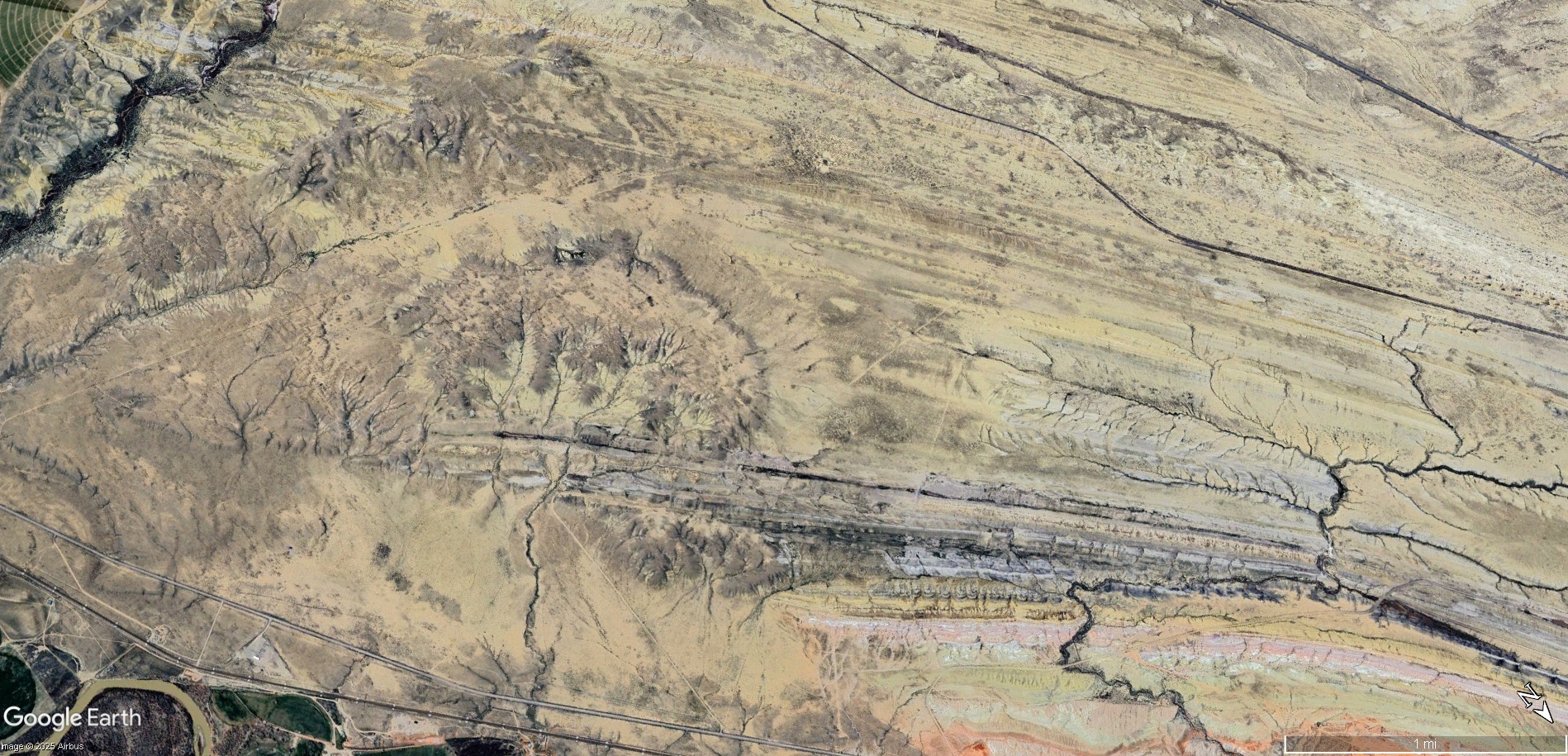
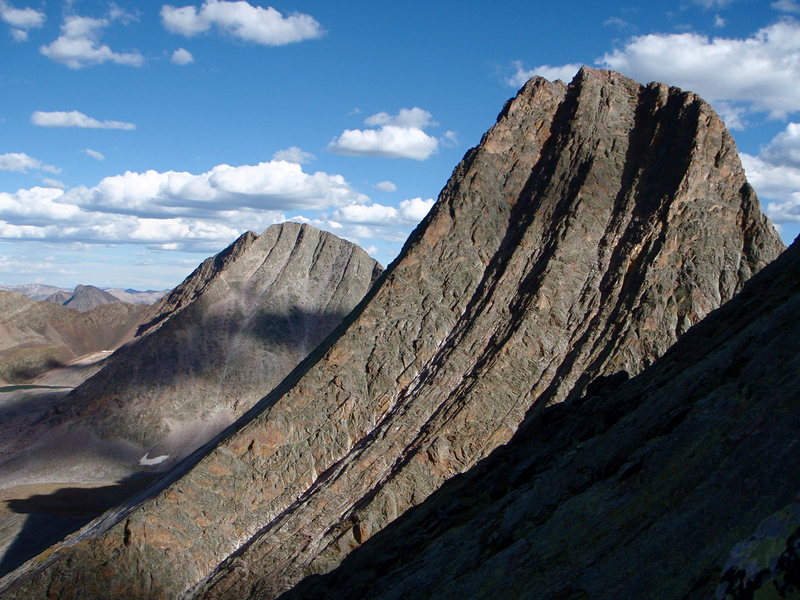
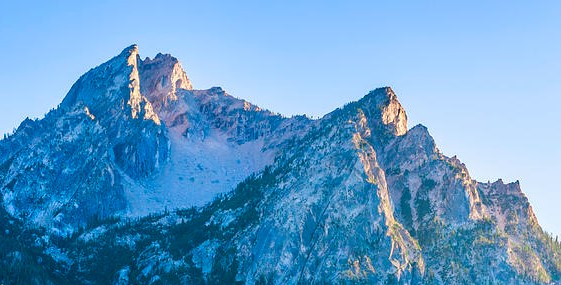
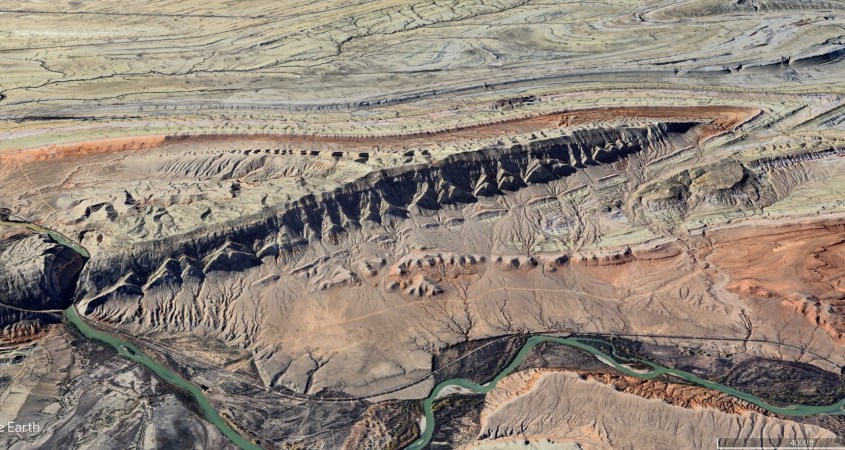
Figure 1. Sheep Mountain Anticline, Wyoming USA

I mean no offense to Myron Cook. He knows what he’s been taught. He authentically believes the theories of his predecessors are confirmed by his own observations. Unfortuntely, his predecessors were wrong and he suffers confirmation bias, because if one squints hard enough, a million years of erosion can be imagined to do almost anything.

I chose his video because I think it is excellent. He communicates his knowledge in plain language, and explains technical concepts without hubris, or condescension. He obviously loves Nature and is curious and enthusiastic. He presents excellent footage of the mountains – much better imagery than I can provide. I like him. Maybe he will see this article and become curious about the Electric Universe.

I’m linking his video because it allows a convenient comparison of particular features and explanations. He gives a textbook explanation most mainstream geologists would substantially agree with. I hope you enjoy his video, as I did, and give him a thumbs-up and only positive comments.

The Plasma Orogeny of Sheep Mountain

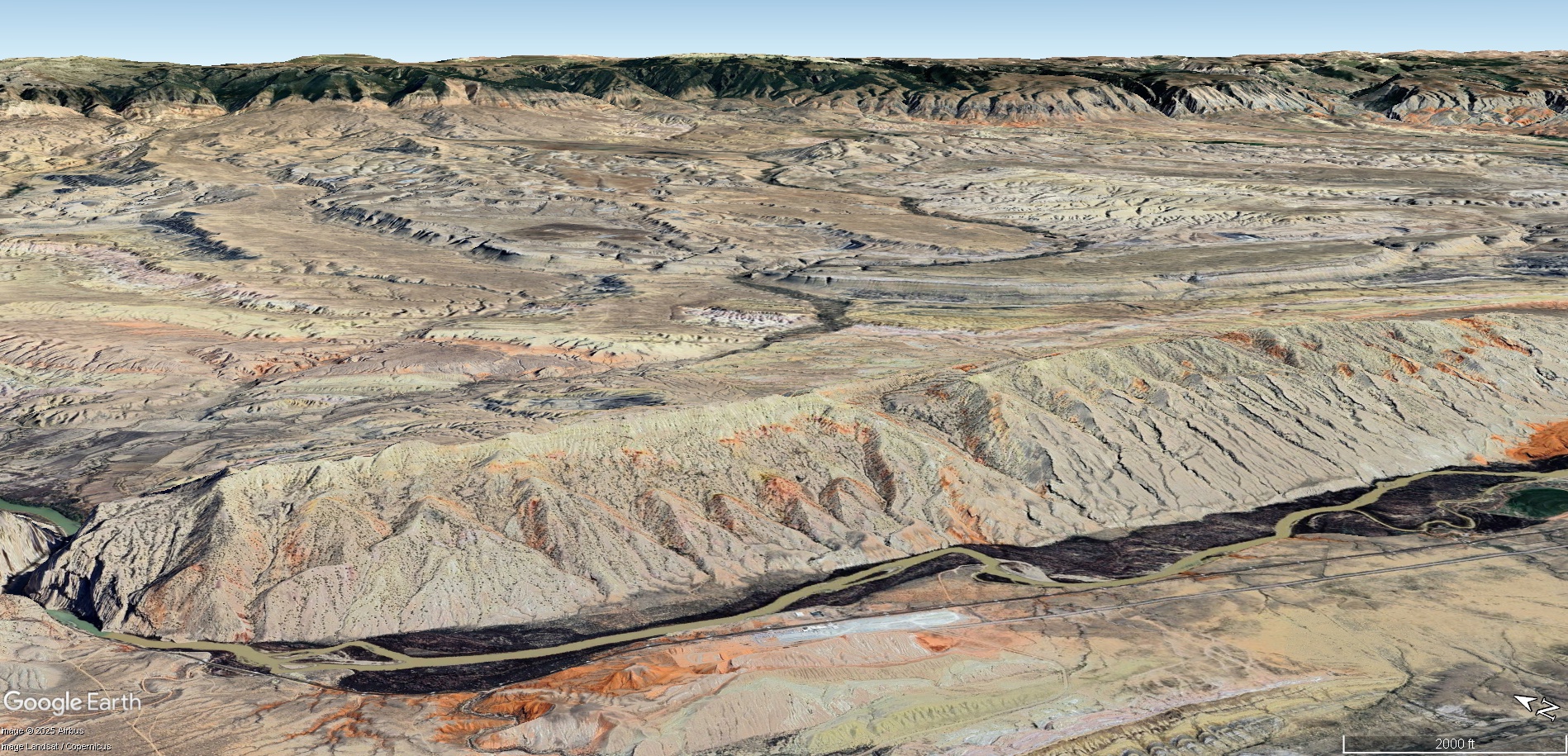
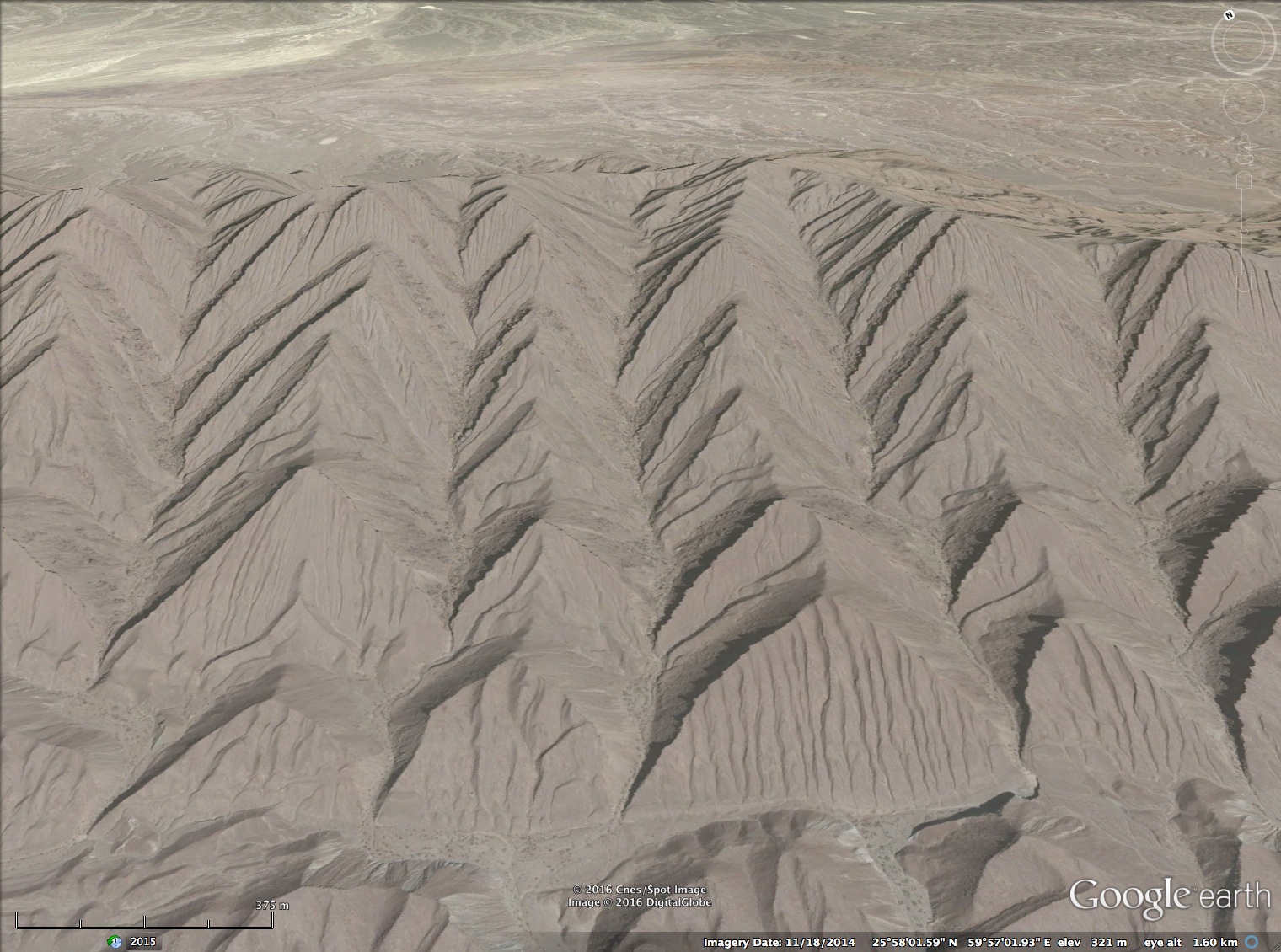
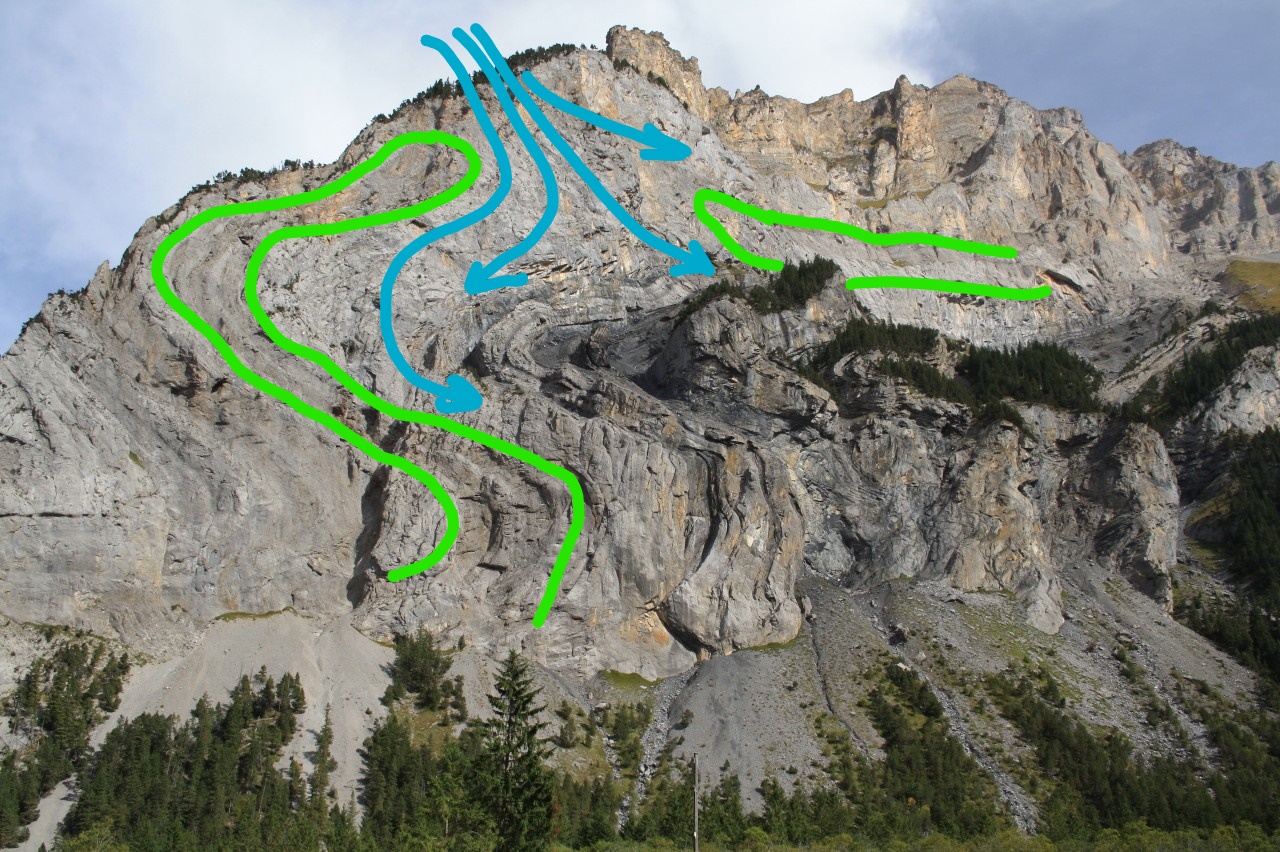
The triangular shape and planar face of the fins, or flat-irons, was made by sonic shockwaves. That is why they appear as repeating harmonic forms. What you will notice in several examples we’ll look at later, is that flat-irons and related mountain features are shaped like shock-waves, down to the finest detail. However, before looking at the finer detail, higher fidelity innerstanding will be achieved by starting with a broader contextual view.

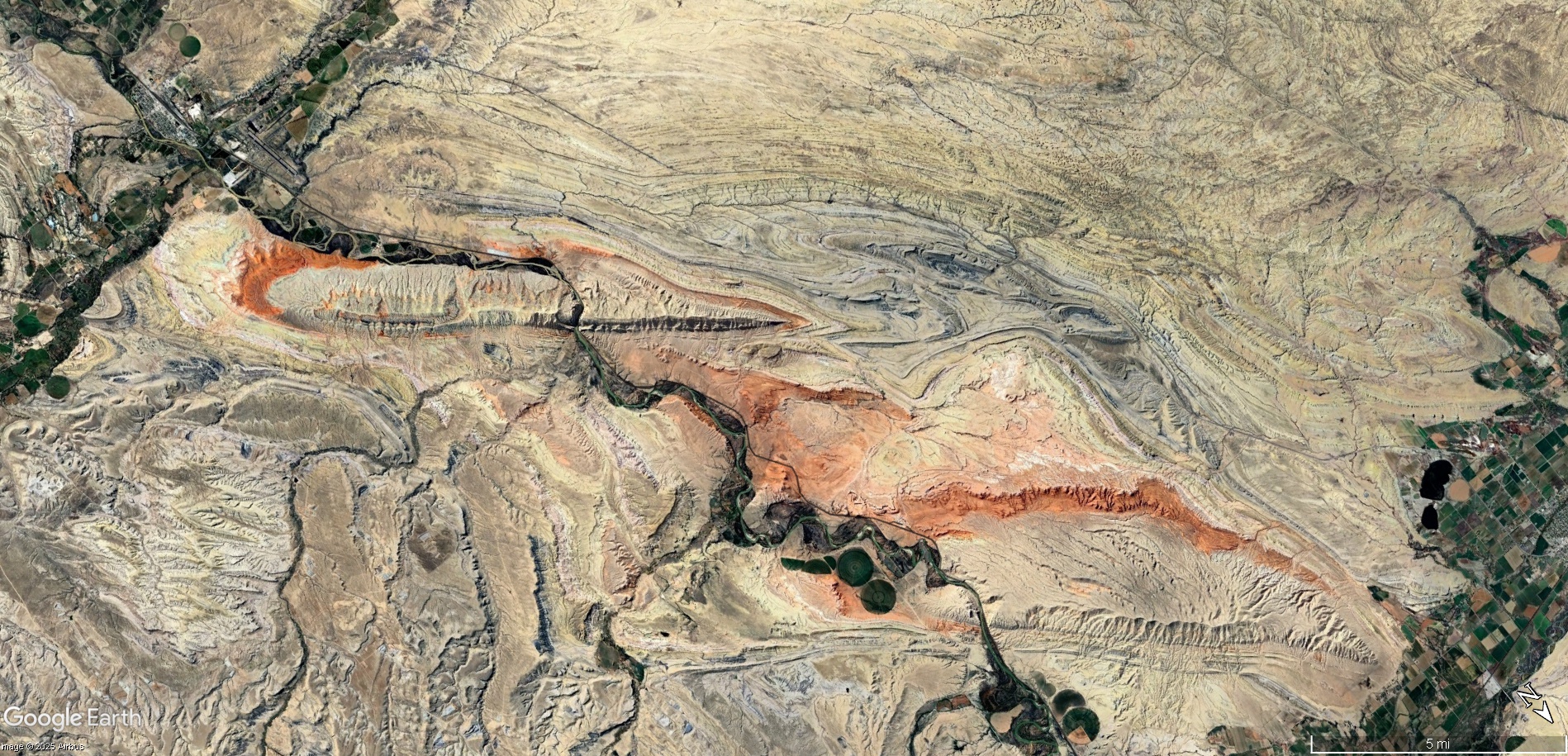
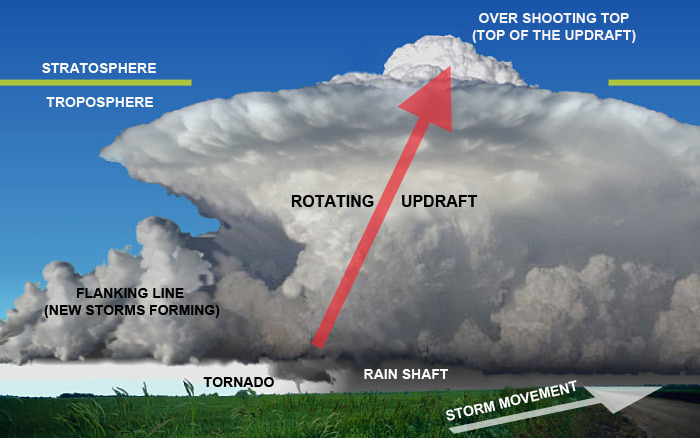
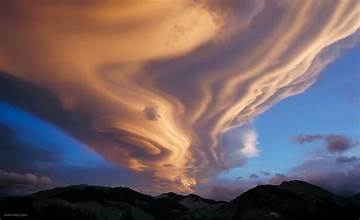
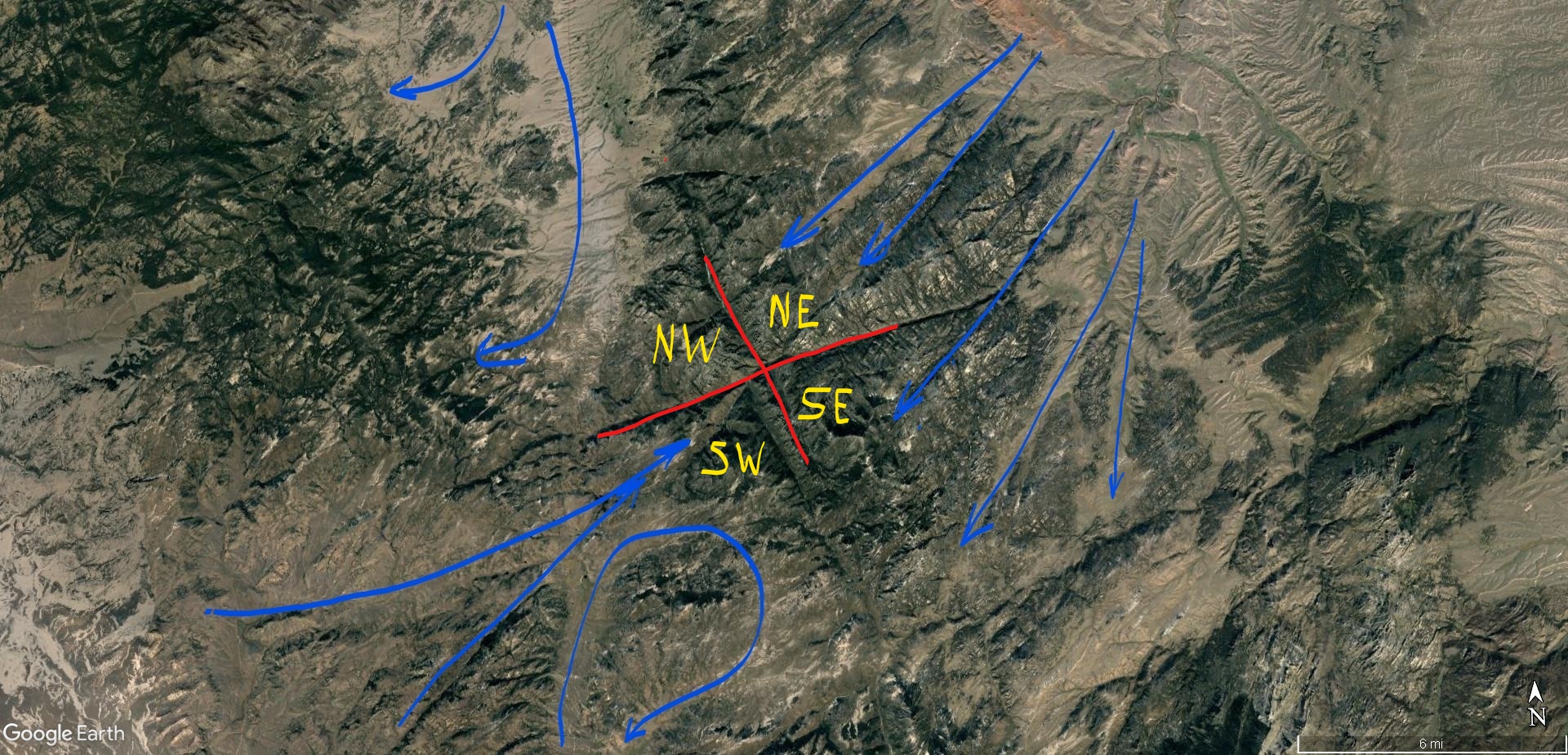
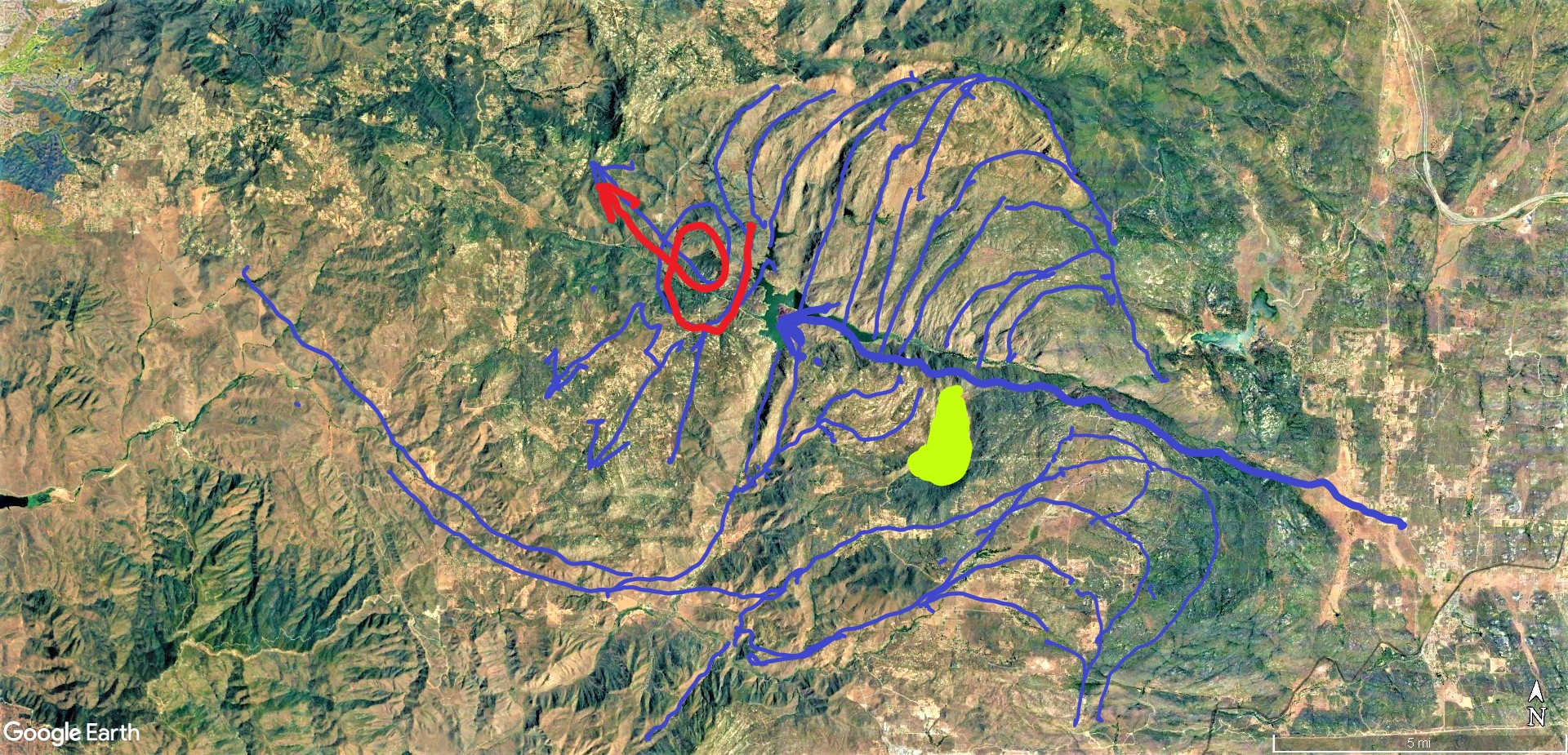
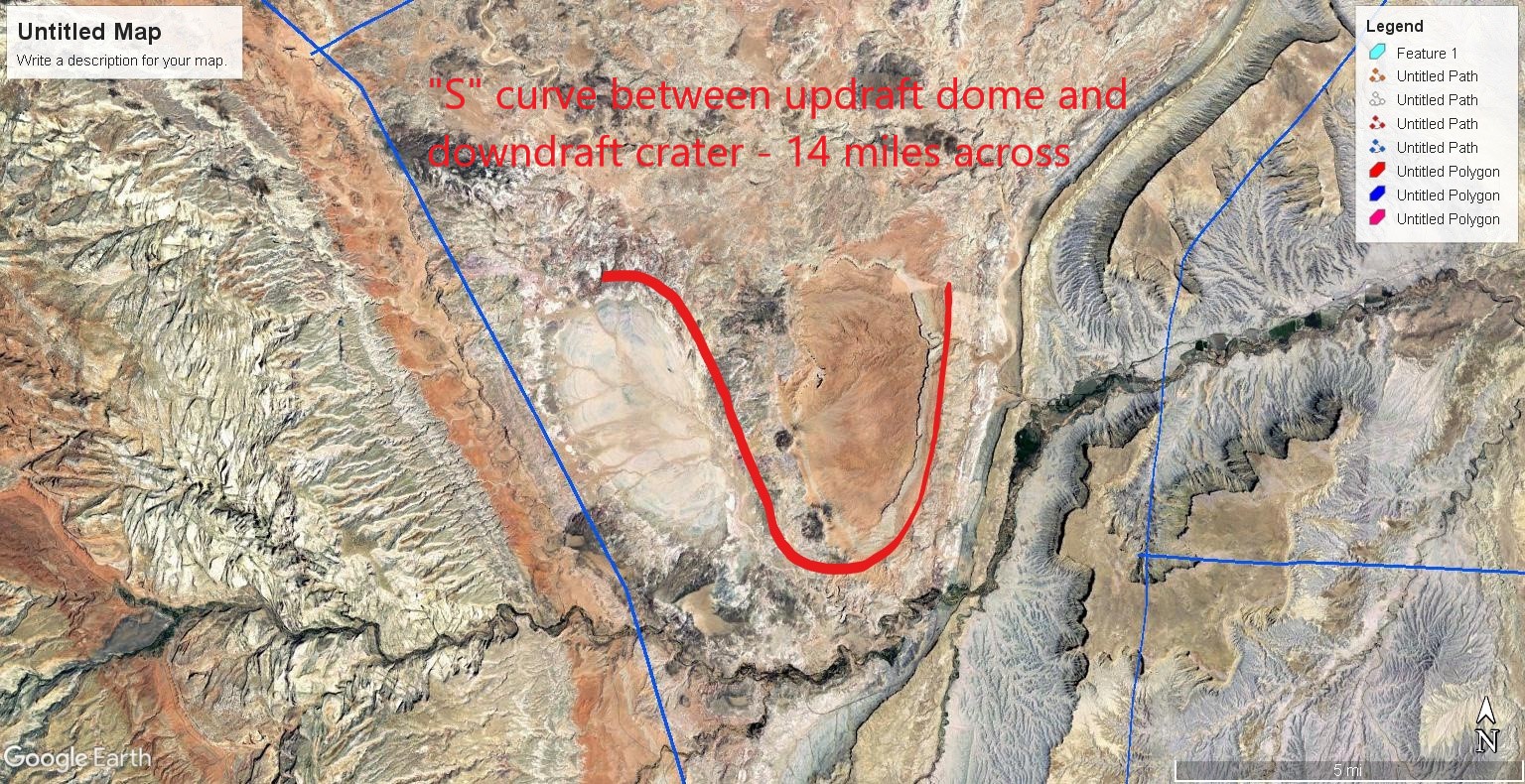
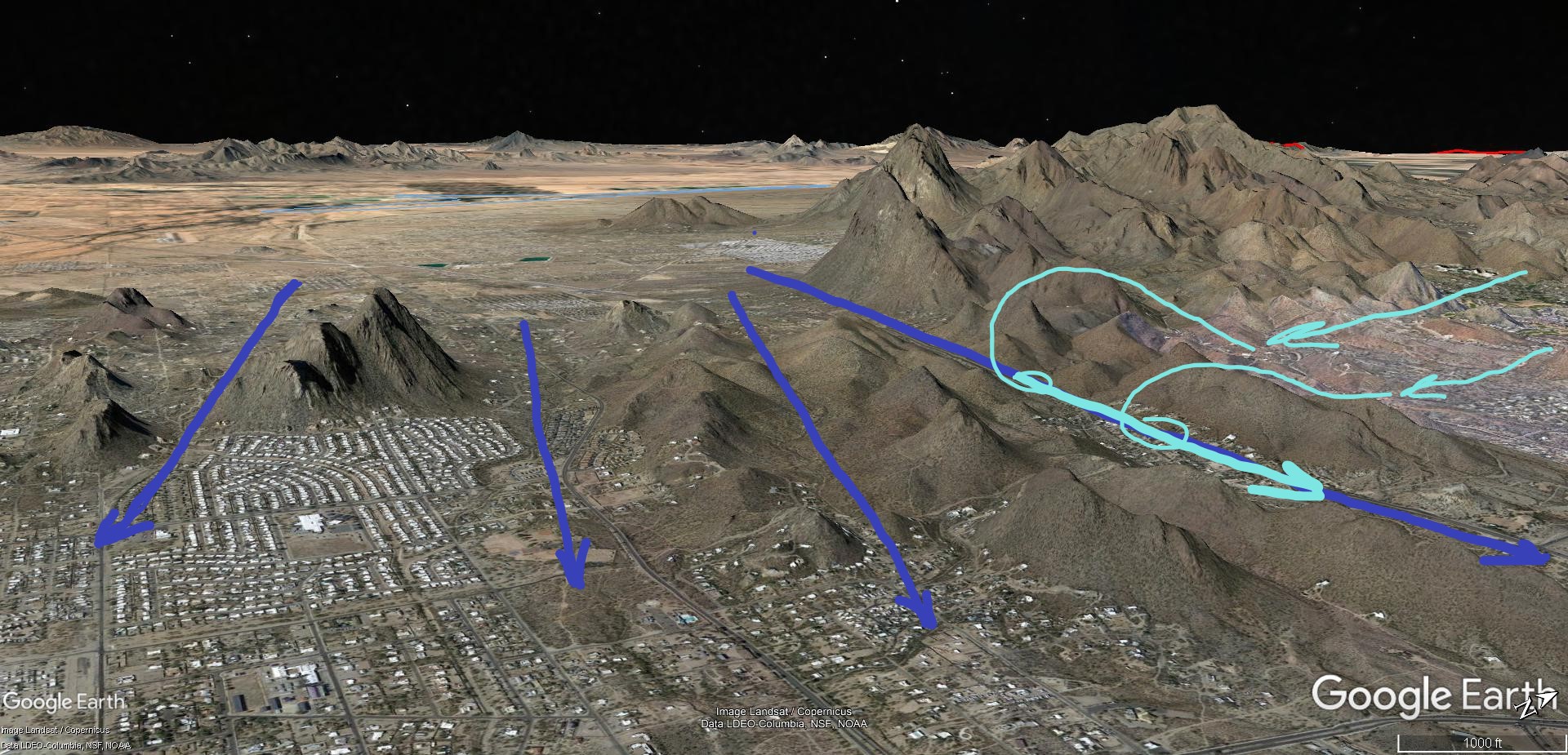
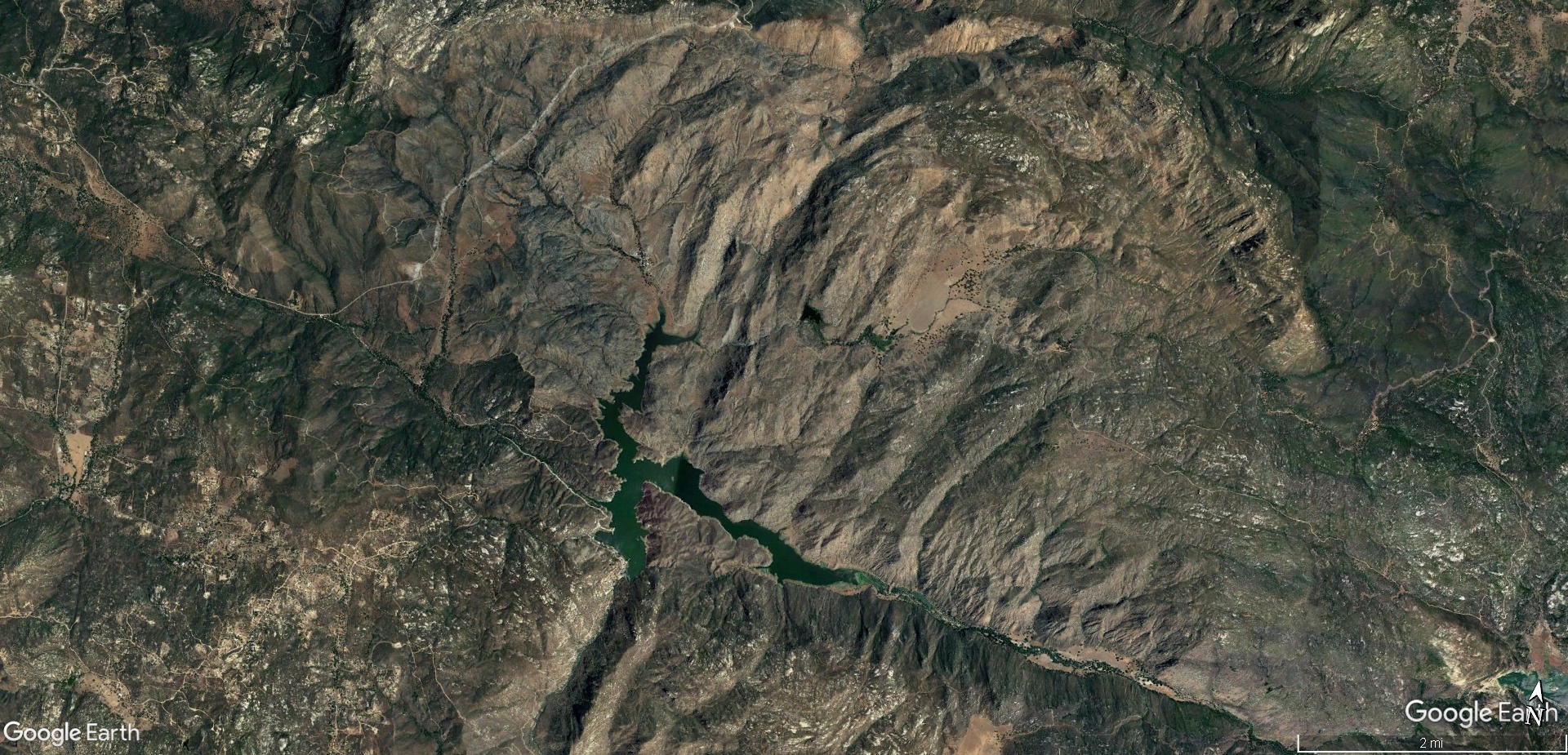
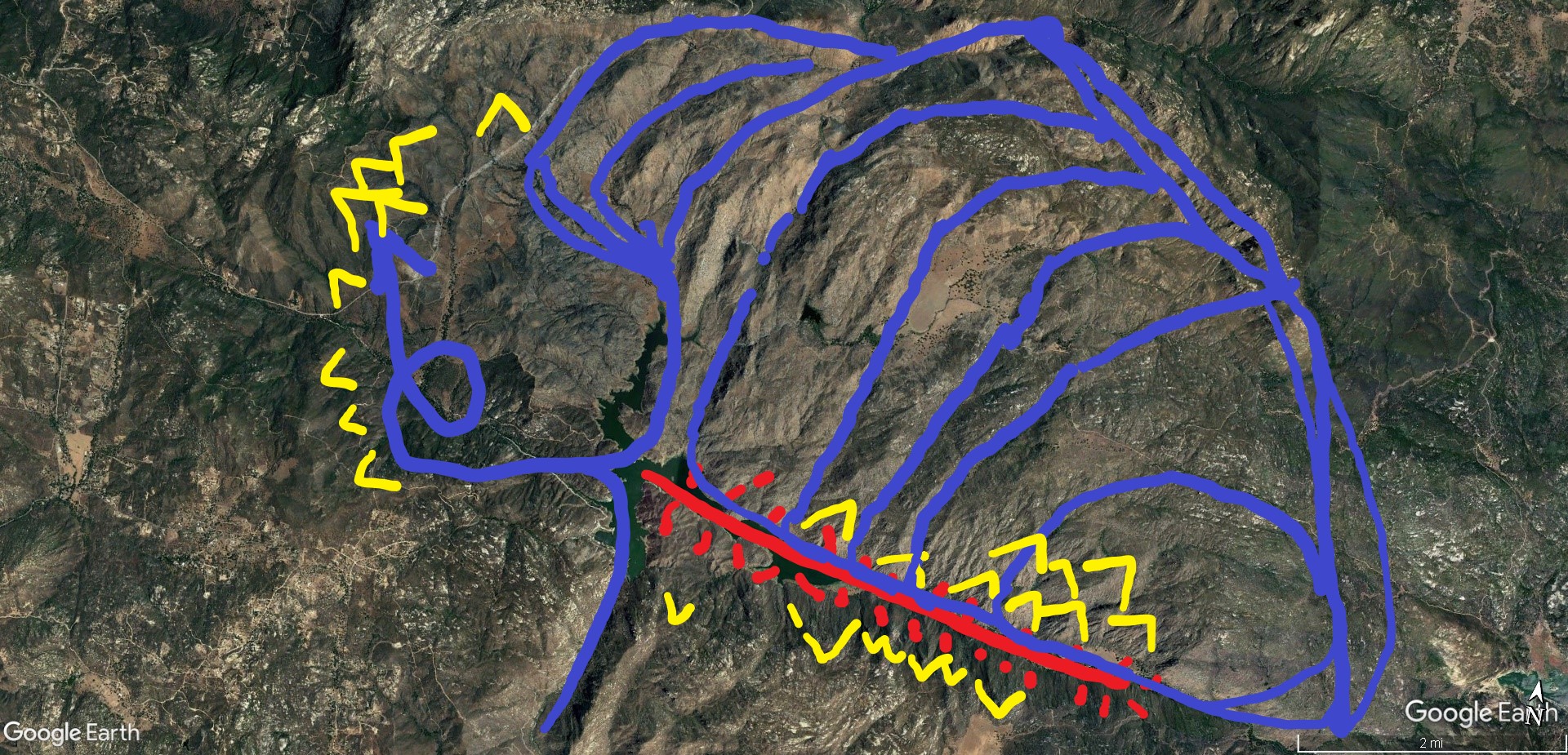
Sheep Mountain Anticline is a dune raised beneath a giant, updrafting wind that fed an even larger plasma storm system. The swirling patterns of topography immediately surrounding the anticline tell the story. These patterns were literally blowtorched into the earth by downbursting plasma winds from the same storm system.

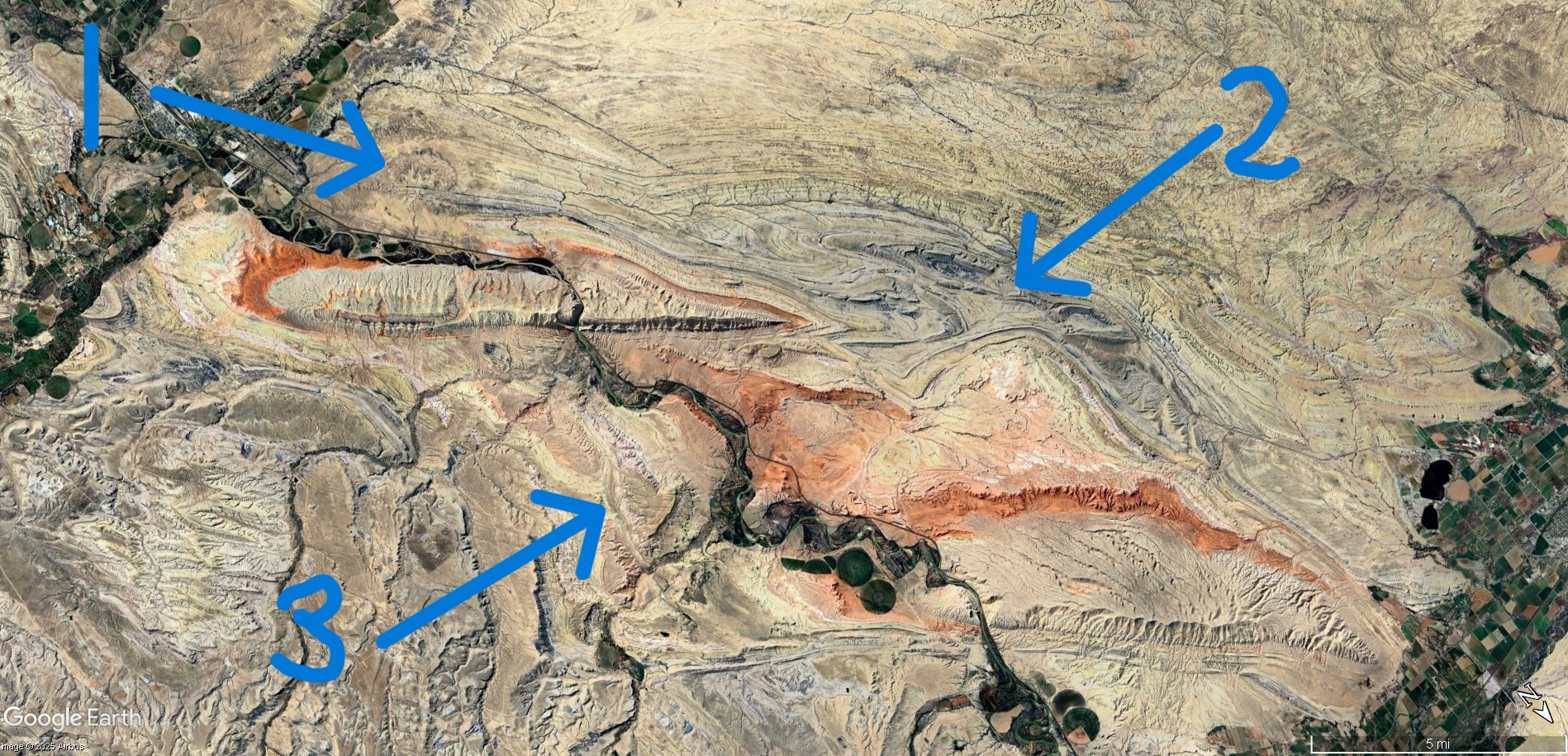
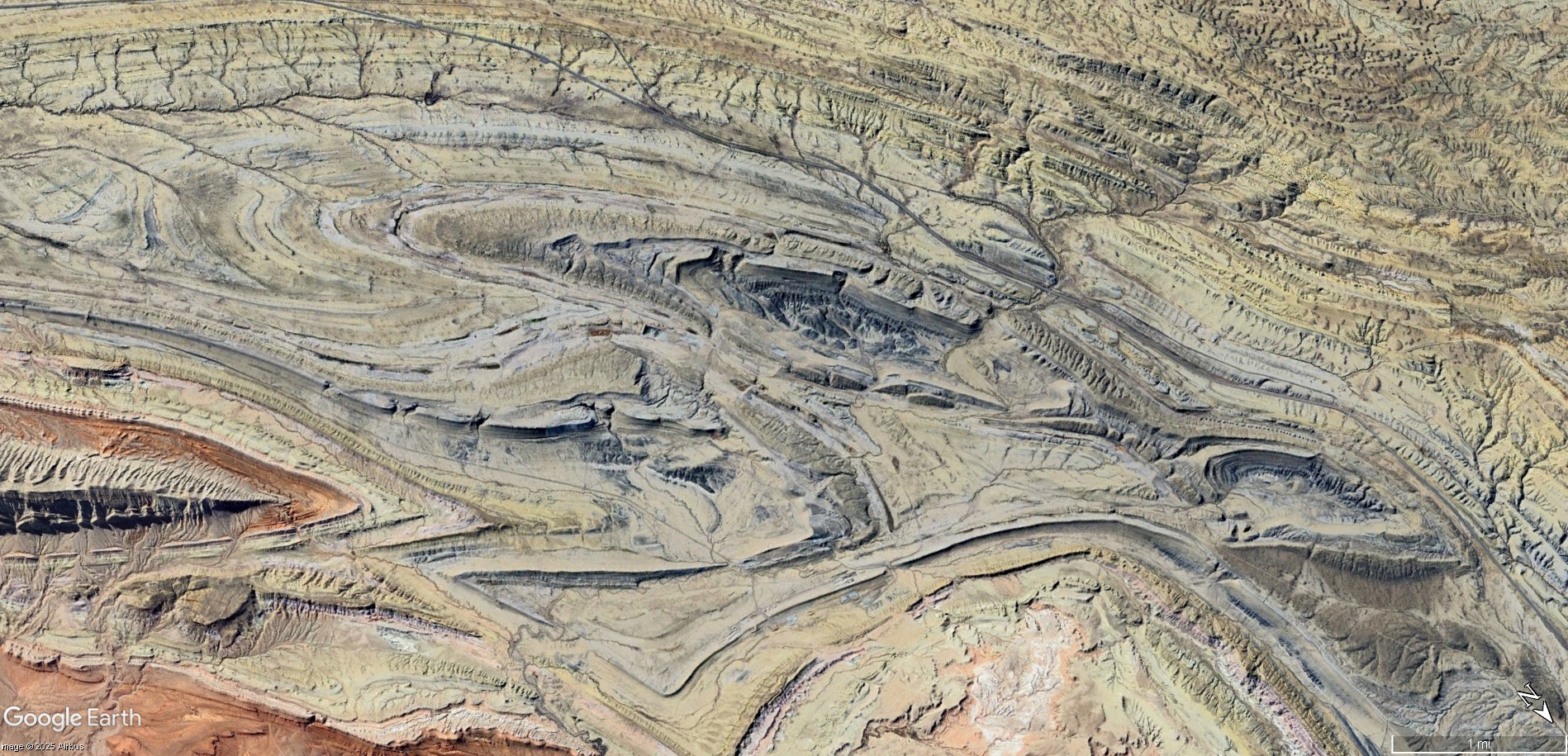
Figure 3. Sheep Mountain and surroundings

Figure 3 is annotated to highlight points of discussion, but the slider can be moved to see the raw image without annotations. Sheep Mountain is the snail-track shaped mountain outlined by a rust colored layer of earth sitting center-left in the image. Please expand images to examine the intricate patterns closely and note the following:

Area 1, directly above Sheep Mountain shows a slightly oval crater pattern. Area 2 shows two almost cojoined oval craters. Both of these features are surrounded by a pattern of hills and dales that looks like a figure-eight racetrack. The figure-eight pattern mates with the contours of Sheep Mountain perfectly, as if they were molded together. Area 3, below Sheep Mountain has a more paisley pattern of craters, but these are oriented lengthwise almost perpendicular to the mountain.

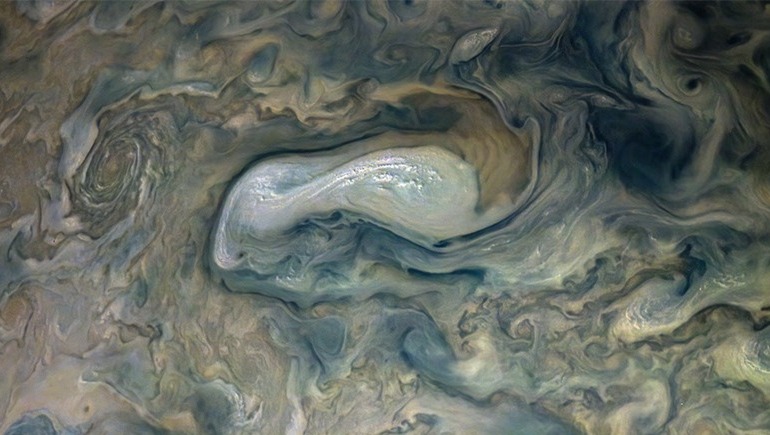
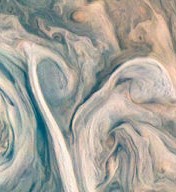
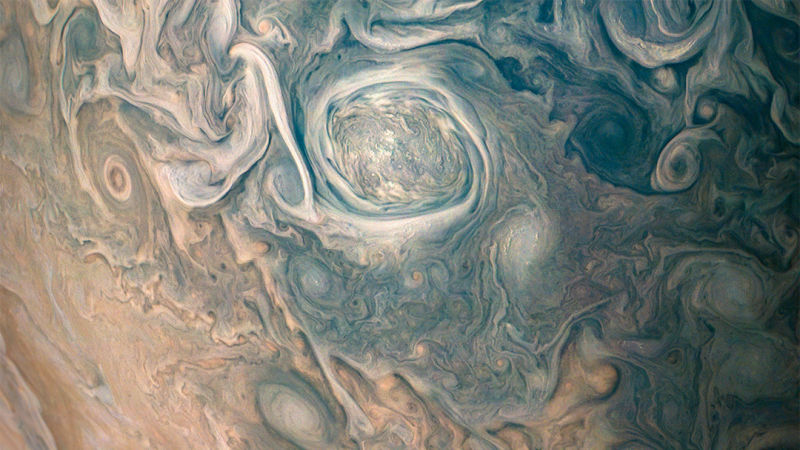
Plasma storm systems capable of producing the same windforms at ground level are found on Jupiter, at a much larger scale, but in the same fractal, paisley patterns that created Sheep Mountain and many other similar mountains found around the world.

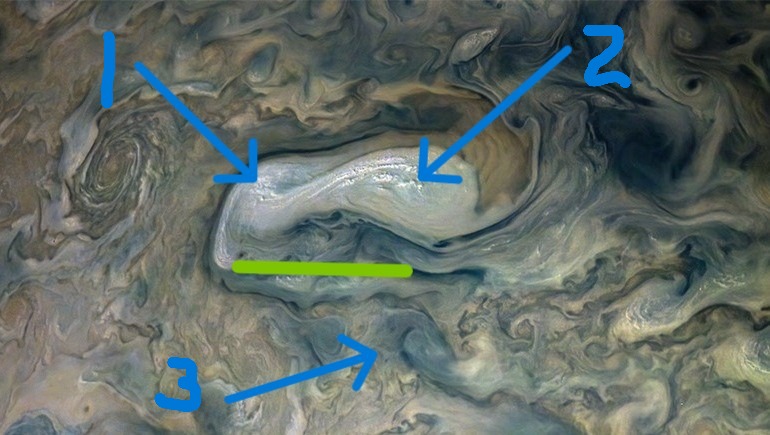
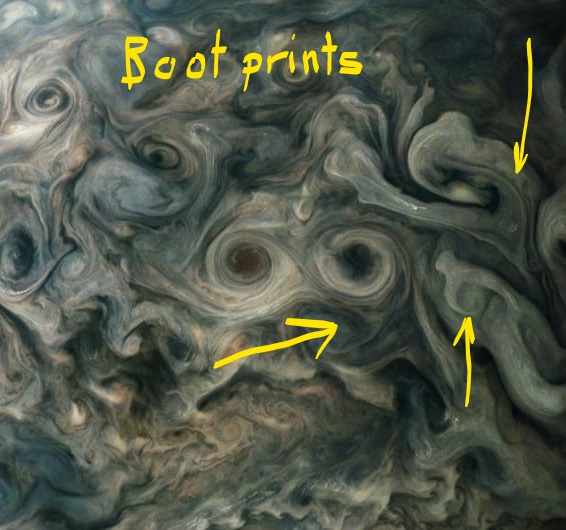
In Figure 4 is an image of a storm system on Jupiter that is very close to the pattern of storm that made Sheep Mountain. Again, it is annotated to compare with the areas noted in Figure 3, but the slider will remove the annotations.

Figure 4. Storm system on Jupiter

Area 1 on Jupiter clearly shows a hook shape indicative of a tornadic rotation. Area 2 appears to have two counter-rotating cyclones. They are embedded in a storm cloud shaped like a figure-eight in an identical configuration to the figure-eight racetrack by Sheep Mountain. There is even a squared-off shelf-cloud on Jupiter configured exactly like the squared-off top of the racetrack. Below the white figure-eight cloud are paisley shaped storms in Area 3 oriented exactly like the paisley craters in Wyoming.

Between these is a linear bar of angry looking clouds. This is the updrafting inflow wind to the giant thunderstorm, where dusty plasma winds reached supersonic speeds as they lifted, leaving a pile of dust behind, removed from the wind electrostatically, to form Sheep Mountain and it’s fins. Where Sheep Mountain formed is indicated by the green bar. Chevron shapes appear in the clouds where the inflow occurs. At least that is what a similar storm did in Earth’s formative years, when cold, dusty plasma engulfed the planet. What is taking place beneath the storms of Jupiter is hard to say since we can’t see the surface. I will only say, it’s not what NASA tells us.

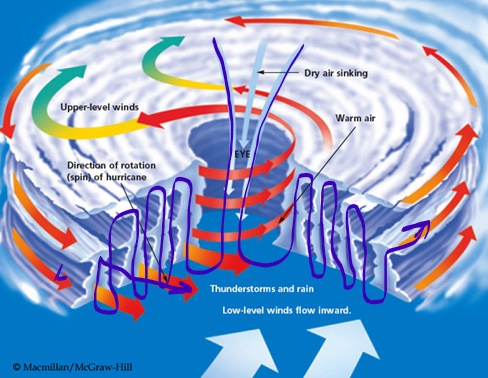
Why, one should ask, would the top of the clouds on Jupiter, or anywhere else tell anything about the ground below? Because the most electrically charged, fast moving winds are vertical winds in updrafts and downbursts. This is true on Earth and Jupiter. So, what you see looking at the top of Jupiter’s clouds are primarily the tops of towering updraft columns and cyclonic downdrafts. Just like meso-cyclones and cyclones on Earth are built around central updraft and downdraft columns.

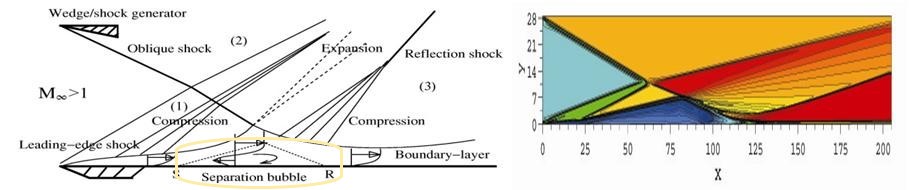
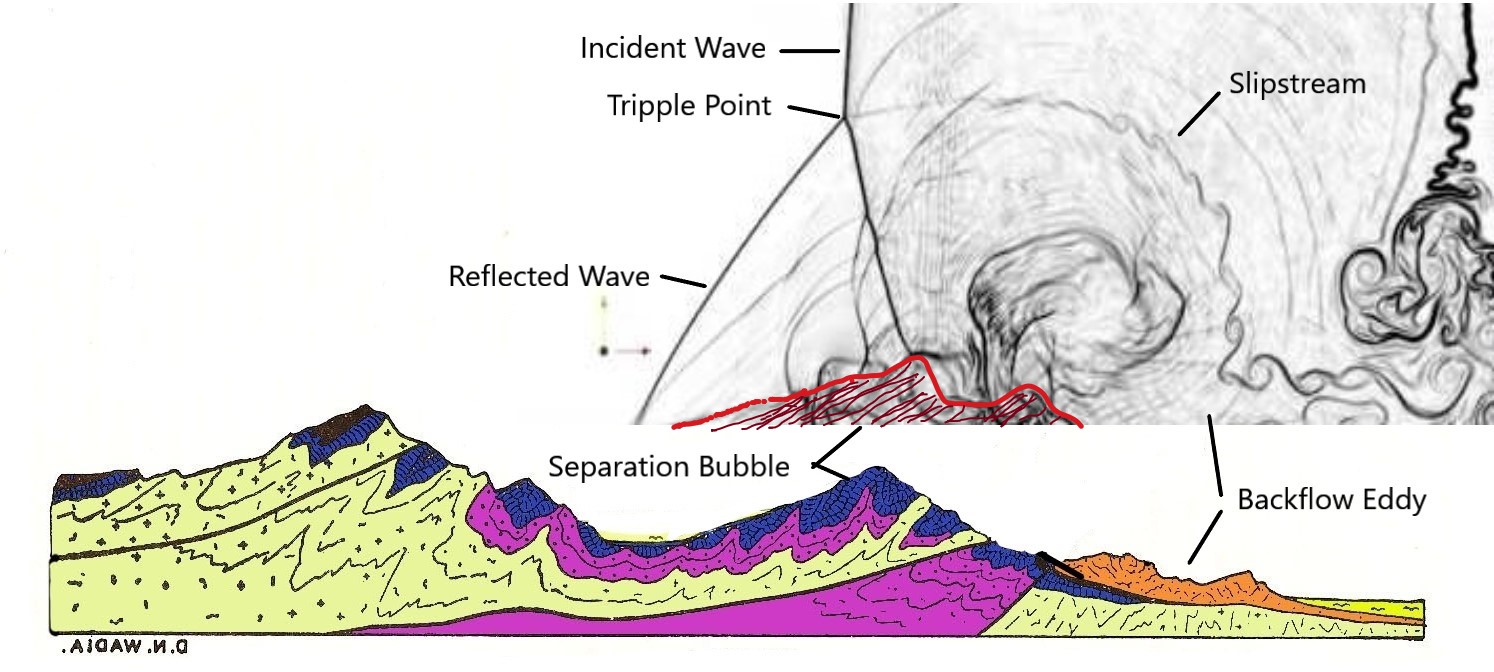
The updrafts are building mountains. As the wind lifts from horizontal to vertical flow, it accelerates, creating a shockwave. Dusty plasma wind passing through the shockwave releases its dust electrostatically and deposits it into a region behind the shockwave called the separation bubble.

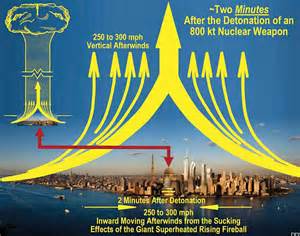
Figure 7. Destruction by Nuclear Convection

The storm is creating the same effect that air-burst nuclear detonations cause: an explosively fast updraft that draws a supersonic ground wind in it’s suction. Harmonic shockwaves form at the inflow to the updraft where the wind deflects and accelerates upward. This has been simulated by airburst models.

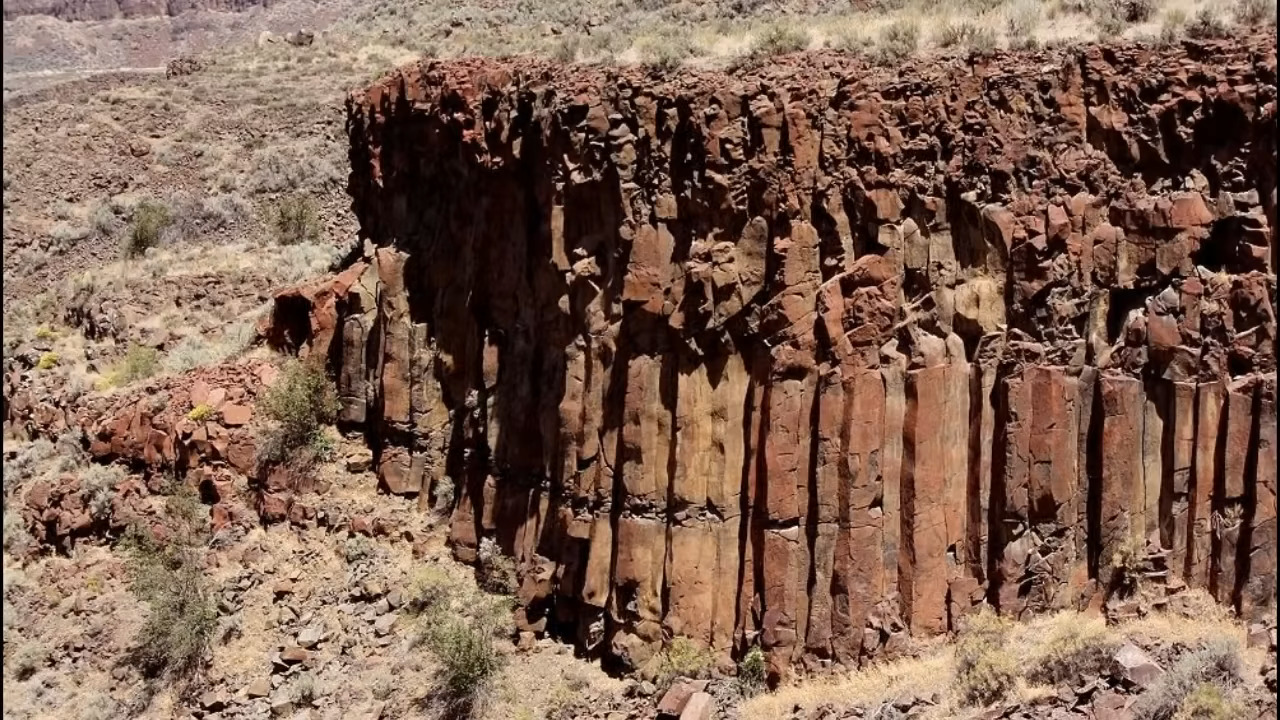
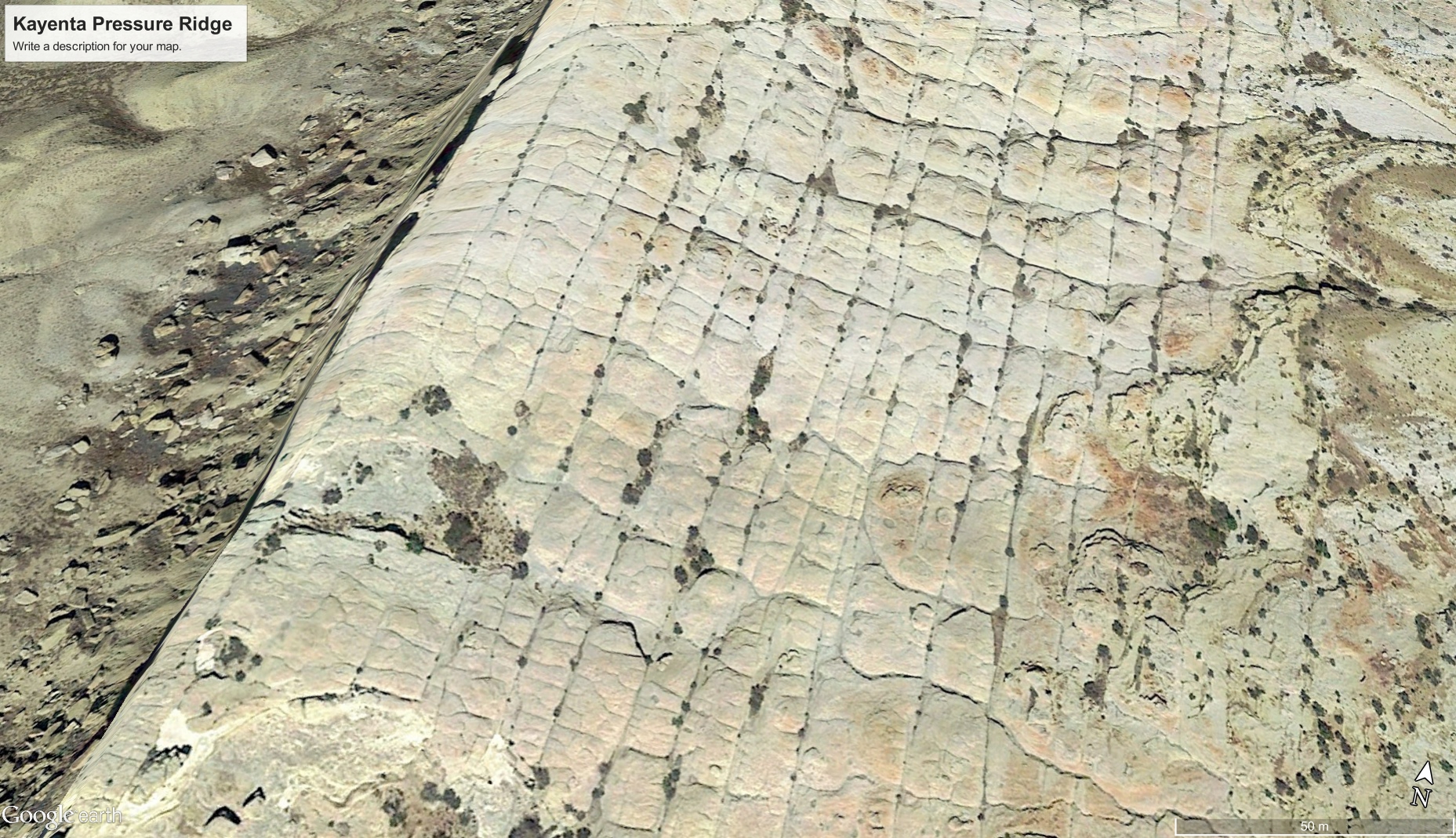
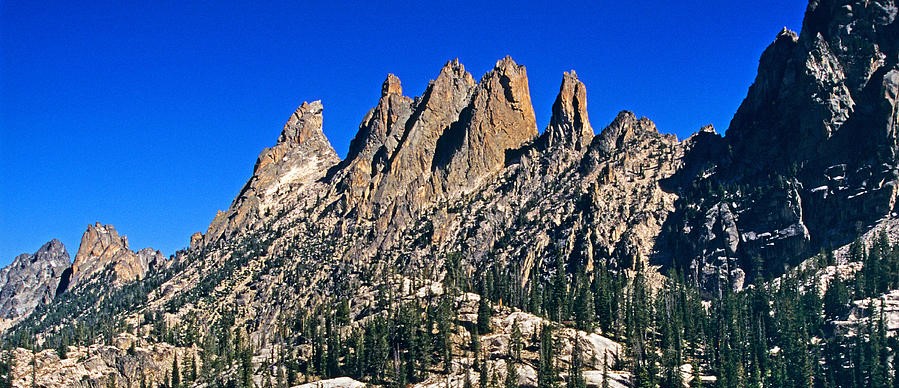
Flat-irons are found in almost every mountain range on Earth. They can be limestone, sandstone, or granite; sedimentary, metamorphic, or igneous. They can form an entire tetrahedral mountain, a harmonic series like an anticline, or flatirons on a mountain flank, and they will perfectly match the shape of shock-waves. That is one hell of a coincidence.

How random seismic forces and erosion create such geometric perfection without leaving everything crumbled is a mystery, because geologists can’t make this happen in a lab. They can shake, tumble, stretch and squeeze earth and rock all day long, or even a billion years, and they will only make a pile of rubble. Erosion softens edges, it does not make them sharp and straight. They can never form tetrahedrons of such crystalline form because these are products of creation, not destruction.

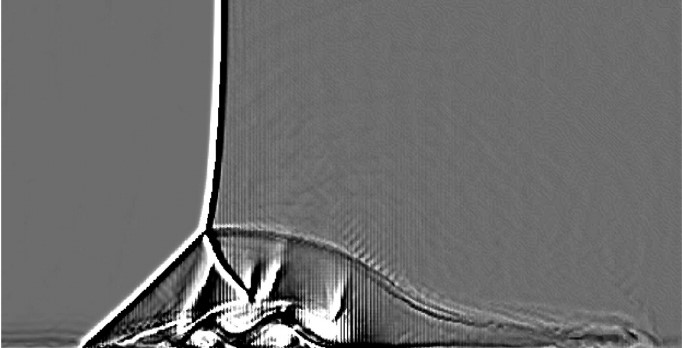
However, engineers do it in wind tunnels all the time. When a supersonic wind hits a surface, it deflects, accelerating the wind, creating a shockwave. Behind the shockwave, in the boundary layer beneath the fast moving wind, a compressed, dead air space is created called a separation bubble. The shape of the separation bubble, under ideal conditions, is a perfect tetrahedron.

Figure 9. Separation Bubble formed in a wind tunnel

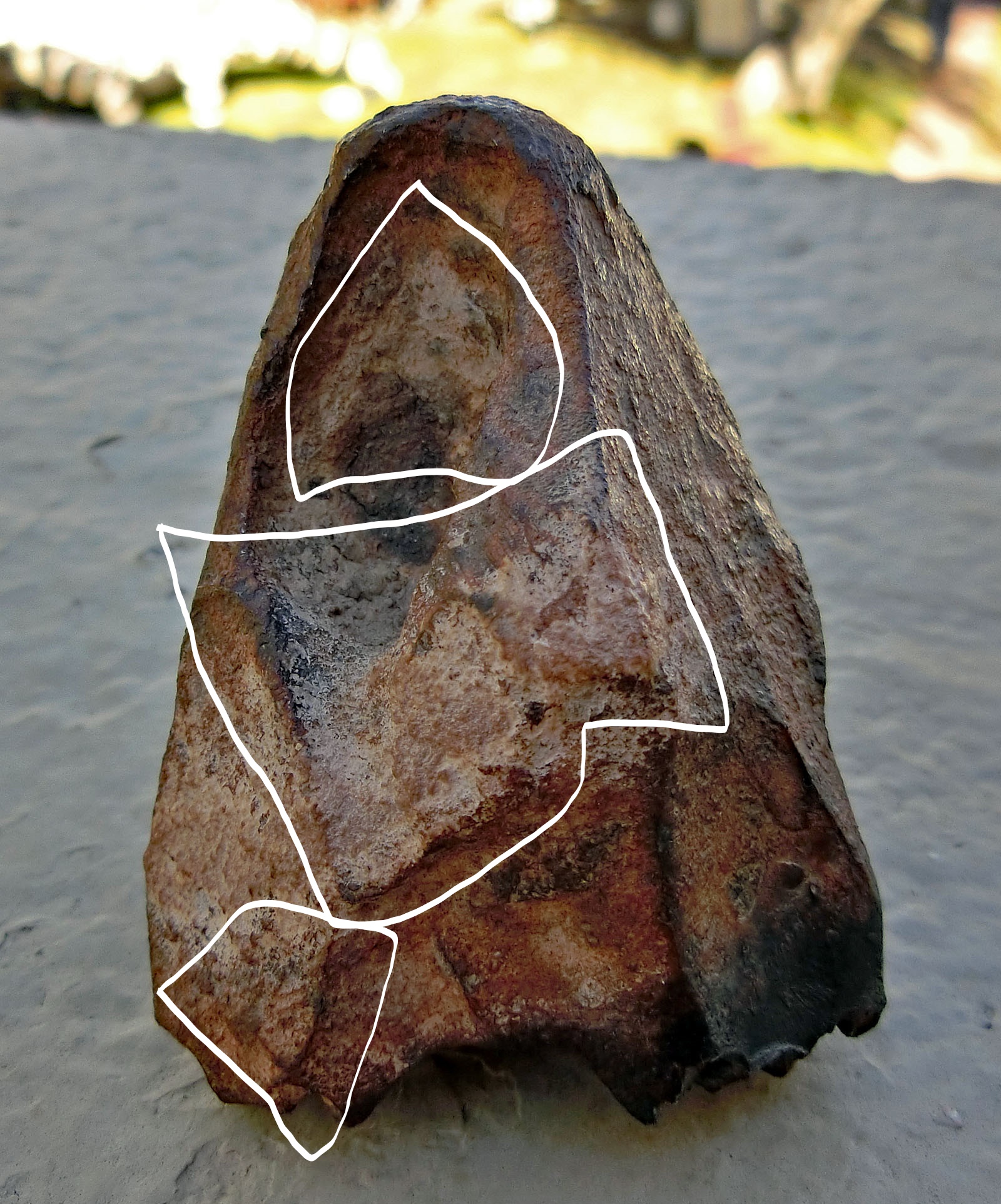
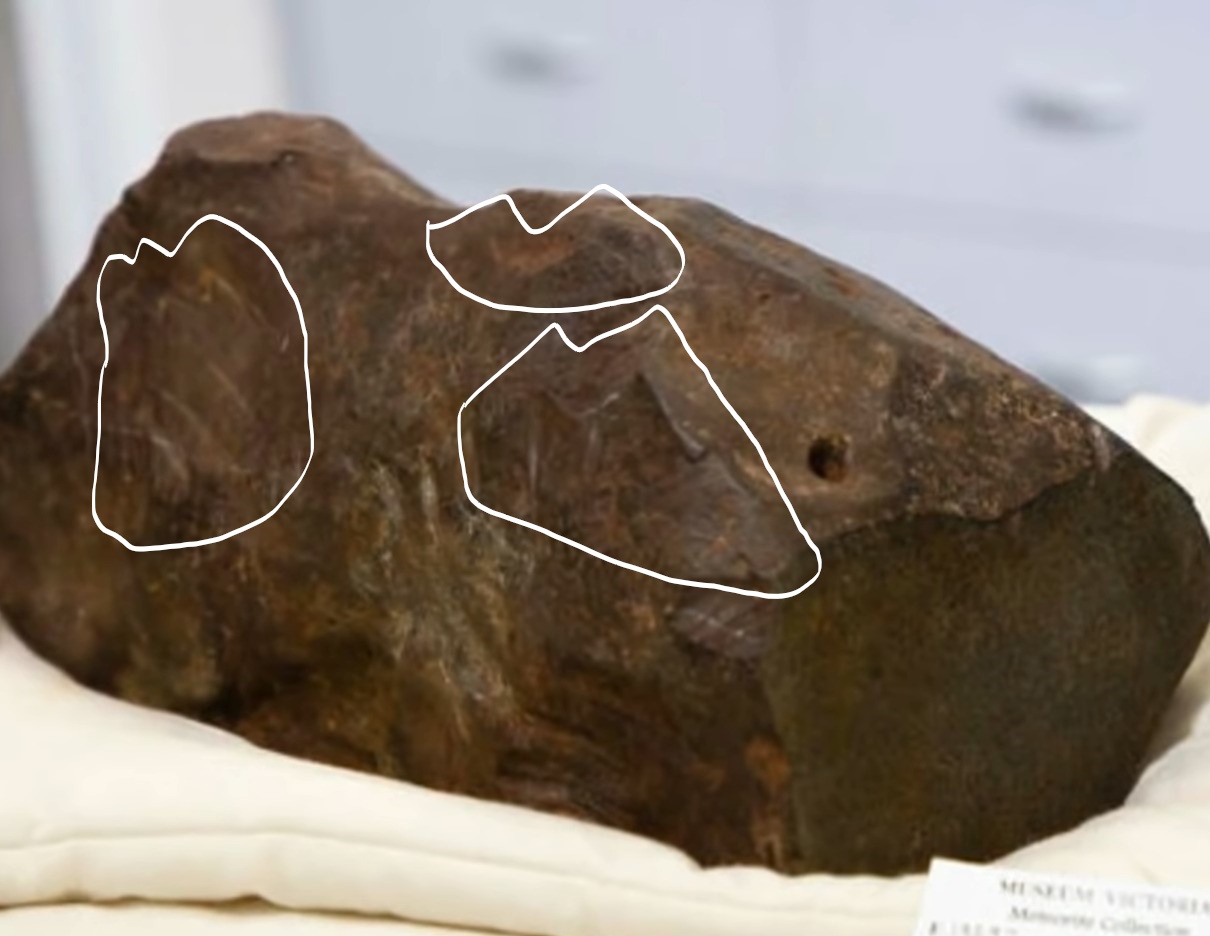
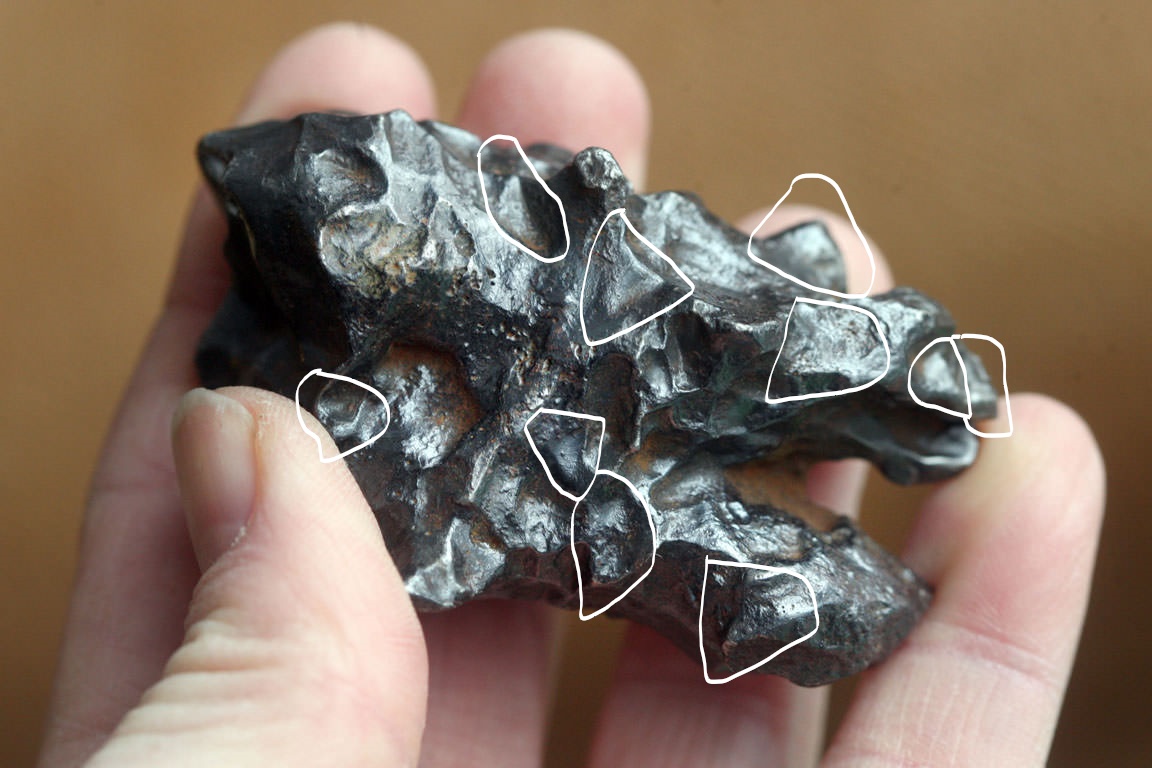
Analogous to an ocean wave forced to rise, curl and break onto a beach, it’s shape defined by Fibonnacci; when a supersonic wind is forced to rise, curl and break, it’s shape is defined by Pathagoras. One can see the flat triangular face of such tetrahedrons on iron meteors. Because they entered the Earth’s atmosphere at supersonic speeds and began to melt from the heat, shockwaves sheared across the meteor’s surface as it tumbled through the atmosphere and left triangular shapes of molten iron in the separation bubbles. These are “flat irons”, or “fins”, created by shockwaves and they are identical in shape and porportion to those on the flanks of the mountain shown in Figure 10.

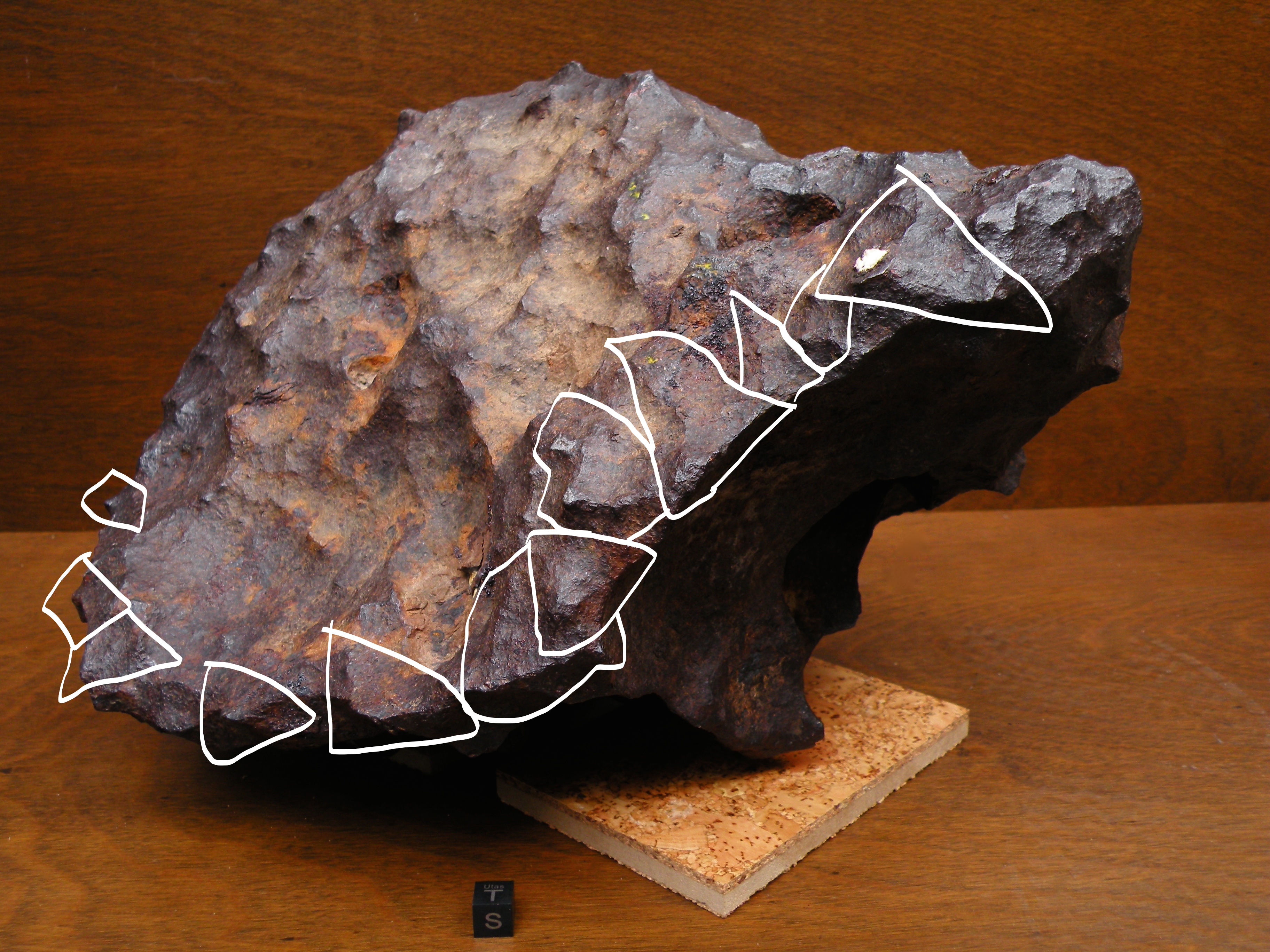
It is not coincidence this meteor has triangles on it. Every iron meteor develops shockwave separation bubbles as they ablate at supersonic speeds falling through the atmosphere. Here are more in Figure 11.

How wind shaped flatirons on the mountain is no different than the flatirons on meteors. High speed wind pushed material into triangular pockets of still air shaped by shock waves. How the wind makes a mountain in the wake of a supersonic shockwave is no different than making sand dunes. Sand fills-in slow moving compression waves that form pockets of still air that faster wind rides over. The mountains are different only in that the wind was supersonic, so the bumps were sharpley defined tetrahedrons, and the wind was dusty plasma, not just sand.

Proof is the harmonic repetition of forms found in both sand dunes and mountains, because they are both produced by sonic pressure waves. Erosion doesn’t harmonize. Erosion is entirely dependent on a watershed being available to collect adequate rain to erode things below the watershed. What you see in the mountains are impossibly eroded peaks, box canyons and repeating geometric shapes that have no watershed above them to begin the erosion process.

Geologists invented something called “mass wasting”, which means the parts of the mountain they can’t explain just disappear, presumably sand-grain by sand-grain over millions of years. They don’t know where it disappears to, or what carries it away, or how it magically produces repeating harmonic forms. They cannot demonstrate it happening by any means. It’s the geologists version of dark matter. They say things to explain it like, “nature rhymes”, that don’t explain anything, but sound very eloquent.

A cold, dusty plasma differs from a plasma of noble gases used in electronics and neon signs. It is not fully ionized and has dust, sand, or even rock entrained that is not ionic, but carries a surface charge. Surface charge on the dust polarizes to align with the electric field, so the dust drifts like a charged particle with the plasma. It is “cold” because the bulk temperature of the plasma is reduced by the non-ionic matter.

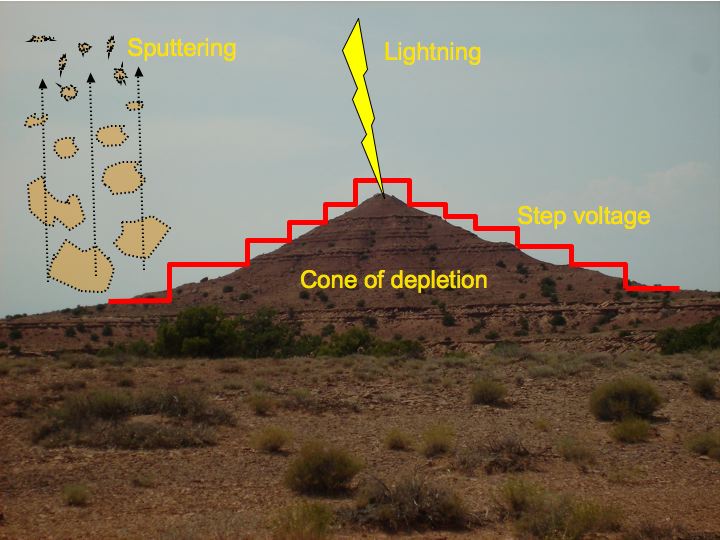
Cold, dusty plasma is not well understood. The entrainment of matter makes it more like a foam than atmosphere. Particles of dust suspend like bubbles of foam, bouyed by electromagnetic forces. When those particles come in proximity to a surface of opposite charge, they stick electrostatically. That is how a plasma wind deposits a mountain, because it blows over land that has been electrically charged, either from the ground below, or from lightning above. Shockwaves act as waveguides for lightning, which charges the land in their shadow.

The limestone Sheep Mountain is composed of was sucked out of a sea somewhere else and blown to Wyoming by the wind. Different materials blew in before and after, sandwiching the limestone between. Myron notes it is “fine-grained”. It is most likely the water, fish, fossils and all, were lifted from a sea-bed by subsurface electrical discharge and delivered as an electrified slug of limestone mud by plasma winds. Existing sub-sea canyons are the remnants of those events. They are the deepest places on Earth and, as usual, a mystery to consensus science.

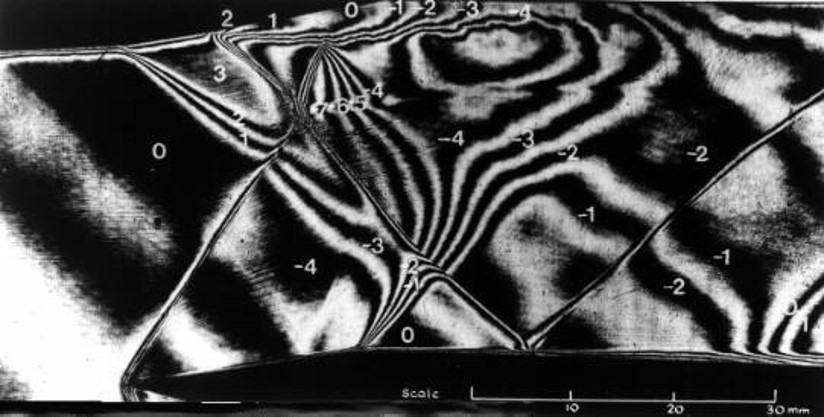
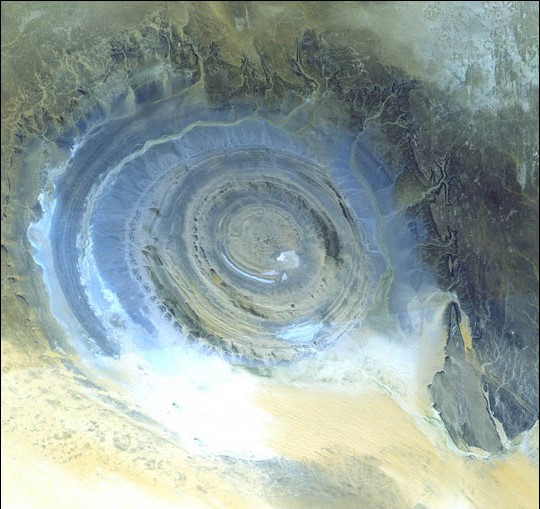
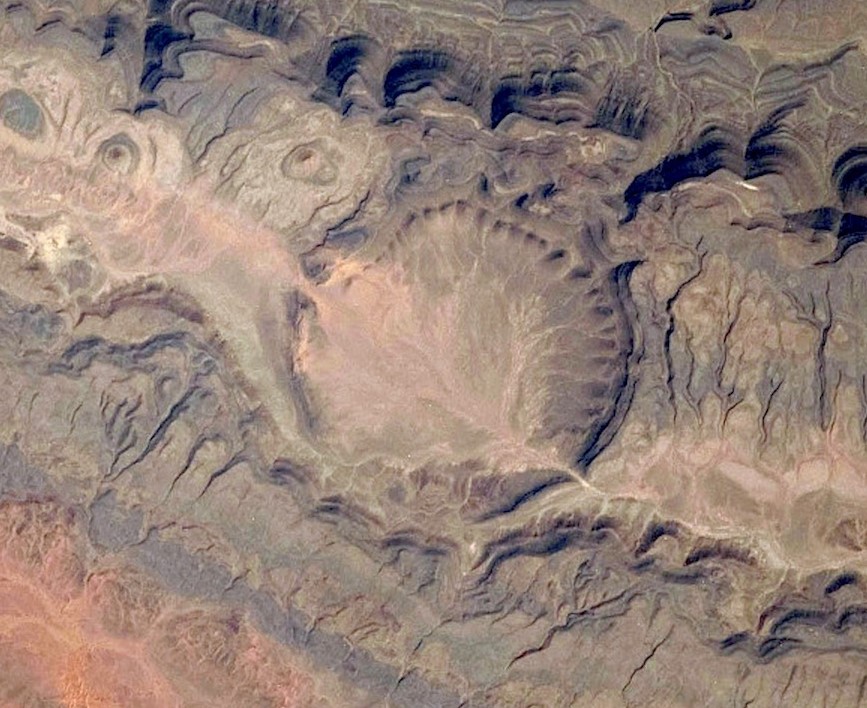
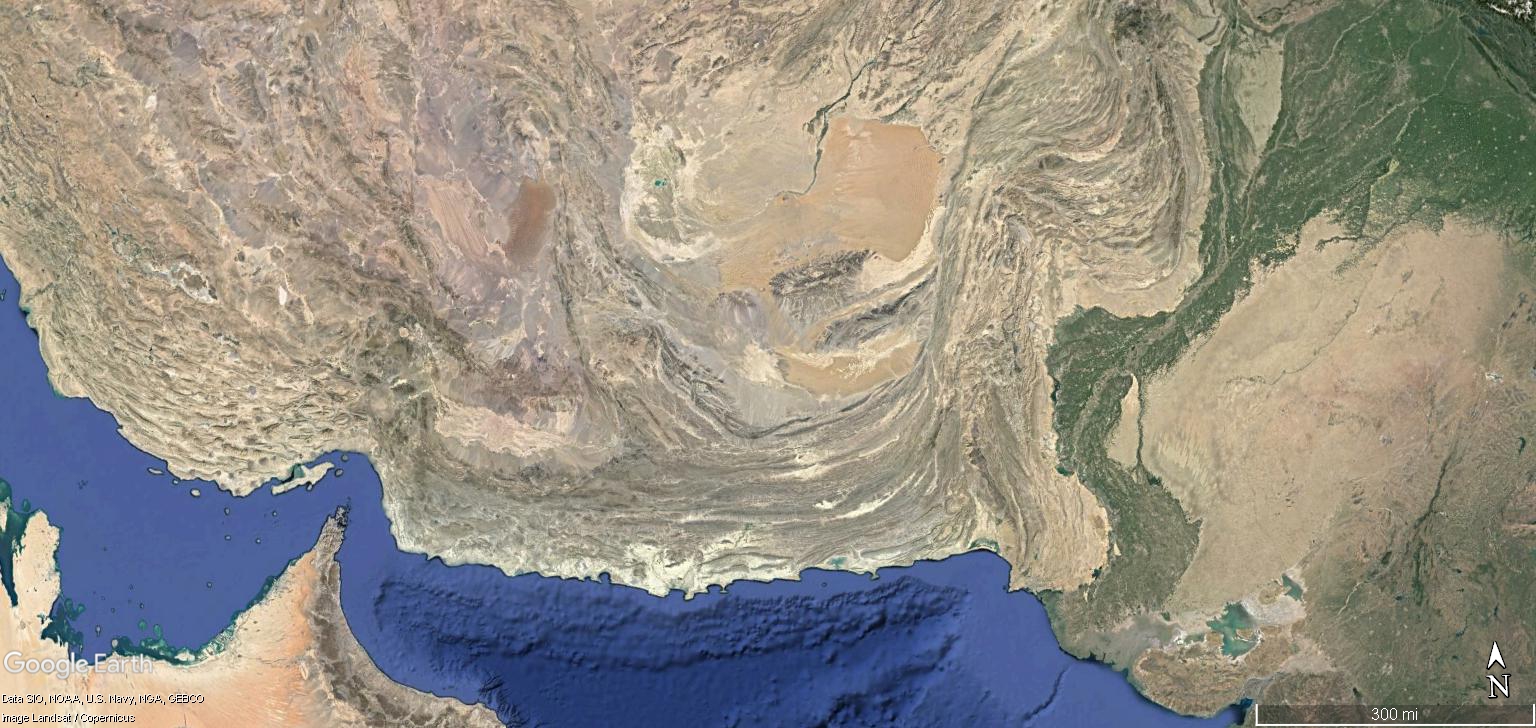
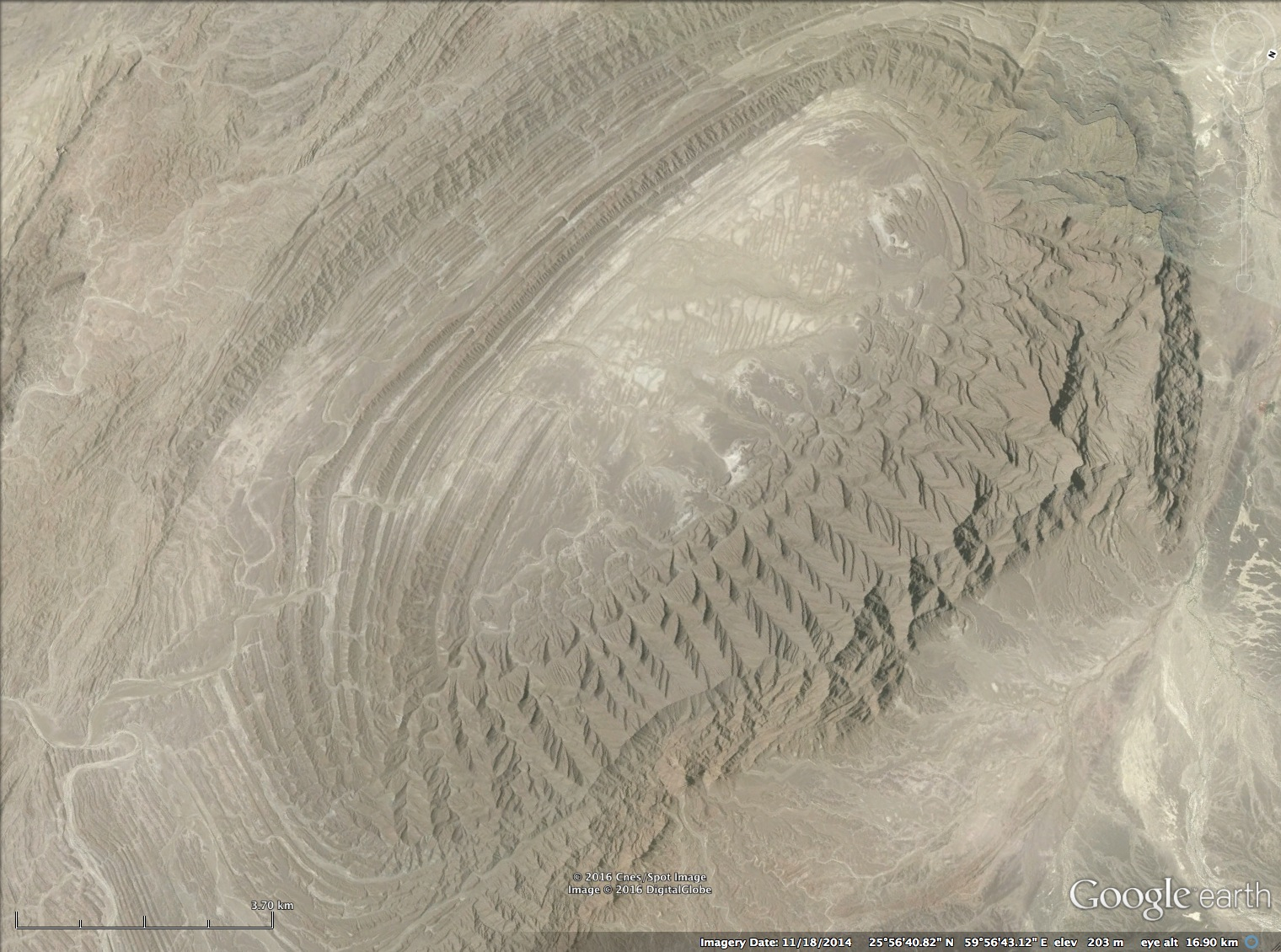
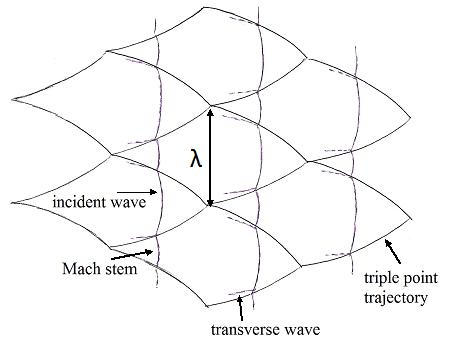
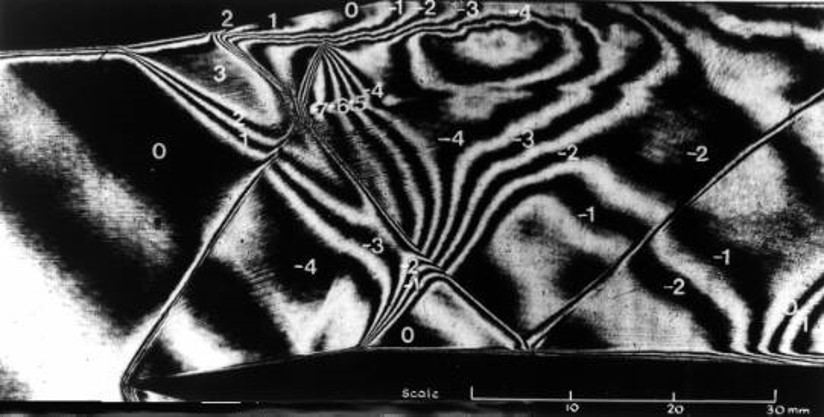
If triangular flatirons and tetrahedral mountains were the only similarity to shockwaves, that could be called coincidence, but there are complex details that are precisely replicated. Figure 14a shows a ring of mountains in Pakistan similar to those near Sheep Mountain. They are patterned with harmonic, tetrahedral fins and another feature particular to supersonic shockwaves called a Prandtl-Meyer expansion fan. A wind tunnel image of an expansion fan is shown in Figure 14b.

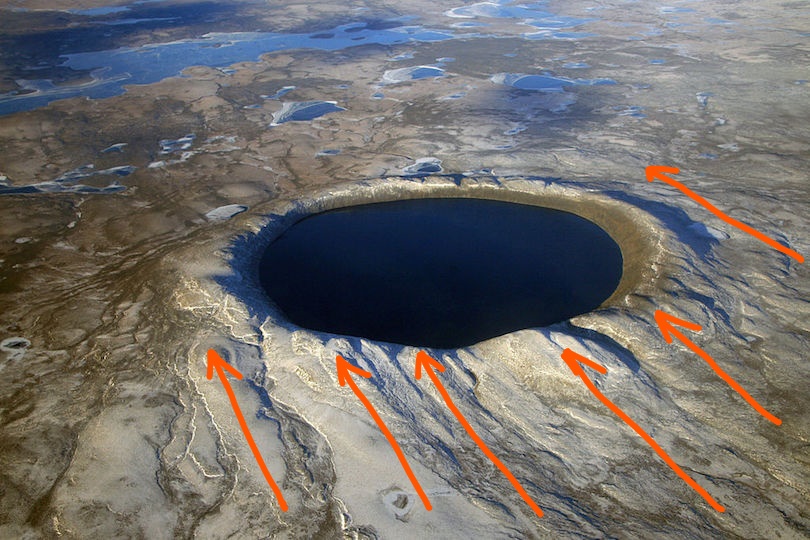
Erosion creating an expansion fan is beyond coincidence. All of the features in this mountain, it’s bootprint shape, it’s fins, the linear hills that make the expansion fan, the crater and shockwave blasted rim are exactly shaped and positioned as they should be if caused by a supersonic downburst wind.

It isn’t a one-time anomaly either. Figure 15 is a comparison of the crater in Pakistan with another in Mexico, halfway around the world. Downdrafts blast these types of craters like a plasma blowtorch. This one also has a rim the shape of a bootprint lined with tetrahedral fins, and an expansion fan of linear hills, also with fins on the windward side. The crater in Mexico indicates a clockwise rotation, the Pakistan crater is counter-clockwise.

Also shown is a storm on Jupiter with the same bootprint shape and the dark eye of a hurricane in the center, rotating clockwise, shown for comparison. The thin, white rim of clouds shaped in a hook are formed by updrafts, while the dark cyclone in the center is the blowtorch. The expansion fan is in the clouds sweeping gracefully off-image to the left.

The parallel rows of linear hills in expansion fans are made like the ‘figure eight’ racetrack next to Sheep Mountain. The wind blew perpendicular to the rows of hills and dales beneath higher altitude up-and down-drafts, creating an interference pattern of high and low pressures on the ground. The narrow, linear, parallel hills are pressure ridges, where wind speed was slowed and dust deposited, while low pressure, fast moving air swept the lanes between.

Updrafts and downdrafts are convection currents, but they aren’t only thermal currents, they are driven by the planet’s electric field. In a plasma storm, there are heavy charge concentrations in the clouds inducting charge concentrations on the ground below, and in the layer of aerosols and dust that lays over the ground, amplifying the electric field.

Condensate is a charge carrier. Where there are clouds there is higher charge density and a stronger electric field. Dust and aerosols carrying a positive charge are lifted by the electric field, generating updrafts. Paragliders and hang-gliders know this as “cloud suck”. It’s extremely dangerous because it can trap them in a cloud and even lift them into a thunderstorm.

The ground charge must reflect the sky, and vice versa, because of capacitance. It’s as if the pattern of striated clouds shown in Figure 16 were a mold that was pressed to the ground to create the racetrack. Electricity makes the pattern and wind does the rest, molding the pattern of dust being deposited the same way it molds the cloud condensation – by voltage. As above, so below. The explanation is capacitance.

It is capacitance between Earth and sky that causes lightning and tornadoes in the first place, as both are examples of coaxial currents generated by capacitance. This is simple physics that can and has been reproduced in tabletop experiments. It’s the electric field and it’s constant feedback with magnetic fields that twists plasma winds into electric currents that segregate into vertical jetstreams that create incredible bootprints, figure eights, horseshoes and paisley patterns in Jupiter’s clouds and the matching fractal shapes on Earth.

Updrafts leave “sedimentary” deposits behind, as charged dust is electrostatically precipitated by shockwaves, which act as lightning rods. The sudden compression and expansion of a shockwave causes ionization and the formation of a double-layer, making the shockwave a plasma conduit. The shockwave touches ground at the separation bubble, making it the charged hot spot where the dust collects anodically, layer upon layer, in the exact shape of the pressure ridges and shockwaves formed by the wind.

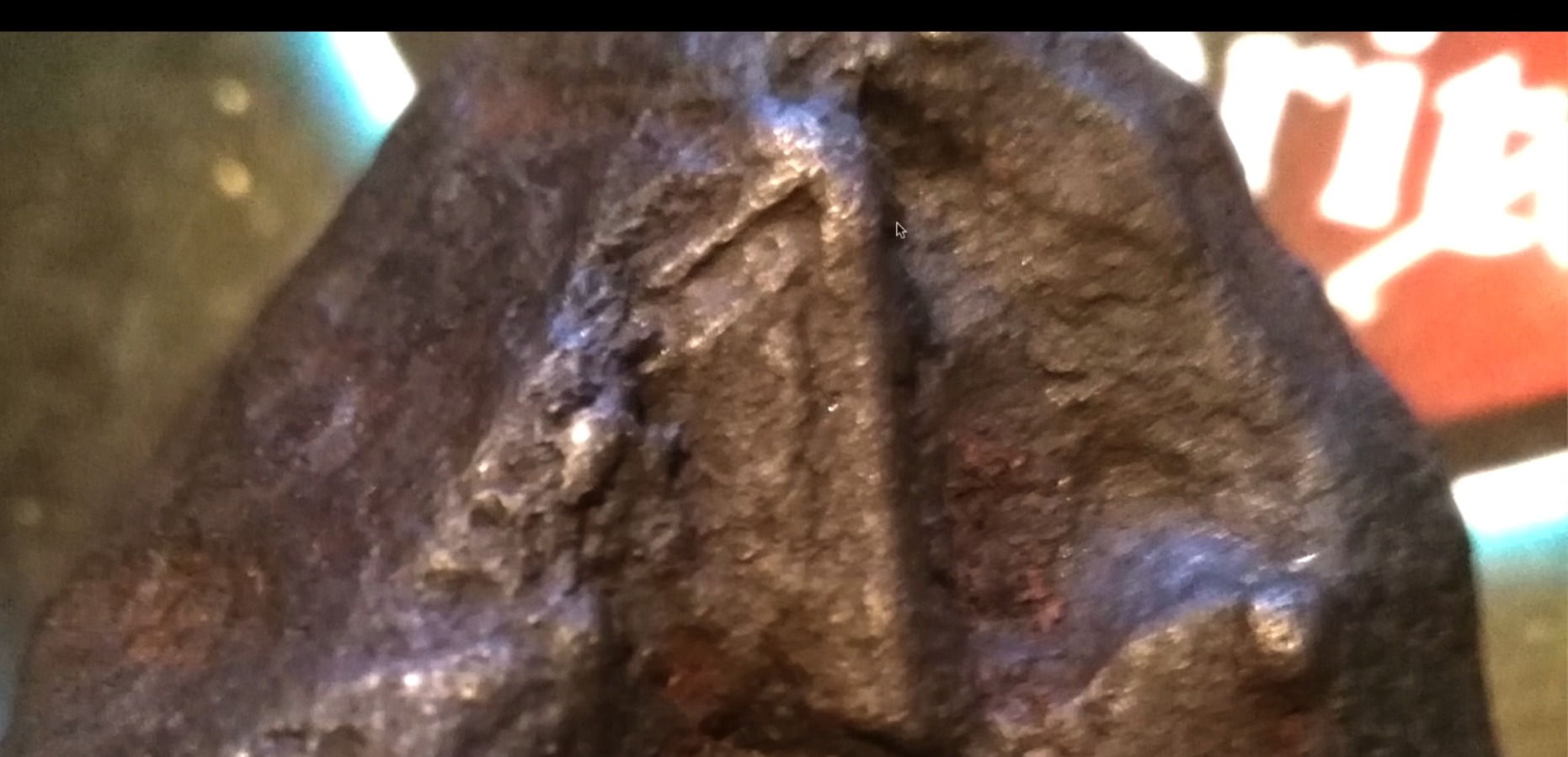
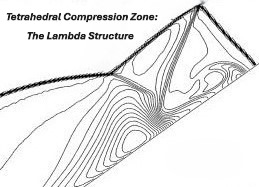
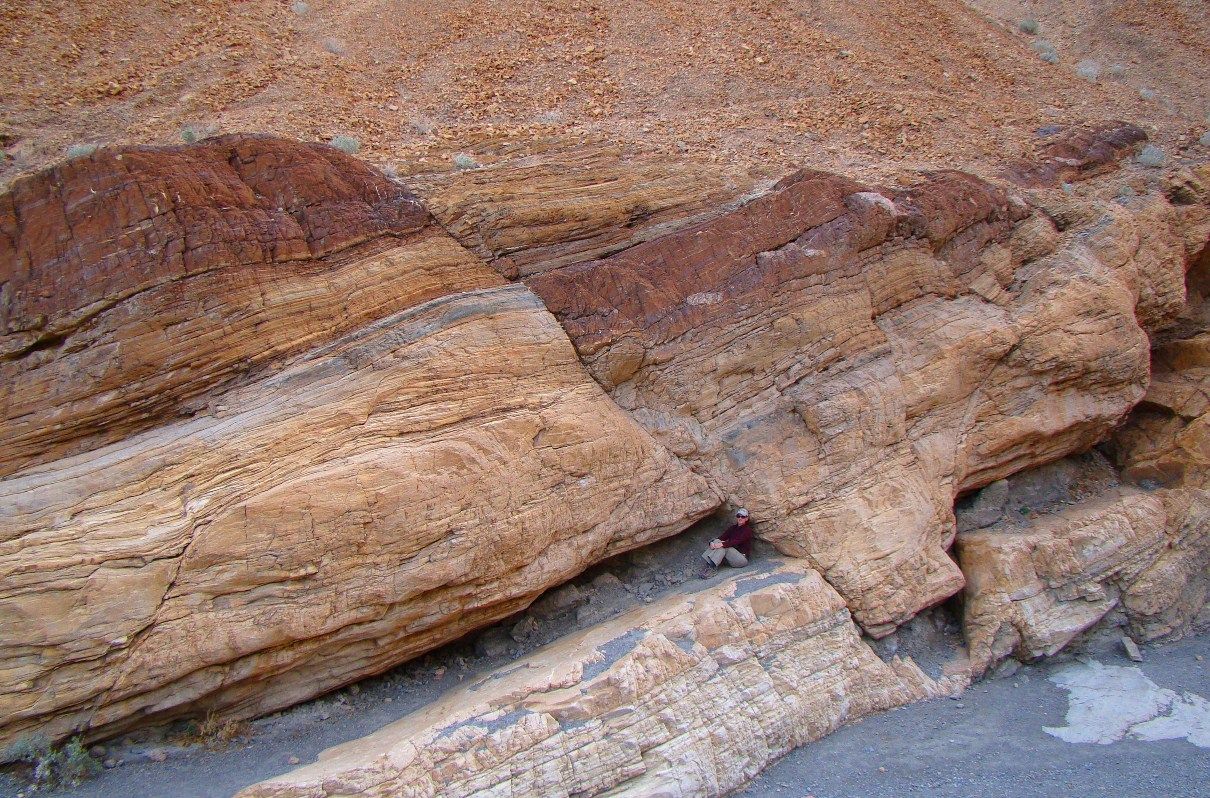
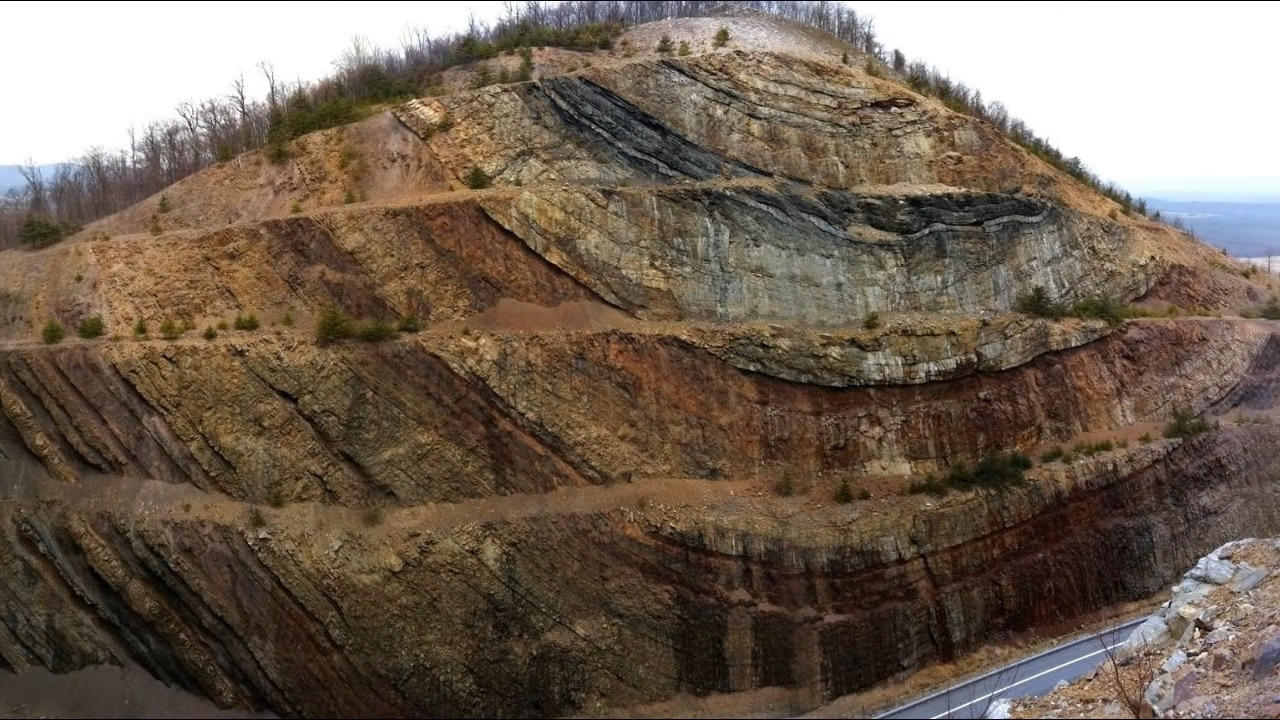
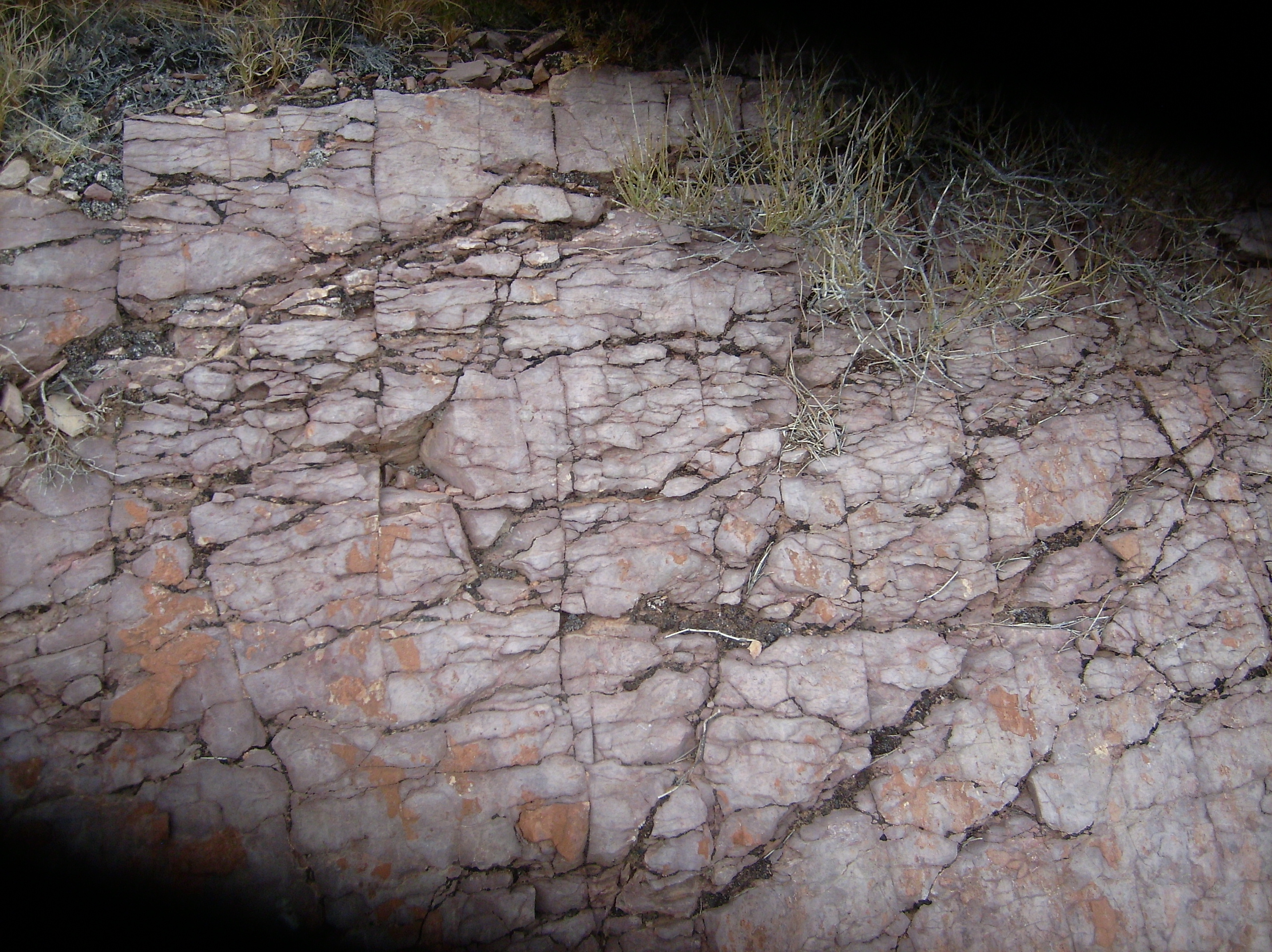
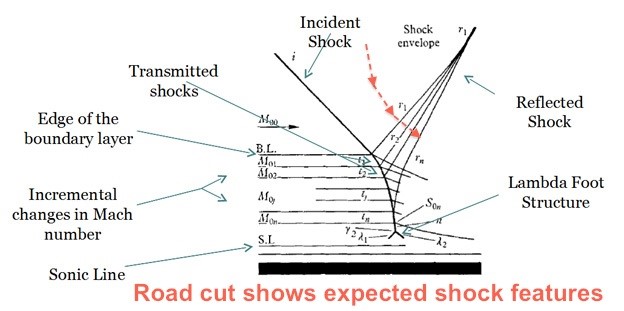
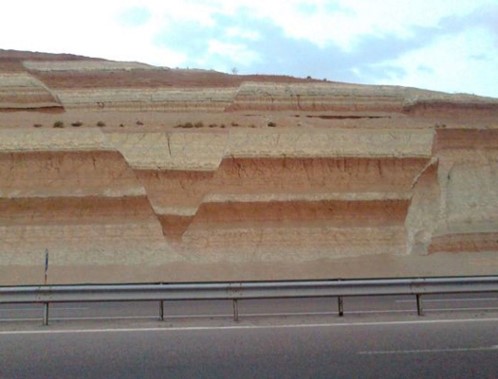
Figure 17 shows a textbook diagram of a feature called the “Lambda Foot”, with some examples found in Nature. It is a compression wave created at the boundary layer contact between a shockwave and it’s reflection. It causes a sudden step-shift in pressure regimes between the incident shockwave and it’s reflection, which can clearly be seen where the sediments are offset. They are difficult to find as they are embedded into the base of mountains, but clear examples can be found at roadcuts and cliff faces. Consensus geology calls these “slip faults”, as if the ground just fell into this slot. They are not “faults” at all and have nothing to do with “tectonics”. They are 100% caused by shock waves.

Most telling is in the difference between the center image labeled “laminar flow” and the right image labeled “turbulent flow”. Turbulent flow happens in fluids, not solid rock.

Each layer of sediment was plasma-borne dust, carried in the wind, segregated into step-voltage regimes in harmony with pressure regimes, stacked vertically by capacitance. Higher pressure, means higher density, means higher dielectric effect in an electric field. Plasma layered wind followed the voltage and pressure profile as it carried charged dust into the lambda foot. That dust, suspended like bubbles in a foam, electrostatically connected with the ground and adhered in the exact same profile as the wind that carried it.

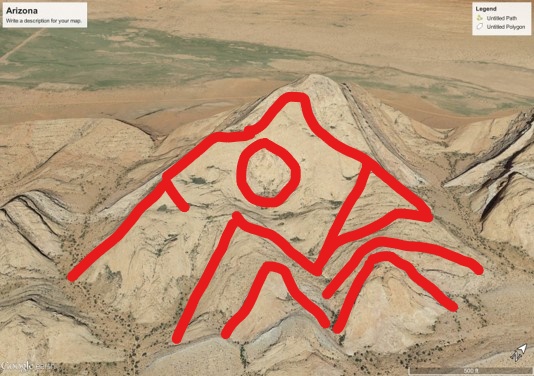
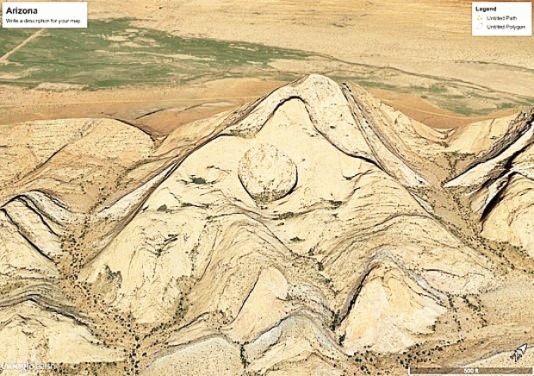
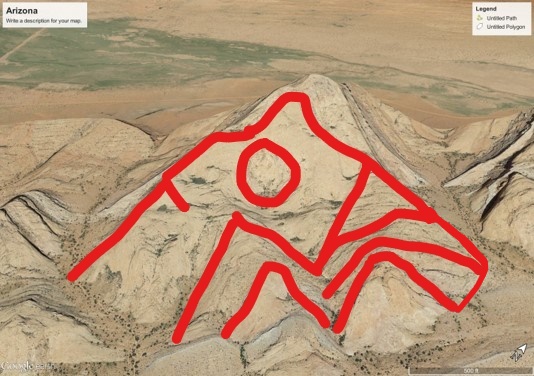
Another shockwave feature easy to find in Nature is a hole in the center of tetrahedral fins. Figure 18 shows a flatiron in Comb Ridge, Arizona produced by an unstable shockwave. The instability causes a low pressure zone on the face of the separation bubble that will eat away a hole, like this one. I have highlighted the face of an unstable separation bubble, produced in a wind tunnel, that shows the hole forming, as well as smaller harmonic tetrahedrons. The entire shape of the shockwave is almost identical to the flatiron in Comb Ridge.

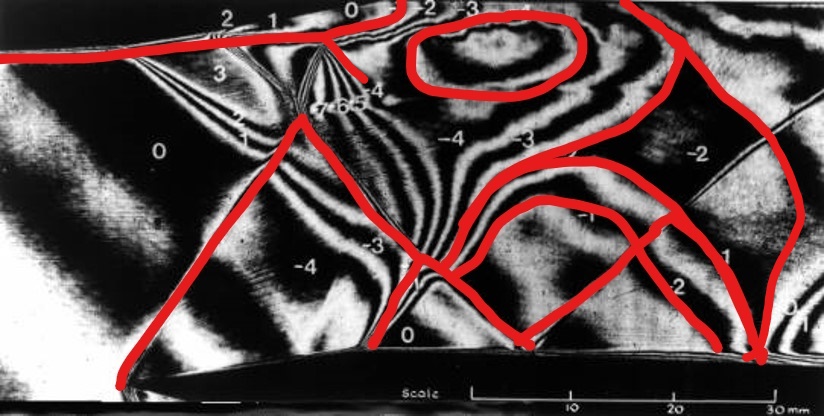
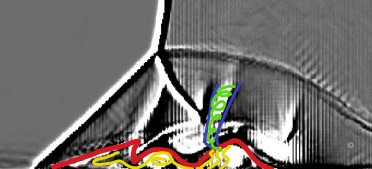
Even geology of highest order strangeness can easily be identified with shockwaves. In Figure 19 are several examples of what I term “sawblades”. Also shown are Schlieren images of where in a shockwave ‘sawblades’ form along the top of the separation bubble, highlighted in yellow among other features within the shockwave structure. Please take time to zoom in to the unannotated version of the shockwave to see the sawblades clearly, they are very tiny in the image.

In the turbulent backdraft of a supersonic shockwave, horizontal tornadoes form. Figure 20 highlights these rotating winds and shows examples of the result when such winds are composed of dusty plasma.

Dense dust rotating in the tornado that connected to ground, electro-statically adhered, freezing in-place, while un-grounded plasma remained suspended in the wind and blew away, leaving half, or a quarter of a petrified tornado.

Consensus explanations require this rock to bend into a jelly roll deep underground by some unknown process, and then rise to the surface by another unknown process, plus a few million years of unknown things happening that cause half the jelly roll to disappear. None of their processes can be demonstrated, but they give it a name anyway to make it sound real: “tectonics”. Our explanation is a two step process with electric wind and dust and can be reproduced – the process is already used everyday in manufacturing.

How windborne dust was compacted and seemingly flash frozen into place tells us it had to be electric. Only a dusty plasma could be so thick and still act as a fluid. Only ionic matter and charge bearing dust could instantly recombine and chemically bond to a crystalline form, in situ, in this manner. It just stretches the imagination to consider entire mountains being blown into place and almost instantly formed like they were made of whipped cream, but that is what electricity and a dusty plasma can do.

Scientists sorely need to be challenged to rethink everything they’ve done in the past century. Gravity has trapped theoretical science inside a black hole, looking for dark matter, dark energy, unicorns and multiverses in all the wrong dimensions. Science needs to study Nature as it’s actually experienced instead of moving space and time to suit the scientists’ career path.

Thunderbolts.info has dozens of articles and videos explaining how geologic phenomena like flat irons, craters, canyons and mountains were formed by Earth’s electric circuitry and plasma winds. We show how the winds of Jupiter are a living example of it happening. It comes down to recognizing the fractal patterns of charge diffusion on a spherical capacitor, because it’s the electric field of a spherical capacitor that shapes the wind. On a side note: it’s how the weather can be, and perhaps is, manipulated electrically.

In his video, Myron illicits the “rhythms of nature” as the cause of repeating harmonic forms, like Sheep Mountain’s fins. “Rhythms of nature” is a poetic observation, not an explanation. Consensus science is full of them: “The butterfly effect”, “billions and billions of years”, singularity, infinity, duality, monopole, black hole, worm hole and “space-time”. It’s all a load of crap.

The Electric Universe is about finding answers to the greatest mysteries in Nature. One has to start by asking the right questions. Materialism in science leads to the wrong questions, because they are predicated on the wrong theories.

Energy, frequency and vibration, my friends. Energy makes the hologram; matter doesn’t matter. It’s just energy having a rest inside it’s own magnetic nest.

Cheers,
A Bad Day On Mars

They call Mars ‘Scar Face’. His weapon, the Thunderbolt. They say his union with the Goddess, Venus, birthed creation.

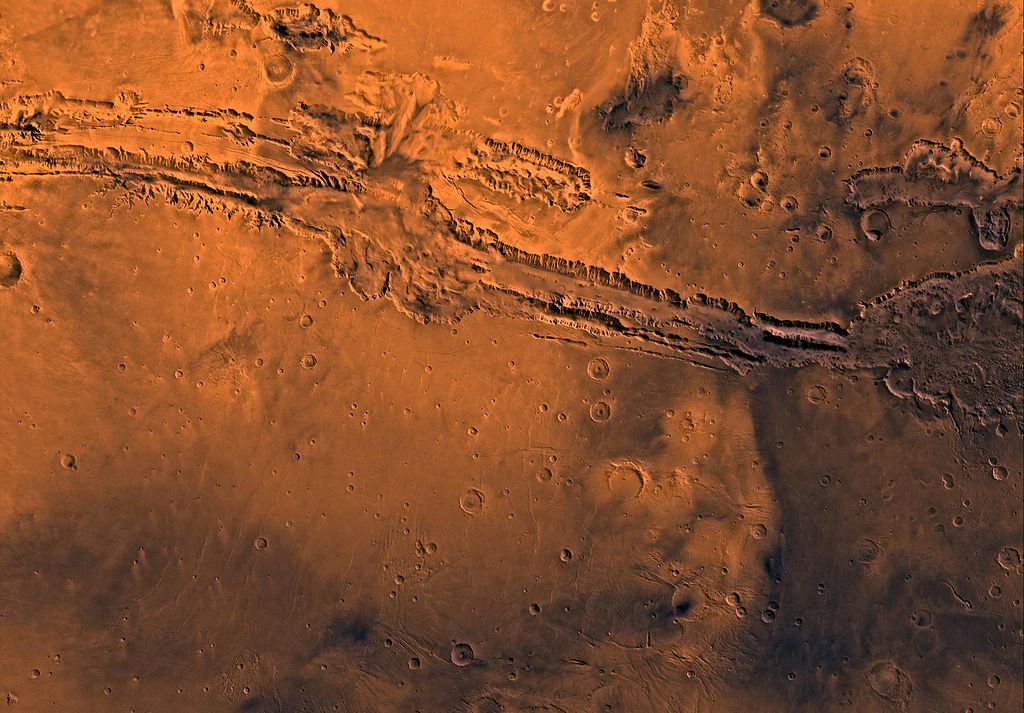
This legend is about Mars, told by the Pawnee, a North American First Nations tribe that had no telescopes. But the scar is there. Valles Marineris is the longest, deepest, most evil looking chasm in the Solar System. Yet it’s impossible to see with the naked eye given Mars’ vast distance from Earth. How odd the Pawnee seemed to know of it.

The Pawnee theory sounds like the Greek, Mayan, Incan, Egyptian and Norse mythologies. Did the Pawnee share their best leaf in the peace-pipe with everyone in the world? How else could such a randomly bizarre story spread? Or was everyone talking about an ancient, global event experienced and remembered at a time when Mars was so close it appeared as big as the Moon, or even bigger? 

Mars is a desolate planet. Mostly sand and rock. The planet retains a remanent magnetism, but there is no active planetary circuit like Earth’s. Compared to Earth, it’s atmosphere is exceedingly thin. It can raise a dust storm, but no rain. We hear theories that Mars has lot’s of water somewhere deep inside, and indeed we’ve found enough to wet a teacup, but no rivers to carve canyons. Especially not one six-miles deep. There is no evidence on Mars to indicate Valles Marineris was carved by a river of any kind.

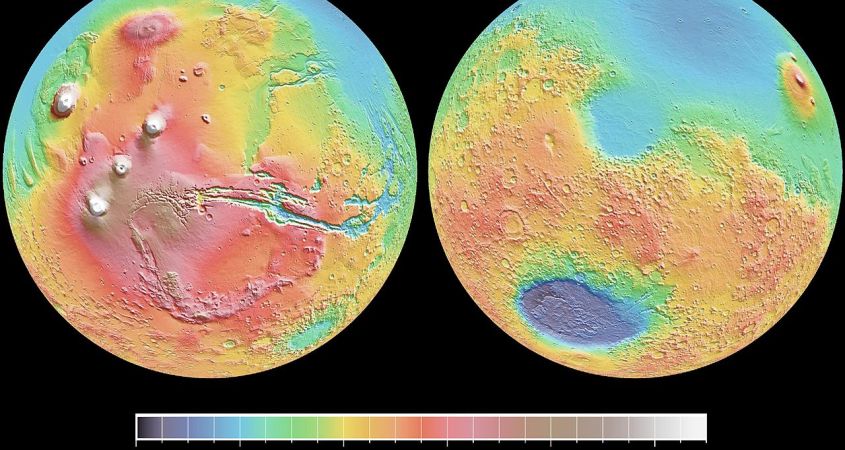
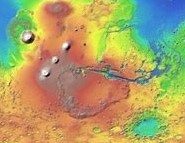
It resembles cuts made by a radial saw, not meandering water. There is a particular symmetry to both the canyon and it’s surroundings. The canyon is composed of parallel linear cuts, which divides the plateau it pierces into a figure-eight, with a ring of highlands and a ring of lowlands neatly segregated by the canyon. Beyond the west limb of the canyon, Tharsis Mons rises like three mice in a row, triangulated almost perfectly by Olympus Mons.

The entire Tharsis Mons structure is counterbalanced across the breadth of the canyon by giant craters – including the very deepest places on the planet. The Hellas Planitia and Argyre crater are anomalous sinks in the highlands, juxtaposed across the planet from the “volcanoes”, with the canyon smack in between. This is a dipolar symmetry, like anodes and cathodes in opposition across the width of a sphere.

There is no rational theory based on tectonic forces, volcanism, erosion, or impact that explains the collective symmetry of features, so it is ignored by “curious” scientists. However, classical physics does have an answer for anyone who chooses to find the truth.

Capacitor overload explains the gash, the dipolar symmetries, the craters and the other features. It doesn’t explain the cause, but if we listen to the ancients along with the evidence we get significant clues, because the stories always mention Venus. The discharge left a distinct pattern on the planet that tells the story of that day. This explanation can, and has, in part, already been demonstrated in the lab.

Capacitors fail explosively. They fire a spark from the inside-out, and blow a hole in their casing, sending a sonic shock-wave, sparks and molten-matter flying. Valles Marineris is the scar of a discharge from the interior of Mars, because the energy entering the planet exceeded the planet’s energy storage capacity.

The straight-cut gash of the canyon itself is clear visual evidence of electro-magnetic forces. But the gash is not as straightforward as a simple cut from a plasma torch discharging through the planet’s crust. It is part of larger pattern that involves spherical capacitance, magnetic induction, drift currents, sputtering discharge and redistribution of matter. It is a pattern both anodic and cathodic, displaying dipolar alignments, multiple arc discharges and glowing plasma circuits shaped by magnetic induction.

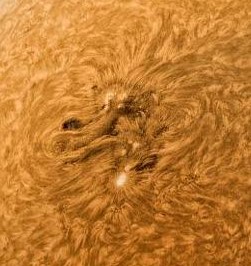
The best comparison to make is with a solar storm. Solar storms are examples of the Sun’s spherical capacitance in discharge mode. The Sun is always discharging, but Mars did it one time because of a sudden catastrophic overload. For either case, what the sparks do is very similar: they follow the magnetic fields.

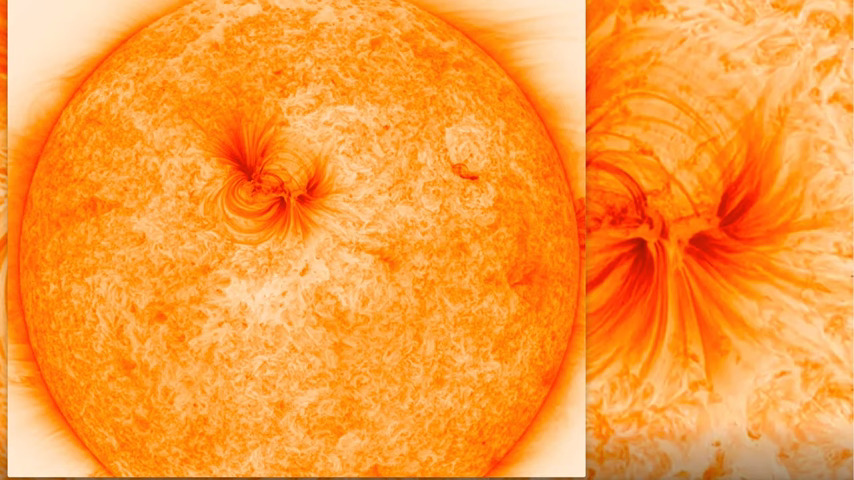
A blown spherical capacitor shoots violent, relativistic, arc-mode currents radially from the surface of the sphere, producing magnetic fields around the discharge. A Solar discharge, sometimes called a flare, does the same, creating similar magnetic field patterns. We can compare a solar storm with Valles Marineris and see these similar patterns, particularly the figure-eight magnetic field of an electric dipole.

The figure eight pattern is due to the electric dipole, which is from currents rising and falling vertically with respect to the crust in coronal loops. The pattern isn’t unique to a blown capacitor. It’s not unique to the Sun, Mars or any particular electrified body, nor whether it is from an arc-mode discharge, or dark-mode drift currents. It’s a feature of the circuit pattern and the dipole it creates that causes the figure-eight E-M field under any of those conditions. So the circuit pattern can be recreated, and has, to produce similar results.

Michael Steinbacher and Billy Yelverton produced what they termed the “Crooked Smile”, which is in the same pattern as Valles Marineris. The entire experiment can be viewed at Thunderbolts.info: “Valles Marineris in the Laboratory?” I’ll just point out three observations important to the circuit.

  1. They laid a dielectric layer over a grounded layer, producing capacitance between the electrodes and ground.
  2. The electrodes were composed of a matrix of pins to distribute charge, hung above the dielectric layer, to create a wide discharge column across an air gap.
  3. They sprinkled sand above the air gap over the plate so as to allow each grain to acquire charge as it drifted through the electric field.

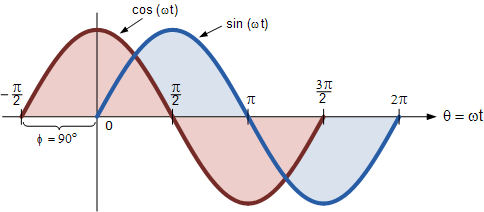
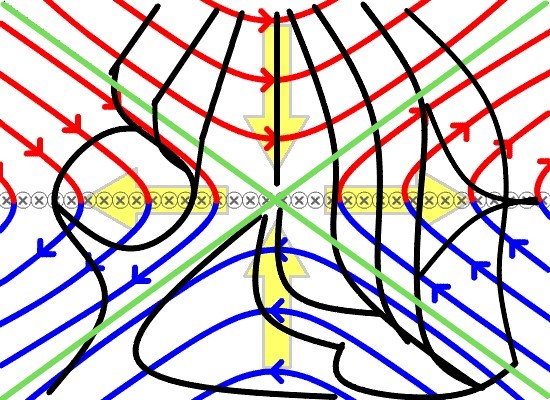
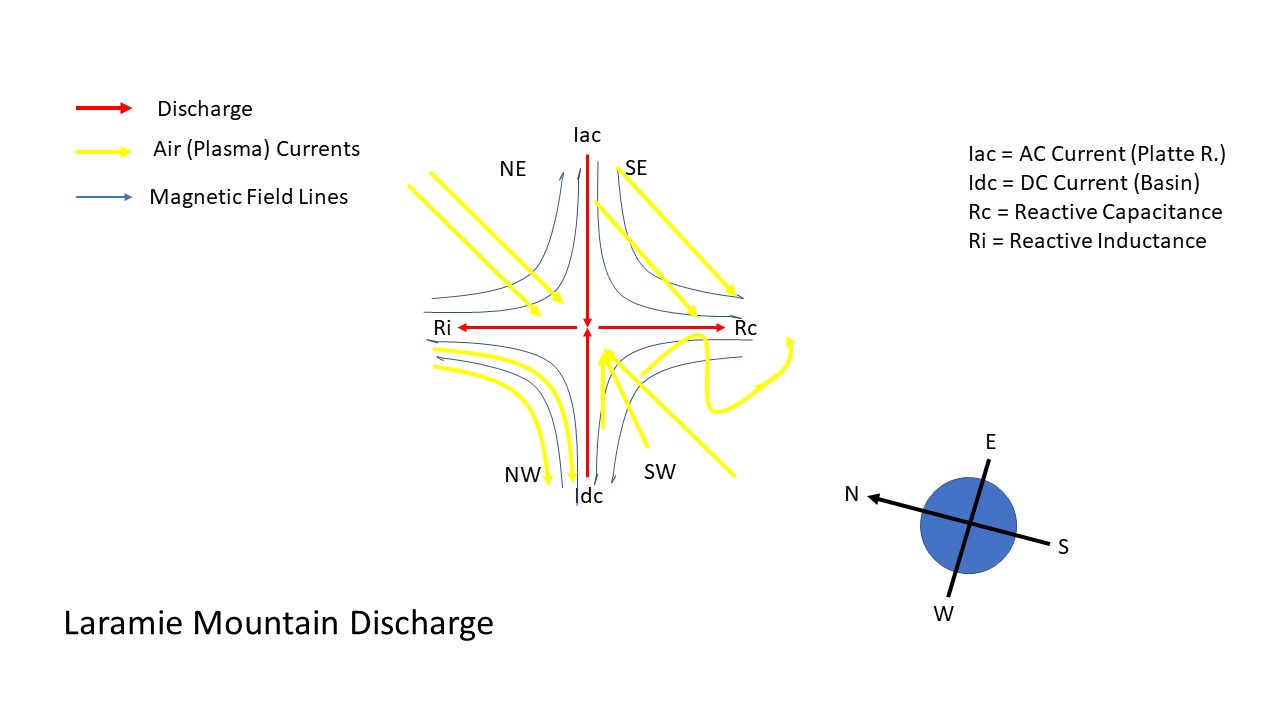
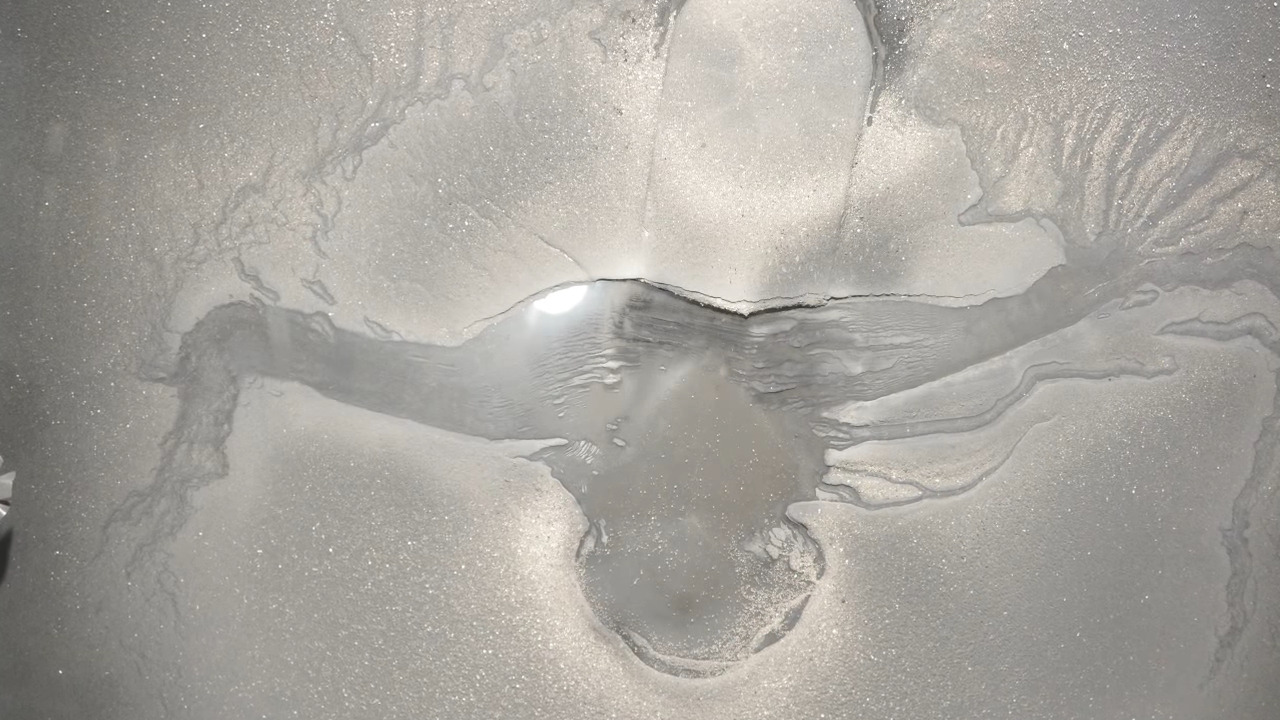
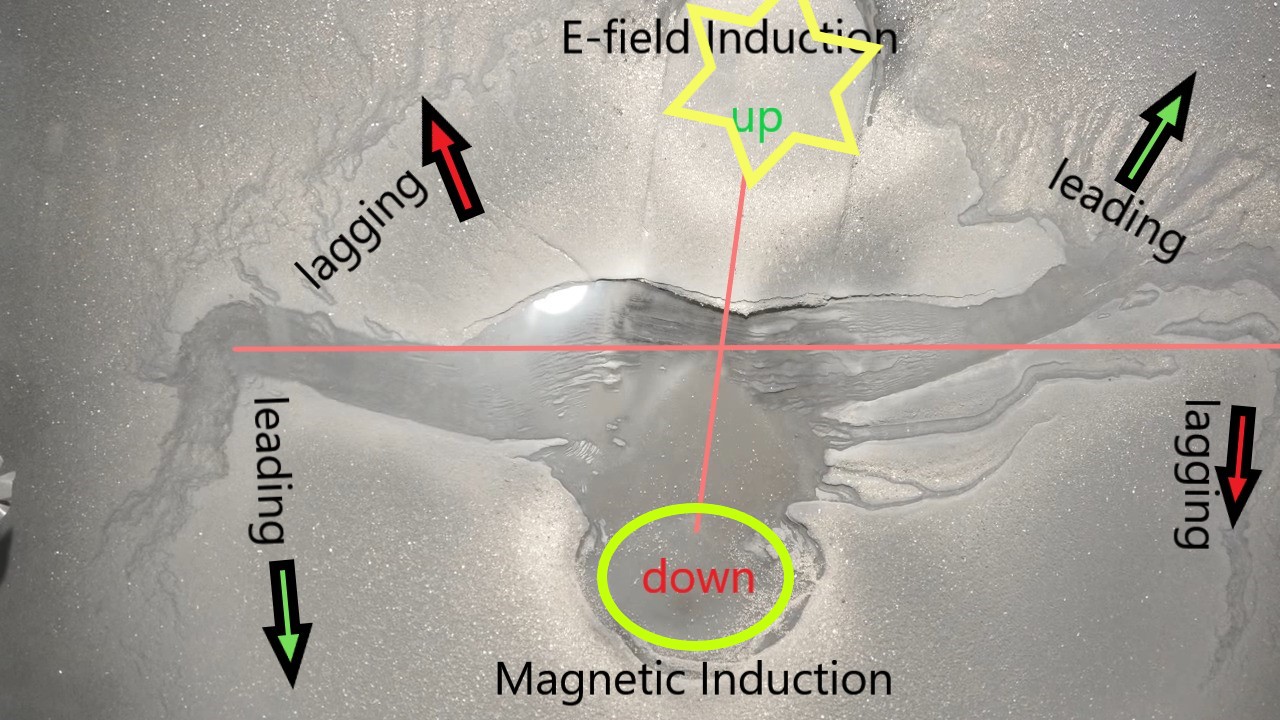
The sand landed either in layered deposits, or didn’t, leaving a sand-free surface. It’s the sand-free surface that takes the canyon’s crooked smile pattern. The crooked smile is an interference pattern caused by the capacitor layer, because it delays return currents by 90 degrees of phase. There is also a delay between actions of the electric field and the magnetic field, because the magnetic field lags. So what results is a multi-phase interference pattern of charge-saturated and desaturated zones on the dielectric plate that the charged sand is either repelled from, or attracted to.

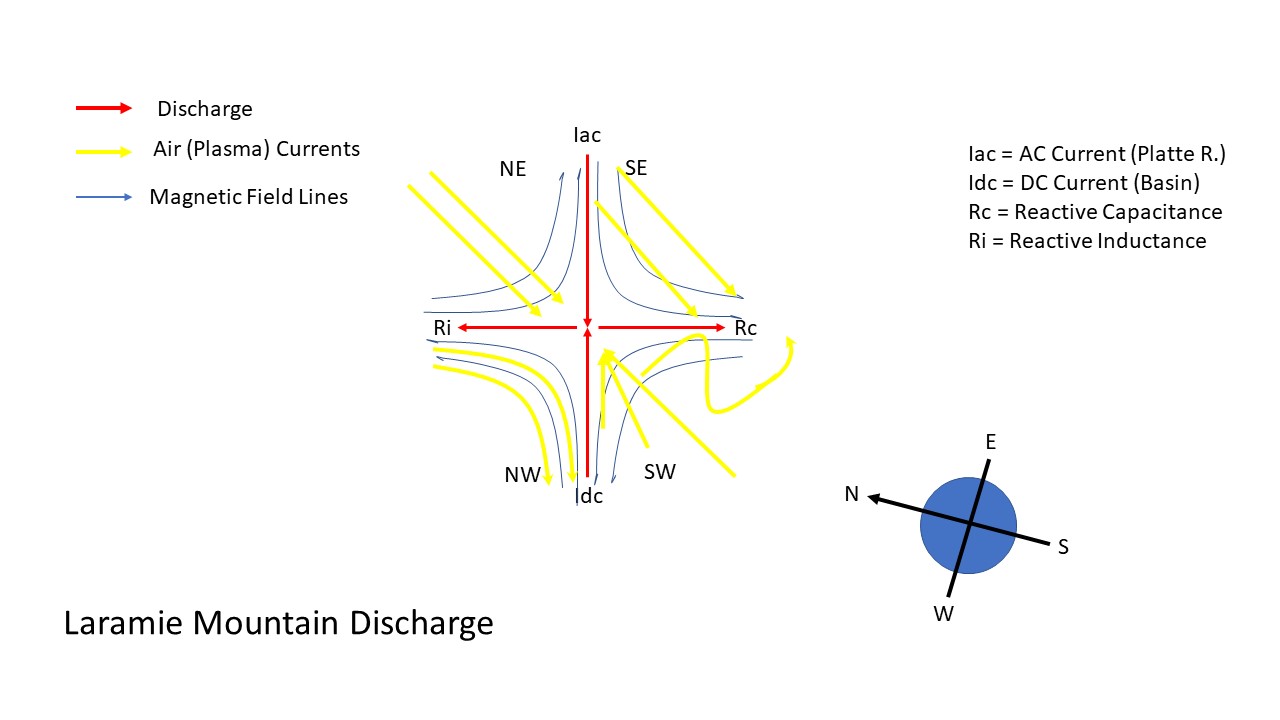
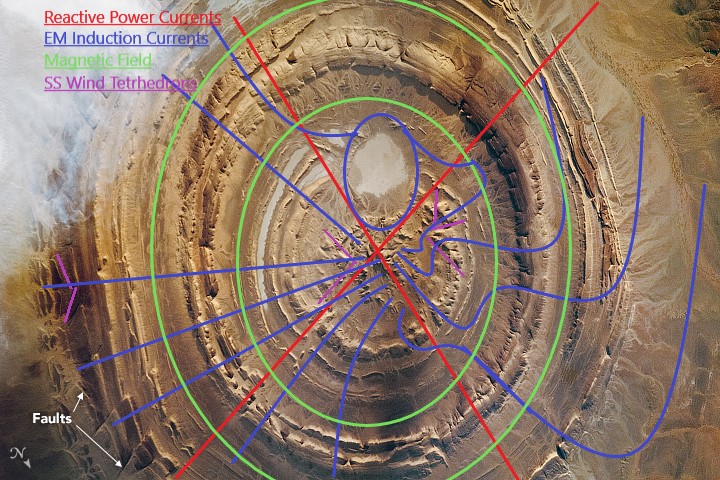
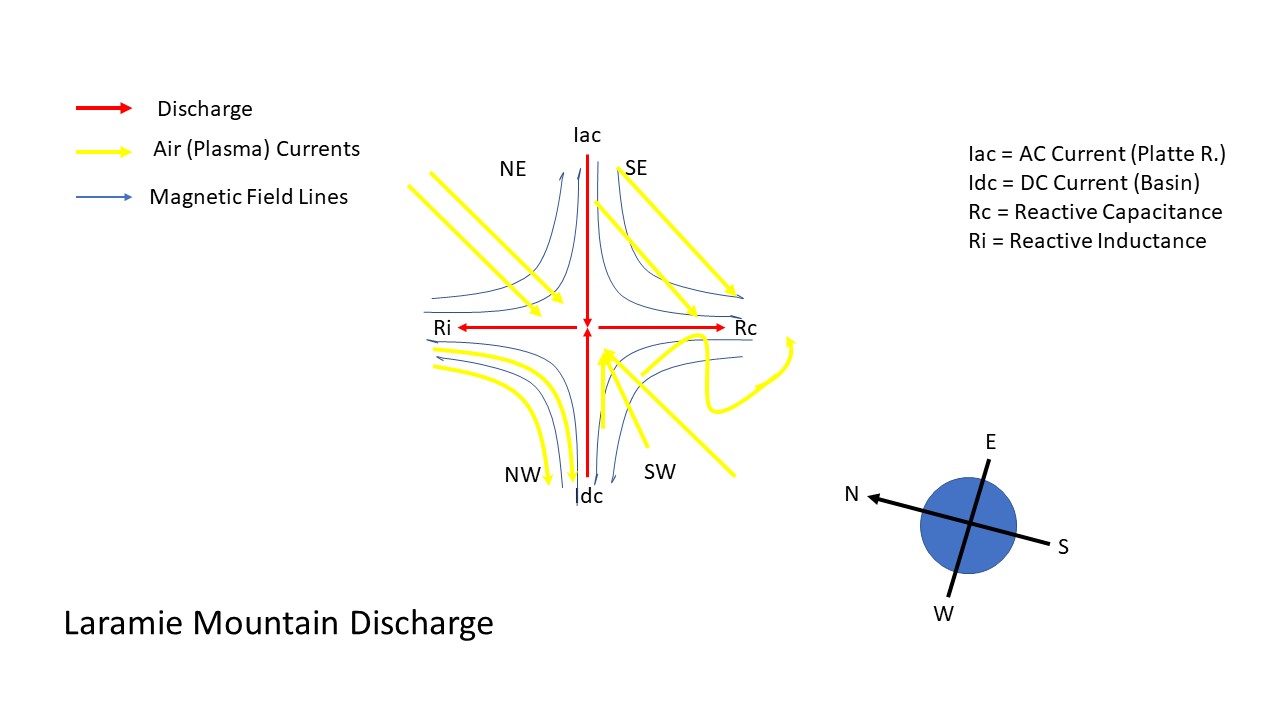
A similar, more complex interference pattern is described in “The Keystone Pattern“, “The Cross from Laramie” and “Granite Cauldron and the Boiling Boulders“; articles that present similar discharge patterns here on Earth caused by plasma storms. The Keystone Pattern, like the Crooked Smile, is caused by reactive currents surrounding a discharge current. Reactive currents are magnetic and electric field induction currents that are patterned by the E-M field as the discharge passes through a dielectric layer.

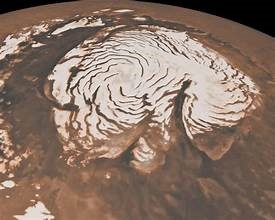
The appearance of Mars suggests an enormous EMP struck the north pole, which spread surface charge across the crust of the planet. This would have stripped away the original atmosphere leaving a dense plasma of charged dust particles and gases. It also left a charged layer of soil, which immediately sputtered – lifted off the planet into plasma winds by the coulomb force between the crustal surface and the electrified atmosphere. The winds deposited the dust surrounding the oppositely charged, southern pole. This is why Mars, like the Moon has regolith piled on one hemisphere and not the other.

Charge spread both inside and outside the planet’s crustal layers to saturated capacity and ultimately overload. The explosive discharge left anodes – volcanoes; and cathodes – craters, where looping coronal discharge issued from the planet. The canyon and figure eight is at the center of this discharge, beneath the coronal loops, where filaments of magnetic induction were the strongest.

It’s what electricity does in a spherical capacitor – store away as potential energy and discharge as capacitance is reached – and Earth and planets with atmospheres are spherical capacitors because we can actually see, feel and hear Earth discharging. We see it on Saturn, Jupiter, Venus, Uranus and Neptune as well. Any thunderstorm will prove it. In fact any natural atmospheric phenomena you can name: aurora, clouds, lightning, hurricanes and tornadoes are the actions of a spherical capacitor inducting and discharging, as are earthquakes and volcanoes. One testable RLC mechanism explains how planets work. Climate models don’t account for this, which tells you how important it really is.

Electrically speaking, the Earth, stars and planets are RLC circuits inside an electro-magnetic bubble that create an internal electric field. That field is contained, like the pressure inside a bubble, inside the spherical layers of multi-junction capacitance created by the planetary crust, atmosphere and plasma-sphere. It doesn’t matter if the “crustal” layers are solid, liquid or gaseous plasma. They are dielectric layers that form capacitance in the circuit. They also reflect energy back into it’s interior, making the bubble a resonant cavity.

The internal electric currents respond to the currents outside the bubble the same way high-side transformer coils do, inducting a higher voltage inside the bubble than exists outside.

Induced currents inside the Earth is modelled by Hans Alfven’s Transformer Model of Earth. It is a model I agree with, but Alfven was only modelling the energy coming in. He did not include the circuitry of energy storage and discharge, which is the capacitor in the circuit. It’s a necessary addition to model the complete RLC circuit.

The Earth’s internal electric field radiates from its core to the sheath of the spherical capacitor, vectored in opposition to the external electric field of the Sun, which makes the planetary body an electret. Any electrical stimulation from outside elicits a higher voltage response internally – “As above, so below” – that resonates within the spherical cavity. This amplifies internal currents and excess energy stores in the spherical shells of the containment bubble, while releasing measured amounts of energy through the capacitor to maintain a steady state. At least up to the point where dielectric breakdowns occurs, when the internal electric field gets too strong and starts pushing energy through in a runaway arc-mode discharge.

This is what happened to Mars.

An X-class flare on the Sun is the electrical circuit equivalent of what happened to Mars. A breakdown of the capacitor’s dielectric layers and a violent, arcing discharge.

Spicules on the Sun are electrically analogous to sputtering discharges that made the smaller craters on Mars. The largest craters and volcanoes are the anodes and cathodes of magnetically induced coronal loop currents that extended across one hemisphere of the planet.

Although this is conjecture, myths like the Pawnee’s suggest Venus sent the EMP. If Mars were aligned in a linear orbit between Venus and Earth, orbiting Saturn, as Electric Universe theory suggests, Saturn the brown dwarf star, may have expelled a CME directly at the linear grouping, blasting them out of Saturn’s orbit. The EMP that struck Mars would have passed around Venus as a surface charge, leaving Venus a hot cometary body. Hitting Mars, it blew the circuit, leaving Mars stripped of it’s electro-magnetic sheath. People on Earth would have seen it. They also would have experienced what remained of the EMP after it passed around Mars, which might explain some petroglyphs and the transition from the first sun, Kronos to our second sun, Sol, as myth has it.

What else may have happened to Earth under this scenario? Besides myths, there should be evidence of electrical scarring on Earth as well. Perhaps we’ve even looked at some of it in past articles.

Conjectures about how it happened aside, Mars is a blown capacitor. That much can be empirically demonstrated.

Cheers,

Megalithic Chemistry

The mystery of ancient megaliths stirs wonder in any curious mind. They are artifacts from our deepest past, thousands of years old, yet enduring the millennia with more grace and stamina than anything built since. Controversy over their age; who, how and why they were built has raged, it seems, for as long as they have stood.

Many investigators contend that answers provided by the academic consensus don’t match the evidence. They say the evidence suggests they were built by an antediluvian race of people using technologies we have yet to decipher. They point to worldwide archetypical iconography that implies a common origin. And they insist pyramids and other structures have features too similar not to be the result of a coordinated effort. They say each one is geo-positioned in relation to the others in an intentionally planned, global pattern. Theories as to their purpose range from granaries to alien spaceports.

Consensus academia says these impeccably designed structural complexes are the tombs and temples of ancient kings and observatories of the stars. They are structures devoted to ceremony and religion because ancient people were highly superstitious and afraid of Nature. They say they were aligned to track the seasons, so the rulers could predict eclipses and know when to plant crops. They built with stone because stone is what they had, and the commonality of the pyramid is because it is the simplest structure to make by stacking stones. And, of course, they say any global pattern in iconography, or geo-positioning is entirely a coincidence. Simple answers for simple, stone and bronze-age people.

As an engineer, what puzzles me is why ancient people built with stones weighing hundreds of tons when they could have broke them down to smaller, more manageable pieces the way we do. Why the painstaking polygonal masonry with seamless, mortar-less joints? It’s as if these structures were designed to withstand earthquakes and tsunamis. What compelled ancient people, who according to the consensus were learning how to farm, to divert their attention to becoming master architects and erect cyclopean structures just for ceremony.

Big, symmetric pyramids are exceedingly hard to build. So is carving, dressing and moving giant stones. Such effort devoted to ceremonial structures by people just learning to create a sustainable society doesn’t add-up. Living as dirt farmers while building amazing, but otherwise useless temples to the dead is not how societies prioritize resources.

Agriculture without technology requires immense human resources. For example, colonial America utilized 95% of the population for agriculture to keep-up with its needs, leaving 5% to work on everything else, including ceremonial structures.

Roman Aqueduct

We have many examples of early societies that focused colossal resources on agriculture, like the Pueblo culture in central Arizona who built such extensive networks of reservoirs and aqueducts to irrigate the desert that we still follow their plan today. And the Romans who built roads, cities and aqueducts connecting a continent-wide empire. These societies allocated far more resources on utility solutions than on ceremonial clap-trap.

It reasons the ancients would focus resources on practical structures that paid dividends in higher productivity rather than pure ceremony, because that is what we do. We spend the vast majority of our resources to build plants, mines, factories, dams, roads, sewage and clean water systems, and a small amount on cemeteries, churches and monuments. The reason is obvious: it’s necessary; and why would not the same be true in ancient times?

Many independent thinking theorists have pointed to the industrial look of megaliths and proposed a greater, functional purpose that tangibly benefited society; including power generation, water pumping, and wireless communication. These ideas have merit because they are use-cases that would benefit a growing agricultural society to a degree worthy of the expense.

I’ve taken interest in the alternative theories. Building power plants is what I did for many years. Having looked at several of these theories, however, none provided a satisfying answer. The reason is they typically focused on one particular structure, like the Great Pyramid, and had no comparative answer for the other megalithic structures around the world, or even similar ones nearby. They also failed to identify all the attendant facilities needed to use the power, water, or whatever. I keep an open mind, but I have electric eyes and can only see holistically. Important stuff was missing in every theory. There had to be common denominators that connected all of the similarities, diversities and explained the confounding complexities.

Electric Universe theorists, Megalithomania explorers and curious others have been saying as much for a long time. They have uncovered hints at the truth about these structures, but to my eyes, no one has provided an explanation as to their purpose. Now, I believe someone has.

His name is Geoffrey Drumm, and his book is “The Land of Chem”. The “landofchem.com” is his website. He first published in 2017 and has produced a huge amount of video content backing his claims, expanding his theories and exploring the real technology of the ancients.

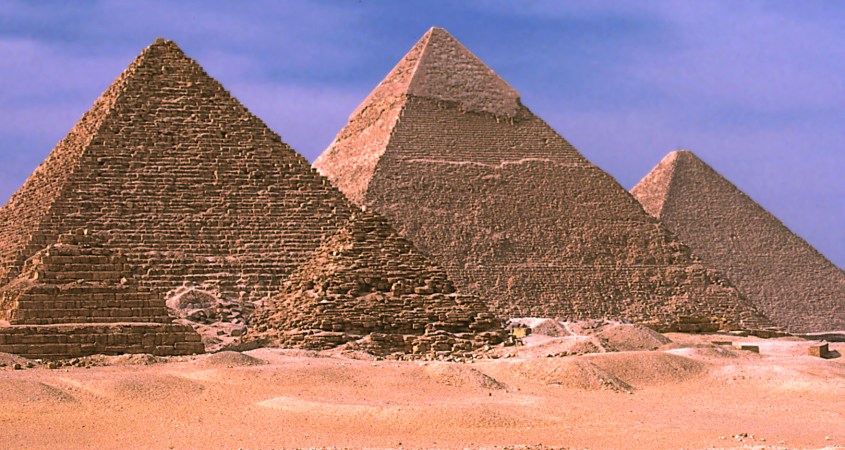
Drumm presents a thesis that the ancient structures were chemical processing plants used to produce chemicals for solution mining and crop fertilizer. How mundane, yet sensible. The ancients weren’t communicating with aliens, spirits, stars, or the dead, but were actually making nitrates to fertilize their crops and acids to solution-mine and process precious metals. Of course they were – just like we do and every other society one cares to look at throughout history.

Modern Fertilizer Plant

He backs his thesis with on-site investigations to confirm predicted channels, passages, chambers and other features for fluid flow, pressure control and containment in the Egyptian pyramid-temple complexes. Trace elements from the processes are even identified.

I believe he is substantially, if not wholly correct. In my former career I built and operated cogeneration power-plants integrated with a variety of chemical processes and visited too many refining, processing and manufacturing plants to count. I know a process when I see one. Drumm identifies precisely the use of chambers, passages, tunnels, even the choice of rock used in a construction, and how it integrates into an overall process-flow. He identifies the chemistry, the process and the systems integration, as well as the products and purpose. The products and purpose make perfect sense in a growing agricultural empire and the use-cases justify the expense, unlike any other theory ever presented.

The integrity of his work is in identifying how the pieces and parts worked together. They worked like chemical plants do today: mixing and reacting, settling and separating, transferring aqueous solutions here and there. The vessels they used were stone, not steel, but the processes were no different. He provides common sense, holistically viable, technically verifiable answers. This dramatically separates his from any other theory.

The Earth-sky connection.

He also correctly identifies the power source that ran the processes. Nature’s electricity. Lightning and telluric currents. This is another reason I know he’s right. He’s the only theorist who doesn’t lose his mind and go extraterrestrial when it comes the energy source. He understands it comes from the Earth. No aliens were needed.

Drumm’s examination is primarily of the Giza Plateau and it’s pyramid complex, and certain standing stone sites in the UK and Europe, but I contend his model will apply throughout time and geography across most if not all megalithic sites, because it provides the simplest, most verifiable answer that fits with the needs and capabilities of those cultures. It’s a theme repeated at every site one could consider a cradle of civilization. Occam’s Razor will prove Drumm right.

Drumm’s work speaks for itself and I urge anyone interested to begin with his “You Tube” channel, @thelandofchem. I simply want to help spread the word and unabashedly promote his work. I hope everyone listens to what he has to say. I know there are those in the Electric Universe who will see the value in his work immediately.

I also hope some of you will will use your knowledge to test his work. More eyes will help elucidate the truth. I doubt anyone can actually refute his theory as a whole, and expect more eyes will simply corroborate and expand the evidence he’s right. This is knowledge the whole world needs.

Drumm’s work is important to the Electric Universe, especially. It is essential to understand our true past and the electrical state of the planet in past times, particularly at the dawn of civilization when these impressive works were erected. The knowledge Drumm is sharing aids our understanding of the environment that demanded such incredible specifications. The insight of knowing purpose when contemplating the mystical past also sharpens our focus understanding ourselves and our planet today.

The world was different thousands of years ago. It was different when petroglyphs were being laboriously pecked into rocks to depict plasma aurora in the sky. It was different when people occupied vast underground chambers excavated in natural rock, or sheltered precariously under canyon walls. And it was different when the megaliths were built, because they were built to standards that surpass any kind of construction needs we can imagine in todays environment.

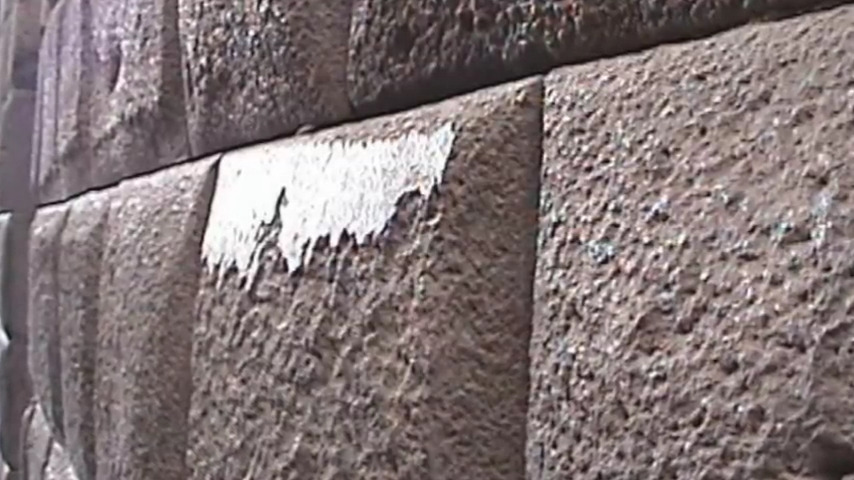
Stones as much as a thousand tons are found stacked upon each other and fitted with such precision it defies logic. Compound curves are commonly mated to perfection. It is the type of complexity we use computer aids, robotics and heavy equipment to achieve today, but the ancients apparently did it with their eyeballs, plumb bobs and soft bronze tools. They must have had a very important reason to build that way.

It’s not that they couldn’t build the megaliths by such primitive means with lots and lots of time and labor; the question is why? Why build to such extreme specifications, as if each structure must withstand a tsunami.

Perhaps that is why – they did need to withstand tsunami’s, fierce winds, earthquakes and lightning. Not to mention the pressures, heat and corrosive environment of a chemical plant. The electrical nature of the planet was in a much higher state of potential in ancient times than it is now. We know this because of the archetypes from those cultures – the Thunder-Gods – and the decoding of those archetypes by Velikovsky and the Electric Universe community. We know the consensus does not account for these factors. Therefore, I look for evidence of an electrically stressed environment when I look at ancient structures. And there is ample evidence to be found.

There is significant evidence of lightning damage, vitrification and burning found at many megalithic sites. Magnetic signatures in the stones reveal past electrical stress. And the nubs and various odd architectural features appear designed to collect and discharge built-up surface-charge away from walkways and openings where people would pass.

I have pointed to the mortar-less perfection of how the blocks are fit being a requirement for electrical continuity. Also, I’ve noted that the copper, bronze and iron pins placed between stones would be useless for structural integrity and must be for ensuring electrical continuity across gaps and seams. Maintaining continuity prevents step-voltages that might spark, causing structural damage, a fire, or even killing someone. Solid contact between blocks would be a specification required by structures designed to withstand electrification.

The megaliths were built not only to withstand plasma storms of intense lightning and the attendant winds, floods and telluric currents, but to also absorb and utilize the power from them. Energy ebbs and flows through our planet. It’s an electric circuit that inducts, stores and releases energy as it spirals through waves of plasma from the Sun and stars. Ancient megaliths made use of this energy flow as it transferred from Earth to sky. The ancients reigned in the power of Zeus almighty – and his thunder gods – to geo-engineer, at scale, their nations.

Dowsers can identify telluric power avenues in the land by feel. I know they are right because they match my own findings in geology, where I see that current flow left it’s pattern. Dowsers will point out that megaliths, almost without exception, are built on these telluric avenues.

Rory Duff is a researcher of note in this field. His work demonstrates that the megalithic sites are built on grids that coincide with Ley Lines. In my own research, I’ve shown that Ley Lines correlate with landscape features on the continents. The features and the Ley Line patterns are due to spherical capacitance at the planet’s crust. And this spherical capacitance power grid is what ancient megaliths are positioned on.

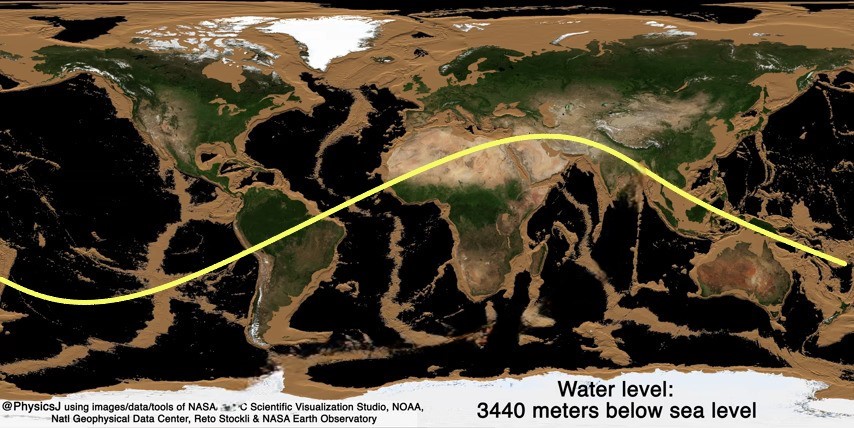
Eighteen of the most notable megalithic complexes, including the Giza Plateau, Petra, Mohenjo Daro, Machu Picchu, Easter Island and Angkor Watt, fall on a great circle around the globe. Not only do they fall on this great circle, they are positioned at the highest telluric energy centers, where the greatest rivers on Earth meet the sea. The Nile, Niger, Tigris, Euphrates, Indus, Ganges, Mekong, and Amazon; the cradles of civilization. These great river valleys were originally formed by discharges from Earth’s interior in a primordial stage of Earth’s development.

Why is this so? Why would electric current well from the Earth at these points along a great circle? Possibly because this circle corresponds to a specific orbit around our planet, called a “two-day orbit”. A two-day orbit is similar to a LaGrange Point orbit, only instead of being geo-stationary, the orbit returns a satellite in this orbit to the same position every second day along an unvarying great circle. The great circle of the megaliths and the great river valleys is the same great circle.

Roger G. Gilbertson is the independent researcher who discovered this, as he describes in the following TEDx talk: “The Unusual Earth Orbit Circling Above Our Ancient Past“. He makes a compelling presentation of facts that few people are aware of. One might, as he does, contemplate satellites, or alien motherships orbiting Earth in communication with the ancients along this two-day orbital path. But this is counting unicorns instead of looking for facts. The fact is the geology of the Earth will show this path was once the orbit of the Moon. At that time, someone who lived on this circle at say, Easter Island, experienced a moon every two days and no moon at all in the days between. In this orbit, Earth never eclipsed the Moon, leaving it always in bright sunlight.

It’s well established that the Moon is getting further from Earth, which implies it was once much closer. This two-day orbit was, I contend, it’s ancient orbit, and that is why the Earth blew out sparks along this path, creating the great river valleys. And that is apparently why the Ancients sought out this path for living quarters sometime after the event, after discharges between Earth and Moon had reduced the potential between them. It provided fertile valleys and a still simmering power source.

It’s the reason, I believe, the Moon is tidally locked, always presenting its scarified face to Earth, while it’s backside is mounded with regolith. Earth pulled this side of the lunar face off by plasma discharge, and tide-locked the Moon while in close orbit. The lunar craters are remnants of the event, as are Earth’s prime river valleys.

It is, I believe why lunar regolith and crust are chemically reduced, while Earth’s crust is oxidized. That is what happens between an anode and cathode. The Moon’s craters are cathode spots. It is also, I believe, why ancient texts and lore refer to specific gods associated with specific cities, and mountains. These were the anodes. They likely believed recurring storms every two days along this path were local gods sustaining magical power in these locations, energized by the lunar orbit.

Perhaps this continuous orbital path of the Moon was close enough to feel it’s gravity reduce weight and make big stones easier to move. A continuous path of colossal tidal pull, seismic unrest, hurricane and lightning generated by a vortex of energy leaving the Earth in a plasma umbilical chord attached to a tidally locked Moon would present an extreme electro-magnetic environment, where even the nature of Nature would seem foreign. Perhaps the stone itself changed character, impressed with a current that caused low melt-temperature components to change phase and soften the stone.

Planetary Ley Lines – 2-day Orbit in Red

The Electric Universe community knows the connection between plasma and archetypes from ancient times and we know the connection between plasma weather and geology. Rory Duff and like-minded people know the connections between megalithic sites and Earth’s energy flux, and have noted the electromagnetic signatures of past plasma events in the stones. Geoffrey Drumm presents hard evidence of the actual purpose of Megalithic stonework as energy collectors, conductors, capacitors, and aqueous chemical processing facilities. Put together it’s a lot of information.

Layered together this information may provide holistic answers for why Megaliths were built the way they were. Knowing they fit an obvious societal need subject to specific environmental conditions provides context for a re-examination that will provide clues to the environment on Earth at the time. Industry centered in fertile valleys around farming and mining resources really needs no further explanation, but the conditions that required megalithic specifications does. There also remains a big knowledge gap as to when this happened, who did it and what was the state of the Solar System at the time.

These are the fertile valleys, the cradles of civilization, of agriculture, of community. Ancient people built with stone and utilize Earth’s energy beneath a Moon that appeared every other day, bringing with it plasma storms, earthquakes and swelling seas. They used Nature’s raw material; granites, basalts, sandstones, and limestones as electrical conduits, insulators, batteries and heating elements. They used the rock at dual purpose for structure, containment and catalyst. They used the Sun, Moon and stars to precisely geo-locate facilities where Earth’s power flow could be accessed. It implies wisdom about how the planet works and a symbiotic relationship with it. It’s something we need to re-discover if we truly want to understand this planet and how to live here sustainably.

The evidence is out. The narrative we’ve been fed by academia continues to crumble. Truth will out the disinformation. As shocking truth, after shocking truth floods our consciousness this summer, make “The Land of Chem” one of your reads.

Cheers,

Lightning And Its Fractal Domain

When the leading edge of Hurricane Hilary approached the Borrego Desert, I watched from a high vantage some miles away. A line of thunderheads organized into a mothership super-cell that exploded with frightening power in the dark hours before dawn. Once it began, it stayed lit for twenty minutes, like a giant glow-plug. Sparks crazed it’s clouds and licked the ground, while a constant flame burned within.

The explosive encounter was as much about the land as it was the clouds. Like a Tesla coil, the ground was part of the circuit of the storm. It was the land’s response to the hurricane at that place – the Borrego desert – that polarized the energy, amplifying the clouds into an arcing demon.

The sight hinted at scenes our ancestors recorded in myth and petroglyph. The archetypes of major religions, past and present, largely consist of anthropomorphized interpretations of plasma events and phenomena. Not only the event, but equally important, the location it was witnessed is immortalized.

For the moment, set aside whether you believe in gods, demons, or aliens. Ancient people believed. If we want to understand the message they left, we need to re-imagine the context for it.

Dr. Anthony Peratt demonstrated that ancient petroglyphs depict plasma instabilities in the Earth’s plasma-sphere. Specific discharge patterns such as “Squatter man” and “Jacobs Ladder”, to name two of the most prominent, are pecked into the rocks on six continents in identical form and context to verify that some global plasma event took place roughly 12,000 years ago.

The Squatter-man image is of a glowing plasma current forming toroid rings. The rings are known as “reactive currents”, formed by magnetic and electric field induction circulating around the central discharge. The central discharge is a current following the field-lines of Earth’s own, amped-up magnetic field.

What Dr. Peratt doesn’t discuss in his work is the consequences to Earth’s weather beneath those descending arcs of glowing plasma. After all, one must realize magnetic field-lines have no ends. They are electromagnetic interference patterns generated within the Earth and make continuous paths all the way through. Peratt’s instabilities were auroral currents similar to the polar aurora we experience today, but amped-up to the point they glowed along the field-lines much farther from the poles, appearing higher in the sky and visible around the globe.

Much of Earth’s circuitry is internal and unknown. Electrical discharge patterns and how they occur on planetary bodies provide the most outwardly obvious clues. It is electrical discharge that makes and patterns planetary crust, weather and atmospheric phenomena, and it’s what is portrayed as the archetypical demi-gods, demons and alien craft in the various narratives.

The atmosphere and crustal surface present a unique interface to electric currents. It presents an enormous resistance to the current. Also, the plasma physics of near-Earth space becomes quantum chemistry in the atmosphere, and solid-state diffusion in the crust. And charge densities follow geometries shaped by the interfaces, which influences the shape of discharge and its effects. The evidence is in the geology of Earth’s crust, where the electromagnetic effects left undeniable patterns, and in the patterns of weather even today, although it’s operating at a much lower wattage.

We’ll talk specifically about discharges that occur vertical to the plane of the ground, as in cloud-to-ground lightning, which strikes normal to the ground and leaves a pattern such as a crater. Some types of planetary discharge display different aspects of magnetism and reactive power because they are not oriented perpendicular to the ground, like cloud-to-cloud, or ground-to-ground arcing. Those are point-to-point connections that have a different return path in the circuit. Today we’re examining radial discharge from the sphere of the planet, which produces coaxial discharge circuits, where the discharge and return path share the same space.

This is important, because we tend to think and work in terms of Euclidean geometries. Spherical planets are spherical capacitors that produce spherical E-M fields that move currents around in spherical geometries. Straight lines projected on a sphere are no longer straight, they become geodesic, parallel lines are no longer parallel and geometries become distorted.

This leads to tessellation of plasma structures in a spherical capacitor, as charge separates into cells. Interference patterns of compression and rarefaction in a charged atmosphere leads to negative charge in plasma separating into cells surrounded concentrically by positive charge, or vice versa. Given the spherical geometry of planets, these form as tessellation cells in the atmosphere and crust.

Process of charge concentration, separation and establishing current paths. Standing wave interference stores potential energy in tessellated cells. Opposing polarity circuit patterns form along interfaces and centroid-to-centroid pathways, separating charge coaxially. Nodes interconnect into circuitry.

Tessellation cells are what shape charge accumulation and separation, and produce various atmospheric and crustal electrode patterns that are absolutely essential to understand the fractal shapes in geology, weather, solar storms, or any other effect of spherical capacitor discharge.

Tessellated charge concentrations mirror from ground to sky forming a pagoda of segmented E-M domains, layered by natural dielectric frequencies, where coaxial discharge occurs.

Tessellated cells are not point sources, but act like opposing electrode plates with uneven, pulsing energy. In conductive layers of the atmosphere, tessellation cells will contain a volume of charge that forms an electrode. Electrodes will stack naturally, due to the mirroring effect of capacitance to form segmented, polarized columns. Charge distributions at one end of a cell mirror charge distributions at the other in opposing polarities. This forms the pagoda-like structure of a coaxial, stacked capacitor, with it’s base grounded to Earth and it’s column extending to the plasma-sphere, sheathed by it’s own magnetic field.

This structure is the segmented, or one could say corpuscular electromagnetic domain where atmospheric discharge occurs. In terms of an electrical circuit, this is the same corpuscular structure that forms coronal discharge from the Sun. Tessellation cells are what shape anode tufts, as anyone familiar with the Safire Project has seen. It is the structure of Earth’s own coronal discharge and all spherical capacitors, including all the stars, planets and moons. Not all of it is visible to the naked eye on Earth, as it is largely composed of drift currents. The arcs and glows from discharge we see is only a fraction of the action.

But ancient time were different. They lived at a higher potential, which means a higher frequency, when ionization occurred more readily and the sky glowed as a result. Glowing tessellation cells – electrodes in the sky, where currents collided, emitting patterns of light – are the evidence.

Charged, glowing plasma forming circuits in and around tessellation cells are what these ancient petroglyphs represent. In fact, tessellation patterns usually accompany squatter-man glyphs. Squatter-man is the vertical column of a discharge from Earth, and the tessellation cells are the footprint of the discharge columns on the ionosphere and layers of atmosphere. Its proof the sky was going crazy. It’s also evidence that the Electric Universe is correct, and the weather is 100% caused by circuitry.

The story is one of a sky ablaze with energy, not from angelic haloes, alien craft, asteroids, or comets. It was from the Earth itself, amped-up with potential by another “Velikovsky”-type electrical source. Perhaps the Sun. There are several processes to unpack what took place, and how it relates to petroglyphs, lightning and geology.

Tessellation is an aspect of standing-wave interference. It’s a geometric way to map the topography of interference patterns. Standing waves in a plasma store and release energy in cross-currents of induced reactive-power formed in oscillating magnetic and electric fields, which meet perpendicular to each other. These fields conform with the geometries of tessellation patterns because charge densities conform with the compression and rarefaction patterns in the atmosphere. It’s magneto-hydrodynamics in a weak atmospheric plasma.

Tessellation cells vibrate to form standing waves within standing waves. This can go on forever, by the way, with frequencies within frequencies making standing waves within standing waves in fractal repetitions, creating complex tessellation patterns.

Tessellation will produce a variety of geometries including polygonal, spiral, radial, polka-dot and linear patterns. They can become unstable, transient patterns, or stable, standing wave patterns. They can fractionate into multiple holographic echo patterns in lateral cells. However, there are several influences that lead to certain tessellation patterns that can be found repeatedly in cloud formations, geologic structures and elsewhere in Nature.

They are responsible for the array of spiral, concentric ring, checkerboard and fluid-maze petroglyph images pecked into the rocks. The ancients witnessed these glowing, sparking patterns in the sky and considered them messages from the gods.

Glowing patterns in the ionosphere were from a high energy event, like the aroura that commonly occur at the poles. The reason aroura discharge looks like curtains of light is because the light is produced by glowing, tessellated cells. The Birkland currents that reach Earth pass through tessellated atmosphere.

Everyday weather is patterned by tessellation also, but with more subtle energy. We’ll review a few examples of tessellation in the clouds. Geologic regions of Earth display the results of sputtering, glow and arc discharge patterned by tessellation during times of extreme electrical stress. We’ll examine a few examples. Moon craters are the footprint of tessellation cells, as are Earth’s craters and some of it’s mountains. We can deduce cause and effect that creates these various conditions because it can be reduced to the pure logic of circuitry.

x-y aspect of the magnetic field for a discharge along the z axis.

Once a tessellation cell forms an electrode, another forms naturally by capacitance in vertically adjacent, charged layers of atmosphere attempting to mirror the first layer. These layers form in opposing polarities creating dipoles between them and forming a coaxial stacked capacitor circuit between the ionosphere and ground. Each segment in the stack has it’s own frequency, or phase in constant feedback with adjacent segments as current flows through. Phases superposition at the electrode, and therefore, can be deconstructed from the interference pattern.

Shape of the E-M Domain of a discharge. Note that dipolar alignments always remain straight lines. Ground nodes should be stationary relative to sky, so this is upside-down in relation to how an actual thunderstorm works.

The first thing contributing to the cellular pattern is magnetism, which results from moving charge. Whenever there is moving charge, as in a lightning discharge, the current establishes a magnetic field around it. This forms a columnar sheath around the current with magnetic walls to enclose “the domain”. Everywhere inside this domain electro-magnetic forces are dynamic.

The domain compresses and expands with the movement of charge through it, which pinches the magnetic sheath. A fast moving current constricts the domain hyperbolically, while a drift current leaves the domain loose. As one cellular domain constricts it draws energy from surrounding domains, which expand.

The hyperbolic shape is a consequence of dipoles rotating at different rates, and phase angles produced by reactive power interference in the process of magnetic pinch. This shape shifting is important in driving charge to-and-fro within the domain, creating cyclic patterns of induced drift currents.

Looked at in cross-section, one sees cross-currents of oscillating radial and circumferential induction fields, compounded by leading and lagging periods between voltage and current phases.

It is frequency and phase that segregates the domain column into cells, with electrodes being the interfaces. It is the superposition of phases at the electrode where the interference pattern occurs.

Electric fields move ions one way, while magnetic fields move them another way, and leading currents pattern first and lagging currents come to overlay. Repeat this in cycles, adding energy from the surroundings as available, and complex standing wave patterns emerge.

How tessellation patterns electrodes, currents and circuits in the atmosphere depends largely on the charge carriers. Nature doesn’t use copper wires. Atmospheric charge is water, ice, or dust borne charge, called bound current when it’s moving, and derives from coherent, polar alignment of charge densities on aerosols and condensates. It turns the clouds into cells and filaments of weak, dusty plasma, even though the particles are mostly water vapor, not dust. Water in all it’s forms is far more electrically structured and complex than a piece of dust.

Capacitance forces dipolar separation of charge on any body.

Capacitance forces dipolar separation of surface charge on any body. Electric fields align these into coherent bodies of bound current similar to the way an electric field coherently aligns magnetic dipoles to create a magnet. Coherent bodies of bound current in the sky are called clouds and it’s why they look like electromagnetic interference patterns – that is exactly what they are.

Tessallation cells are contiguous radially as well as tangentially to the sphere of the Earth throughout the atmosphere. It’s structured like bubble wrap, where the bubbles are organized in layered columns. Currents are free to flow from bubble to bubble and interstitially along bubble interfaces. Our focus is on discharge currents that fount from the Earth radially, but it is important to be aware of the lateral interconnectedness of the discharge domain as well, because cells trade energy in this direction. Visible condensation is evidence of continuity in currents delivering energy this way.

Look at developing cirrus clouds and you will see a continuous backbone of condensation form that displays continuity for a circuit. The circuit will branch tendrils to fill cells surrounding it, ultimately making the shape of a feather, or horsetail, with a 90 degree bend at the end where the current turns with the cell walls as the induction phase changes it’s direction to be field aligned with the cells.

Stratospheric, ice-borne charge tends to separate into linear filaments that rotate into cyclonic winds that are ungrounded. Waterborne, mid-level winds are influenced by the ice layer above, and the surface-ground layer below, giving it three-phase, ungrounded current activity which evolves into tetrahedral shapes. Ground-surface charge is from dusty, heavy, diffuse ions that are influenced by potential with the more uniform charge distribution in the ground beneath, so tends to draw tornadic-ally from four sectors.

Ground charge on Earth is negative, and because it’s grounded to Earth and transports by solid state diffusion, it draws charge primarily from below, coning upwards to meet positive charge saturating the surface of the domain footprint. On Earth, this interface becomes a grounded, three phase junction.

Tesla understood this and “invented” the delta-wye three-phase connection. The fact is he copied Nature. He was a good inventor because he was a better observer of his surroundings.

Earth’s atmosphere forces the domain to become a multiphase circuit. Under tension, an atmosphere layers itself by dielectric properties at different altitudes, as density, temperature and chemical composition change. Layers of water vapor and ice are more conductive layers and have a natural frequency different from dry air. Higher, low density atmosphere is more ionized. Double layers form between these natural frequency phases, which segregates the domain column into cells, and each cell becomes a domain of it’s own, interconnected to adjacent cells in the manner of a stacked capacitor.

Two-phase interference at domain cell junctions.

Each segmented cell has its own natural frequency response to the enormous electric field that contains it. The electrode pattern is the superposition of each contributing frequency, where charge separates.

At discharge, segments join, coupled by resonance, and become a coaxial, closed circuit current. Much of it is composed of reactive, drift currents that go unseen, because the entire domain is actually a sputter pattern. Arc and glow mode currents form in and around the high density center of the domain, except in the lower, water cloud cells coupled to ground, where arcs filament around the center of the domain.

The electric field beneath the thunderstorm is locally amplified by the tension between the plasma in the clouds and the plasma ground-surface charge. The tension is technically a “line-to-line” voltage between the cloud and ground-surface currents, which are out-of-phase with each other as the plasma on the ground-surface is trying to follow the action of the plasma in the cloud.

It’s the freakwensy, stoopid!

Atmospheric scientists do not understand anything I just wrote. They believe lightning is a dielectric breakdown of static charges and can’t understand why their math doesn’t work. The voltage potential between line-to-line alternating currents is subject to spiking while resistance drops. This happens when phases match, which causes the dielectric breakdown. It’s a different calculation.

When the ground and cloud phases resonate, the entire domain is in harmony and resistance in the dielectric medium drops drastically, allowing filaments of current to connect in a complete, unified-frequency circuit between the cloud and ground. Its how Nature tunes itself, like one tunes a radio. Once the right frequency is found the signal gets through.

The electrodes separate charge. The discharge we see, whether its named lightning, or a Disney character, is the recombination of the opposing charged currents when they collide. This is particularly evident in sprites, because they display positive plasma flames above, and negative arc tendrils below the actual electrode in the upper atmosphere. The sprite shows both the charge separation and recombination in a visible discharge as current filaments through the electrode pattern.

Mature thunderstorms, with their anvil tops and rotating mesocyclones essentially fill the lower segmented cells of the columnar domain and the entire structure acts as bound currents in a circuit. The middle, toroidal layer snaps and pops as it grinds between the other layers like a motor.

A thunderstorm and its EM domain: anvil and toroidal clouds fill their respective cells above a ground-surface charge saturation, forming a stacked capacitor. Negative lightning discharges from the toroid around the central updraft, while positive lightning connects anvil to ground outside of the domain.

Most cloud-to-ground lightning is generated around the central updraft of a thunderstorm. Because a mature thunderstorm is the domain and it’s central updraft is it’s positive inner current surrounded by a torus of negative cloud-borne charge, the faster the updraft, the more sparks are generated around it as current channels back to earth in a coaxial circuit.

Anvil clouds are electrode plates in the stacked capacitor. Mammatus are tessellation cells within the anvil that collect charge into tufts. The cloud base and wall cloud of a thunderstorm are footprints of the bottom of the domain cell. Tornadoes are Marklund discharges from the rotating thunderstorm cell, connecting to ground and forming fractally similar imbedded domains.

In high wattage events, connection of the discharge to ground can cause a resonant frequency discharge to take place at the interface, which will sputter a crater. Electric waves of charge build, reflect and superimpose at the interface of a high dielectric in the same way sonic waves build to a shock-wave when they reach the speed of sound in a given atmosphere. Resonance forms a standing EMF shock-wave when it’s slowed from near light speed to solid-state diffusion speed at the air-ground interface, called a “resonant frequency discharge” that splays perpendicular to the vertical discharge column across the plane of the ground with nuclear intensity. Energy expended along this plane is also called “reactive power”, and it forms induced currents in both the ground and atmosphere at the interface.

Because this interface is exposed to ground charge, ground-surface charge and the influence of cloud charge, with lead/lag effects, they superimpose on the ground surface in a multi-phased, grounded interference pattern. Because Nature always finds a balance, the multiphase pattern is usually dominated by three phases and therefore a 3-phase, grounded pattern is most common. Because of the explosive power of resonant frequency, enough energy is often available to express all three phases in the landscape.

Not all craters are created equal. Some are produced by rotating Marklund currents and some are sputter patterns that removed layers of charged earth. Most have raised rims deposited by dust, drawn by magnetic induction to the edge of the discharge domain. In the examples provided, typical features of the pattern are produced by sputtering, winds and arc discharge that excavated and re-deposited the topography.

A radial discharge pattern on a single vector from both sides of the ring, and sometimes with a bar crossing through the ring appears in most cases. It is due to magnetic field induction and is always biased to one side of center-line because of lead-lag interference. Tops of craters show evidence of being swept by fast, linear, electric winds being driven in the grounded 3-phase Keystone pattern. All of these features and several more are evident in the Richat structure, which was formed by a large, hot, supersonic, 3-phase, buzz-saw of a Marklund tornado.

The circular rim is from electric field induction outside the magnetic sheath of the domain. It’s the footprint of the domain. The rim is raised by an inflow of dusty winds drawn to the discharge, and this can be confirmed by how the layering of the rim is structured. There is regular interference that cancelled rim building at intervals on one side of the ring, giving it a saw-blade effect where shock waves formed. A raised rim forms when windborne ionic dust is drawn in and sticks to the charge-saturated ground where induced ground currents flow.

The crater and depressions are where matter was lifted because it carried a surface charge from saturation with the ground-surface. The sputtering lifts everything saturated by ground-surface charge, down to the interface with ground charge. This interface is flat, so it leaves a flat crater floor.

In other words, the shape is a pattern of cathodic and anodic hot spots in the ground and the action of ionic dust laden winds redistributing matter from cathode to anode by sputtering.

Because tessellated domains form both anodic and cathodic regions, polarities can be reversed and form a mountain instead of a crater. These also conform to the Keystone pattern, but whereas a crater’s pattern is biased to the ground phase, mountains are patterned with more emphasis on the ground-surface phase, because it is primarily formed by ionic, dust laden, ground-surface winds in that frequency.

Moon craters are simple discharge structures compared to terrestrial craters because they are only two-phase, direct current coaxial discharges, and have no Keystone type standing-wave complexity of multiple resonant phases. There is just a lead and lag phase of discharge and return circuit, which sputters away matter saturated with ground surface charge to the level interface with the Moon’s ground. That is why almost all the Moon’s craters have flat floors and are the same depth.

Tessellation is evident in “doublet” craters that are joined without any evidence of one having “ejecta” spilling over the other, as if two asteroids improbably landed simultaneously. Sputtering doesn’t make “ejecta” in the first place, and a doublet is so obviously caused by tessellation that one day, small children will laugh about the idiocy of impact craters the way we laugh at “flat earthers” today. Tessellation is especially apparent in the occasional hexagonal and squared craters found among otherwise round craters on the moons. It’s the natural spherical geometry of an area surrounded by circular cells.

This same effect is seen in geologic structures impressed with strong electric currents. A high, but steady current forms close-packed, tessellated, polygonal columns. In the image shown, each column has a head and almost buried foot feature, like a battery, defining where the electrode interfaces were.

Not all discharge is above the surface. Discharge punches maars, karsts, breccia and kimberlite pipes through the crust. The shape these structures take is the product of where the depth of electrode junction is and whether it sputtered matter out, or left a de-saturated zone behind. Subsurface discharge is primarily from energized aquifers, or mineral deposits that vaporize and vent to the surface leaving various blow-hole and fulgurite tubes.

It’s no exaggeration to say every landform on Earth can be identified with an understanding of energy, frequency and vibration. In a holographic, Electric Universe, everything is an interference pattern, including matter. It’s just potential energy stored in a standing wave. If one identifies the fractal nature of spherical tessellation, it makes it possible to map Earth’s circuitry.

Earth’s Ley Lines

Tessellation is apparent in Earth’s ley lines, because magnetic induction in Earth’s crust follows their pattern. They can also be locally mapped by correlating with tessellation cell patterns in the topography. The Ley pattern, by the way, is densely packed with geometric uniformity, implying formation under very high electrical stress.

The ancients built on these Ley lines. They developed astronomy, astrology, numerology, geometry, geography, as well as cultural and religious narratives in context with their observations of Nature. They immortalized events with astrologically oriented temples, pyramids and megaliths placed geometrically about the Earth. It’s quite apparent their astronomy was to observe the Earth’s position and attitude with respect to the Solar System and Galaxy. They did not go to all that trouble just to know when to plant crops. They did it because at one time Earth’s position was out of whack.

Their most ancient works were constructed to withstand severe electrical storms and the shrieking winds, lightning, tsunamis and earthquakes that accompanied them. What’s left today are Cyclopean stone-works strewn across the continents; broken, scorched, vitrified and magnetized. Apparently, they did not withstand. Survivors sheltered in cliffs, caves and hollowed out rocks to protect themselves from being electrocuted, buried, scoured, drown, and irradiated by “the gods”.

“As above, so below” isn’t a mystical belief, it’s the most cogent description possible of the way the Earth works. The ancients certainly knew this better than today’s academia. But priests attributed the clouds to the will of the gods and sacrificed the children to appease them. That is what misunderstanding Nature will do when priests and academics bring their fears to the altar.

We need to stop this nonsense and recognize things for what they are. Who knows what’s in the future of an Earth with a magnetic field that’s shifting. Whatever happens, when the storm comes, leave the children alone. It’s already too late to do anything about it.

Thank you.

Mount Origami – More Proof of Plasma Winds

Origami isn’t this mountain’s real name. It’s called Friday Fold, and is in the Alps, near Bern, Switzerland. Because it’s such a complex piece of earth, it serves especially well to demonstrate the actions of electric circuitry and plasma winds in mountain formation. In fact, this mountain displays electromagnetic/sonic-shock effects so well, it might be considered the “David” of plasma wind sculptures.

Friday Fold on Gasterntal, Bernese Alps

It also provides another opportunity to review sonic-shock effects, and expand our knowledge. This exquisite visual evidence portrays so many details of shockwave behavior that it could almost stand alone as proof that plasma winds sculpted the face of our planet. Therefore, we’ll spend some time reviewing shockwave evidence you may have seen in this space before, but it will be worth it to see how this one mountain ties it all together.

One has to wonder how these rock layers bent without breaking? Let’s first take a tongue-in-cheek review of the scientific consensus model for how such a mountain came to be. We should poke some fun because their theories are based on some incredibly hollow assumptions.

The consensus will say heat and pressure under tons of overburden made the rock plastic, and seismic forces made it twist. But these formations are right beneath the surface, where no such heat and pressure exists. So, the consensus added millions of years to allow time for something to happen.

And they have concluded that somewhere in that time this mountain grew deep underground under tremendous heat and pressure, either as a bottled-up volcano, or an ancient seabed, before being twisted and shoved thousands of feet through the Earth’s crust, bending without breaking, to arrive in the Alps – the very rooftop of Europe.

The twisting occurred because the continents are, according to the consensus, creeping across the face of the Earth like undulating amoebas, slowly smashing into each other and causing the crust to fold like an accordion. .

This requires some cause to push the continents, for which evidence has yet to be invented. Being a consensus, however, demands a settled consensus. And settled, they have, on the idea of subduction, whereby continental plates try to hump each other. One plate rides up onto another like a horny walrus causing all kinds of mayhem – earthquakes, volcanoes, and faulting from up-and-down accordion action. It’s an act of violent tectonic rape that shakes the bedframes, but very slowly over millions of years.

This still doesn’t answer what does the pushing, but it explains the heat and shaking. The consensus still looks for a source that pushes the continents around. Peer-reviewed papers claim it could be Plutons, Dark Energy, Dark Matter, micro-Black Holes, or a wormhole. These are “things” with names but no explanation. Many think it’s related to the idea – really just a wild-ass assumption – that the Earth has a core of iron that spins inside like a ball bearing at a different rate than the rest of the Earth. It’s been doing this for billions of years, right under our feet, and we don’t even feel it. It’s so damn smooth, like a Lincoln Continental, except when the continents bang around.

Consensus science model of mountain formation.

While agreeing to disagree about the pushing force, they agree on the humping. But the consensus model for mountain formation from accordion action needs one more act – erosion. They have to fill-up those millions of years. The concept is demonstrated in the above piece of “science”. The idea being mountains were really, long ago pushed up way higher, even two-three times as high as they are now, and then worn down by erosion over those millions of years. This has to happen in their models to produce mountain shapes – the sharp peaks, cliffs, deep cut canyons – and the fact they find “river rock” and sea shells on top of mountains and all other sorts of geologic strangeness.

Never-mind wear causes shapes to round-off, not sharpen. It’s counter-intuitive that mountains result from wear, of course, because it’s nonsense. Welcome to cognitive dissonance.

Their theories leave a lot of questions. Like, where is all that eroded matter? But the biggest question of all is how does that model of time plus random forces produce the harmonics that are so obviously present?

Look at the above pictures, and others to appear later. Go look at the mountains outside. There are harmonic shapes everywhere. These are sonic wave-forms. They are the result of an interference pattern generated by electric winds. The tetrahedral shape of mountains and layered triangular flat-irons are due to a high pressure zone in the shockwave called the Lambda Structure.

Harmonics in shockwaves are found in longitudinal, transverse and compound form. A longitudinal harmonic occurs when multiple lambda structures form simultaneously, side-by-side across a wind-front as an interference pattern. A transverse harmonic occurs when sequential lambda structures form in-line with the wind, like a jagged sine wave, building tetrahedrons one atop, or in-front of another as the shock wave travels into the wind. A compound harmonic occurs when both happen together, in symphony.

Transverse structures portray changes in amplitude to the lambda structure over time, allowing a way to determine if the winds were building, or diminishing as the mountain deposited. Longitudinal structures portray changes in amplitude as well, allowing determination of relative wind strength across the wind front.

Changes to the Mach angle, portrayed on the windward side of the tetrahedron, allow a way to determine relative changes to the wind velocity, in both direction and speed.

The mountains are waveforms. The waveforms are evident in virtually every mountain structure except for volcanoes, and even some volcanoes exhibit them, although the cause and effect are different. Some mountains are clearly defined tetrahedral shapes from supersonic winds and some are piles of fluid dunes, deposited by subsonic winds. The same shockwave forms appear time and again in every type of mountain, from igneous granites to sediments of sandstone and limestone, belying the consensus concepts of formation.

Consensus geology generally ignores the obvious harmonics because their paradigm holds no answer. That is why I never believed them. If you can even find where consensus geology tries to explain harmonics it revolves around meaningless pleas to butterfly wings, interconnectedness and complexity. Ponderings of the eternally confused. They are so full of crap.

They can’t explain it because they ignore the obvious role of electricity. Harmonics are a consequence of resonant frequencies in electromagnetic waves. Sound waves, light waves, any wave. The energy that drives the wind is electromagnetic.

You will know, if you have followed Electric Earth geology, that plasma winds and electrical discharge sculpted the face of our planet. Not parts of it – everything. Erosion and time have had superficial effects on a landscape shaped by Earth’s electromagnetic field, which time and again has amplified to catastrophic levels. Earth’s birth was electrical, and plasma winds scoured it’s face then, and since in repeated events of high potential that piled layer upon layer of sediments during storms of Jovian intensity. As myth has it, and the Thunderbolts.project knows, Zeus really did throw lightning.

That episodes of plasma storms swept the planet is, verifiably evident. Mount Origami is evidence of fluid, ionized dust deposited by supersonic winds during one of these episodes. The shape of it’s sinuous folds is irrefutable proof of supersonic winds.

Most mountain structures are formed like a sand dune, deposited by dust laden, plasma winds. The wind, however was in places supersonic, travelling in jet streams of electric current segregated by magnetic fields and step voltages. Winds swirled in coaxial vortices, paralleled at different speeds, passed each other in opposite directions, and crisscrossed like a freeway overpass. Polarity, harmonics, the electric field and magnetic induction patterned their motions. They were winds like those on the planet Jupiter are today.

Supersonic winds form shockwaves where there is a change in momentum, meaning a change in speed, direction, or density. Any bump on the ground in the path of such wind will produce a standing shockwave. Shockwaves produce sonic waveform geometries sharply defining regions of compression and rarefaction in the atmosphere. These geometries can be reproduced without fail in the laboratory using simple wind-tunnel models.

The image shown is an example. It portrays a standing shockwave produced by a supersonic wind in an expanding volume chamber. Note the nuanced patterns that barely show as shadows, as well as the darkly defined lines that portray the incident shockwave. These are all harmonic reflections that resonate with the incident shockwave, and portray an interference pattern of compression and rarefaction downstream.

Supersonic shockwave and downstream harmonic reflections.

Like any sound wave, shockwaves echo, refract, resonate and cancel in the manor that classical physics predicts. The dark lines in the image are from light refracted by the high density, extreme pressure in the shockwave, taken by Schleiren photography. Each dark line is actually a razor thin region of extreme compression and temperature. Compression also ionizes air in the shockwave, and in the charged plasma environment at the time mountains were built, they became electrical conductors between the clouds and ground.

It should be recognized by intuitive reasoning that in a plasma environment, sonic waves and electromagnetic waves become one and the same. The energy in the shockwave forces ionization, as demonstrated when nuclear-blast shockwaves generate lightning. Add an electric field amped to super-storm levels, winds mixing a chemical soup; and Earths atmosphere had to mimic Jupiter’s, with gargantuan electric shocks trying to balance charges, and the shockwaves acting as lightning conduits.

All of the regions in the shock pattern influence mountain building, and the evidence is left in the rock. So we’ll take a look at a few examples to establish how to observe this, and then discuss the formation of Mt. Origami.

There are three regions highlighted in the next, simplified diagram of a standing supersonic shockwave and it’s turbulent downstream reflections. Use the slider to see the features highlighted.

Lambda Structure – red, Separation Bubble – green, and Expansion Fans – blue.

The highlighted features play the most common roles in mountain building. The first, most obvious feature to examine is the ‘Lambda Shock Structure’, also noted as the ‘Bifurcated Structure’, highlighted in red. This region is where a deflection of the supersonic wind creates a standing wave, called the ‘reflected shockwave’ in the diagram, because it is a reflection from the floor, but is sometimes referred to as the incident wave depending on the framework of the experiment.

The Lambda structure is, in 3-D, a tetrahedral bubble of high pressure and low velocity created where the fast moving airstream separates from the ground and deflects upward. Like wind flowing over an airplane wing, the deflection produces a low pressure, high velocity zone above, and a high pressure, low velocity zone below. In a highly charged plasma environment, it was also a densely charged, delta-wye junction in the circuit between sky and ground, which made it act like an electrostatic dust bin.

The shape of the tallest, most dramatic mountains on the planet are direct visual proof of this. Note there are singular peaks and repeating, harmonic peaks. These were created in a singular storm event that swept the face of the planet. A storm so violent that supersonic winds generated lambda structures thousands of feet high. A wind so dusty it filled those structures to overflowing during that singular storm. This is just my opinion, of course, based on what I see around me. I will say in my defense, that many ancient texts and myths tend to agree.

Everest is a particularly good display, because it shows the magnitude of the freaking winds I’m talking about. It’s twenty-nine thousand feet tall and has sea shells in it. Meaning it was dredged from the sea and deposited high-speed into an electromagnetic Jell-O mold generated by an electrified wind dragging across the face of the Earth. To my mind, this could only be possible if nearly the entire atmosphere was in supersonic motion.

The angle of the windward face of the Lambda structure is related mathematically to the Mach speed of the wind producing the shockwave. The Lambda structure forms a triangular plane at this angle, situated perpendicular to the wind direction, just like the windward facet of a sand dune. It is called the Mach Angle and can be used to determine the wind velocity for a given gas density.

Everest’s north face, on the Tibetan side, is this windward face. The stratification of it’s limestone sediments are at an angle of ‘dip’ much shallower than the North face profile that portrays the Mach angle. The stratification is very evident in the photo of Everest shown.

Please note in the accompanying shockwave image, inside the Lambda structure, there are echoes inside that have a reduced angle of dip compared to the Mach angle of the tetrahedron. This is highlighted in red in the image above.

Compare the stratification dip on Everest to it’s Lambda outline, and there is a similar relationship to the internal pressure stratification in the Lambda structure, indicating the mountain was deposited in layers at this angle under the influence of a continuous wind until entirely filling the tetrahedron. The layers vary in composition, indicating the wind itself was layered, or segmented in composition.

Did the layers deposit sequentially, one atop the other; or did a single wind, rainbow-layered in chemistry fill this lambda structure all at once? I strongly favor sequential layering, but haven’t ruled-out the rainbow. At least, it did not happen over millions of years. It occurred during a single ‘storm’ event. Geologically speaking, it happened all at once.

That must have been something. The entire planet must have spun. In fact, it did. This can be shown – and will be in future articles – by identifying the interference patterns that remain for us to observe. The devil is in the details, however, so understanding shockwaves first is critical. With direct knowledge of how supersonic wave structures act, anyone can see – and study – these structures in the mountains for themselves. There is a wealth of peer-reviewed material in applied science, written by engineers without political agendas, that can be relied upon to study shockwave behavior. The mountains are at your disposal.

The next feature is noted as the ‘separated flow zone’, or more commonly the separation bubble highlighted green in the diagram. It’s this zone of the shockwave structure that formed Mt. Origami. This zone is really a sub-set, or bubble within a bubble of the lambda structure. Because these are sonic waves there are harmonies, and this is a harmonic within the lambda structure. It can fill with dust and create a mountain which will show unique characteristics. One is the ‘double peak’ configuration caused by destructive interference in the waveform.

The separation bubble is an even higher pressure, lower velocity zone within the Lambda structure. It can also be turbulent, with sucking de-compression zones and backflowing eddies. It is subject to destabilizing as wind velocity fluctuates, and as the bubble fills with dust. The instabilities make identifiable patterns, one of which is ‘double peaks’.

Tucson Mountains

It’s cause is the ‘expansion fan’, the third feature highlighted blue in the diagram, that creates a standing wave interference pattern. This is an interference pattern common in mountain ranges everywhere, where linear, windswept valleys stretch between rows of tetrahedral peaks caused by a low pressure expansion fan at the top of the separation bubble.

Interference patterns in a wind field – Tucson Mountains, Arizona. Light blue – deflecting supersonic wind, dark blue – ground-hugging cross-wind from expansion fan interference. Note the tetrahedral facets on the windward side and smooth on the downwind side of the mountains.

The Schlieren photo shows the low pressure zone created beneath the expansion fan that evacuates this region of the separation bubble with fast circulating winds, leaving a valley between two peaks. In profile, one sees two harmonic peaks, but is actually parallel rows of peaks.

Blue represents airstream direction. Red represents separation bubble and destructive interference due to expansion fans.

It’s important to understand the expansion fans are standing-waves of low pressure that re-vector the wind 90 degrees to the wind forming the shockwave. It causes recirculation, or whirlpools of low pressure in their wake. The whirlpool effect redirects the wind ninety degrees, like a horizontal tornado obeying the right-hand rule, which is how the wind flows hugging the ground in the interference pattern.

Sequential and longitudinal tetrahedrons form in a wind-field, separated by lanes of destructive interference.

If conditions are right, the expansion fan can also suck dust into this region of the separation bubble and fill it, although examples are harder to find because they are usually beneath the ground. The example on the left shows an improbable convex hill made of concave stratigraphy. On the right is an example of an intrusive stratigraphy curling like a wave beneath a perfectly level ridge. This is, literally, a petrified tornado curled beneath an opposite polarity cross-wind that leveled the surface.

A separation bubble produces harmonics in wind tunnel tests that can be perfectly matched with complex mountain forms. Wind deposits “sediment” layers aligned with pressure regimes within the separation bubble. More often these are deposited in laminar planes, like this geologic depiction of the layers in the Catalina Mountains, in Tucson Arizona.

However, these pressure regimes curl like waves – because they are, – when there is turbulence.

Turbulent shockwave reflections can do the darndest, harmonic things when they are energized with high charge density. Note in the region downwind of the lambda structure shown next, there are regular, parallel, vertically linear shock reflections. This is a fine harmonic detail in the pattern of compression and rarefaction that can be found in extremely energetic events.

It’s expressed in the rock as regular perpendicular seams, where knife thin compression waves carried currents that evacuated matter and left checkerboard cracks.

Red lines outline fine, standing-wave pressure stratifications in the shockwave.

The next image shows greater fidelity of the intricate standing wave geometries that can form in the Lambda foot near the separation bubble. Bear in mind, the wind blows through sonic waves, but they aren’t bounded by the wind alone. They couple to, and vibrate the solid matter they contact, as some of the energy they convey reflects, and some absorbs depending on the properties of that material. These sonic wave patterns are what you’ll see if you examine rocks much. At least where I live, granite and quartz is crisscrossed with fissures in these same geometries.

The coupling occurs because the matter is being deposited in a fluid, or semifluid state around the shockwave itself, and therefore molding to it’s intricate pressure regimes and boundary layers, all of which is energized with electric current that solidifies to rock as ions recombine to absorb the energy.

The following images display, on the left, a diagram of pressure regimes at the boundary layer of a reflected shockwave. On the right is a perfect example in nature where this exact thing happened, layering windborne dust in the exact mold of the shockwave because this dust deposited into the shockwave as the separation bubble filled, following its exact pressure and step-voltage profile. Yes, I said exact three times.

What’s especially telling of wind formation are downburst craters. Downburst craters occur where the eye of a cyclonic storm impacted the land beneath like a supersonic blowtorch. It typically created ‘boot-print’ craters, with the inner rim of the crater displaying harmonic, tetrahedral shock-patterns where the plasma wind deflected from the ground. The very type of cyclonic storm that produced boot-prints on Earth can be seen raging in Jupiter’s atmosphere today. The glaringly apparent harmonics in these waveform structures can fully be explained by plasma winds, and is reproducible – did I mention Jupiter, where it’s happening today?

There is only one rational, reproducible cause that complies with known physics to produce such harmonic effects, and it’s not erosion. It is harmonic sonic waveforms produced by supersonic winds. Harmonic waveforms appear at every scale from the structure of the rock itself to the shape of the tallest mountains, and each and every one can be modelled with wind and a dose of current.

The next image highlights features of a mountain in Comb Ridge, Arizona, along the rim of Monument Valley, formed by an unstable shockwave. In it there is a circular hollow in the center of the tetrahedral mountain. This is also the result of an expansion zone that creates a tornadic circulation which eats into the separation bubble. Around it, harmonic mini-tetrahedrons are forming in forward positions as the destabilized shockwave was beginning to advance into the wind.

Unstable shock wave created a hole in Comb Ridge.

Next are highlighted prominent features on the image of an unstable shockwave produced in a wind tunnel. You can see, adjusting for perspective, they are patterned almost identically.

Unstable shock wave creates a hole in the face of a separation bubble.

Which brings us back to Mt. Origami and it’s strangeness.

The hole is why. Mount Origami, like the mountain in Comb Ridge had a hole in it, too. It’s a very common thing to find such holes in mountain faces, because they were all formed by winds that repeated the same actions again and again. Here are a few examples:

Look carefully at the next image, which is a close-up of the hole in the mountain in Comb Ridge. You will see the hole penetrates layers into the face of this tetrahedron, and even undercuts the rim. The hole penetrates deeper at the center, and concentric rings of the penetrated layers are exposed.

The Hole in Comb Ridge.

What forms these holes is a whirlwind that attacks the face of the tetrahedron due to instabilities in the shockwave. The whirlwind drives into the face like a drill. If conditions are right, this whirlwind can drill a hole in the mountain as it forms, and then suck dust from the upper regions of the airstream, and inject it into this hole like a firehose.

Being in a plasma wind, the whirlwind is a Marklund current, which is coaxial, with a spiraling negative current that draws matter up, surrounding a downdraft current of positive ions. The outer whirlwind drills the hole and the inner current gabs dust from above and injects into it.

Imagine taking a hot croissant from the oven, still chewy and too hot to eat. Before it cools, punch a hole in the center of it’s triangular face and inject it with cream cheese. Fill until it separates the croissant and lifts the top layer. Now, press your hand on it and squish until the cheese begins extruding out the sides. That is essentially what happened to Mt. Origami. Take a look:

Green outlines the ‘hole’ formed by a vortex. Blue indicates where ‘fill material’ was injected by the vortex.

The outline, in green, profiles the hole discontinuity and blue lines trace the flowstone sucked into the gap. This tetrahedron formed in the separation bubble of a shockwave that destabilized, allowing a vortex to form on the face that penetrated the nascent tetrahedron and blew dust in, like injecting cream cheese. The shock wave itself, and the patterned layers that it molded, under tremendous pressure, were curled by the inflection in the wind, which changed the attitude and shape of the original tetrahedron, folding it back like a flap of croissant and filling beneath with hot fluid material.

The following pictures show where hot, semi-fluid matter extruded and dripped, covering the stratified layers with flow-stone.

Perhaps you are still skeptical the wind could do this? Then take one more look at the entire panorama of the Gasterntal mountains. Examine all the details. It is a living sculpture in perfect profile of an unstable separation bubble, portraying in excruciating detail the turbulence in the wind.

Panorama of Gasterntal is a shockwave display.
Mountain formation within a turbulent shockwave showing tornadic instability formed by expansion fan.
Folds are created by turbulence in the separation bubble.
Central to the panorama is a curling wave.
Intricate pressure patterns form acute geometric bends – not random forces over millions of years.

This should nail the coffin shut on consensus geology and prove plasma winds. The entire mountain displays intricate shockwave patterns that can be matched, curl for curl with a repeatable wind tunnel test. And this isn’t the only example of the same turbulent form in mountains. Mt. Origami happens to be the best example I’ve found.

Of course there will be those who call this pareidolia. They are the same people that say the paltry, one-way force of gravity shapes and powers the universe. They are the same people who say millions of years of erosion makes harmonic, perfectly formed tetrahedral peaks in the shape of shockwaves. They also say a room of monkeys could write the Bible if given enough time. They are the consensus – herd minds who have shepherds who feed them this nonsense. But for normal people, I think common sense and a pair of eyes is all that’s needed to see what is actually sitting in Switzerland.

Wind blew through sonic shock patterns of high charge densities, carrying matter. A chemical Pandora in reverse – all jammed together in layers that conformed to shockwaves that came and went. A brief interference pattern caused by some ‘Velikovsky-style’ event. Only their pattern is left behind, as solid as a rock.

There is no need for equations, or a PhD. Nature provides the empirical knowledge by example. God wants us to know. Besides, you must be aware by now, a PhD is evidence of complete matrix absorption – the highest level of brainwash.

This is why I am a Natural Philosopher, not a psy-op-entist. Why waste time on detailed forensics when the truth has already been revealed? It’s my Dharma, which is to say, my pleasure to show humanity, not to prove anything. Belief is in each individual’s heart; not charts, or equations. You look, you see, you think and you decide.

Thank you, and Cheers!

Egyptian Hieroglyphs – Are we missing something?

I want to state up-front that I have no training in Egyptology. I am an engineer, providing an engineer’s perspective on what we are about to discuss.

The topic is electricity, of course, and how it was used in ancient Egypt. We’ll look at evidence that’s been overlooked. I think it will enlighten our appreciation for the Egyptian’s engineering sophistication and refine our understanding of their spiritual beliefs and practices. This is not to suggest anyone else is wrong, simply that interpretations may be incomplete because of what has been overlooked.

We’re going to focus on the tools being used by the characters in certain hieroglyphs. It’s the character’s tools and attire, and how they are portrayed being used that we are concerned with. This collage of images depicts some of the tools. They are the Was Staff, the Djed, the Ankh, the Crook and the Flail. A few others will be introduced later, but some combination of these appear to be employed in most of the depictions we’ll look at.

The common attire is the headgear and collar. The headgear varies widely, but common features are the protruding antennas, usually in the form of cobras at the forehead; and the shape, although variable, always forms an absurdly voluminous envelope about the head. The collar covers the chest, made of concentric rings of metals and beads of precious stones. Metals, especially gold, were used profusely, in both the attire and tools, as were minerals such as Lapis Lazuli.

Notice the positioning of the tools in the next group of images. Notice how the flail is held brushing the shoulder. The crook is held to the neck. And the characters are in the act of touching each other using their hands, nose, staff and ankh. The Ankh is often depicted held a fraction of an inch from a character’s nose by the hand of another.

What I’m suggesting is they were shocking each other. They are depicted in these images passing electric currents through each other, using their hands and tools to make connections.

To my limited knowledge, no one has mentioned this before. There have been speculations about use of high technology concerning megalithic construction, and even that pyramids may be a type of electrical generator, but I’m not aware that anyone has suggested they were zapping themselves.

Yet, that is what is being depicted. It’s very simple really. In each of the images the characters are in the act of making connections between themselves, the floor, their headgear, and some brushy-looking implement using the tools. The brushy implements appear in grounded stands, bowls, or held in hands, like the flail, or a fan. The Pharaoh is often depicted being fanned by courtiers.

I know convention is they depict Lotus flowers, Nile Lilies and such, and perhaps they are. My observation is they are charge collectors. Like when one rubs a wool sock on a balloon, it builds static charge. The brushy implements may be fabric, stalks of dry rushes, animal furs, or feathers; that put in motion brushing another material, develop a very high-potential surface charge like a Van de Graff generator.

Brushy implements appear as part of the circuit, being connected by hand, or tool. The headgear and collar is also meant to collect charge, with the large surface areas enveloping the head and an antenna to collect and concentrate charge at the “third eye”.

They are using these implements to build a huge static charge, which is a very easy thing to do by just rubbing things together using the right materials. The headgear and neckwear must concentrate charge and shape an electric field around the individuals head. It appears in some cases constructed to produce St. Elmo’s fire, or a Jacob’s Ladder above the head. In all of these depictions, they are creating a circuit to experience electric fields, frequencies and currents around their heads.

Has anyone noticed this before? An awareness that Egyptians used electricity is not novel, but head zapping? It’s known they made batteries because there are artifacts. And they electroplated everything with gold, like it was powdered sugar. But has anyone ever suggested they were shocking their brains?

There are interpretations of these same implements as sonic frequency devices, which makes exceptionally good sense. However, for a good buzz, electric fields and discharge do the same thing, way better. Besides, holding a vibrator in the hand dampens the vibration unless it’s being fed energy. The depictions show circuitry between characters, the floor, furnishings and implements providing continuity between points of charge collection and generation.

Almost anyone outside of consensus science has concluded, by now, that the “Dendera Lightbulb” hieroglyph is depicting something electrical. With what we’ve just discovered, let’s take a closer look at that particular set of hieroglyphs.

The entire scenario depicts a circuit, with the Djed delivering capacitor charge to what appears to be a giant lightbulb. It clearly shows halos of plasma discharge between the characters and the bulb – into their heads. The bulb is a giant plasma ball being charged by a big-ass capacitor. There is circuitry, frequency and discharge into peoples heads taking place here.

The Djed appears to be a primitive plate capacitor, its plates likely made with a crystalline stone to store charge, separated by air gaps and a dielectric core, stood on an isolated, central pillar. It is portrayed as part of the circuit, often in context with characters using bare hands, or bladed connectors held to jump the plates.

The ankh, staff, or hand is used to deliver the spark and control continuity for the energy to flow through the individuals. We can confirm people in those times considered the staff a type of spiritual tool, used to convey magical power, because it is explicitly depicted that way not only in Egypt, but in the Bible and other works. Electricity would fill that bill.

The Ankh is considered “the Key of Life” by experts. A tool the gods used to deliver the spark of divine life to the Pharaoh – through his nose, for some reason. Spark of life indeed. Zap your sinus cavity and you’ll feel alive alright.

There is another type of tool that appears to be a lamp, or incense burner. In context with the other implements, I think these are tools that produce ionizing flames. Perhaps they contain reactions using carbon black, magnesium, oils or other reactive elements. Notice the tools in the images have two parts, one being a wand that contacts the flame, and the lamp itself. Perhaps the wand is a catalyst, or flux to generate ions when heated and the other tools are positioned near to accumulate charge. These look to be depictions of preparing the tools, by saturating, or de-saturating them of charge before use. De-saturating makes perfect sense as an act of purification, to exhume any lingering ‘spirits’ before the next use.

In the next painted image note the circuitry. Note that some characters are on pedestals and some not. Note the same pattern and color of dotted and hashed lines used for the hooked staffs are used to outline the headgear. It appears they are touching to flow current through their arms and headgear using staffs and other tools. The motif might represent how charge diffuses through the circuits.

Forming circuits.

It appears the central characters are about to transfer charge they have built-up to the Pharaoh’s hat, while standing on pedestals. The Pharaoh is grounded and his crown and flail are a different color, perhaps to indicate he’s ‘purified’ with the opposite charge and ready for a high voltage connection to the gods.

Text box, or grounded pedestal?

And there are three cartouche suspended at headgear-level, and two orbs above that, also bordered in this pattern. They look to represent physical objects present in the diagram, and not just bordered text. There are instances it is hard to tell if a glyph is showing a text box, a physical item, or both.

Perhaps we miss a layer of meaning and the cartouche represent prayer wheels that, when spun, generate an electric field with the grounded floor, enveloping the characters and amplifying voltage potential. The shockers are isolated on the pedestals to generate a step voltage between them and the Pharaoh, who is grounded.

Or, perhaps charge is generated in a dedicated room with batteries and capacitors and then delivered through the wall by an electrode.

It appears to me, the Pharaoh liked to get shocked. The bigger the better. Maybe this was how he proved his strength; his divine connection to the power of the cosmos, and his ability to share that energy with his people. It seems entirely consistent with established interpretations that they were using electricity this way, and even confirms why they considered these hats and tools so significant.

Ménage-a-zap.

They were celebrating “the spark of life” from the standpoint of people who used electricity in their lives and understood they were dealing with the cosmic force. I think it’s we who get lost in the centuries of layered dogmas about their many gods and underestimate the profound understanding of nature they possessed. I think this is true of other ancient cultures, and we, the linear reasoning, scientific reductionists have long ago accomplished the goal of reducing our awareness.

Another aspect to consider is these electric ceremonies are being conducted, one can assume, in temples constructed of megalithic stone. Several glyphs portray pedestals the characters sit on, or touch. Some appear to be inside some kind of chamber. These rituals may have been conducted in the bowels of the earth, inside granite chambers, or in the open air on platforms that amplified Earth’s natural electric field.

If they were in chambers, using ionized gases, they would necessarily be rarefying the air. This could enhance plasma activity tremendously, but might have consequences such as death by suffocation, or toxicity. Perhaps they generated a tolerable gas like helium. Or perhaps the exposure was limited to an anteroom where a brief purification ritual took place. It’s something to consider.

The floors are key to every circuit. We can assume they are stone, and likely conductive. Seated characters are often on isolating pillows, or pedestals, building potential before grounding their tool to the floor.

Characters are also seated on low thrones that appear grounded to the floor and layered in appearance, as if they could be a type of capacitor. That, I imagine would send a shock up their spine right through the top of their silly hat.

Passing current through the spine, sinuses and skull has some exotic effects. We know it works for lobotomy. Lightning victims generally have bad effects. On the other hand, there are “marital aides” made with plasma electrodes, so sparks can’t be all bad. Hopefully, the Egyptians knew how to get positive results.

I believe their use of granite, sandstone and limestone for temples, and all manner of subterranean vaults; their placement over aquifers and other water features; and their locations around the world were chosen strategically to make use of Earth’s electric field.

What I can say for sure, as an engineer, is that the little copper, bronze and iron connectors found in megalithic stone foundations all over the world have no structural purpose. Any force large enough to move several tons of stone would snap these pins in a heartbeat. The only rational purpose is to provide electrical continuity between stone blocks to distribute charge evenly and not cause unwanted sparks at the joints.

The same is true for why they meticulously mated stones together without mortar – to provide solid continuity. And the enigmatic nubs left on otherwise finished stones is not for lifting, or because the stone workers got lazy. They are positioned around gates, doorways and passageways to deflect discharges away from where people walked.

An energized stone, especially one being struck by lightning, will absorb and discharge current, and one doesn’t want that to happen across the doorway you are walking through. So the nubs are collector points for charge to accumulate and discharge safely, and help desaturate the stone near the seams, openings and walkways they are placed around.

There is no doubt in my mind that ancient Egypt was a different world than we know, with a different Earth potential, a different frequency, different energy, a more electrified environment compared to ours; and they used it in ways we must struggle to imagine, because it is a world foreign to us.

The article linked below sheds some light on ancient construction practices.

MIT Engineers create supercapacitor from ancient materials.

This article describes how MIT Engineers made a capacitor from cement, water and carbon black. Their experiments show a slight doping of carbon black with concrete allows it to hold a useful capacitor charge. The team calculated that a block of nanocarbon-black-doped concrete about 3.5 meters a-side can store about 10 kilowatt-hours of energy, enough for the average household’s daily use. In other words, your home’s foundation could be your energy storage device with this technology.

Likewise the Egyptians, and other megalithic builders, used granites and other stones with natural electrical properties. Granites are composed of silicates – silicon and oxygen compounds with a bit of other elements mixed in that form crystals and platelets that readily diffuse charge. Granite is highly conductive, and piezo-electric, which means if it’s vibrated it generates electric current.

Sonic vibration would be the easiest way to stimulate the stone and give it a frequency. It would generate a direct current, pulsed by the resonating, sonic frequency. It appears everything they did was based on static charge and discharge, obviously because Nicola Tesla hadn’t been born yet.

I can imagine, deep in the bowels of a temple, being surrounded by granite’s natural energy, enhanced by sonic vibrations delivered by trumpets and drums from the pageant outside the chambers. Waiting patiently for my spiritual awakening, while incense fills the room with dense aroma, and the only sound is a hum and crackle as priests turn tables of feathers against my skin, speaking incantations. These things fill my mind with hallucinations; charge my body with dry anticipation; and encase my head with a buzzing presence.

Then: Wham! Somebody pokes an ankh at my nose and fire shoots through my butt to the top of my head, energizing chakras I didn’t know I had. I could see someone doing that – not me – somebody who deserves it, like a Pharaoh. The Mayan Kings stabbed their penises, which sounds a lot worse.

Perhaps electric current stimulated a spiritual experience. Perhaps it enhanced psychic ability. Perhaps it stimulated psychedelic experiences. Perhaps all three. Maybe that’s why their gods have dog heads. If one thinks about it, head zapping might be considered for many ancient mysteries.

Do we really accept these monstrosities were caused by binding a baby’s head? Or did head zapping cause it to unnaturally grow this way? Did the Egyptians really make astronomically complex constructions from stone by pounding and cutting with copper saws? Or did they employ electric currents with the stone to make it disaggregate, and therefore be more malleable? These are the questions that I ponder when I look at the works of ancient Egypt. I’ll close with some more images where I see elements of electric circuitry. I encourage you to look with ‘electric eyes’ and see what you find. .

Granite Cauldron – Part 2

In Part 1 of Granite Cauldron, we discussed boulders and their formation. We looked at several examples where the granite displays unambiguous patterns that perfectly match the known behavior of hot, viscous fluids forming drops and flows at atmospheric pressure. We discussed my proposition that this is the result of a massive telluric current. That is, an electric current emerging from below Earth’s crust and diffusing into the crust, where it charged a conductive aquifer near the surface, causing electrolysis and generating heat that boiled the sand capping this aquifer.

To complete our understanding of the theory, and in particular why the ground boiled, it’s time to take a broader view of the mountains themselves to see how the cauldron came to be. It will help if you have also read, or watched previous articles on “The Keystone Pattern” , because that pattern is a definable, predictable consequence of current discharging into, or from the Earth, and will be referred to in this article.

Repeatable and predictable is as close as it gets to proof, right? We’ll look at how the Keystone Pattern is evident and then discuss the plausibility of electrolysis and heat making granite from sand.

The Cauldron

To orient yourself, look at the following Google Earth image, and use the slider to see annotations. The mountains in question are within the lower area circled. The city on the coast at the bottom of the image is Tijuana, Mexico, and above it, with the large bay, is San Diego.

The circles have crosses in the center, and you can see by using the slider, that these correspond to deep cut valleys, and the circles highlight valleys and highlands ringing the cross. You can also see several other circular, cross and parallel valleys elsewhere, but the features highlighted easily dominate the region.

Move slider to see highlighted features.

In the lower circle, in the lower-right quadrant below the cross, is Potrero where most of the photos in Part 1 were taken. A closer look at this area reveals more patterning to the canyons within and around the circle. The next image shows there are parallel, linear canyons in the upper right and part of the upper left quadrants formed by the “X”. Use the slider to see them highlighted in blue.

Blue lines are electric wind vectors, red is Marklund current rotating up, green indicates sputtering due to ground-charge saturation.

These canyons were cut by electric winds driven by reactive currents on the ground. Reactive currents are induction currents in the electromagnetic field surrounding a discharge. Reactive currents are at 90 degrees to the primary current discharging, so this is a pattern of currents and winds hugging the ground and flowing into, away from, and circling around the center of a discharge coming out of the Earth at the center of the “X”.

The annotation indicates in red where the winds twisted and lifted into a tornado along the left-hand of the cross, and opposite on the right is an area shaded green where electrical sputtering took place, leaving a large, flat bottomed valley. Both of these, and the linear winds are predicted by the Keystone Pattern.

As are the lower quadrant winds, which the canyons show blew radially away from the “X” in the left quadrant, and blew circumferentially around the “X ” in the right quadrant.

Tornado = Marklund Current

In the next annotated Google Earth image, the slider shows yellow and orange annotations where shock waves left tetrahedral patterns. The orange tetrahedrons were from supersonic winds exiting the tornado.

Tornadoes are a class of weak plasma discharge known as a Marklund current. It is, in fact, a coaxial circuit from cloud-to-ground with a positively charged current spiraling up on the outside, which is the dusty part of the tornado we see, and there is a central downdraft of negatively charged current. It’s this central downdraft that blows out from the bottom of the tornado at supersonic speed that caused standing-wave tetrahedrons to form in it’s blast zones in the left quadrants.

We don’t notice this outflow wind in the puny little tornadoes seen today, because a) nobody is looking for it, and b) it’s overwhelmed by the positively charged bulk of dusty wind being drawn into the rising outer rotation. But in the amped-up, high pot electric storm that made this tornado, the negative outflow was substantial and carved into the ground to slip beneath the spiraling positive inflow, and that is why it’s marks can be found on the landscape.

The yellow annotations are from shock waves caused by arc-blast from a ground hugging discharge that formed the cross, highlighted in red. This filament of arcing discharge heated and vaporized everything in it’s path, and the explosive wind of expanding gas left shockwave separation bubbles that formed these tetrahedrons.

Because the pattern indicates winds circulated counter-clockwise, the right hand rule says the current was coming out of the Earth. The winds followed the charge distribution on the ground, which was patterned by reactive currents. Reactive currents are currents induced by the electromagnetic field that surround the vertical discharge current. They are sometimes called eddy currents.

As the discharge circuit sparks the E-M field rotates, creating an interference pattern on the ground between magnetic induction and electric field induction, which are at 90 degrees to each other at the center of the discharge.

All of the features shown can be found in craters and mountains all over the planet, and some other planets, because it’s what electricity does. It’s a predictable, repeatable, fractal, naturally occurring proof that we live in an electric universe and, like us, gravity is just along for the ride. But more specific to the boulder cauldron, this pattern confirms that electrical charge welled from the Earth, with it’s charge concentrated at the center of the “X”.

“X” marks the spot. The magnetic field forms the ring around it. But magnetism takes time to develop, so is out-of-phase with the electric field allowing hysteresis into the circuit, and standing waves result. Each quadrant exhibits a particular shape of charge distribution as the E-M field modulates, as leading and lagging induction currents form and the dominating force shifts from the magnetic to electric field.

This pattern is just an interference pattern like the bars of light produced in the famous “two slit” experiment. It is more complex, because it involves multiphase, alternating electric current and magnetic fields which are things that have stumped consensus science for the past century. This pattern should be well understood and well recognized, but it’s not, even by electrical engineers because they don’t dive deep into understanding the flow of energy and ignore the obvious influence of the ether. They use convenient approximations, graphs and models and ignore fidelity in the fundamental waveforms.

The ground-sky interface presents a huge wall of resistance. Current welling from the ground suddenly loses its conductor – all the water and metals in the ground – and meets the high dielectric air. Even if the air was a conductive, dusty plasma, as it most certainly was, the change in density from solid-state to gas presents a huge step resistance. Resonant frequency discharge occurs when back-emf forms, reflecting off this resistive barrier and superpositions – matches frequency – resonates, in other words, like a shock-wave and forces the energy orthogonally from the vertical plane to the horizontal, across the face of the earth, gouging channels in its path due to the fact the energy wants to stay in the ground where it finds conductance, and because it’s arc-blast is an explosive wind.

To better understand the patterning it helps to see the vertical channeling that occurs in coronal discharge currents. Dark-mode, drift, or coronal currents are used in manufacturing to electrically apply coatings; a process called sputtering, or to remove material; a process called electro-dynamic machining, EDM. In both processes there are two electrodes: one giving-up material and one gaining material – a cathode and an anode, – and a circuit through the atmosphere between.

Orange tetrahedrons are from blue tornadic outflow, yellow are the arc blast of a resonant frequency discharge, in red.

Such currents pattern themselves into circuits of two-way, positive and negative channels. These channels are what appear at opposite sides of the “X”, where sputtering occurred on one side and a Marklund current on the other. Positive and negative biased plasma channels precisely as experiment produces in point-to-plane coronal discharge, as shown in the diagram: “Primary Reaction Channels in Coronal Discharge”.

When these mountains were built, the electrodes were the Earth’s crust – ground – and plasma charge concentrations in the clouds – storm. This formed an electric field geometrically similar to a classic point-to-plane discharge in air. The footprint of a tornadic wind and sputtering, juxta positioned precisely as experiment predicts, is worth noting. It’s the same damn pattern as a meso-cyclonic thunderstorm, with it’s rain curtain, down-burst channels, updrafts and Marklund currents located in the same damn places, every damn time. When will these so-called scientists notice?

Close-up of Arc Blast and Tornado footprints.

The sputtering channel and the Marklund, or “electric wind” channel are one and the same channel looping through the electrode. It is a coronal loop, which is the same electrical circuit that makes coronal loops on the Sun. It’s the same electrical circuit that drives thunderstorms and the storms on Jupiter. It is the same electrical circuit witnessed and recorded by ancient people – probably just before it killed them.

To demonstrate how this is a predicable, repeatable, fractal expression of a coronal discharge, look at the other, larger region circled in the first image at the beginning of the article. Below both circled regions are compared, and I have highlighted where the electric wind and sputtering channels left their marks. They are mirror images of each other. The quadrants are simply rotated opposite each other. Both have counter-clockwise rotation.

Northern circled region close up.

Looking closer, one can identify the sputtered region is now occupied by the City of Ramona. Typical of sputtering, it leaves a flat-bottomed, kidney-shaped valley ideal for farming, grazing and occupation.

City of Ramona lies in a sputtered valley.

The Keystone pattern is a set of patterns created by a primary discharge current and it’s reactive currents in an E-M field, and will display at an interface where coronal discharge occurs due to a step rise in resistivity, like on a capacitor plate, or the surface of an atmospheric planet. Like fingerprints, or snowflakes, they are of a pattern set, but no two are identical, because of local influences like the materials involved, which are never precisely the same. A similar pattern was previously shown to form the Laramie Mountains in Wyoming and the Richat structure in Mauritania.

The blisters begin on the Baja Peninsula, and continue up the coast, eventually to become the much more energetic strato-volcanoes of the Pacific Northwest. These southern blisters are still-born volcanoes, whose energy was expressed in chemical outpouring from electrolysis, rather than the explosive convulsion of a sub-surface arc discharge. Even today, the region is hot and boiling, with several hot springs and even utility-scale, geothermal power production in the desert valley to the east.

The volcanic lineament all along the North American plate boundary, and other continental plate boundaries as well, is caused by electric current that runs the edge of the boundary as it drifts from beneath the plate. The continental plates are thick cratons of basalt piled with layers of sediment, and makes a collector plate to current welling from the Earth.

We can deduce this has to happen, because Earth is inducting electric current from the Sun at the poles and Earth doesn’t store it all. We know the crust forms a spherical capacitor in the path of this energy, and the patterned charge distributions that result from capacitance can be seen both in it’s geology and in it’s weather. The Keystone Pattern is one of several examples of tested, or testable phenomena caused by electromagnetism. Shock wave tetrahedrons are another. Tornadoes, cyclones and meso-cyclones are another. The alternating El Nino/ La Nina currents that influence the climate of the entire planet is another. These are all patterns of motion, phase and frequency provably caused by the planet’s own electromagnetism. We can also measure it, in the form of telluric currents and potentials, if we want to look.

The continents present extra layers of capacitance, which means they collect charge. That charge then leaks around the edges and self-organizes in a patterned E-M field, called the fringing field. Current flows in the fringing field, heating things up and wreaking havoc, like earthquakes and volcanoes.

The reason this region boiled and electrolyzed instead of bursting in volcanoes is due to the geometry of the Telluric currents in the fringing field. This has also been discussed before, in “Subsurface Birkeland Currents”. Fringing currents not only occur at the continental edges, but also criss-cross continents along old plate boundaries of the earliest cratons. This forms intersections in the current, called triple junctions, and creates cyclic current loops. There is also feedback input from electric storms, solar storms and cosmic wind. The net effect is the fringing currents are self-organizing circuits with functionality. A circuit of triple-junctions and ring currents with amplifying inputs is the description of an Operating Amplifier.

Op Amps switch current flows, directing current at each junction by amplifying, or resisting it. This region lies between junctions, in the “bridge” of the Op Amp, where the current was held to a lower level by the geometry of the circuit itself.

One triple junction is immediately south of the blisters we’ve been discussing, and can be identified by the Pinacate volcanic field in Sonora Mexico. Another is to the north near Mendocino, California.

Between these nodes the number of volcanoes is greatly reduced and are distanced apart compared to the continuous line of huge strato-volcanoes to the north of the Menodicino node. Likewise the profusion of volcanoes south of Baja node continues through and beyond Mexico. Between there is the Shasta, Lassen and Mammoth volcanoes and a few lesser eruptions, but not with the energy and density elsewhere on the lineament. Not coincidentally, this is also the exact same reach parallel to the San Andreas fault, because the fault is from a discharge inducted between these nodes.

It all makes perfect sense looked at as an Op Amp circuit. The fault parallels the continental fringing field current. It’s at a shallower depth and came after the mountains were built, so came after the fringing field current. It connects between triple junctions in the bridge of the Op Amp, where current can bypass around the ring portion of the circuit. It creates a high voltage/low current situation between the nodes that induced a parallel current. This is sometimes called stray capacitance, because the induced filament is field aligned to the bridge current and it acts like two, thin linear plates of a capacitor. The induced filament sparked, creating the fault and still causes occasional earthquakes.

The entire Pacific coast and it’s features such as the San Andreas fault, the Sierra Mountains, San Juaquin Valley, the coastal ranges including the subject mountains, and even the Great Lakes on the other side of the continent can be explained in great detail by the electric circuits in the fringing field. But that takes us beyond the scope of Inkopah’s rocks.

The Rock

In case you think the idea granites are produced by electrolysis is crazy, please look into how elemental silicon was first produced. In 1854, pure elemental silicon was first produced in crystalline form as a product of electrolysis.

Sudden charge diffusion into a salt water aquifer beneath, or within layers of sand, perhaps still saturated having been dredged from the sea by tsunami, would evolve blossoms of oxygen by electrolysis that channel to the surface. Hydrogen would evolve, too. But being the smallest, slipperiest molecule, hydrogen would escape first, easily permeating through the porous sandstone overburden,. What hydrogen didn’t escape would cling to the sand giving it a positive charge.

The oxygen would follow, forming an ionic flow of current which would heat-up the channel. Electrolysis itself does not generate heat, but the current of ions, free electrons and chemical reactions would. It would boil and superheat the water, perhaps bringing it to triple point, where electrolysis more freely takes place. Oxygen would react with ions in the sand, especially iron. There is every evidence of this, as the rock and ground are suffused with iron pyrite, mica and the orange stain of iron rust. Everything was very hot, but not subject to the explosive thermal shock of arc discharge that vaporizes matter.

Granite, like 95% of all rock on the planet, is composed of silicon and oxygen in the form of silicates, like quartz. Almost all rocks are essentially silicon, oxygen and a small percent of other elements.

Oxidation is a reaction, whereby oxygen, in this case, gives up electrons to become a cation, and another element gains the electrons to become an anion. When iron rusts, the iron is oxidizing because the iron is stealing electrons to become iron oxide. Any metal, except gold, will oxidize.

Silicon is particularly wont to oxidize with oxygen to create rocks. Granite in particular is a conglomeration of the micas, clays, quartz and feldspars listed below.

Major groupStructureChemical formulaExample
Nesosilicatesisolated silicon tetrahedra[SiO4]4−olivinegarnetzircon
Sorosilicatesdouble tetrahedra[Si2O7]6−epidotemelilite group
Cyclosilicatesrings[SinO3n]2nberyl group, tourmaline group
Inosilicatessingle chain[SinO3n]2npyroxene group
Inosilicatesdouble chain[Si4nO11n]6namphibole group
Phyllosilicatessheets[Si2nO5n]2nmicas and clays
Tectosilicates3D framework[AlxSiyO(2x+2y)]xquartzfeldsparszeolites
From Wikipedia:

They are all crystalline compounds of electrically bound silicon and oxygen.

Silicon melts at 2577 degrees F, 1414 C and boils at 5909 degrees F, 3265 C. However, it’s unlikely temperatures this high were reached.

Application of an electric field with both AC and DC current has been tried and proven to lower the melting temperature of silica substantially, even to only a few hundred degrees – temperatures one can achieve in a conventional oven. Therefore, if electrolysis occurred, the electric fields generated would have naturally lowered the melting temperature by helping disassociate the crystalline bonds and liquify it. The presence of water also lowers the melting/boiling point of silica.

Electrolysis is accelerated by heat, saltwater, and capillary action – all present. The reaction is especially helped if the water is supercritical. That could be the case for water welling up from the deep under significant pressure at a temperature that melts sand.

The piezo-electric effect of current in the rock crystal itself would have had an effect, too, amplifying the release of free electrons and literally vibrating the rock. Electrically, granite is an excellent conductor, a chemical sink for oxygen, and, under stress, a piezo-electric generator.

Essentially all the conditions to promote boiling and electrolysis are present, from the materials to the energy welling from deep in the Earth.

To show how easily granite conducts electricity, the following film produced by James Hammond shows coronal discharge across an air gap between a granite block and electrodes. Notice that current diffuses entirely through the granite,, expanding to reach the entire electrode on the bottom. Also note, these discharge filaments are little plasma tornadoes. This may give you some visual clue to what the granite cauldron once looked like.

Video courtesy of DiveFlyFish.

After some time, the coronal discharge begins to eat away the rock, forming conductive channels that starves current from the other filaments and focuses it ultimately into an arc-mode discharge. Jim’s experiment is reversing the process of granite creation by disassociating crystalline bonds and melting and dissolving the rock.

Only electricity can do that – both construct and destruct matter. Interference is always either constructive, or destructive. Which brings up the bigger question: What is your interference pattern – what energy do you project?

We live in a fractal universe of energy and information, holographically presented us from without and within. Look inside to find the universe, because every element of a hologram contains the entire image. Every element of our being holds the answer, if we let the signal through. And, our energy projects tomorrows pattern. The future is in our hands.

So let’s make it better.

Cheers, and best of luck.

Granite Cauldron

Between the Borrego Desert and the pine covered peaks of Cleveland National Forest in eastern San Diego county, California, there is a domain of solid granite called the In-Ko-Pah mountains. The In-Ko-Pah’s have nary a tree; only coarse, manzanita chaparral that springs from chinks in the rock, like the hair of an armadillo. It’s a barren, broken land, forsaken to brooding hoodoos, rodents, snakes and decomposing granite.

Desert View Tower

Place names give it’s mood: “Valley of the Moon”, Devil’s Canyon, the optimistic “Boulder Park”, and “Coyote’s Flying Saucer Retrieval and Repair Service”. Most notable is the “Desert View Tower” in In-Ko-Pah canyon. The tower is made of the native granite, and stands Tolkenesque, commanding a view of the wizard’s cauldron around it.

As a child I remember the tower had a coffee shop. We never stopped, because “…we’re almost there”… there being still two hours away. I wistfully watched it’s golden glow, suffused with coffee and sweet-roll smells, pass from the backseat of a ’50’s Cadillac, a ’60’s Lincoln and two ’70’s Ford LTD’s. It presented a glowing warmth for the traveler, standing high above the road in this stark, alien landscape.

As it happens, I’m living here now. In a rural, mountain community called Potrero, which lies in this ‘cauldron of granite’ region, where I have taken the opportunity to look at the rocks.

What I conclude from observations is that these granite boulders are bubbles of boiled sand. Not hollow bubbles, but solid drops of granite, formed as boils at the surface of a hot fluid matrix. ‘Cauldron of Granite’ is an accurate description, as the energy came from below, and by electrolysis and thermal convection, boiled through layers of sand to the surface, liquifying the sand in the process, like one would melt metals in a cauldron.

As exemplified in these photos, many boulders look like the kind of candy made with drops of molten sugar. A viscous, thick material that quickly cools to form a skin that holds its drop shape, while the inside remains hot and liquid. The shapes are like frozen beads of molten glass.

Bubbles and drops take a cellular form due to surface tension that forms a skin around the fluid, and a pressure/density differential across this membrane. The bulging, rounded shapes suggest these formed in atmospheric pressure, rather than deep underground, as consensus science tells us. There had to be a lower pressure and density surrounding these drops as they formed to allow the free-form shapes, bound only by surface tension in the skin.

We will observe multiple other points of evidence that these boulders are electrolyzed boils, including evidence of how the mountains were formed and how they became electrified to boil boulder fields. In this, Part 1 of a 2-part series, we’ll discuss the Boulders. Part 2 will discuss the Cauldron and what caused these mountains to boil.

As we review the evidence and discuss the potential causes and processes, bear in mind the situational context of the Earth at the time. Earth was in upheaval due to some cosmic disturbance. The atmosphere and the ground, all through the crust, was charged. In some places, saturated zones eroded away, electronically machined by sputtering and arc discharge. Other areas had lower levels of saturation, where charge diffused through the ground and caused secondary and tertiary events at the surface that aren’t easily identified with something purely electrical. Thermodynamics, chemistry, fluid dynamics all conspire to increase the complexity of natures product. The granite cauldron is a display of such complexity.

The Boulders

Examination of the rocks, and the region as a whole, leads me to conclude the granite was boiled as a consequence of electrolysis in an underlying aquifer, where oxygen and hydrogen became segregated and channeled through layers of sand and water. The oxygen channels reacted with elements in the layers of sand, creating blossoms of hot boiling silicon compounds that solidified in contact with the atmosphere; suddenly cooling, re-combining and re-crystallizing as granite, but still in the shape of fluid drops.

Chocolate Kiss Rock

The evidence to back my theory is in the shape of the boulders, which precisely conform to the shape of fast cooling drops and clusters of drops. In fact, the boulders conform to shapes made of melted glass – silica dioxide – which is what these rocks are largely composed of. They do not conform to the expectations of conventional erosion. There is also evidence in the topography of the coastal mountains, which display the clear patterns of a large discharge of current from the Earth.
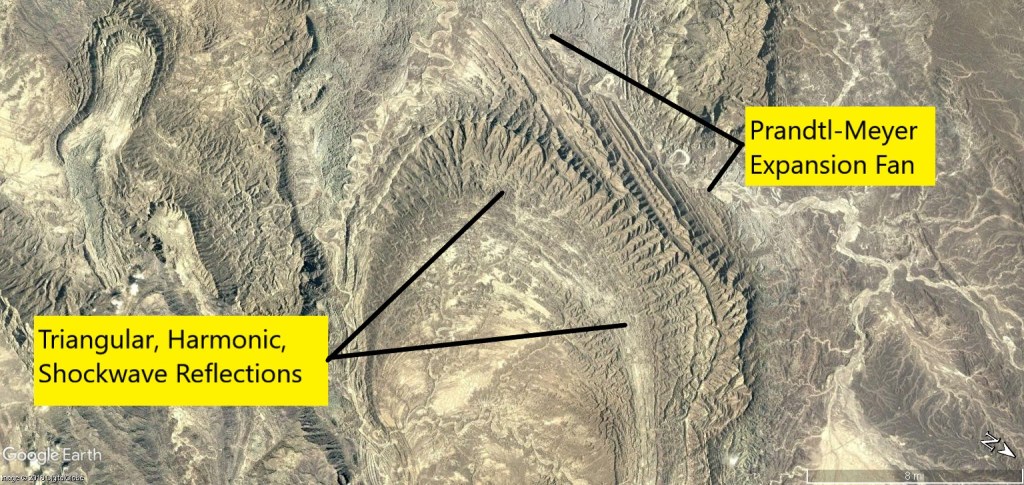
This differs from the consensus theory which has granite formed deep in the Earth as a volcanic flow that didn’t erupt to surface, but became trapped under extreme pressure and temperature for eons as it’s crystals grew. Then an accordion-like action of the Earth’s crust, triggered by subduction of the continents, caused these granites to be shoved 5000 feet above sea level where they have been lashed by wind, rain and freeze for millennia to produce the polished and rounded, but sometimes square granite boulders that we see.

At least the consensus and I agree there was extreme heat from within the Earth. My boiling drop-theory suggests things pretty much happened all at once due to a high voltage electrical impulse diffusing through a sandstone aquifer.

Boulder Foam

Evidence the boulder formations are boils is their shape, as depicted in the images previously shown, where singular drops formed and froze. While some retained an ovular shape, they dehydrated and contracted as they cooled, often leaving conical or flattened drops. This is exactly what one expects from a hot molten drop that cools, dries and solidifies quickly.

More often, however, one finds clusters of boulders that were once co-joined, like bubbles in a foam. In a foam, bubbles and drops conform to each other, matching shapes across cellular membranes. It’s very obvious the boulders shown in the next set of images are clusters of drops that have dried and fallen apart, leaving matching surfaces where they were co-joined.

Steam and other gasses exited the rock as it cooled. The expansion of gas and steam at the surface contact with atmosphere likely helped cool the surface faster, increasing the surface tension in the skin and causing shrinkage of the drop. As the drop shrank it separated into lobes, which further shrank and broke apart.

Comparing the boulder clusters shown, to the bubble clusters in the next group of images, one sees the same polygonal interfaces, the same segmenting and interstitial bubbles wedged between larger bubbles. The only difference shape-wise is that boulders are solidified drops, not bubbles, and they shrank as they dried causing segmented lobes to separate and fall apart.

When bubbles and drops cluster, those on the interior of the cluster tend to be polygonal shapes. Because the internal pressure between co-joined cells in a cluster is more, or less equalized, internal membrane walls experience no pressure differential and are flat. Outer cells in the cluster, however have a differential between interior pressure and the atmosphere, and therefore bulge. That is exactly how these boulder clusters are structured.

If one makes a symmetrical cluster of five equal bubbles, the one inside the other four will be a perfect cube. There are several examples of polygonal bubbles in the images shown. Singular boulders tend to be rounded, while boulders in clusters tend to be polygonal, especially the ones in the cluster centers.

The squared shapes and flat surfaces between boulders is proof they formed as drops in the atmosphere. This granite has no “grain” oriented in a certain direction, or any other internal structure that would cause them to break in a particular way as a result of earthquake or erosion. The only explanation presented by physics is if these rocks were clustered drops. A child can make a perfect square with soap bubbles. I challenge any PhD to do so with erosion.

Surface tension had to conform to the volume reduction, so one of two things happened. If the skin had cooled and recrystallized, it became rigid and further shrinkage of the hot interior caused the hard shell to break, leaving a sharp crack. If the skin was still plastic and viscous when the drop shrank, the skin conformed around the fluid interior leaving rounded edges. Most, if not all rock structures display one, or both consequences of shrinkage.

Separations that occurred from shrinkage after the skin ‘set’ into a hard shell, couldn’t conform and broke, leaving sharp edged cracks, as shown in these photos. These breaks tend to form an “S” shaped curve, not orthogonal segments.

Drops in clusters, with membranes still soft and pliable, show rounded edges and concavities where drops separated and shrank. These cellular segments tend to break parallel and orthogonal, at specific angles particular to each cluster.
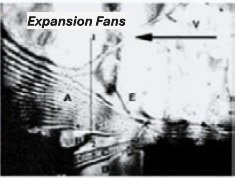
The angles, or dip of the horizontal surfaces vary widely. It seems likely some force was pushing some clusters over, like the wind, or gravity was making them topple. The angles from one cluster to another are not consistent, which suggest variable winds, something perhaps expected over a boiling cauldron.
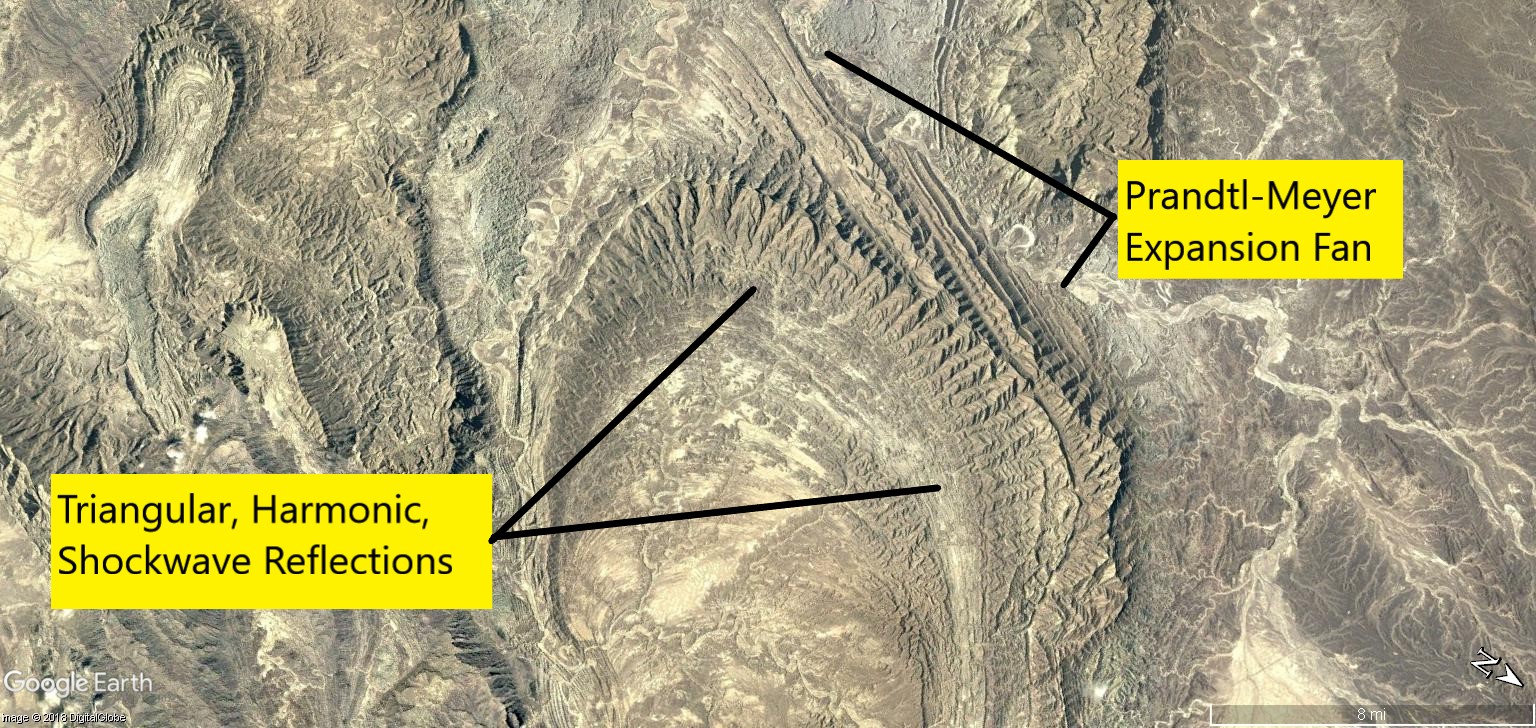
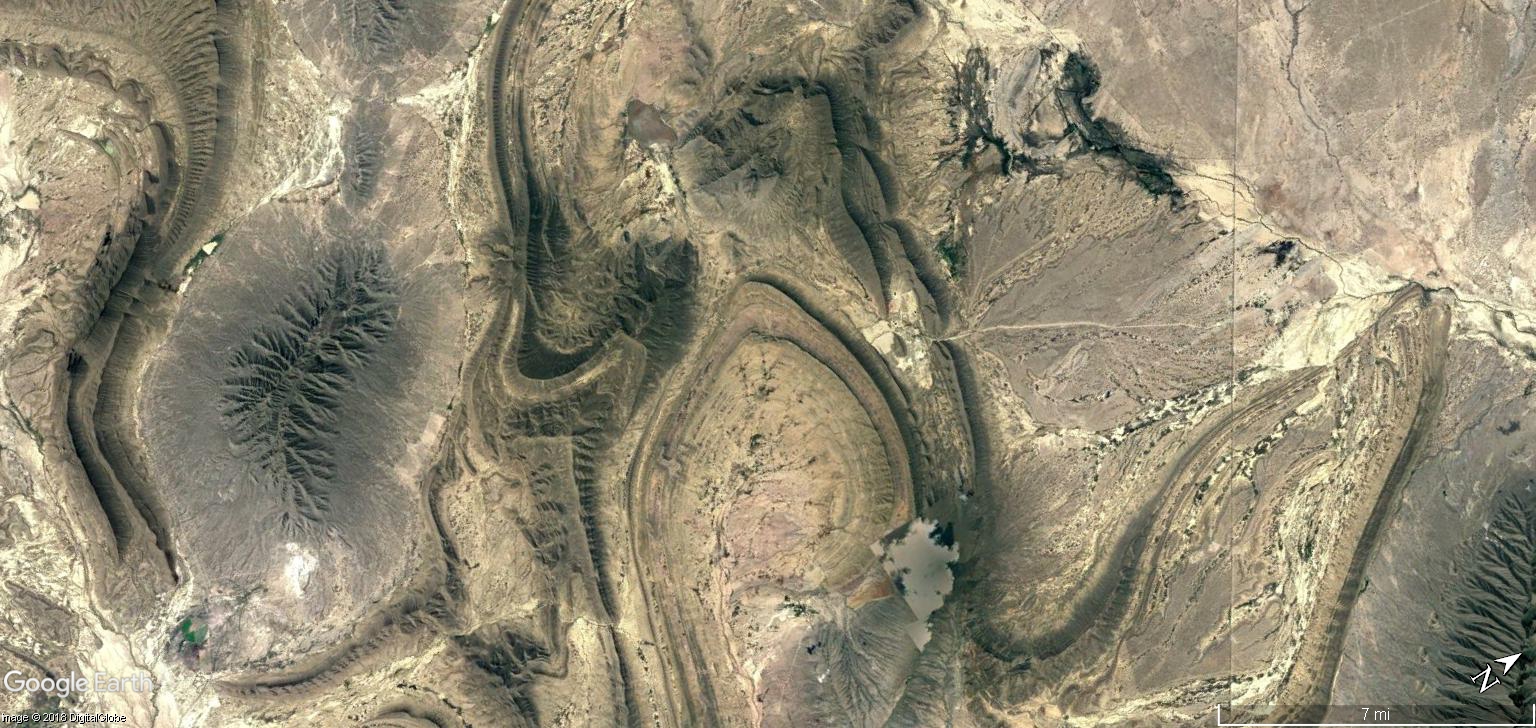
Another compelling evidence these boulders are boils is the columnar geometry of the largest structures. The segmenting is cellular, as already discussed, caused by cooling, shrinkage and surface tension related skin effects. The columnar shape, however, indicates convection. Vertically elongated, clustered polygonal columns are a known effect of heat convection, called – what else: convection columns. What is boiling? A process of heat convection.

Flat surfaces are left where bubble walls pressed in tall squarish columns, and then fell apart after cooling, shrinking, cracking and segregating. Everywhere boulders are co-joined, or conforming to each other in shape, interfaced with puzzle-piece concavities and bulges, because they were fluid and plastic during formation.

The granite boulders are visually patterned precisely as one would expect a viscous, frothing fluidized matrix to look if it were frozen mid-boil. Compare these formations to viscous drops, bubbles, foams and boils of various fluids and you can find analog formations with these shapes and features.

Look at the sequence of images below, and it’s apparent how the bubbles separate. It begins with a thin crack where a shrinking drop begins to segment into smaller drops – top left and bottom. Then drops begins to separate, and the edges round-off along the seam in fluid manner, like a bubble. And then they separate completely, like water balloons. These are examples of shrinkage when the skin is still plastic and molds around the cooling drop of molten material.

Another evidence for boils are top hats – one boulder directly atop another. Consider a viscous, molten drop where the surface rapidly cools and crystallizes to a semi-solid crust. And then more hot fluid pressures up inside, but the bubble’s crusty skin can’t expand, so fluid gushes out the thinnest skin of the bubble at the very top, thus creating a new bubble stacked atop the old. In the case of a cluster of bubbles, they can stack into columns.

A similar feature is the necklace, where interstitial drops seep-out around the base of larger drops, forming a beaded necklace.

One evidence I consider irrefutable is the “water-balloon effect”. The next group of images is of the same rock structure from different angles. I’ll just point out the obvious. The top, segmented rocks were once fluid sacks, like viscous water balloons that erupted out the top of an older boil and flowed down it’s back before shrinking, segmenting and solidifying.

Opposite the dripping side of the balloon is a concave side where drops in the cluster pressed against other drops that have since fallen away.

Wind, I suspect, flattened and pressed these bubbles together forcing the concavities instead of forming the more typical orthogonal cracks and separations seen in the majority of boulder clusters. The inner folds of the concavities have fluid ripples – the actual impression of turbulent waves and ripples in the separating skin between bubbles. I interpret this as an indication wind, seismic, or some other cause was vibrating the bubble.

In the following gallery are several more examples where drops in a cluster pressed together, leaving concavities beneath overhanging ‘water balloons’:

There are multiple other patterns in the rock that display fluid/drop/bubble behavior. Large waterfalls of rock can be found where a molten mass erupted from the flanks of a mountain and sheet-flowed down it’s side, like a volcanic lava flow.

Close examination of sheet-flow patterns show even more evidence, such as the appearance of standing waves.

The pattern of a viscous river shows where flows joined to form standing waves:

Looking at the foot of the granite flow, it resembles the foot of a glacier, or lava flow:

Perhaps the most compelling, singular example the rock formed as a boiling fluid, and suddenly froze when exposed to the atmosphere is shown in the next example. Here, liquid rock has poured out the side of a pillar and froze like a faucet of running water.

This next photo shows the same thing – a pouring outflow from a standing column:

Pouring outflow spilled down the right side and pooled below.

Like injection molds, the rocks have nubs and tubular pour spouts where fluid passed between cell structures:

There is something to be said about the regularity of how rocks section in proportion to their volume, as if there were a frequency causing a harmonic response in the body of the rock. It could be a seismic vibration from the fluidized, boiling cauldron itself, or it could be from sonic shock due to atmospheric winds. It’s also possible that the piezoelectric effect of current in the crystallizing skin of the boils caused vibration.

Many questions remain to be answered about how this rock formed. The atomic and chemical reactions are complex given the unknown amounts of current and potential involved, the profusion of elements involved and the unknown state of Earth’s atmosphere. Even Earth’s orbit and what it orbited around at the time these rocks formed is unknown.

One thing for sure, however, these rocks formed in atmospheric pressure. There is no possible way these shapes were produced while confined deep underground. Nor is it possible they were produced by any form of erosion. The forms were caused by a viscous, plastic fluid confined only by surface tension. Their shape is self evident. There is no argument that can be made to deny it. They look like drops and bubbles because they are.

There is a reason boulders boiled from the Earth east of San Diego. To understand how this happened, Part 2 of the Granite Cauldron will look at the mountains themselves and how they formed.

Shine On, You Crazy Diamond!

This week I received the news of Wal Thornhill’s passing. I wish to pay tribute with this article. Wal was a mentor to us all in the most important field of all – the true nature of our universe. Wal’s many theories and predictions succeeded because he sought the truth. Not for credentials, funding, accolades, or power; he sought the truth for the sake of knowing – as we all should. It’s the true intent of science. It’s a true source of joy.

I began this article, weeks ago, to discuss the truth. It was never intended to be about Wal. It was, and still is, about truth seekers in the Electric Universe. “Shine on, you crazy diamond” is an ode to garage experimenters, theorists, scientists and deep-thinkers everywhere who are grounded and harmonized with natural frequencies. But Wal is the epitome of such people. No B.S. got past Wal – believe me, I tested him. So, the title now takes added meaning – as things always do in a fractal universe.
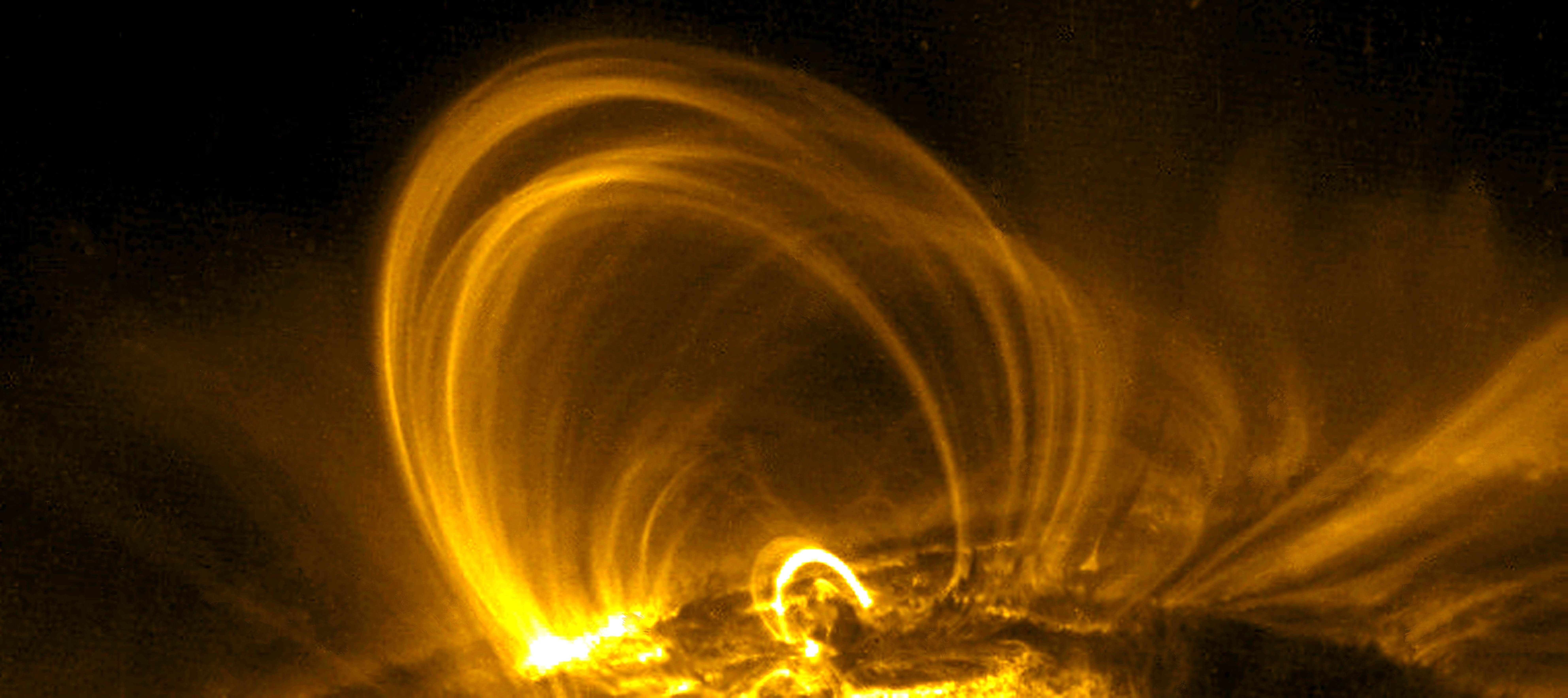
How do you know the truth when you see it? It’s because you recognize a pattern. You trust yourself to know what you are seeing, hearing, or feeling. You know because it resonates within you. A pattern from memory, like a mother’s face, is a pattern that harmonizes heart and soul, and you know. There is no doubt, the instant you recognize Mom’s face, or whoever is your closest, “every bone in your body” knows it. It’s something everyone does. But it isn’t work of the conscious mind. It’s the work of an observant state of being. It involves every sense, conscious and unconscious, mind and body; the whole antenna resonates.

Like riding a bicycle, your mind doesn’t tell your body how to keep balance. It just does – as long as you stop thinking and just pay attention.

When I first stumbled into the Thunderbolts.project, I didn’t have a clue what I was going to write about. I just knew I found the right place. In the first weeks I binged on Thunderbolts videos, especially Michael Steinbacher. I watched all of his. As an engineer with a smattering of geology experience, it made sense to look for electrical evidence on the Earth. After-all, it’s accessible, more-so than telescopes, particle beams and buzzy, high voltage labs.

Michael’s videos led me to an addiction: Google Earth. I’ve always had a thing for maps. There are patterns – always patterns, whether looking at highways, cities, airline routes, or topography – there is a wealth of information in the patterns. Earth’s topography is patterned. I could not put a finger to how, or why, but I could see patterns that stretched for thousands of miles that had no ‘reasonable’ explanation. There were repeating patterns, geometric patterns. Some patterns were similar to other planets, yet others were unique. There had to be a reason. I had already dismissed conventional thinking at this point, of course, and reasoned these features must be electric. We see, plainly, electrical scarring on planets and moons, and the electric atmospheres of the gas giants. So it must be on Earth – but why does Earth look so complex.

I stumbled, again, always stumbling, into evidence of shockwaves on hillsides. It came about because I searched “craters” and found a blog by a guy who was a demolitions expert. He was writing about shockwave features on hillsides near his home and proposing they were crater rims. He recognized harmonic tetrahedral patterning caused by sonic shock because he’ d spent a career in the military analyzing the blast zones of heavy ordinance. He was a man who knew shockwaves when he saw them.

As a mechanical engineer, I have a good amount of experience with such things myself. Shockwaves – yes, but more importantly, I’d learned to listen to technicians like this guy. The operators, the mechanics, the people who are hands-on. If you want to know the process, don’t ask the people who manage it, ask the people who operate it. Beyond already knowing something about “shock diamonds”, I innately trusted this guy knew his patterns, even though he had no academic credentials.
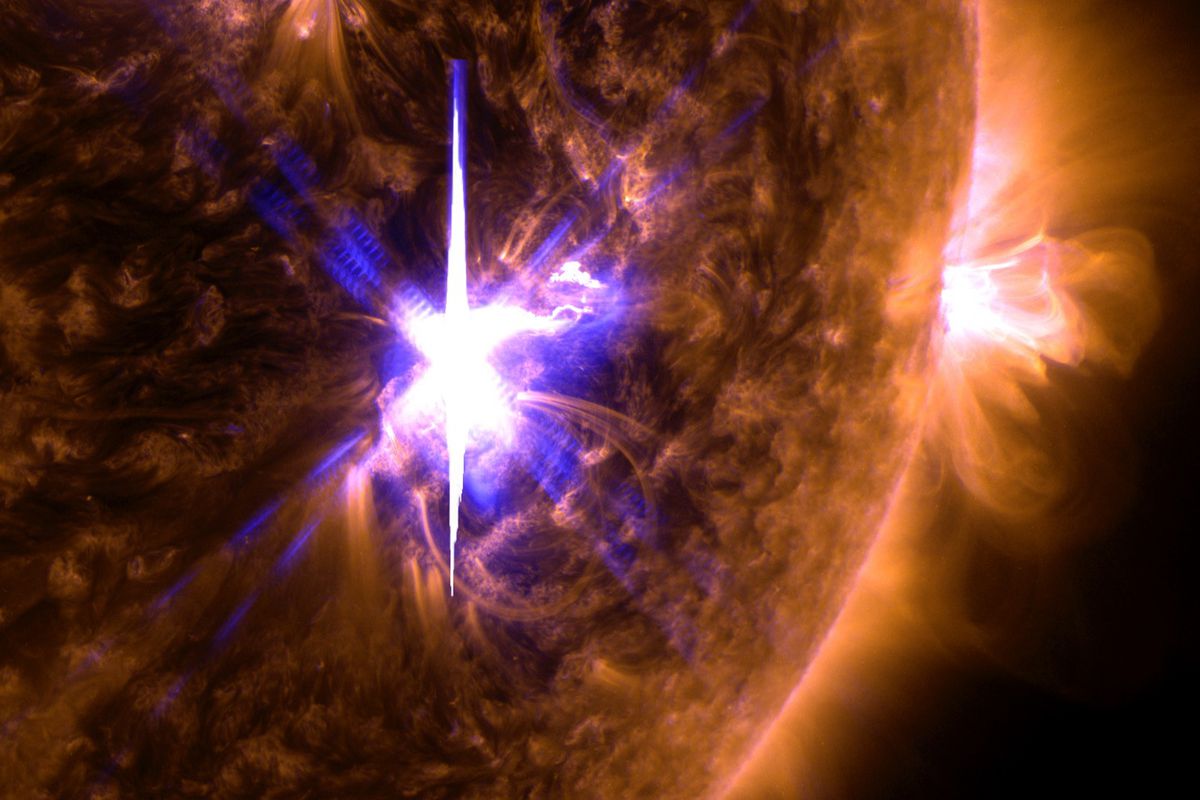
I began searching for these patterns. Lo and behold, they are everywhere. Not only did I find harmonic tetrahedrons, created by compression zones called “separation bubbles”, formed where a super-sonic wave impinges on a surface. I found multiple features of fine detail distinct to shockwaves embedded in rocks, mountains and entire mountain chains. Scalable, harmonic, self-similarity plastered across the global landscape everywhere I looked could only be from one cause: sustained plasma storms.

I finally had evidence, from personal investigation – from a position of knowing – what caused patterns, at least many on Earth, and that we indeed live in an electric universe.

Only a charged environment could develop supersonic winds that could freeze rock in-situ in the precise form of the shockwave. Coulomb force and recombination is the only process that makes physical sense. A dusty plasma environment would accelerate winds to supersonic speeds, rippling the landscape wherever shockwaves reflected and segregating winds by step voltage and ionic density. To produce what I witness on Earth’s crust, Earth’s atmosphere had to be a rainbow-banded chemical soup, like Jupiter’s atmosphere. There had to be several global storms to produce the layers of geology and episodic fossil evidence of extinctions – a recurring nightmare.

And since I’ve written several articles showing the shock features in detail, showing self-similarity between Jupiter’s storms and landforms on Earth, and exploring many other geologic examples of electrical formations and scarring, I know what I’m showing you is the truth. The patterns speak for themselves. My explanations may suck. I may not describe the electric circuit properly, or organize my streams of consciousness well, but the geology is there, Jupiter is there, winds, storms, rocks – it’s all out there to go look at for yourself. The data I use is open source, available to anyone with an internet connection. One can research shockwave patterns, standing waves, separation bubbles, and anything else I write about with a few clicks of a mouse.

You can see the patterns for yourself. It’s the only thing that will invoke faith, because that is what knowing the truth comes down to: faith. This brings me to the point. Faith is how you know the truth. Faith in yourself. Do you believe your lying eyes?

I’m not speaking about faith in God, although that is the ultimate faith. I’m using a small “f” faith to mean conviction in any particular realm, such as the faith one has they can unerringly find their mother’s face in a crowd, or ride a bike. It’s a reliance on all of your senses, conscious and unconscious. You recognize the pattern, and your gut, heart and soul resonates. It feels right. It’s common sense. When you know, you know.

How else can one know they are objective unless they know and trust themselves? It’s an internal thing, to be confident in oneself, and the only way to satisfy that is to see, hear and feel for yourself. Relying on someone else’s word makes one a parrot.

Now this brings to question, how can I have faith I know what I’m seeing when pretty much the entire world of academia ‘knows’ I’m wrong, and that tectonic forces like subduction, expansion and uplift created mountains, plus billions of years, blah, blah, blah.

Because they don’t show you anything but drawings and models. They can’t explain, or even try, the fractal forms; the harmonic repetitions; the phase-angled vectors of frequency interference. Their explanations don’t explain; they describe processes that no one has ever seen. The one thing they never talk about is electricity in circuits, which is like explaining life without mentioning breathing. And if you dig down to their fundamental assumptions that underlie the whole house of cards, you’ll find it’s based on unfalsifiable, “billions and billions of years”, dark energy-type dreamed-up concepts force-fed by whatever humpty-dumps were in-charge.

In other words, to believe them is to trust them rather than yourself. And they’re idiots.

I also know, because I worked in the energy industry, that much of science is political, not truthful. It’s marketing – it’s meant to persuade you, not inform you. This corruption is pervasive throughout quakademia.

If you seek the truth, without fear, or bias, you’ll know when you find it because you’ll find confirmation. It will present itself – you just need to be aware. A week ago I camped on flat “alluvial” plain covered in gravel near the Colorado River. I knew the plain to be a windblown feature created in the arc-blast of a discharge event. It had nothing to do with an ancient river bed as consensus theory would have you believe. So, I began examining the gravel. It was predominately typical river rock, rounded by water erosion as consensus theory goes. But as I picked up rock, after rock, a specific pattern became evident. Many, if not most of the rocks I looked at had a flat side.

One side indeed was rounded and polished, as if washed by sand and water, but one side was flat. Which entirely confirmed my expectation, because I suspected such gravel to be the result of rock rain. These “river rocks” fell like rain after being blasted into the sky as molten glass and reconstituted as drops and hailstones. The ones that were still hot and molten inside, but had a cooled crust, landed like pudding drops, making the flat bottom; and the top exposed to winds, still screaming, made elongated and rounded streamlined tops to the drops. You know these rocks. They’re the best ones to skip.

The flat bottom is the tell. Water erosion doesn’t explain that. The rock rain was a pleasant surprise. I wasn’t looking for it – it was just there where I camped. This happens almost continuously from things as mundane as gravel, because the entire planet is evidence.

One will also find along the way people like the demolitions expert, who’s blog and identity is somewhere in the way-back machine (I’d like to thank and credit him). Obscure blogs and videos arrive in my streams weekly that either inspire new insight, or confirm a prior postulation. Seek and you will find, because that is part of the pattern.

I watch YouTube channels with less than 500 subscribers who know better than professors; people with no academic background but with curious minds who examine magnetism and electricity with products from e-bay. I listen to people with spiritual connections, who’s faith comes from experiences scoffed at by consensus science. I read random articles in the news… find rocks here and there. I live a continuous stream of synchronicities. Information specific to my questions arrives at my doorstep, as if asking the right question is all the invitation Nature needs. The universe wants to show itself to those who want the truth. Evidence is everywhere.

Personal observations led us to know that the Universe is electric. We all recognize the obvious: plasma nebula, swirling galaxies and everywhere the blaze of electro-magnetic balls of discharge called stars. We can see what a crater really is, and therefore lose no sleep wondering why so many are hexagonal. We know, thanks to Halton Arp, that redshift isn’t a measuring stick, and his evidence alone makes the whole Big Bang thing nonsense. We know weather and climate is the Earth’s circuitry in action, and therefore are not shamed by our carbon footprint.

What binds us all is truly electric. The ether flows through us, as the light and warmth that generates the hologram, so there must be a common carrier wave at it’s frequency we all receive. Wouldn’t any creature evolve the ability to ‘hear’ it, given it’s all encompassing pre-imminence? Notwithstanding the uniquely human inability to listen, it seems a natural thing for life to feel that energy. Think of the mysterious animal behaviors, like foreknowledge of severe weather and earthquakes. A pet knowing when a master is on the way home. Telepathic signals are real, IMHO, and they have a physics. One must acknowledge an ether, however, and look inward to find how to tune-in.

In this regard, we are all scientists, by my definition. We each took a look and said that’s electric, because it so obviously is. Recognizing the obvious is critical thinking. Manipulating math to invent invisible forces, energies and matter is, of course the ultimate woo. One can make math simulate anything if you make the rules.

Truth comes about due to intent. Truth is accessible to anyone with the unflinching intent to find it and speak it, because it’s out there waiting for you. As more people become tired of the BS, they will look for new answers. I expect many will find us.

I expressed this expectation to Wal late last year in a few brief email exchanges. He agreed the future will be amazing. He also said keep finding the patterns. Why I think this is a fitting testimony for Wal, is because he and Dave created this environment to explore truth. That is his legacy.

Cheers to anyone who follows it. Shine on, you crazy diamond!