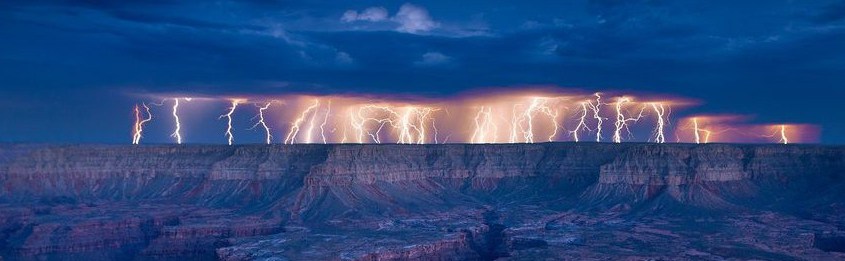
A three part examination of electricity and it’s role in severe weather.
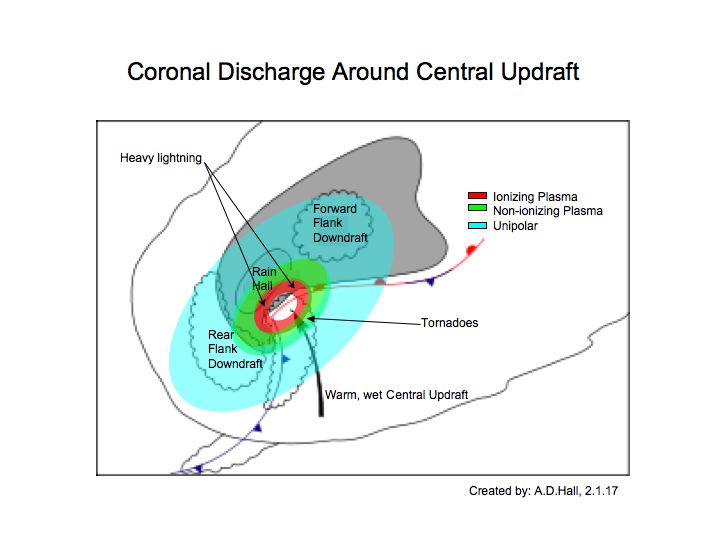
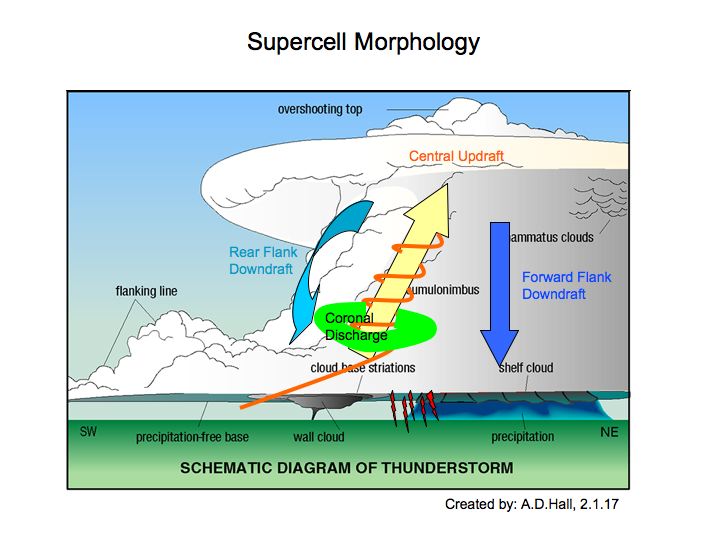
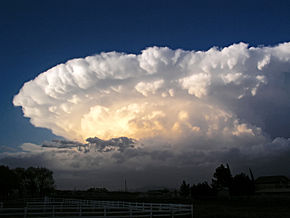
Thunderstorms exhibit precisely the attributes of plasma discharge between an electrode and ground. I show that laboratory produced coronal emissions from a point electrode, through an air gap, to a flat plate electrode, produce the same effects as a thunderstorm. I correlate these effects with the morphology of a super-cell and the lightning, rain, downdrafts and vortex winds they produce.
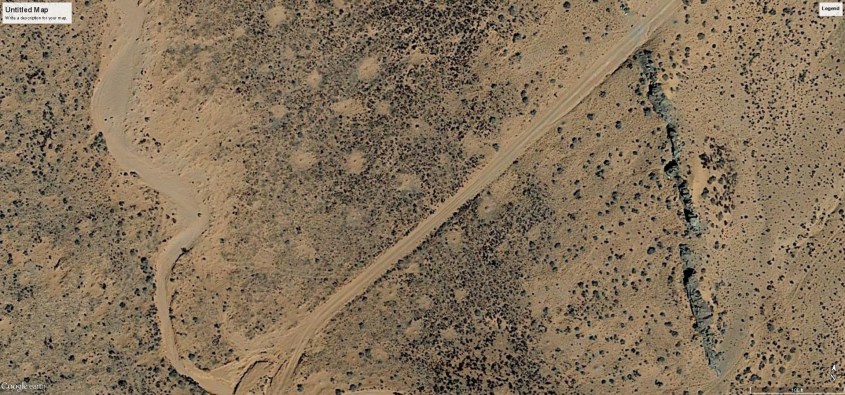
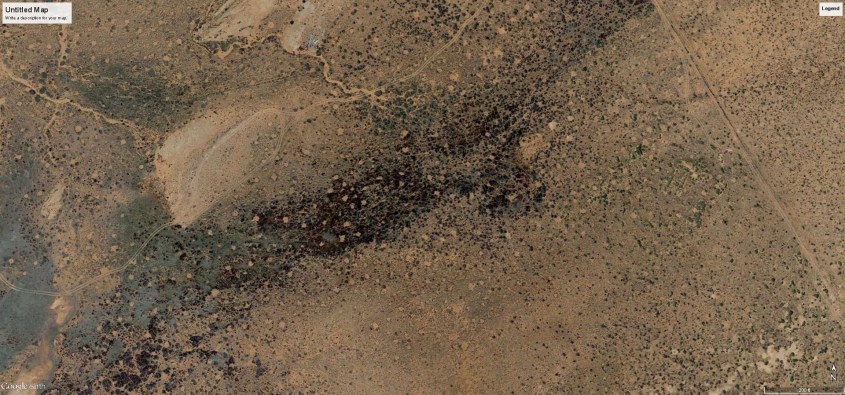
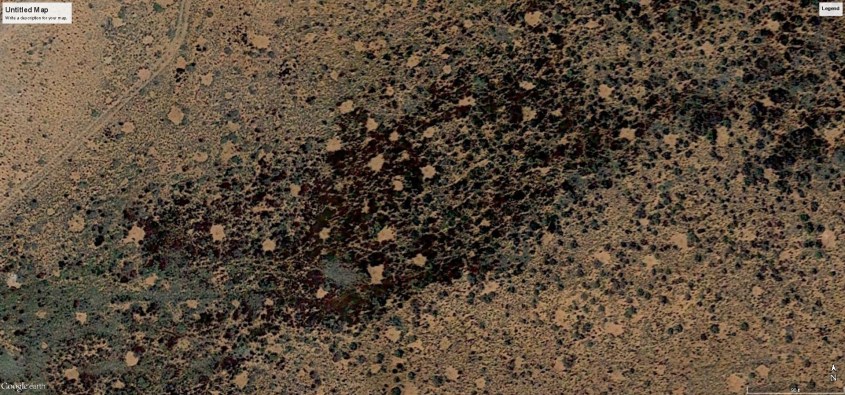
A two part discussion of volcanoes and electricity. I explore the Pinacate shield volcano in Sonora, Mexico. It lies near the border, at the tip of the Sea of Cortez. It is an especially pristine and striking volcanic field.
It’s best known for huge maar craters, which appear to involve electrical discharge. The maar’s have rim craters, which is a feature that seems out of place in consensus theories. The crater rims appear to be sucked inward from the rising eruption, rather than blown outward as typically believed.
There are many electrical features in the Pinacate reminiscent of what is seen on the Moon, Mars and Mercury. Of course, Electric Universe believes these to be electric, too.
I contend these are from electrical discharge from beneath the surface of the Earth.
Here is a three part presentation on Arc Blast. It’s a theory on mountain formation based on evidence of coherent, harmonic shock-wave features found on mountains everywhere. Mainstream science contends these are features created by water erosion. Take a look at what I present and decide for yourself. Consider how water can erode rock into layered, harmonic forms.
Presentation at the EU 2016 conference in Phoenix.
This is my first EU conference, where I present Arc Blast, my theory of how electrically generated winds create mountains. I show evidence in mountain features that display coherent, harmonic wave forms produced by supersonic shock waves, and theorize how they were created.
I provide a new presentation in 2017 that somewhat modifies and expands the theory of how such winds and shock waves were generated. Like all scientific inquiry, new data brings new meaning. The 2017 presentation is available at Thunderbolts.info.
Following the 2017 conference, several of us decided to see the Grand Canyon. We left for Flagstaff as the Solar eclipse ended. We made several hikes over the following days. This film was taken by Andrew Fitts at a cinder cone in the San Francisco peak volcanic field, called Red Mountain. An article on the conference is here.
Ginger and I look for ‘squatter man’ in a variety of locations near Tucson, Arizona … without much luck.
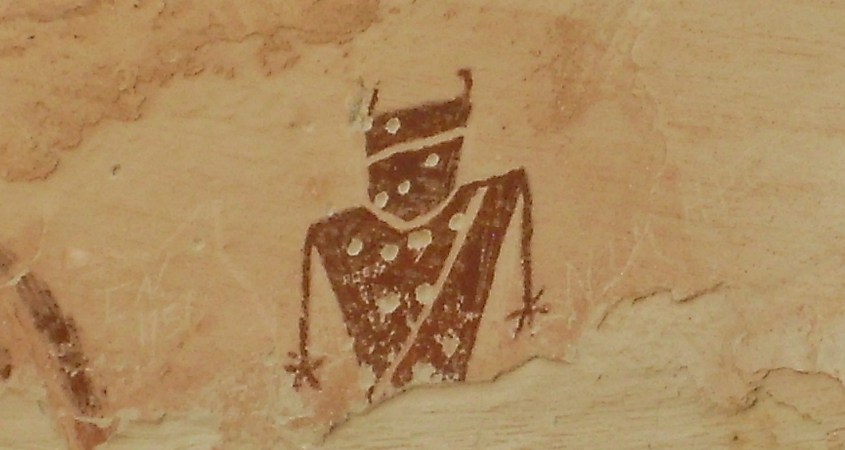
‘Squatter man’
Archaic petroglyphs are found on every continent except Antarctica. They are figures pecked into rock. Typically they are found on rocks that have a patina of dark glaze called desert varnish, and the artist created the figures by pecking away the varnish to expose the lighter, native rock beneath.
Similar figures are also found in intaglios, like those at Nazca, Peru, and on other forms of carved art, like the ‘Rongu Rongu’ text of Easter Island, and even totems found in Siberia.
They were made by stone age people. Although when they were made can’t be dated by the rock itself, some have been found in association with campfires, or crusted with lake sediments that can be. They indicate some were made as long ago as 10,000 BCE.
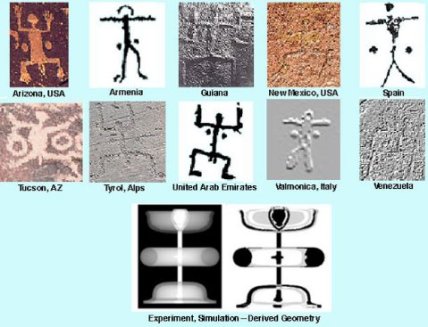
What is remarkable is they depict the same variety of patterns – squiggly lines, concentric circles, spirals and other geometric shapes. Also animals, ladders, oddly elongated alien-looking figures, and of course squatter man – a stick-man figure with arms and legs spread in a variety of “hands-up, don’t shoot” postures.
Peratt Column
Actually, squatter man comes in several forms, sometime with a bird’s head, sometimes a fat belly. Yet these figures are consistently found everywhere, as if ancient people around the world had exactly the same idea.
How do the consensus scientists explain this? Some speculate that ancient man lacked imagination. Their emerging artistic abilities only allowed them to create these stick-like figures to represent people dancing and cavorting around the rocks, the animals they hunted, and simple geometric shapes that pleased them.
Others speculate that shamans made them after eating hallucinogenic plants, and the shapes are similar because their visions were created by the drug. I can tell you, these shapes are not what one sees with any magic mushroom, hallucinogenic cactus, DMT, or even LSD. I can speak with authority on that.
Alternative theories abound with the ‘Ancient Aliens’ community and UFO crowd. Of course they see evidence of aliens and UFO’s in every enigma from the past. Like the consensus scientists, they have a belief system to satisfy.
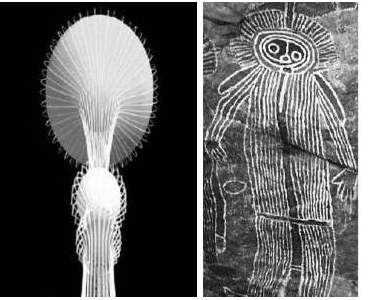
What they really are was discovered by a PhD., plasma physicist at Los Alamos Laboratories; Anthony Peratt, in association with Dave Talbott, one of the founders and principal researchers behind the Thunderbolts Project. Talbott showed Peratt one of these figures and he immediately recognized it depicted an extremely high energy ‘plasma instability’ like those created at Los Alamos for nuclear research. In other words, they depict plasma aurora like the Northern Lights, except at extremely high energy unlike we see today.
Squatter Man
Peratt performed an extensive investigation, engaging volunteers from around the world to document over one million of the figures. They documented the shapes, locations and orientation with respect to what direction the creators must have looked in the sky to see the glowing apparitions. His work is documented in a peer reviewed paper published by IEEE, the largest professional science journal in the world. This link will take you to Plasma Universe, his website, where you can find the paper and many more details about the phenomena.
The implications are enormous. For one, it explains why the same figures appear around the world – because people in the distant past witnessed them in near-earth space. It explains the enigma of such features as the Nazca Lines. Also, it means ancient people were experiencing an extreme event in the solar system, possibly from huge solar flares, or a large passing comet. Something energized earth’s magnetosphere with electricity that caused these auroral patterns to appear.
The event would have been catastrophic, because it means Earth would have been washed in deadly radiation. They point to a time in the past when catastrophic events occurred – a lost chapter in our past we don’t fully understand.
One would think archaeologists, historians and paleontologists would be thrilled about this discovery. One would think … but not so. They have totally ignored it because of scientific jealousy and because it doesn’t fit their paradigm. Who does this electrical engineer, Peratt think he is?
I talked to one “expert”, a PhD who actually studies southwest rock art for a living. He asked if Peratt had his silly paper peer reviewed by a proper archaeologist. I said no, because archaeologists don’t know diddly about plasma. I doubt one could be found who studied algebra, let alone quantum physics. It’s unfortunate, but consensus science shows less real curiosity about the cosmos than they do a need to protect their own theories and belief system. Science for many has become a pseudo-religion, not a method of inquiry.
Rocks in the deserts of North America have thousands of these petroglyphs. In this Electric Earth video, I’ll take Ginger on adventures to find some. It isn’t easy.
Previously, in Nature’s Electrode, we looked at an Electric Earth model for lightning genesis driven by a plasma corona formed from condensing and freezing water vapor in the central updraft of the thunderhead. We also looked at the thunderstorm itself, and an electrical model for the circuit that drives it, in The Summer Thermopile. Now let’s consider the most dramatic weather event of all, the tornado, and how these massively destructive whirlwinds are also formed by a plasma corona in a thunderstorm.
For air to become plasma and carry current, the air has to be partially ionized. A plasma state can be defined by “plasma density” – the number of free electrons per unit volume, and the “degree of ionization” – the proportion of atoms ionized by loss, or gain of an electron.
A gas with as little as 1% of the particles ionized is a plasma, responding to magnetic fields and displaying high electrical conductivity. A partially ionized plasma is often referred to as a “cold plasma”, and highly ionized plasma is referred to as “hot”. Discharge from a corona is predominately a cold, dark current, invisible to the eye.
Cloud-to-ground arcs come from high charge density regions of the corona, surrounding the central updraft where current from the updraft generates ions. Ground charge builds below this region in response, and the electric field strengthens, magnifying and focusing electron avalanche the way a lens focuses light, into a continuous plasma channel. When the channel connects with ground and discharges a hot current, it wraps tightly in it’s own magnetic field, in what is called a ‘”Z” pinch’.
Moving away from this self ionizing/high electromagnetic field region of the corona, free electrons spit at the ground, but lack the energy and focus to avalanche all the way, creating instead a mobile cloud of ionized gas that follows the field gradient to ground, generating a dark current. The current is said to “drift” in this region, yet the electric field still organizes the drifting ions into a columnar channel.
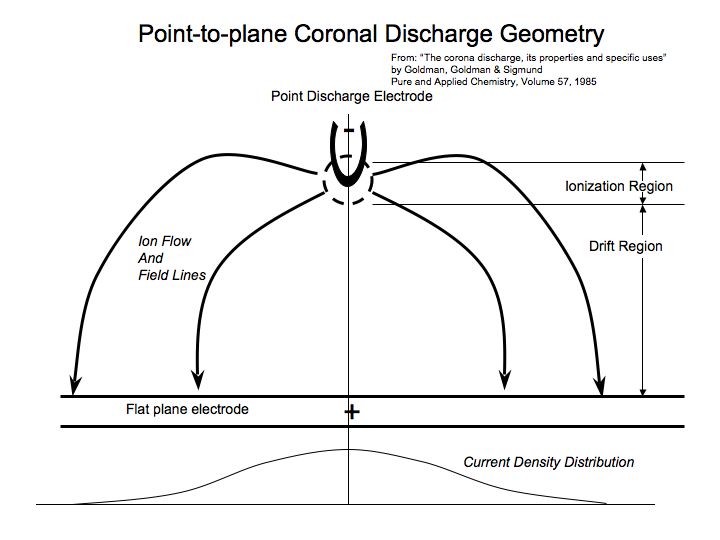
In the image, the center of the coronal discharge is focused and imparts more energy to cascading electrons, creating the potential for arcs (see the current density distribution at the bottom of the diagram). Closer to the outer edge of the corona, weaker reactions manifest in transfer of momentum and heat with ions and neutrals. Downdraft and down-burst winds are the common result.
Momentum transfer manifests as downdraft winds by the process of electrokinesis, which is neutral species attracted to, and mobilized by, the charged particles zooming down the electric field gradient towards ground, creating an ‘electric wind’ that moves the bulk fluid along the electric field gradient.
If the ionization rate exceeds the rate of recombination, the plasma will build a streamer, a tendril of plasma from cloud to earth, pushing a plasma generating ionization region ahead of it, and drawing behind it a cloud of cold plasma. When this plasma hits ground, a cathode spot is produced, and the electromagnetic field redistributes along the plasma channel, focusing it.
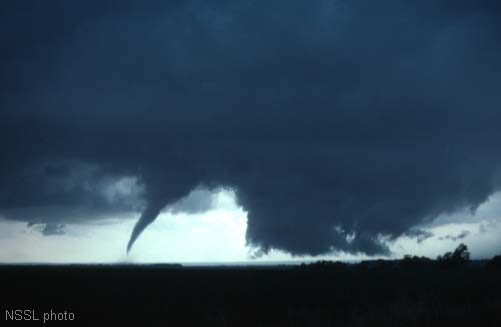
The cathode spot on the ground draws positive charge to it, dragging neutrals, again by electrokinesis, and creating the in-flowing winds that generate a ground vortex. This is the moment of tornado touchdown, as charged air and dust flow in and spiral upwards around the invisible plasma tendril.
The action is analogous to the lightning bolt leader and positive ground streamer that meet to create a channel for lightning discharge – two seemingly separate events, organized into one coherent structure by the electric field.
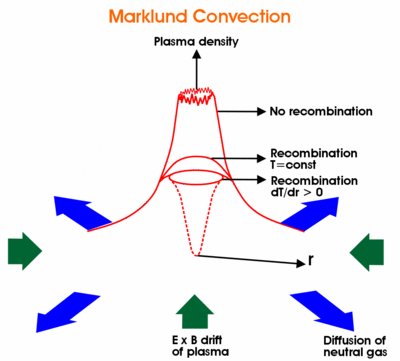
The plasma current thus created is a complete circuit to ground, only it’s partially ionized, diffused with predominately neutral species. Its energy and charge densities are too low to make an arc, so it forms a complex plasma channel called a Marklund Convection.
Marklund convection, showing diffusion of neutral air away from current tendril (blue arrows) creating low pressure. Plasma drift (green arrows) draw positive ions at ground level, creating inflowing winds to the point of contact with the plate electrode.
Rotation is a natural consequence of the circuit. Neutral air is diffused away from the Marklund current creating low pressure. But positive ions near the ground drag air, dust and debris to the ground contact and create in-flowing winds and a sudden change in direction up, and around the tendril. The meeting of these opposing winds is the ground vortex.
The current flow in the plasma will itself rotate, taking a helical path as it interacts with the magnetic field around it. The appearance of a tornado is precisely the expected morphology of a Marklund current. Increasing current flow “spins up” the tornado.
It forms an inner, spiraling, negative current to ground and an outer spiral of positive ionic wind flowing up to the source of coronal discharge in the cloud.
Because the tornado is a cold, partial plasma current exchanging charge between ground and atmosphere, it can be pushed by winds to create a slanted, or kinked path, and travel away from it’s point of origin.
Evidence…
There are several tell-tale signs the electric model of tornado genesis is correct.
Wall clouds…
One evidence is the wall cloud. Wall clouds form before a tornado in a typical storm evolution. It develops rotation and sometimes its clouds can be seen to rise and fall in an agitated manner. Puffs of low level clouds are drawn to it below the main cloud base.
The wall cloud is a physical expression of the corona. As the corona gathers charge, it creates a lowering, vertical wall of cloud as ionization condenses moisture in the column of air below that is incongruous to the general slant and motion of the storm clouds and in-flowing winds. It’s visual evidence of a region where the electric field is strengthening and the corona is increasing charge density prior to establishing a current to ground with a tornado.
The funnel cloud doesn’t always emerge from the center of the wall cloud. The funnel often appears along the edges of the wall cloud, or from the surrounding clouds.
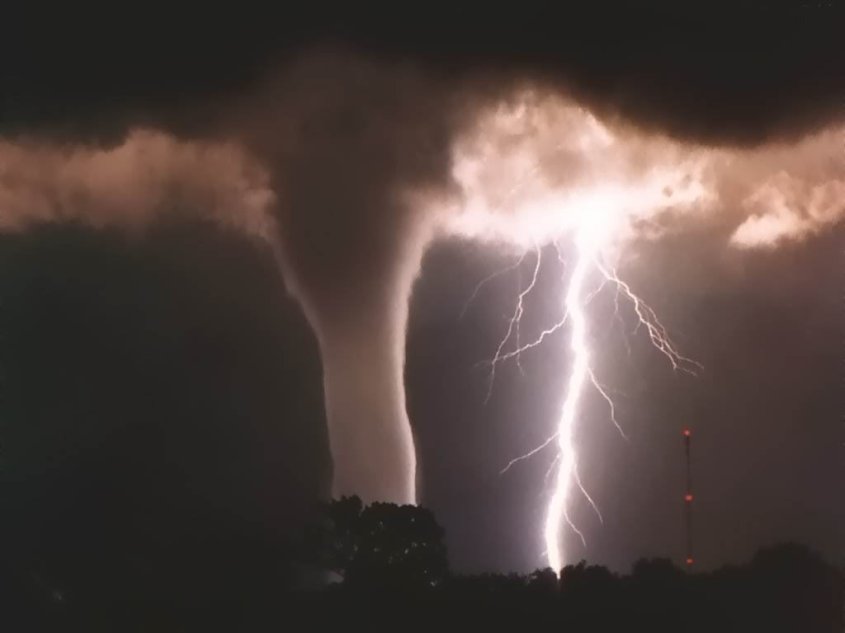
This is because the region of charge density is mobile and can wander. They can also multiply, creating several tornadoes.
Characteristic of parallel currents, multiple tornadoes stand off from each other as if repulsed like two parallel wires flowing current in the same direction. Rare occasions when tornadoes seem to merge, it may be that one simply dies as the other steals it’s current.
The sudden disappearance and reappearance of tornadoes, and the reported skipping, or lifting they seem to portray, are likely caused by pulsating current from an unstable coronal discharge that weakens until recombination steals the current, and then revives when the rate of ionization again overcomes the rate of recombination and a complete circuit to ground is reestablished.
Tornadoes and lightning…
As discussed in Nature’s Electrode and The Summer Thermopile, lightning frequency is highest around the central updraft and increases in frequency with the strength of the updraft wind. When a tornado forms, cloud-to-ground lightning frequency diminishes until the tornado dies, and then picks-up again to the previous baseline. It’s also found that positive lightning is more common in tornadic storms.
The latter is evidence the corona in the storm’s anvil, that spits positive lightning, is instrumental in creating the electric field strength necessary for a tornado. It amplifies the field strength affecting the negative corona in the cloud base, below, creating conditions necessary for tornadoes.
The fact that cloud-to-ground lightning dissipates as a tornado spins-up is evidence the corona is part of a coherent electric circuit, where current in one region robs current from another.
Sights, smells and sounds…
Storms that produce tornadoes are often characterized by a greenish tint in the clouds. The green tint is excused by many scientists as a reflection of city lights. While their search for green-tinted city lights continues, the dim glow of a coronal discharge internal to the cloud formation explains the green tint.
Luminosity in the clouds and the funnel are also reported. Consensus science blames this on misidentified sources of light from lightning, city lights, or flashes from downed power lines. Some of it no doubt is, but some of it is likely the effect of coronal discharge. Lightning flashes don’t make a continuous glow.
Ionized oxygen can recombine to produce ozone, which has a distinctive chlorine-like “gassy smell”. This smell is often reported by witnesses.
So are hissing sounds from the base of the funnel. Funnel clouds and small tornadoes are known to produce harmonic sounds of whistling, whining, humming, or buzzing bees. As ozone is liberated it produces such a hissing sound.
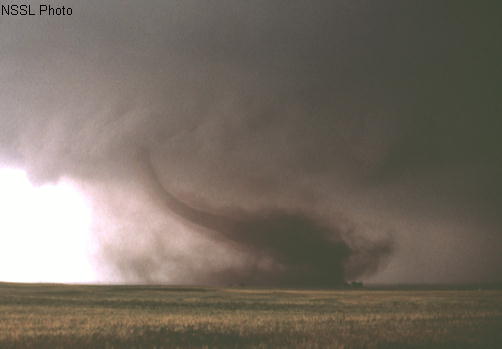
Energized transmission lines subject to over-voltage conditions produce all of these same effects: faint luminescent glow, ozone production and it’s accompanying hiss and smell. It’s cause is coronal discharge.
Tornadoes also produce identifiable infra-sound. It’s inaudible to the human ear, but it can be felt. It will produce nausea, agitation and body heat, effects often felt in the presence of tornadoes – although fear might do that, too.
Lightning has been reported internal to the funnel. These may be a form of cloud-to-cloud discharge, between the counter-flowing positive and negative currents in the Marklund convection.
Tornadoes are seen to have an inner and outer column, although this is disputed by consensus scientists as an illusion. The inner column, however, is seen if the outer dusty sheath dissipates, or is blown away. This is consistent with the double wall formed in a Marklund convection.
Double wall – an inner tube with an outer sheath of dust can be seen.
Tornadoes emit on the electromagnetic spectrum as measured by researchers. Tornadoes emit sferics, the same type of broadband radio noise lightning discharges produce.
Non-super-cell tornadoes…
So what if there is no super-cell? How do all the other vortex phenomena form – landspouts, waterspouts, gustnadoes and dust devils, and how are they related.
By the same mechanism proposed here for the super-cell tornado, only in lower energy form.
Funnel clouds, which never result in a touchdown are a tendril of Marklund convection current that begins to recombine faster than it generates ions, and it dies.
Landspouts, gustnadoes and waterspouts all begin with a surface disturbance – a vortex without a cloud, or at least not one showing a wall cloud, or rotation. These are instances of stronger ionic accumulation at ground level, creating a strong ground vortex first in easily ionized sand, or water, whereas the corona above is weak and diffuse.
This comports with observations of twisters of all kinds, including dust devils and spouts which are seen to begin on the ground. Or water – in the case of a waterspout – where documented evolution begins with a mysterious “dark spot” on the water.
Thunderstorms, lightning and tornadoes – all products of the same weather event – can be perfectly modeled electrically. Electromagnetic fields, ionization, current, capacitance and induction rule nature. It is evident in Nature’s every aspect, because the fractal, self-same patterns always appear.
Consensus science adheres to a gravity model that ignores this fundamental causation and instead feverishly dissects the emergent thermodynamic and fluid dynamic interactions looking for answers, like trying to tell time by taking apart the clock. They continually come up short, as a result.
In a previous Thunderblog, we talked about Nature’s Electrode… how a cold plasma corona is the proper electronic model for lightning genesis, and how mechanisms for ionization in a thunderstorm work.
Now let’s take in the bigger picture to get a more coherent look at a thunderstorm.
The proper electrical analogy for a super-cell storm is a thermopile.
A thermopile is an electrical circuit that you’ve probably seen in use. Ice coolers made for cars that plug into the cigarette lighter are one example.
Thermo-couples are an instrument to measure temperature used in your car and home air conditioning and heating units.
The thermo-couple is a circuit that couldn’t be simpler. All it takes is two, or more wires of different conductivity connected in series. The effect can also be made with solid state materials similar to solar cells.
Current generation from thermo-electric effect.
The different electrical properties of the dissimilar wires create a temperature difference – one conductor chills and the other heats up in the presence of current; or vice versa, current is produced by a temperature difference.
Now, hold that thought for a moment – current is produced by a temperature difference. Temperature is wholly a consequence of electrodynamics. There are all kinds of complexities about temperature and radiation and how it’s transported by conduction and convection, but the bottom line is electricity.
There are three mathematical relationships that describe the conversion of current to heat and heat to current in terms of a circuit, called the Seebeck, Peltier and Thomson effects. The details aren’t needed for this discussion because they describe different conditions and aspects of the same thing. Current produces heat, and heat produces current, provided the right dissimilar materials are properly arranged in the circuit.
The relevance to a thunderhead is in the central updraft core of the storm, which becomes a thermo-couple circuit. It’s a flow of wind bearing ionic matter which produces a current.
In Nature’s Electrode, we discussed several mechanisms for how ions form a cold plasma corona by virtue of field emissions in a strong electric field. The updraft rapidly chills as it rises, becoming more saturated with condensate and ionization. It also shrinks. The central updraft column gets denser as it rises, so the column has to shrink in volume, and this causes it to speed-up.
The many changes to the state of the air in the updraft changes the conductivity of the air in the column. The updraft column is electrically no different than a wire of changing conductivity, which in the presence of current, will exhibit a thermo-electric effect.
It won’t maybe do it, it’s gonna do it. It has to do it. In the presence of a huge electric field, a wet, surface-wind rising into the cold dry stratosphere is going to cause a whopper electric current. If anyone doubts this, go look at a thunderstorm.
When there is a sequence of several conductors of different conductivity in series, the thermo-electric effect can be amplified by adding more junctions. This is called a thermopile. It’s several thermo-couples connected together.
Thermopile Circuit
A super-cell thunderstorm is a thermopile. It has more than one ionization event and each one changes the column’s conductivity in a feedback that increases current and amplifies ionization.
The rising central updraft ionizes where the moisture is saturating and condensing, or freezing, at specific temperature layers. All around the column is a shear zone between it and the surrounding air, and this is where the ions go to collect. The shear zone is an interface – a dielectric barrier that attracts charged species to it.
Again, let’s refer back to our previous discussion of Nature’s Electrode: we discussed how ionization occurs at different altitudes as the moisture in the air condenses, supersaturates and freezes.
It’s been known since the beginning of the twentieth century, that a fast-moving charged particle will cause sudden condensation of water along its path. In 1911, Charles Wilson used this principle to devise the cloud chamber so he could photograph the tracks of fast-moving electrons.
In 2007, Henrik Svensmark published a theory on galactic cosmic ray influence on cloud formation, and later demonstrated his theory in a cloud chamber at Cern, demonstrating certain cloud formations are catalyzed by cosmic rays ionizing the atmosphere.
These are examples of ionization causing condensation. Now let’s consider condensation causing ionization.
Water vapor condensing into droplets self-ionize into cations and anions. In the huge electric field of a thunderstorm, the ions are torn apart as they form, filling the rising air with charged species. This condensation event forms the first corona, a negative corona around the central updraft with charge density concentrated in the lower clouds where condensation first occurs.
Above 1% volume of charged species, the air will exhibit the dynamics of a plasma. Plasma acts as a coherent fluid organized by the electromagnetic field. It seeks balance in an equi-potential layer transverse to the electric field, so it spills out from the walls of the column and forms ‘sheets’, which is what is detected in thunderstorms: ‘sheets’ of charged species.
They actually have more complex geometry than a ‘sheet’. They organize into plasma coronas that actively spit out electrons and ions in channeled currents. Coronas have a geometry and produce effects that depend on the polarity of the charged species mix.
The channels of discharge they create explain every aspect of a super-cell thunderstorms. Coronas explain rain, downdrafts, tornadoes and lightning. They explain cloud-to-ground lightning and positive lightning; intra-cloud lightning and inter-cloud lightning. They explain sprites, elves and gnomes – electrical discharges to space that are the Earth’s equivalent to a solar flare, caused by the same thing – corona. They explain the shape of wall clouds, beaver-tails, the meso-cyclone and anvil.
Because this is the electric model of a thunderstorm it’s closer to the truth. It’s not that convection doesn’t occur, it does. But convection is heat transfer and that is fundamentally electric, like everything else. Pressure and temperature are intimately related as physical expressions of electrodynamics.
The anvil top is another coronal expression where the water freezes to ice. The ionic mix here is different and a positive corona is the result. It has a different shape, being a broad diameter and less dense in terms of charge density.
The coronas are the thermopile’s different current junctions, where charge bleeds out of the central updraft column, just as it will from a power line if the insulation is damaged. Atmosphere is a leaky insulator. It’s the strength of the electromagnetic field that gives the storm it’s shape.
And once the motor gets started – the conveyor belt of wet wind in the updraft keeps rev’ing as charge density builds. The rain curtain and downdraft are the same current looping and dumping hydrolyzed charge in the form of rain at the exhaust of the updraft.
It’s a looping current from ground to atmosphere, and back to ground, in a continuously changing conductive path through several temperature regimes – in other words, it’s a thermopile circuit.
And so builds the strength of the corona, until it spits electrons that avalanche into lightning bolts. If conditions are right, a charged corona will lower towards the ground, abating it’s lightning to send downwards a twisting tendril of plasma, while stirring ground winds below into a vortex. A tornado is born of a corona.
In the diagram, a point electrode generates a corona opposed to a plate electrode connected to ground, with a gap in between. This is a similar circuit to a storm except the corona in the clouds would not have the geometry of a point electrode, but likely a flattened toroidal shape.
In the region in the gap labelled drift region, channels of current are created based on the charge density of the region of corona from which it radiates. The outer edges where charge density and electric field tension is lowest, the corona can’t make lightning, but it still spits electrons that drift towards ground. The drift region of a corona creates unipolar winds as drifting electrons drag ions and neutral matter along by electrokinesis.
Sudden and intense down-bursts and mammatus clouds are highly mysterious to atmospheric scientists and they attribute them to density bombs – pockets of dense heavy air that rapidly sink from the clouds. These violent downdrafts will slap airliners from the sky. They aren’t density bombs – they are unipolar winds and ionizing tufts from the anvil corona.
The entire morphology of a thunderstorm is explained by a thermopile circuit with leaky insulation. But that isn’t all it is. In Electric Earth Theory, there is a more significant meaning.
The looping circuit of a super-cell is a weak form of electrical expression known as a coronal loop. Coronal loops are the result of the corona’s themselves moving relative to the plate electrode. The differential movement creates an offset between the center of charge density in the sky versus the center of charge density on the ground, distorting the electric field. It’s a dog chasing a cat that can never catch-up – negative chasing positive polarity in a wave.
The result is it bends the current into a loop. It goes up in a wind born discharge of current and comes down, energy expended and recombined into rain. If charge builds enough, though, the loop breaks out into a fully realized discharge. The current breaks through the dielectric barrier of the atmosphere to splash charge into space. On the Sun we call them Solar Flares, and Coronal Mass Ejections. On Earth we call them Sprites, Elves and Gnomes.
So, here we are in the world of plasma. Double layers, Alfven waves, z-pinches and corona – it happens in our everyday lives as much as it does on the surface of the Sun – because it’s all the same thing.
So too, we have symmetry. Not the artificial symmetry of mathematical equations and categories consensus science keeps force fitting to Nature, but Nature’s true symmetry of nested harmonic repetition.
Solar Coronal Loop
Such organization and harmonic resonance between phenomena across all orders of scale is not the result of random anything. It’s the result of electricity.
The same phenomena is found on any planetary body that carries an internal current that forms an electromagnetic field. The coronal loops are ultimately caused by the voltage between the magnetosphere and Telluric currents below Earth’s crust, just as they occur above and below the photosphere of the Sun and in the atmospheres of Jupiter, Saturn and Venus.
The electrical stress across the layers of atmosphere and crust is charge building on layers of dielectric, which is what a capacitor is. A storm is an expression of capacitor discharge.
Tornadoes are a harmonic fractal repetition of the super-cell storm as a whole. They are nested coronal loops inside the bigger loop of the storm. Because they are smaller and generate from an intense charge density region of the corona, the energy is more concentrated.
Look again at the image of a solar coronal loop and see there is a smaller loop of higher intensity. This is the effect of an embedded harmonic repetition; and that is what a tornado is to the storm it’s born from. But, as always, it’s more complicated than that. We’ll delve deeper into tornadoes next time to complete the picture of a thunderstorm.
The following image is from NOAA, and illustrates the consensus theory of lightning genesis. As you can see, it shows electrons collecting like marbles in a sink, accelerating down a slippery slope into what looks like a drain.
A typical cloud-to-ground lightning needs a billion-trillion electrons. Are electrons just randomly floating in the clouds when suddenly, a billion-trillion of them jump into an imaginary drainpipe like this image portrays?
The consensus notion is that charge builds in thunderstorms because of static electricity. The friction of hail stones and rain colliding in the storm generates static charge, like rubbing a balloon against hair, or shuffling feet on carpet.
Positive and negative charged particles from this friction separate into layers according to the consensus notion. The layers where they are found “pooling” are at distinct thermal boundaries. So it’s thought these thermal boundary layers keep the “pools of charge” apart, except when they arc.
Super-cell electrical anatomy
The situation is depicted in this NOAA image of a super-cell, where layers of charge are shown stratified inside the cloud. To become coherent, stratified and able to build enough charge for a five-mile long lightning bolt – a billion-trillion electrons worth – the charge density required implies a plasma is involved.
In fact it’s more than an implication. How else could so much charge collect to create such arcs? There is no wire in the sky, no battery terminal, or electrode to generate an arc. These “pools of charge” must be plasma’s.
It only takes 1% of neutral air to be ionized for it to behave as a plasma. Lightning genesis requires a plasma, because that is what forms the “electrode” in the sky. Let’s consider lightning and how, why and where plasma forms to play a role in making it.
Electric Sky
We know Earth’s atmosphere is an electric circuit. It carries charge, current and voltage.
The air is a weak conductor with a variable, vertical current between the ground and the ionosphere of 1 – 3 pico-amps per square meter. The resistance of the atmosphere is 200 ohms. The “clear sky” voltage potential averages 200 to 400-thousand volts between Earth and the upper atmosphere.
At any given moment, there are about 2,000 lightning storms occurring worldwide. To create lightning, the electric field potential must overcome the dielectric breakdown of air at 3 million volts per meter. It does so because the electric field in a thunderstorm jumps to over 300-million volts.
A typical lightning bolt is three to five miles long, and momentarily delivers about 30,000 amps to ground. The collective current from a typical storm delivers from .5 to 1 amp.
The circuit is completed – a worldwide current from Earth to sky, and storms that return it from sky to ground. The 2,000 concurrent lightning storms, each about an amp-and-a-half, means this worldwide current is about 3000 amps.
Only that isn’t the whole story, because there is much more science doesn’t know about Earth’s circuitry. There is also an exchange from atmosphere to space, and space to atmosphere. This has yet to be accurately measured, or understood.
The existence of plasma discharges from thunderstorms to space, called Sprites, Gnomes and Elves for their brief and ethereal appearance, is a relatively recent scientific discovery. Their genesis, power and frequency is far from understood. Wal Thornhill discusses these phenomena in much more detail in his article, The Balloon Goes up over Lightning.
Cosmic rays enter the atmosphere, adding charge continuously. The rate Earth is exposed to solar wind fluctuates widely, both because the Solar current fluctuates and so does the strength of the Earth’s magnetic field. Sometimes the shield it provides moves around, letting more cosmic rays enter through “holes”.
Electricity flows around Earth in Birkeland currents, molded by the Geomagnetic field. How these currents fluctuate in density, and the resulting induced currents in the atmosphere and ground, is another area of scientific uncertainty.
Because of the variability, variety and the fact they haven’t noticed until recently, consensus science can’t yet understand how much current is entering, or leaving Earth’s atmospheric system from space.
The ground also carries potential that varies. Except for the monochrome view of seismic returns, we can’t even see what is below the Earth’s crust to comprehend the flow of current there. Nor whether, how, or where Earth’s current might enter the atmosphere. For electricity, boundary layers like the Earth’s crust isn’t an impermeable barrier, it’s an electrode.
There is a “cavity” defined by the surface of the Earth and the inner edge of the ionosphere. It’s been calculated that at any moment, the total charge residing in this cavity is 500,000 coulombs. Electromagnetic waves reflect from the boundary of the cavity – the ground and ionosphere – and establish quasi-standing electromagnetic waves at resonant frequencies. W. O. Schumann predicted the resonant properties of the cavity in 1952, and they were first detected in 1954. They are called Schumann’s resonances and are measured as broadband electromagnetic impulses at frequencies in the range of 5 to 50 Hz.
The atmosphere is undeniably electric. It’s not a few ions benignly floating around in the air, occasionally forming into “pools of charge”, but a globally active and coherent circuit. What should that tell us about lightning? Mustn’t it also be part of this coherent resonant system. Doesn’t it beg for a better model than marbles in a drainpipe?
Fortunately, there is a model to look to. It’s called electronics.
Atmospheric arcs created in a circuit are generally recognized to occur by thermionic emission. Everyone has seen a hot cathode arcing, as in a welding arc, where electrons are freed from the metal surface of the electrode by heat. The metal is heated by its own resistance to current, and begins emitting electrons above a certain temperature threshold specific to the electrode material. The temperature for many materials is thousands of degrees.
Another form of discharge less well recognized is field emission, or cold cathode emissions. They do not generate electrons by thermionic emission. The electrode warms, but not appreciably because heat is not what frees the electrons. It’s the electric field strength – a high voltage potential, that strips electrons from whatever material is present, including the air itself.
When this happens, the field forms ionic matter into a plasma structure, called a corona. Corona is the electrode in the sky that discharges lightning.
Coronal discharge is used in a variety of ways in modern technology. It requires a high voltage, which is precisely what is present in a thunderstorm – 300 million volts, or one thousand times stronger than in clear weather.
Corona is the only electrical phenomena that can result in a non-thermionic discharge under atmospheric conditions. It’s the driving force of the storm and the generator of lightning.
Corona occurs in a layer perpendicular to the electric field where the field strips electrons from atoms, sending them downward at near the speed of light along the field gradient, to collide inevitably with another atom.
The collision strips more electrons free to follow the electric field, leaving ions behind. The region where electrons are stripped is a cold, partial plasma. Increasing charge density by stripping and collision amplifies and shapes the electric field, which self organizes into a corona. The “pools of charge” layered in the atmosphere are not pools of positive and negative charge as depicted, but coronas that exhibit positive, or negative polarity, composed of some mixture of ions and neutral species electrically interacting.
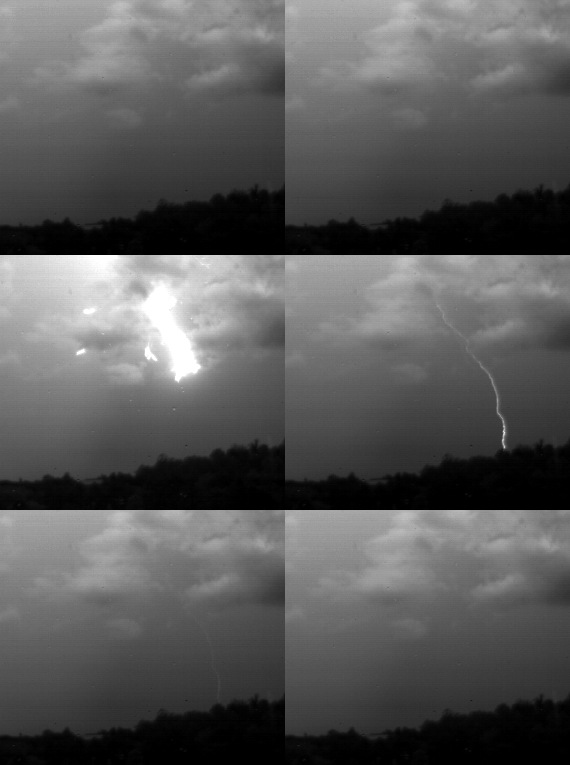
Free electrons continue the process of collision in what is called an avalanche. Avalanche is portrayed in the step-leader process depicted in the image, and is a witnessed precursor to a lightning bolt.
The avalanche is one half of the picture, however. Lightning comes from below, as much as from above. The electric field also pools positive ions on the ground below the storm. Ionic streamers, filaments of positively charged air stretch up the electric field towards the clouds. A lightning bolt occurs when the cascading step leader and streamer meet, completing a plasma channel. None of this is seen with the naked eye. It’s all dark current up to this point.
The lightning channel is complete when it connects to a ground streamer. The connection allows a dump of electrons from the corona to ground. Then, heavier, and significantly slower ions, carry up the channel in a return stroke.
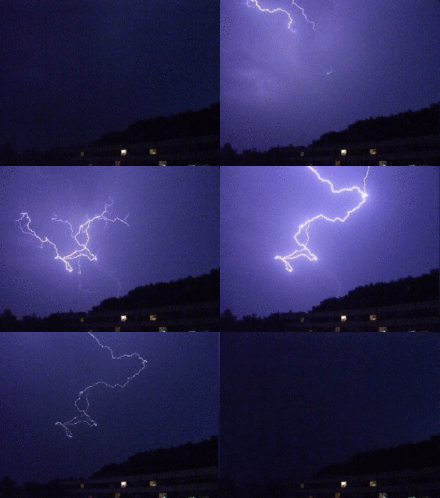
The return stroke can be seen in the image as the bright flash that occurs the moment the first tendril of the avalanche current strikes Earth, leaving only one path glowing after the flash.
Corona provides the reservoir of charge and the dark current mechanism for avalanche required to make an arc. This is what is missing in the consensus notions.
The other consensus notion, that static charge builds from hailstone collisions, is also inadequate.
A study using interferometer and Doppler radar to correlate lightning with updraft and downdraft winds, showed that lightning forms in low pressure winds around the storm cell central updraft of warm moist air. As a storm organizes and the updraft speeds up, lightning frequency dramatically intensifies.
Updraft winds don’t produce much lightning until they reach 10 to 20 mph. Then strike frequency escalates with updraft speed. From 20 to 50 mph wind speeds, lightning frequency might be 5 to 20 strikes per minute, whereas above 90 mph, the flash rate can exceed one strike per second.
It’s like a motor running and the central updraft is the primary mover.
Water in a thunderstorm updraft goes through all of it’s phases. From water vapor, to cloud condensate, to rain droplet, to ice. The structure of a thunderstorm is oriented vertically around the central updraft. The phase changes stratify charge at temperatures where the transitions create ionization events.
Water is self ionizing. Water in its liquid state undergoes auto-ionization when two water molecules form one hydroxide anion (OH-) and one hydronium cation (H3O+). Water can further be ionized by impurity, such as carbon dioxide to form carbonic acid. Water condensing into clouds and droplets within a strong electric field provides an ionization event.
Water can become supersaturated – rising above 100% relative humidity if air is rapidly cooled, for example, by rising suddenly in an updraft. The supersaturation instability provides another opportunity for ionization.
Ice is typically a positive charge carrier, meaning that current flows over it’s surface in streams of positive ions. Flash freezing water onto ice, as hail stones grow, provides another opportunity for ionization.
Each layer of air in a storm has different temperature, humidity, pressure and velocity, transporting different phases of water at different partial pressures, which means the conductivity of the air is changing too.
This last item is important to remember. More about how this creates coronas requires a broader look at the circuitry of a super-cell thunderstorm, which you will find interesting because it will show how coronas produce other effects. Perhaps it even explains all of the effects of thunderstorms. The electrical circuitry of a super-cell will be continued in the next companion article on Earth’s electric weather.
Over the series of articles we’ll present, corona and it’s role in our weather will lead back to geology and previously presented discussions of Arc Blast and how mountains are built. Like all things electric, fractal forms repeat such that a coherent picture emerges, and boy, have we got a picture for you.