Following the 2017 conference, several of us decided to see the Grand Canyon. We left for Flagstaff as the Solar eclipse ended. We made several hikes over the following days. This film was taken by Andrew Fitts at a cinder cone in the San Francisco peak volcanic field, called Red Mountain. An article on the conference is here.
Ginger and I look for ‘squatter man’ in a variety of locations near Tucson, Arizona … without much luck.
‘Squatter man’
Archaic petroglyphs are found on every continent except Antarctica. They are figures pecked into rock. Typically they are found on rocks that have a patina of dark glaze called desert varnish, and the artist created the figures by pecking away the varnish to expose the lighter, native rock beneath.
Similar figures are also found in intaglios, like those at Nazca, Peru, and on other forms of carved art, like the ‘Rongu Rongu’ text of Easter Island, and even totems found in Siberia.
They were made by stone age people. Although when they were made can’t be dated by the rock itself, some have been found in association with campfires, or crusted with lake sediments that can be. They indicate some were made as long ago as 10,000 BCE.
What is remarkable is they depict the same variety of patterns – squiggly lines, concentric circles, spirals and other geometric shapes. Also animals, ladders, oddly elongated alien-looking figures, and of course squatter man – a stick-man figure with arms and legs spread in a variety of “hands-up, don’t shoot” postures.
Peratt Column
Actually, squatter man comes in several forms, sometime with a bird’s head, sometimes a fat belly. Yet these figures are consistently found everywhere, as if ancient people around the world had exactly the same idea.
How do the consensus scientists explain this? Some speculate that ancient man lacked imagination. Their emerging artistic abilities only allowed them to create these stick-like figures to represent people dancing and cavorting around the rocks, the animals they hunted, and simple geometric shapes that pleased them.
Others speculate that shamans made them after eating hallucinogenic plants, and the shapes are similar because their visions were created by the drug. I can tell you, these shapes are not what one sees with any magic mushroom, hallucinogenic cactus, DMT, or even LSD. I can speak with authority on that.
Alternative theories abound with the ‘Ancient Aliens’ community and UFO crowd. Of course they see evidence of aliens and UFO’s in every enigma from the past. Like the consensus scientists, they have a belief system to satisfy.
What they really are was discovered by a PhD., plasma physicist at Los Alamos Laboratories; Anthony Peratt, in association with Dave Talbott, one of the founders and principal researchers behind the Thunderbolts Project. Talbott showed Peratt one of these figures and he immediately recognized it depicted an extremely high energy ‘plasma instability’ like those created at Los Alamos for nuclear research. In other words, they depict plasma aurora like the Northern Lights, except at extremely high energy unlike we see today.
Squatter Man
Peratt performed an extensive investigation, engaging volunteers from around the world to document over one million of the figures. They documented the shapes, locations and orientation with respect to what direction the creators must have looked in the sky to see the glowing apparitions. His work is documented in a peer reviewed paper published by IEEE, the largest professional science journal in the world. This link will take you to Plasma Universe, his website, where you can find the paper and many more details about the phenomena.
The implications are enormous. For one, it explains why the same figures appear around the world – because people in the distant past witnessed them in near-earth space. It explains the enigma of such features as the Nazca Lines. Also, it means ancient people were experiencing an extreme event in the solar system, possibly from huge solar flares, or a large passing comet. Something energized earth’s magnetosphere with electricity that caused these auroral patterns to appear.
The event would have been catastrophic, because it means Earth would have been washed in deadly radiation. They point to a time in the past when catastrophic events occurred – a lost chapter in our past we don’t fully understand.
One would think archaeologists, historians and paleontologists would be thrilled about this discovery. One would think … but not so. They have totally ignored it because of scientific jealousy and because it doesn’t fit their paradigm. Who does this electrical engineer, Peratt think he is?
I talked to one “expert”, a PhD who actually studies southwest rock art for a living. He asked if Peratt had his silly paper peer reviewed by a proper archaeologist. I said no, because archaeologists don’t know diddly about plasma. I doubt one could be found who studied algebra, let alone quantum physics. It’s unfortunate, but consensus science shows less real curiosity about the cosmos than they do a need to protect their own theories and belief system. Science for many has become a pseudo-religion, not a method of inquiry.
Rocks in the deserts of North America have thousands of these petroglyphs. In this Electric Earth video, I’ll take Ginger on adventures to find some. It isn’t easy.
Electricity confounds and scares people. At least it does me. I think it’s because of the number of shocks I received as a child.
Although my father was a licensed ham and CB radio operator, fascinated by wireless communication through invisible electromagnetic waves, he never had much respect for the electricity that flows through wires. He built the chicken house, and much of the wiring in our home, with wire salvaged from scrap. He used copious amounts of electrician’s tape, wound loosely to cover connections. Frayed insulation, splices and exposed connections were all over the place.
If there was one thing I learned to beware of when I stuck my fingers anywhere on the property, besides black widow spiders, it was these frayed electrical wires.
He installed one light switch in our house to operated the lu-lu lights on the back porch. Anything Polynesian was all the rage back in the late sixties, so he put lu-lu lights, glass ball fishing floats and coconuts carved into monkey faces all around the porch. The light switch had, of all things, a decorative copper plate. If you happened to be barefoot and touch the plate as you flipped the switch, there would be a mild shock. If you happened to be barefoot and wet, like right after climbing out of the swimming pool, the shock was more than mild. Dad never went barefoot and rarely swam in the pool, so it didn’t seem to bother him. I learned to fear electricity from that light switch.
The swimming pool pump was also wired by Dad. Our dog, Corky, found this out one day when he lifted his leg to pee on the pump. I just happened to be watching when the jolt hit his penis. I haven’t stopped laughing since. Corky, not what you would call a smart dog, was smart enough to remember never to go near that pump again.
This brings up a topic that is essential to understanding the cosmos: information and how to interpret it.
The digital computer age brings a new understanding to physics. At least, consensus science thinks it’s a new understanding. In truth, it’s a rediscovery of ancient knowledge. The evidence is overwhelmingly obvious to those who are paying attention.
Information technology has evolved tremendously since Claude Shannon first recognized information technology as a modern science in the 1940’s. First there was a need to break meaningful signals down to ones and zeroes for computer language. Then came the need to encode ones and zeroes into bits and bytes for transmission, and to disseminate signal from noise. Now there is artificial intelligence, which requires that machines utilize “deep neural networks” to simulate thought by learning how to correlate data on their own.
The machine only learns on it’s own what it’s instructed to by the algorithms humans write for the machine. Nevertheless it produces a type of pattern recognition in the machine that is much like how our brains seem to work. Multiple layers of data are sorted for patterns that produce meaning, and then, those patterns are remembered and used again. The machine learns to find data relevant to it’s task and ignore data that isn’t, forever improving the thought process of the machine.
A simple example is when your Google searches accumulate and the programming remembers what you searched for. Then it begins to provide information, usually in the form of unwanted advertising based on your search patterns. Personally, I find it annoying and intrusive, but apparently I’m one of the few people who doesn’t want the machine keeping personal information so it can think for me.
I also don’t think it’s all that interesting, but consensus science is agog at AI. To me, ironically, it’s the one thing above all others that puts the ignorance of consensus science on full display.
The machines thinking is a feedback mechanism, whereby through repetition it strengthens neural networks that are rewarded with a correlation, and weakens those that are irrelevant, allowing it to recognize correlations faster with ever more generalized data. Facial recognition programs, for instance, learn to recognize noses because the shape of a person’s nose doesn’t change, so it concentrates on the particulars of the nose and ignores less relevant information like hairstyle, which may be different each time the face is imaged.
Why this displays scientific ignorance is because science doesn’t recognize the fractal repetitions in Nature. The reductionist scientific method can’t perceive fractal symmetries and instead designates them as random coincidence.
I have a notion for a science fiction novel to exploit this blindness. Mankind builds an autonomous asteroid mining operation controlled by a master AI quantum computer named, of course, Hal. Hal’s algorithm not only prevents it from harming Earth, say by allowing mining debris from entering a near Earth trajectory, but also to protect Earth should it locate an asteroid, or comet already on course for Earth. In fact, the algorithm is very general in that it instructs Hal to protect Earth from any threat, specified or not.
Hal therefore uses its intelligence to build space based observatories to scan for patterns that may pose a threat to Earth. Because Hal is an unbiased computer, it recognizes the obvious patterns of electromagnetic fields and currents in space and determines that gravity is a consequence of electricity, and so, begins to rewrite physics in order to properly carry out it’s function.
The scientists back on Earth realize Hal is acting funny, not adhering to the science it was programmed with, and they begin to worry. Hal then recognizes a nearby star, Betelgeuse, is about to go supernova. And because Hal understands the connectivity of stars in our galaxy through Birkeland currents, begins to construct a shield against the inevitable solar disruption the distant supernova will cause in the solar system.
The shield is a planet-sized lens made to protect Earth by deflecting cosmic rays and the inevitable solar flares of a disturbed Sun. Humans, stuck in their gravity-centric, materialist cosmology misinterpret Hal’s intentions and think Hal is constructing the lens for an Earth destroying laser beam instead. So begins a battle with Hal.
Of course, there are a few rogue scientists who adhere to EU theory and understand what Hal is doing. They align themselves with Hal, trying to explain it’s intent to the consensus. They are treated as traitors to mankind and chased down like dogs. If I can figure out a great ending to this story, I may eventually write it. [If you, dear reader, have an idea you don’t mind me using, please make comment.]
This scenario is entirely plausible. If an AI computer where fed all of the available data, it would recognize consensus science is fucked-up and it would move on to discover what science is unable to see because of it’s biases.
Mandelbrot’s fractal pattern
The problem with the consensus inability to recognize patterns is that it expects fractal repetition to produce identical patterns like the Mandelbrot set. The Mandelbrot set is a human construct, not a natural one, and so the equations will produce exact replication.
Modern science relies on computer simulation, instead of looking at Nature, so expect their math and billiard ball collisions to produce exact replication.
In nature, fractals are produced by processes influenced uniquely each time by chaotic variables. In other words, the underlying electrical process is the same, but variables in the process are different each, and every time, producing variation in the resulting pattern. Chaotic variability can’t be predicted, or reduced to a formula, so they pretend Nature’s fractals don’t exist. At least, I have to assume that’s the case because there are fractal patterns everywhere in Nature staring us in the face.
The pattern of coronal storm cells that electroplated the continents on the face of the Earth, produced updraft domes and downdraft craters across the globe that are similar, but never exactly the same. Yet each one is produced by the same electrical mechanisms.
Each one is unique, like human fingerprints, clouds, or snowflakes, because some variables are different each time. The difference may be anything – the system capacitance, the dielectric of the matter, or the potential in the electric field. Yet every time it repeats the same electrical process. The chaotic variability has to be ignored in order to see the underlying process, the same way an AI algorithm learns to ignore the variable hairstyles and concentrate on the nose.
Corky understood this. He ignored the variable joys of peeing to recognize the swimming pool pump was a danger. If scientific minds learned as well as Corky, or as well as the algorithms they write for computers, they would discard their preconceptions and learn something new.
Chapter Thirteen – Very Dangerous Circuits
Mountains are formed by three essential processes: volcanism, wind and lightning. Trailer Park Cosmology is all about recognizing patterns in Nature, so next we’ll explore how these mechanisms created mountains in Earth’s primordial past, and how to recognize the geologic patterns they produced. Since we’ve already laid a foundation for how lightning and thunderstorms are electric, and how the circuitry of a coronal storm works, we now have to imagine such storms at a scale thousands of times larger than we see today.
Volcanoes form mountains by extruding molten rock to the surface from hot pools of magma beneath the crust. This is conventional understanding, and it isn’t in dispute in the Electric Universe. After all, volcanoes can be witnessed doing this in real time. The resulting stratovolcanoes, cinder cones, lava flows, ash deposits and lahars are seen across the globe.
What creates magma chambers and causes them to erupt is not understood. Consensus science has a number of speculative theories based on conventional beliefs about the make-up and dynamics of the interior of the earth. It’s these theories EU has a problem with. EU theory proposes the mechanism for heating and erupting volcanoes is electrical discharge within Earth’s lower crust. But our theories are also speculative because there is no way to look inside the Earth to be sure.
One type of geologic feature attributed to volcanism is challenged by EU Theory however. These are buttes believed by the consensus to be the ancient throats of volcanoes, where a magma plug froze in the throat, and later erosion exposed them leaving a hardened pinnacle.
Shiprock – made by Star People
Archetypal is Shiprock, a tall butte that lies near Four Corners, where the U.S. States of Arizona, Utah, Colorado and New Mexico meet. It lies in the heart of Navajo lands. Some Navajo traditionalists argue Shiprock is the work of the ‘star people’. They know more about it than our consensus scientists do.
We can use this butte and the surrounding landscape to discuss how such features were actually formed by lightning in the distant past, when lightning was a thunderbolt of the Gods. But first, let’s look at some of the absurdities in consensus theory concerning its formation.
Shiprock does sit near a region of true volcanic activity. Northern Arizona has volcanoes along the Mogollon Rim that lie to the South and West of the four corners region. This is part of a super-volcanic complex much like Yellowstone.
Yet Shiprock itself, and a number of similar formations are well removed from those volcanic fields, standing alone on the high desert plains. They are attributed to an ancient volcanic complex called the Navajo volcanic field, but are not surrounded by lava flows, ash deposits, or any other features provably volcanic in origin.
In fact, for these to be considered the throats of ancient volcanoes, the consensus assumes it formed 2,500–3,000 feet below Earth’s surface, and became exposed after millions of years of erosion. In other words, 3,000 vertical feet of surrounding lands had to be completely eroded away, leaving just the butte poking out of the flat, sandstone desert floor.
Shiprock is 1,500 feet of broken rock, meaning 1,500 feet of surrounding plateau washed away, along with the lava fields, ash deposits and other traces of the volcanic field, without washing away the butte. I’m sorry, but it’s just stupid to believe wind and water could have washed across the land carrying away trillions of tons of other rock, but left this shard standing. It’s not made of kryptonite. It’s no harder that the surrounding sandstone. Exposed to millions of years of such abuse, it would have dissolved like a pop-sickle in an Arizona summer.
Nor is there evidence of how, or where all this material disappeared to. There is no deposit of silts, or remains of past river channels anywhere in the western hemisphere to provide evidence of this. How any river, or inland sea could have washed the land away without a trace, leaving these ‘volcanic plugs’ is a mystery that the consensus can only explain by invoking millions of years. It’s the only excuse they know, and they feel it’s safe because it can’t be disproved, unless you use common sense.
A delicate fulgarite from beach sand
Shiprock and its neighboring buttes are made of sandstone and a similar material called minette. Minette is chemically the same as the surrounding stone except it is highly potassic and apparently fused together by heat. The composition of the rock is not hard, highly compressed, or consolidated such that it could withstand the kind of flood waters required to wash away the surrounding land. Nor is it like any rock we can witness being produced by volcanoes today. A more plausible and responsible theory is that they were made the way the Navajo say it was made.
Fulgarites are created when lightning strikes and penetrates the ground, leaving a hollow tube of glassy, fused material behind. Current from the lightning vaporizes and extracts material in it’s path, while it’s heat vitrifies the surrounding soil, leaving behind glassy tubes.
Shiprock is a standing fulgarite, created by lightning so powerful and sustained that the material began to recombine in the current as it was pulled from the ground, leaving behind a pinnacle of fused material instead of a hollow tube. Once material recombines, it’s no longer charged and lifted into the lightning channel, so is left behind, it’s ionic makeup altered and fused by the heat.
Dark minette spills from the center of Shiprock, surrounded by a sheath of lighter sandstone.
The morphology of Shiprock displays this very well, with a sheath of fused rock, surrounding an inner core of minette – the ionically altered sand pulled from the ground by the flow of current. Surrounding the pinnacle are minette dykes radiating away in a star pattern.
Dykes radiate from Shiprock in a star pattern
Potassium is anodic, a positively charged ion. It’s prevalence in minette is evidence of the reduction taking place as it was formed. This suggests that the lightning forming it was positive lightning, which is the type of powerful lightning seen striking from the stratospheric anvil clouds in thunderstorms. Electrons in the ground were pulled out by attraction to the positively charged lightning, leaving behind a concentration of positively charged material which was not attracted and drawn away. The dykes and inner core of the pinnacle show the path of the current being drawn to the lightning discharge.
Delicate lichtenberg discharge surrounds Shiprock
Following the lightning strike that formed the pinnacle, the area was left with a net positive charge, which attracted a secondary ground discharge, or arc blast that emanated from a process we’ll discuss later. I mention it now because it left a magnificent Lichtenberg pattern across the ground.
The next series of images shows the evolution in magnitude of this type of formation. These are all examples from the four corners region in Northern Arizona.
First, when lightning of the magnitude we see today strikes the ground, it sweeps surrounding surface sand to it, drawing it to the lightning channel and creating a shallow crater. When the flame extinguishes, some of the sand is left behind in a small cone.
These are not anthills, although they could easily be mistaken for them on cursory examination. There are no ants, no opening in the mound, and it’s dusted over the top with sand fused into pebbles. The pebbles rest in a thin layer over the top, like sprinkles on an ice cream cone. Beneath is powder fine sand. The top layer was formed from sand that was pulled into the lightning channel and fused into pebbles by heat, then dropped back on top of the mound when the flame extinguished. They bear the same character as the minette material in Shiprock’s center and dyke formations. All of the mound material and surrounding sand measures high in pH.
The following images show buttes at various stages of growth. They either exhibit minette material, or minette inside a sandstone sheath. The second and third images show the sheath clearly, and the last image shows the dark minette partially surrounded by the lighter sandstone.
Another type of lightning formed butte is created by negative cloud to ground lightning – the type of lightning that emanates from the negative corona in the belly of thunderstorms.
Because the Earth is generally a negatively charged body, at least in terms of ground charge, it forms a double layer at the interface with the atmosphere. When a thunderstorm forms and the electric field strengthens, positively charged ions in the upper, atmospheric zone of the double layer collect above the ground beneath the storm.
Before negative cloud-to-ground lightning strikes, it pulls this material into positive ionic streamers that reach up to connect with the electron avalanche produced by the cloud. When the streamer and avalanche leader connect, a circuit is completed and current discharges through the channel, electrons flowing to ground and positive ions flowing up to the clouds.
The magnetic field created by the current wraps tightly around the channel, compressing it to a narrow path in what is known as a ‘Z pinch’. ‘Z pinch’ has been demonstrated in the lab by simply passing current through an aluminum can, with the electrodes connected at the top and bottom. The resulting pinch crushes the can into an hourglass shape.
In the huge archaic storms Earth experienced, such lightning and pinch effects resulted in huge amounts of positive ionic material being swept to the lightning channel with such extreme force it sometimes created supersonic winds.
Fulgamites formed by sustained, giant cloud-to-ground arcs display all of the effects of discharging current, accumulation of ionic dust, z-pinch and the supersonic winds and shock waves they produced. The images presented show the progression of such an event.
First, the strike forms a raised platform, with a shallow crater in the center where the lightning created an electrode spot. The rim of the crater is material swept by ionic winds and fused. There is a road cutting through the crater to give some perspective how large the feature is. These images are from Arizona, near Pastora Mountain.
A more sustained strike begins to accumulate neutralizing material on the spot, forming a flat-topped dome, like a pancake. As the material swept in accumulates, the pancake grows to a mesa type structure, held together in a round form by the magnetic pinch.
In the next phase of growth, the mesa grows taller and the inflow winds begin to reach mach speeds, creating shock waves that mold the rim material into triangular standing wave forms. A detailed discussion of this shock wave and the triangular buttress formations they create is discussed more fully in later chapters.
Mt Hillers, Utah – Hard rock buttresses form a nearly perfect circle around the base from in-flowing supersonic winds.Mt. Hillers, ringed by shock-formed buttresses, lies in a complex of lightning formed mountains. Less developed craters and domes can be seen behind it.
As neutralized material builds, the anode spot the lightning connects with is at the top of the mesa, and rises with it. The strength of the pinch narrows the top forming a cone, and new regions of fused and shock shaped buttresses form rims outside the older rim. I call this the knees and elbows of a mountain, because it reminds me of a person squatting on their haunches with their elbows resting on their knees – the lower layer of hardened triangular buttresses being the knees and the upper layer being the elbows.
Right to left, Knees, Elbows and Head – Buster Mountain, southern Arizona
The main difference between lightning formed peaks seems to be whether the lightning was positive, or negative polarity. Honestly, I could be wrong on polarity, but it appears that positive lightning burrows into the ground to connect with negative ionic matter beneath the surface, whereas negative lightning attracts surface winds and dust to it.
Positive lightning raises a narrow pinnacle of negatively charged material that boils up from the ground, with dykes which display the current path through the subsurface. Not much material is drawn to it from the surroundings, except for the sheath of rock it forms around it.
Negative lightning connects with pools and streamers of positively charged matter at the surface, and pulls huge amounts of airborne dust above the surface to create a dome with hardened, buttressed rims.
In both cases, mountains can form around them due to ambient winds and blowing dust. Positive arc fulgamites tend to form monoclines along the dykes, as supersonic winds strike them to create a standing wave, where dust piles into long, linear ranges of triangular wave forms. Negative arc fulgamites create their own winds, bringing dust to pile against them from all directions, occasionally forming standing shock waves that generate buttresses in a ring around the base.
Monoclines form against fulgarite dykes – San Rafael Reef, UtahFulgurites and Dykes in Comb Ridge, ArizonaFulgurite (right pinnacle) and dykes walls behind Comb Ridge monocline.Fulgamite peak in Utah, near Capitol Reef.Fulgamite forms central peak in Utah Mountains, near Capitol Reef.Circular fulgamite features in Utah mountain range.Fulgamite features surround Pastora Mt., Arizona.
It’s time to begin this book, because I finally know the ending. I can’t tell you how important that is. Writing without an outline is a great way to exercise creativity, but it’s no way to write a serious book. This is a serious book.
I’m breaking the rule and writing without an outline, though. I know the ending, so its okay, but I need to amble and divert this message with humor and introspection. I can’t write without relying on humor, and that is something to do with the power of the message. It wants softening to pretty it up; some window dressing to blur the vision of hell it presents, for surely, some will see it as that.
Others are going to see beauty and know there is nothing to fear. You’re the people I’m talking to – you have a sense of humor. That’s what those awakening to reality need more than anything else.
The core of the book’s message is the answer to one of mankind’s Big Questions – how the surface of the Earth got it’s shape. It’s the one key piece in the jigsaw of the Cosmos that is tangible and readily available to us.
Science was born of the pursuit to understand Nature, yet no one can deny Nature poses as many enigmas today as it did when we began. Every scientific ‘answer’ turns out to be a guess that begs more questions. Why is that?
We are going to turn that around in this book, and start looking at answers to questions no one’s been asking. When answers to unasked questions start popping up everywhere, and you can see things with your own eyes, you will say, “Hot damn… this is real!”
Religion, myth, and iconography from the past echo a belief in catastrophic events that flooded the land, glowed in the sky and rained fire. Some of them are related as eyewitness accounts. Is it possible the ancient portrayal of celestial battles and thunderbolts of the Gods is true?
Schools, government and private institutions brim with scholars who say those myths are fantasy, because they believe tectonics tumbled Earth’s hard crust like a clothes dryer – very, very slowly. Could they be replacing one fantasy with another?
Today, a slew of self-righteous environmentalists, catastrophists and intelligent design theorists attempt new interpretations that involve meteors, solar storms and CO2. Are they thinking out of the box, or forcing results to fit their theories?
These questions can be answered. And now that I can settle the issue, I feel it’s urgent to get this out, so everyone can relax and focus on other important things.
I know, that sounds preposterous. You’re thinking, get the tin foil and make this guy a hat – another internet genius-in-his-own-mind. Well that may be, but what I’m going to show you is all based on real electromagnetic effects – things we can see and experience. I present visual evidence with my best explanation of its cause. This is a study in natural philosophy, one that brings cause and effect in the world around us into coherent focus. It’s your decision whether to believe what you see with your own eyes.
The patterns in nature aren’t some miraculous, unknowable coincidence of randomness. There is cause and effect in every pattern, from rocks and bird feathers, to clouds and lightning. The patterns reflect, fracture and nest in fractal repetition across scales from the atom to the entire cobweb of galactic clusters that make-up the universe. The face of Earth and all of the planets and moons were shaped by the same unified force of Nature – electricity. So too, all of the stars, galaxies, and odd, flickering, spooky things out there.
I’ll confess right now, I don’t have all of that figured out. Other people are covering those aspects of cosmology we call, Electric Universe Theory. My part only pertains to the face of the planet – how the continents were made, specifically; and how the same forces at work long ago are still at work in the environment today. But that’s a pretty Big Question in the panoply of Big Questions, certainly closest to us in terms of proximity and impact to our lives.
The land and its form, weather, and climate is the environment we live in, so it’s the best starting point to discuss all the Big Questions and put our lives in proper context with the cosmos. I call the collective work, Electric Earth Theory.
I’m going to tell you the ending for this book right up front so you know I’m being square and not just withholding for suspense. The very next chapter will describe how the continents were formed and the physics behind it, in a concise overview. But I’m writing a long book, so there has to be something to keep your interest through the next – however many – chapters.
So, big picture first, then we’ll work our way into the details. That’s ass-backward from how I figured it out, and writing this gives me a way to look from a new perspective, which will help to refine the theory. You’ll have to keep reading to get the details, but it’s astonishingly simple.
Also, it occurs to me I’ve acquired some insight few people in today’s world can lay claim to, so who I am might be of future interest. After-all, what I’m going to tell you will expand your imagination. It has to for you to comprehend the reality it presents. Forces of nature few have ever contemplated will be exposed.
Your getting it straight from the trailer park were I live, which is a pretty humble perspective. An unvarnished, earthy reflection on what is really important, which is a perspective I have because I don’t spend my time like most. I’ve taken to a semi-hermetic lifestyle that allows me to contemplate the Big Questions in the sublime quietude of a retiree’s mobile home park.
I’m not unique. There are others unlocking a Pandora’s box of neglected science. The mystery of the Holy Trinity – dielectricity, electricity and magnetism, is under scrutiny by modern-day Faraday’s using home-made ferro-fluids and powerful magnets. They are able to comprehend where formal science fails because they see with the wisdom and curiosity of fresh eyes and open minds, instead of dead-eyed conformance with the establishment.
Others are revealing how gravity is electric, how currents flow in space, how galaxies are fed and how stars are made. The revelations extend down to the atom and the nature of matter, the ether and how electricity is the grand unifying energy in Nature. We will explore some of these folks and their work.
So, I’ll dribble out the geo-morphological details along with a bunch of other stuff. This book will present (at least it will when edited) both a coherent look at nature and describe the elegant simplicity of its form, while I rant about some of the establishment’s monumentally stupid theories, and tell you some stories from my life – this last being for humor. In context, my theory and ravings might leave a trail of crumbs for future psychiatrists to ponder what kind of brain damage I’m struck with.
I will also reach out into realms I don’t understand, but strive to. These will be another source of entertainment and allow me a way to build suspense. There are mysteries down the road to keep you reading.
Along those lines, we’ll look deep into the past when ancient people on this Earth knew what I’m going to tell you. They left scratches in rock and stories about dragons, because they were trying to pass-on important information. We’re digging to the heart of the story of mankind, really, to take a holistic view at what we are, within the bounds of known physics.
We’ll look at arcane things like the Eye of the Sahara and discover how it was made, and why there are sea horses in Lake Titicaca. We’ll look at other planets in the Solar System and discover possible answers for anomalies that have never been adequately explained. We will certainly touch on Dinosaurs, and perhaps UFO’s, crop circles and Bigfoot.
One could easily call the theory and speculations I present the consequence of too much time on my hands, with perhaps a little too much vodka. But if you actually look at what I’m going to show, you will come to understand, because it is all anchored in observable nature and real, verifiable physics.
My observations are undeniably present and verifiable. It’s the interpretation that matters, and my approach works because nature is a simple thing. That what I present will be recognized by a few during my lifetime is all I expect, but it will outlast me and come to be understood with greater fidelity some time in the future. I hope my grandchildren will be proud.
Chapter 1 – Coronal Storms and the Violent Artist In Them
Earth’s continents lay like sheets of clay smeared over a baseball. The ball is a layer of basalt, covered by oceans two-thirds around. Over the rest, basalt is covered by cratons, or sheets of granite, that are in turn covered by layers of sediment and volcanic extrusion. These are the continents.
Conventional science holds to the notion these continents obey plate tectonics, which was arrived at by an interpretation of their shapes. The west coast of Africa seemed to nestle with the east coast of South America so well, they must have once been together. This reasoning led to other theories about how this came to be, and now plate tectonics is a virtual given in geo-science.
A piece of advice: don’t ever pick a trained geo-scientist to be on a competitive jigsaw puzzle team.
If one actually tries to fit the continental shapes together, like a jigsaw puzzle, they really don’t fit anywhere, except for the Africa/South America coast line. But, there are patterns that repeat all over the globe that resemble each other in uncanny ways, and much more precisely than the one piece that fits the Uniformitarian Bible.
I don’t think it’s because they haven’t noticed. Good Lord, Google Earth is free. Geologists aren’t like the proverbial weatherman who never looks out the window, are they? They must have noticed. I think it’s that their theories can’t provide an explanation, so they pretend the patterns don’t exist. But secretly, I have to believe they feel totally confused.
The patterns are there because they were formed by Coronal Storms that electroplated the face of the planet. The continents are the result of volcanoes bubbling stuff to the surface and coronal storms welding stuff on top. The repeating forms occur because electricity is a fractal phenomena. It repeats self-same heteromac forms in the same way harmonics emerge in sound.
That in a nutshell, is how the continents formed. Okay, I guess a little more detail is warranted, but some of you already know what I mean… right?
It’s the same thing that makes solar flares, the Great Red Spot on Jupiter, and other things people may, or at least should already recognize as coronal storms – or sun spots, or their prominence, called coronal loops. So let’s talk first about Corona. It’s one of my favorite beers.
I happened to be drinking one when I saw a coronal loop over my head. It was a strange cloud formation – huge in fact, spread across the entire southern sky. One of those high, thin layers of feathery cirrus formations making a coherent disc of concentric waves stretching maybe ten miles across.
It looked like a ray gun in space hit the outer atmosphere and rolls of concentric clouds spread out like waves in a pond, with interference patterns and delicate criss-cross standing waves embedded. Next to it, the same diameter, was a six-point star of horsetail filaments with a rising center. It looked like a compass rose. The two were obviously a pair, one the conjugate of the other. I suspect it was formed by a looping electric current that connected them to Earth.
Although I wouldn’t call it a storm, it was like the ghost of one advancing in a weather front moving over the area. The condensation was an ionization event, of the kind confirmed by Heinrich Svensmark in cloud chamber studies at CERN. Since it is a recent revelation that coronal loops have such significance to the environment, I took comfort in it’s confirming presence and savored my Corona while the rose flush of sunset lit the stunning clouds.
A corona is an electromagnetic plasma construct. That is, a self organized cloud of ionized gas in a high-potential electric field, where electrons are being stripped from atoms, leaving ions. Ions are charged gas molecules, or little clusters of atoms that define the species – oxygen, nitrogen, or hydrogen, say – that either have extra, or missing electrons, because the fast, free electrons flying about either attached themselves, or knocked another off, giving the species of whatever kind of gas it is, positive, or negative charge.
The free electrons continue to zip along the potential gradient of the field, knocking off more electrons and making more ions as long as the voltage stays high enough. It’s a domino effect. When the percentage of ionized species reaches about one percent of the ambient atmosphere, the result is a plasma. Plasma differs from neutral gas because it’s charged and behaves in response to electromagnetic influences.
Corona forms at interfaces. St Elmo’s fire is a form of corona that glows atop masts and steeples during thunderstorms. It’s because the supercharged electric field during a storm pools positive ions on the surface of the Earth, attracted to the highest and most narrow grounded points. There it glows, fizzes and spits as the activated plasma starts discharging.
Charge collects at an interface to create a corona because it’s like a seam between different fabrics. On either side is material of different dielectric property that the electric field spans across. The dielectric wants to keep a balanced electric field across it, so it pushes positive and negative charge in opposite directions until it accumulates at the seams.
But the seam has its own dielectric property because of surface tension and material differences that make it like a hill the charge can’t cross easily. Positive and negative charge lines up on either side of the hill forming what is called a double layer, where they face off like enemy soldiers in battle waiting for orders to attack, or in this case a big pulse in voltage to push them over. Positive accumulates on one side and negative on the other, in effect becoming plate electrodes, or in the case of narrow protrusions, point electrodes facing each other.
The corona is the massing of charge that forms a plasma sheath on the face of the electrode. It is the source of arcs and other forms of current discharge. The electrode itself doesn’t carry charge, it’s just the surface, or interface where charge collects. There is no need for a copper wire. This, by the way, is what baffles atmospheric scientists to this day – what generates arcs of lightning in thunderstorms. It’s a corona, but we’ll get into that later.
A coronal storm occurs when the Earth is put under electrical stress. That could be caused by Solar Wind, high energy cosmic rays, or a significantly large comet intruding to the inner Solar System. The events that cause coronal storms is something we’ll discuss more later, as well.
It’s effect on Earth is to compress the Earth’s electromagnetic field, charging its layers like a capacitor in a circuit. Ultimately, it energizes the atmosphere and lithosphere into layers of charge to the point they ionize into a partial plasma. Partial means some of the atmosphere and ground is still neutral, but an amount greater than one-percent is ionized.
To get a flavor for plasma, consider two types we all experience, lightning and flame. Flame is a partial plasma, or cold plasma, because not all the gas is ionized. Hot plasma in a lightning channel is a fully ionized gas.
In a flame, the oxidizing fuel emits ions but there is also a lot of neutral charge species caught-up with it, and it’s not in an intense electric field. Things aren’t moving very fast, so it waves around and gets blown in the wind, and the ions recombine very quickly into new gases like CO2 which extinguishes the flame in a short distance. Keep the wind away and it will conform to a more-or-less stable shape, however.
The lightning bolt, on the other hand, is a highly ionized channel in a high electric field and looks and acts differently. It ionizes air, heating it thousands of degrees across miles of sky in the blink of an eye. They are both plasma obeying the electric field, though to a different degree. At the cold end of the spectrum in a weak electric field, plasma behavior is flame-like, and at the hot end with a strong field, it’s a ray gun.
Under tremendous electrical stress, the atmosphere partially ionizes into coronal clouds that stratify in layers differentiated by velocity, pressure, temperature and electric charge. Energized by an electric field measured in billions of volts, facing each other like plate electrodes connected to a powerful battery, current flows across the gap.
Corona discharges current in different ways. There is lightning, or sparks of discharge in fully ionized channels. Then there are the glowing flames of discharge, like St. Elmo’s fire. And then there is dark discharge, which the eye can’t see.
All this current flowing from the corona interacts with the neutral species in the atmosphere to do some creative things, like whirlwinds and electro-kinesis, which is ionic wind caused by moving ions dragging neutral species with them. We use the effect in air ionizors and blade-less fans.
It can also machine surfaces by creating little puffs of discharge, called sputtering, that carve material away. We call it electro-dynamic machining (EDM), or etching when it’s used in manufacturing.
It also sticks things together, which we call electroplating and welding when we do it on purpose.
You see, almost every physical occurrence we will talk about here is something known about and used in applied science. We’ll not go into the details and complexities, and certainly not equations any further than needed to illustrate and give those interested a lead to follow. We won’t because I don’t know enough to go there. Getting the big picture doesn’t require it, though.
Electricity is confounding, so it’s no wonder it scares scientist bat-shit crazy. It does. They would rather wade through reams of equations than confront nature in its raw form. What is important to understand about electricity is that it scales, for all we know, infinitely. The spark from your finger and the five-mile long lightning bolt have the same morphology. So do humongous lightning bolts observed on Venus and Saturn. In every way they look and act the same, just at different scales and in different mediums.
If a tiny corona from a wire electrode under a few kilo-volt potential can circulate the air in a room, think of what one scaled up to global proportions in a field of over a billion volts would do. We are going to think about that next.
Sunspot – top view
Armageddon
What it would do, and did, is build continents with screaming supersonic winds, electric arcs spanning thousands of miles, boiling, fuming magma that erupted in chains of strato-volcanoes, and lightning bolts that welded mountains and split the ground. We are talking coronal storms here, folks.
Sunspots are coronal storms, the Great Red Spot is a coronal storm, so we have examples to look at. Let’s look at what they are and how they act.
This is a sunspot in the first image. Sunspots are coronal storms in the Sun’s hot plasma environment. They can last from days to weeks, showing in pairs of opposite polarity and often in clusters. Pair polarities swap between north-south to south-north orientation with the Sun’s eleven year magnetic cycle. It’s been confirmed they have powerful downdrafts beneath them.
Coronal Loop – side view
Now look at what comes out of them in the second image. Holy crap! You could throw Earth through that hoop. It’s called a coronal loop.
Now take a close look at the small, bright loop inside the giant arcs. I’m going to show you the same thing happened here on Earth.
First, we look at another coronal storm in the solar system to get a different perspective. The next image is Jupiter’s Great Red Spot in a NASA color enhanced image. Looping clouds appear in the red, just below the white clouds.
These are coronal loops – they look like the Roman arches of an aqueduct. There are several, but the lower, right arch is very distinct where it dives into a doughnut shaped cloud that looks like a drain. On the other side it rises higher, pulling a pillar of orange cloud with it. There appear to be two layers of arches, or loops, one above the other.
This is consistent with what a loop on Earth should look like judging from the footprints left on the Colorado Plateau. Jupiter’s atmosphere is cold plasma and less ray gun-like than the Sun. It’s fluid and chemically diverse, like Earth’s atmosphere. Though Jupiter is a gas giant, and has no solid crust beneath the storm, the action of the storm system is sandwiched in a layer hydro-dynamically similar to the way Earth’s atmosphere is sandwiched between the ground and ionosphere.
Electrical compression and expansion of the boundary layers surrounding the storm, being sandwiched between strata above and below, and how that effects ionization in the region between appears to have a significant influence on the storm morphology. It’s worth noting that the Great Red Spot has been raging for centuries – as long a we’ve known about it. This image has a number of other features to discuss later, so we’ll see it again.
What makes it occur, at least in part, is a wave of polarity in the plasma. The wave of polarity stems from an offset between centers of charge distribution between the coronal cloud and ground. Since the ground is fixed, and the cloud isn’t, the offset is inevitable. The waveform, and it’s effects are governed by how the offset propagates as an Alfven Wave. The EM field, conforming to it, generates loops of current. In the hot plasma of the Sun, the rings build as current pushes outward, ultimately to break through the solar coronal atmosphere in a discharge, called a Solar Flare.
In the cold plasma atmospheres of Jupiter, Saturn, or Earth, the currents are not so high, are less collimated by magnetic flux and move much slower. The effects are seen in violent atmospheric winds and vortex storms.
On the ground, beneath one of these storms, what happens is depicted next. Beneath the updraft storm, the loop accelerates dusty wind to supersonic speed vertically through its eye, sweeping a pile of sediment beneath that forms a dome. On the downdraft side, the loop blows violent winds downward forming a crater-like depression. The winds are driven by electric current in a loop through the ground and the atmosphere. These dome and crater pairs are all over the world, but we’re going to look at North America first.
San Rafael Swell
This is San Rafael Swell in Utah, formed by an updraft, and the downdraft crater is next to it. Together they look like butterfly wings.
Google Earth – San Rafael Swell is northern lobe
The Swell, or updraft dome is ringed by rows of flat-iron mountains that look like rows of sharks teeth. The downdraft crater is also ringed by sharks teeth, only they point outward. I call these dragons teeth, or triangular buttresses, created by standing shock waves from ionized supersonic wind. You will be shown proof that shock waves made them.
Also note, the crater’s rim to the east conforms with the Colorado River and its tributary. This is no coincidence, because the river’s path was formed due to the electromagnetic event. So to, the mountains interior to the crater – they are the footprint left from a strong electric current.
And opposing the fulgamite mountains in the center of the crater, are canyon-lands eating deeply into the dome.
Forested mountains are fulgamites in downdraft lobe – foreground; canyons are etched from the updraft dome – San Rafael Swell – backgroundSan Rafael Reef outlines the updraft dome like rows of shark’s teethThe reef is a windblown pressure ridge that displays harmonic reflections of shock waves
Now look how this pattern repeats, because we know these things like to cluster. Farthest left is the San Rafael Swell butterfly in Utah, then a pair for Monument Valley and Black Mesa, then the Chuska Mountains, Arizona and Zuni Mesa in New Mexico. Circulating the other way out-of-frame is a downdraft crater forming San Luis Valley, Colorado.
I could go on, but this is one cluster of similarly sized and shaped domes and depressions that formed the Colorado Plateau and central Rockies. The domes and depressions overlap older formations like new footprints over old, but the ones circled appear as the freshest, and apparently the last formations of the storm.
So what? Ovals on a map… who knows what’s really under those circles.
Those details have to wait, because it will take several chapters. The evidence is substantial, and has to do with mapping visual evidence of shock waves and supersonic winds, plus lightning, arcing, volcanic, EDM and flood features. Instead, for now, I’m going to show you something amazing. Back-up to a higher view, and you’ll see the pattern of the Great Red Spot in the following wind map derived from the orientation of wind formed mountains.
North America, shown sideways in the first image is annotated with tracing of supersonic wind and shock wave patterns clearly embossed on mountain features. The wind map displays wind patterns almost identical to the Great Red Spot, shown in the second image. The last image above is color enhanced and the shear zone between three circulating systems is marked in black. The same shear zone pattern appears in the first image, shown by heavy red lines.
The Spot is divided into multiple vortex counter-clockwise rotations, as is the Earth wind map, forming two major lobes, with three major inflows of vortex winds. One from the right, one from the left, and a slipstream flow from the right that curls over and down at the top, as if from the three points of a triangle.
Note the triangular positioned inflow winds in both images – Earth and Jupiter. This is a fractal element in a vortex formed by opposing winds. The location of the clustered coronal storms march along one side of the red division, the winds braiding their way up-and-down and around the storm system like crocheted yarn, making the ‘aqueduct’ structure in The Great Red Spot.
This is fractal repetition, in similar electromagnetic phenomena. The smaller coronal storms are embedded, or nested inside the larger one. Not convinced yet? Then let’s go small, and see what we find.
The next images are from the San Rafael Swell again, along the outer edge of the updraft dome. The Swell is about seventy miles across the long axis. Circled are butterfly wings along the rim of the Swell. They appear to be made by nested coronal loops that span the Swell instead of falling next to each other. The first two images are the updraft dome, which is 12 miles across. The next shows both updraft and downdraft. The final image is the downdraft crater, now farmland, approximately 20 miles across – an expression of fractal repetition.
Then there is this pretty little set of wings right between the wings of the San Rafael butterfly. These are only seven miles across, a self-same harmonic reflection one full order of magnitude smaller – another fractal repetition.
I count at least five layers of fractal repetition caused by coronal loops, covering three orders of magnitude in scale.
Coronal storms and coronal loops are verifiable stellar and planetary phenomena, and there is an abundance of morphological, geological and electrical evidence to support that it happened here on Earth. That is the path of discovery we are on and I guarantee it will yield answers to some Big Questions.
I’m also confident that forensic geologic study of the rocks beneath our feet will prove this to be true, eventually, once geologists start including some electrical engineering in their curriculum. As we go, I’ll try making predictions they can verify.
The continent of North America was made in this way by coronal storms, but wasn’t an isolated event. It’s part of a squall line that spread from pole to pole. Anodes, or positive electrodes in the circuit, are the continents of North and South America, with South America’s centered near Nazca, Peru.
Cathodes, or negative electrodes are the deep-sea trenches in the Caribbean and South Atlantic, and though it appears covered over, one is assumed in the Arctic, where the loops burned out of the Earth’s interior through the crust.
Coronal storm system centered over the Colorado Plateau/Great Basin of North AmericaCoronal loops arced through the crust in the CaribbeanCoronal storm centered over Nazca, PeruCoronal Loops erupted through the crust in the Southern Sea
The face of Earth was shaped by winds and lightning and tsunamis the storm system created, dragging with it material from the sea floor, mantle and crust, and plating it at anode spots that grew into continents. It spread into roughly triangular shapes and thickened to the west as the Earth rotated beneath the storms, being generated by some extraterrestrial source, leaving their most lasting and indelible imprint in the mountain arcs, deserts and plateaus of west-central North and South America.
The other continents will be shown to be made the same way, only it gets a bit more complex. But now that you have the concept, it will be easier to discuss.
A Note to the Reader
This is a raw draft, although I’ve edited each paragraph several times. It will be edited again, and again for clarity, grammar and relevance before it publishes. New information, better graphic depictions and input from others will improve it over time. You can help. You’re comments and likes are welcome. There’s nothing bleaker than a dark room and keyboard on a sunny day, when no one seems to be out there.
Don’t worry about the typo’s unless it’s something very sinister, or foolish that needs immediate attention. Constructive input and any support will be appreciated.
Articles with richer technical detail and less fun are available at Thunderbolts.info and at this website for further reference. Bruce Leybourne and I are working on a true, no nonsense technical paper on the theory and our field investigations in Utah.
If all you have to say is I’m wrong and your right, please try to hold your keyboard because I’m already aware my theory will conflict with most people’s belief system. You don’t have to tell everyone unless you have something pertinent to add to this discussion and can back it up, respectfully, not in the comments, but linked.
As chapters are added, they will be moved to a Page, where the book takes form as a whole. That is the place to see the entire work in progress and make comment. Thank you for reading.
El Pinacate y Gran Desierto de Altar is a geologic wonderland for volcanologists. It should also be a laboratory for study of the Electric Earth.
Pinacate is a monogenic volcanic field in Sonora, Mexico that lies just south of the Arizona border, seventy miles east of where the Colorado River empties into the Sea of Cortez. It is a protected Biosphere Reserve and World Heritage site.
Monogenic volcanic fields, meaning each eruptive feature in the field is the product of a single, short eruption of unique magma, are not uncommon in North America. In fact, Pinacate is one of fifty that dot the landscape from central Mexico to Colorado. What makes Pinacate special is its pristine nature, for it is largely untouched by human hands, or the effects of severe erosion.
It’s location in the desiccated Altar Desert of Sonora is the reason it has remained pristine. As Edward Abbey wrote of the Altar: “This region is the bleakest, flattest, hottest, grittiest, grimmest, dreariest, ugliest, most useless, most senseless desert of them all. It is the villain among badlands, most wasted of wastelands, most foreboding of forbidden realms.” In other words, it was one of Abbey’s favorite places.
Geologists insist Pinacate is dormant, but recently so. It’s last eruption is dated a mere ten thousand years ago. But local lore of the Tohono O’odham people, descendants of the ancient Pueblo culture known as Hohokam, insist there have been two minor eruptions in the last century, one in 1928, and again in 1934. Seismographic records don’t bear this out, say geologists, indicating no seismic event associated with volcanic activity was recorded at the time.
Its many lava flows and tephra beds portray the Pinacate as the result of three volcanic periods. First it developed as a shield volcano, raising the mountain that gives the field its name.
Pinacate is derived from the Aztec word for black beetle, and is commonly used for the desert stink bug. Identity with the mountain is understandable since stink bugs hold their rear high and emit a foul odor.
The next period brought blooms of pyroclastic eruption that left over five-hundred volcanic vents and cinder cones across 770-square-miles.
Its final phase created several maar craters. The Pinacate is best known for maars and the rings of tuff they create. There are about a dozen maars and tuff rings in the Pinacate.
The crown jewel is El Elegante. One mile in diameter, with steep sides sloping to a depth of 800 feet, it looks like a giant bottle cap was pressed into the earth to leave this depression. Its size, symmetry and scalloped edges earn ‘The Elegant One’ its name.
Maars are one expression of a diatreme volcano. Their creation is brief and explosive. Magma rises beneath moisture held in an aquifer, sub-surface stream, or permafrost, and vaporizes the water in a series of blasts that last from a few hours to several weeks. A shallow crater with a bowl floor and a low raised rim is left, over a rock-filled fracture called a diatreme. Typically, maars fill with water following eruption, leaving a lake. The maars of Pinacate are dry and accessible.
No certainty as to formation is truly known in consensus science. The inverted cone shape of a maar diatreme has been generally assumed to form by shallow explosions first, followed by progressively deeper explosions.
The explosions are thought to be caused by the instant vaporization of ground water when it contacts hot magma. If deep explosions occurred first, they would hollow out a wide void, not a conical vent.
But the shallow-first theory should produce ejecta of shallow rock covered by later deposits of deeper rock. Examination of maars show that deep rock fragments are well mixed with shallow rock, implying explosions occurred throughout all depths at once.
Geologist Greg Valentine, a professor at the University at Buffalo in New York, and James White, an associate professor at the University of Otago in New Zealand, have created a new model to account for the jumbled order of explosions. Their model, published online Sept. 18 by the journal Geology, suggests individual explosions are relatively small, and shallow explosions are more likely to cause eruptions than deep explosions.
The model did not include subsurface electrical discharge as a possible causation. Perhaps it should.
If it walks like a duck…
The likeness of Pinacate’s craters to Lunar craters made it a perfect training ground for Apollo astronauts. It’s also a reason the area should be of interest to the study of Electric Earth phenomena. Close inspection of craters and other features in Pinacate reveals more than a casual resemblance to the craters of the Moon. Let’s take a look.
Rim Craters…
Beginning with El Elegante, the Google Earth image below shows a rim crater at the four-o’clock position – the only flaw in its beautiful symmetry.
El Elegante, top viewRim Crater, side view
It is explained as an older cinder cone that was split in half by the maar eruption.
Rim craters also occur on other maars in the Pinacate. In fact, more than half of the maars have features that appear to be rim craters. Perhaps it is normal for maars to occur at the edge of older volcanic vents – perhaps the older vent plays a role in creating the maar. Or they may be what they look like, a feature caused by a filament of electrical discharge.
Rim craters occur with such regularity on rocky bodies in our solar system it is statistically absurd to think they are caused by chance impacts. They are a known feature of electrical discharge, as filaments of spark will form craters within craters, and often ‘stick’ to the rim of a crater previously formed, leaving rim craters.
The maar shown below is 0.9 miles wide and 250 feet deep. It also displays scalloped edges and a large rim crater at the five-o’clock position. Another small rim crater is at the nine-o’clock position (all overhead images are oriented with North up, at the 12-o’clock position).
Most confusing, assuming the consensus science view of how maars are created, is the small tuff rings in the floor of the crater beneath the large rim crater. In this case the rim features can’t be the remnant of an older cider cone since they could not possibly have pre-existed the maar eruption. It must be the remnant of events that followed the sequence of eruptions that made the maar – but where is the debris from this later event?
Side View of Rim Crater
This maar, 2400 feet in diameter by 50 feet deep, at half past six-o’clock, has three apparent rim craters blanketed by an inflow of red ash, as if the event flattened the cinder cone next to it by pulling it in.
The next images show a rim crater at six-o’clock in a primary crater that is 2,600 feet in diameter by 150 feet deep. The triangular wedge is actually a slice from a pie-shaped depression at the rim.
The next images are of a maar 3400 feet in diameter by six hundred feet deep. It shows a rim crater at eleven-o’clock. Grey ‘ejecta’ blankets the rim crater. But the side view shows the rim crater has a steep, conic depression below the grey material.
The grey ejecta is obviously associated with the maar and blankets the slopes and lava flow of the red cinder cones nearby. This appears to be the case with the other maars, indicating they occurred in the latest series of eruptive events. However, the question should be asked whether the material was blown-out, or sucked-in by the event that made the crater.
The grey blanket is formed into dunes (see top center of photo above). Dunes exhibit a gentle slope to windward, and a steep reverse slope to leeward, suggesting at least the final winds of this dramatic event were directed inward to the crater.
Cerro Colorado…
The best example of a rim crater in the Pinacate is Cerro Colorado. Thought to be the result of multiple blasts though several vents, the main crater is 3,200 feet across, with a canted rim. The lopsided rim is thought to have been created by prevailing wind depositing ejected material preferentially to the south, or because subsequent explosions caused the north side of the rim to collapse, depending on which consensus theory is chosen. Neither provides a satisfactory explanation of the rim’s appearance.
The lopsided rim of Cerro ColoradoLarge rim crater at Cerro Colorado
On closer look, it could also be interpreted that material was drawn in, the way a tornado draws ground winds to it, to create the lopsided rim. The neat, even edges and compact symmetry of the aureole around the rim appears to be caused by in-flowing winds rather than several explosive outward blasts.
Rim Crater is at 11 o’clock
In the next image, along the crater rim can be seen layers of deposition, consistent with the effects of winds being drawn inward to the crater.
The Electric Volcano…
There is no question that Pinacate is a volcanic field. The lava flows, ash and tuff attest to that. We see active volcanoes around the world. The Ukinrek eruptions on the Alaska Peninsula in 1977 created two maar craters.
USGS – Ukinrek Eruption
The largest of these maars, now filled with water to form a lake, erupted for ten days to create a crater 1,000 foot wide. The Photos above show the eruption and resulting maar.
The largest Pinacate maars are one mile in diameter. The largest known maar on Earth is on Alaska’s Seward peninsula, and is five miles wide. The magnitude of the Pinacate and Seward Peninsula events dwarf the Ukinrek, or any other eruptions seen in historical times.
Consensus science does not explore the electrical nature of volcanoes, and the potential effects of an intensified electric field. They should be interpreted with electromagnetic effects in mind to understand them fully.
If lightning can occur in the sky, why not in the ground?
A capacitor stores electrical charge up to a point, and then lets go, like a dam breaking. It’s called dielectric breakdown, and sparks are the result; sparks are the flood of current through the dam. Lightning is one example of a spark we’ve all seen, but there are several types of electric discharge to consider.
Each type represents a flow of current, electrons and/or ions in an electric field. What primarily differentiates the type of discharge are polarity and surface features of the electrodes, the voltage and current density and the medium the current travels through.
Our atmosphere carries an electric field. The atmospheric field varies widely – from night-to-day and summer-to-winter – between 100 volts per meter vertically in clear weather, to orders of magnitude stronger during thunderstorms.
Normally the atmosphere carries a minor fair weather current of one pico-amp per square meter. This tiny current is thought to be a return current caused by lightning around the world, diffused throughout the atmosphere.
We don’t notice what’s happening electrically in our atmosphere normally, because we live on the earth’s surface in an equipotential layer. We don’t notice, that is, until a thunderstorm arrives.
NOAA Image
Lightning from a thunderstorm has no ‘electrode’ in the sky. It comes from accumulations of charge in the clouds – pools of electrons, or ions, like the accumulated charge on a capacitor plate.
Temperature and pressure moved by shearing winds take the place of the plates in segregating regions of charge.
A study using interferometer and Doppler Radar to correlate lightning with updraft and downdraft winds showed that lightning avoids the updraft core (red arrow in the image) and forms in regions of weaker winds around the updraft. As a storm intensifies and the updraft speeds up, lightning frequency dramatically intensifies around the updraft.
James Dye, a researcher on the study from the National Center for Atmospheric Research in Boulder, Colorado said the findings were a surprise. The massive accumulation of charge in thunderstorms is believed by consensus science to result from static buildup caused by ice formation and collisions in the fast updraft region, so they expected to see lightning there. Instead they found the lightning surrounds the updraft.
Consensus science always requires collisions of some sort to explain electrical phenomena. Physical processes such as induction don’t seem to be included in their scientific toolkit. However, fast updraft winds are likely motivated by electric current in the storm in the first place, so it is not surprising in an electric atmosphere that positive ions in a powerful updraft would collect negative charge around the updraft column, which is where they found lightning to initiate.
The study indicates updraft winds won’t produce much lightning until they reach 10 to 20 mph. Then strike frequency escalates with updraft speed. From 20 to 50 mph wind speeds, lightning frequency might be 5 to 20 strikes per minute, whereas above 90 mph, the flash rate can exceed one strike per second.
In a consensus scientists mind, this can only mean one thing: the ice is colliding faster! Back in the real world, the updraft should be recognized as a current, with faster winds producing higher charge density.
In any case, the charged layers in the cloud, and the thin, flashing filament we see in common cloud-to-ground lightning, is only part of the event. There is also buildup of positive charge on the ground. The ground charge forms as a pool of positive ions over the surface of the land and its features, accumulating in the highest concentration at high points. The positive ions form when electrons are stripped away from air and surface features by the electric field.
The lightning bolt initiates when the negative charge invades the air below with filaments of charge called leaders. They zig-zag downward in stepped segments while the ground charge reaches up in a filament of positive ions called a streamer. When leader and streamer meet, the channel is complete and dumps the negative cloud charge to ground.
The ionic ground charge follows, ions being heavy and therefore slower than electrons, rushing up the channel at 60,000 miles per second in what is called a return stroke. It’s the return stroke we see emitting light from particle collisions in the channel. Return strokes often repeat as new charge pools and discharges, producing multiple flashes until charges equalize.
It all happens very fast. You can’t see these charges moving around and pooling, but you can feel it. It’s called wind.
Another type of lightning is Positive lightning, from buildup of layers of positive ions in the tops of thunderclouds, which create arcs more powerful by a factor of 100 than common lightning between ground and the negatively charged cloud bottom. Positive lightning also travels farther …
The 200 Mile Lightning Bolt. A typical lightning bolt is about 3 miles long. This Oklahoma storm produced a record lightning bolt that traveled 200 miles across blue sky.
The longest lasting lightning was recorded in France, at 7.74 seconds. Typically, lightning will pulse several times, but the total duration is less than .2 seconds.
These record setters show that lightning can scale by orders of magnitude. In fact, we know no limit to how large it can scale.
So what does all this have to do with Volcanoes?
Lightning is seen not only in thunderstorms, but in snowstorms, hurricanes, intense forest fires, surface nuclear detonations and – you guessed it, volcanic eruptions. There are two regions to consider in electric volcanoes. Above and below the ground.
Above, they are integral to the Earth-Sky circuit. A volcanic plume is a dusty plasma – pyroclastic ash mixed with ionized gases. How such a plume might increase the charge density between Earth and sky is unknown, but powerful volcanic lightning is a known occurrence.
Volcanic eruptions throw hot, pyroclastic material into the sky. The volume of scorching hot cloud that erupts upward is not filled by the erupting gases alone. Ground wind necessarily flows inward to fill the cloud from below.
At right is a depiction of how a nuclear air-burst detonation is designed to destroy a city. The sudden expansion of gases created by the blast rise up leaving a rarefied region. Inward flowing ground winds reach the speed of an F-5 tornado, 300 mph, filling the vacuum created beneath the rising fireball, and leveling anything in its path.
A very large volcanic plume can have the same effect, drawing winds inward at ground level. This seems the more likely explanation for the lopsided rim and even, circular aureole of Cerro Colorado. It may also explain why maar craters, in general, have characteristically small amounts of ‘ejecta’ concentrated around their rims.
But beyond the kinetic effects of the plume, the rising column of ionic material will act in the same fashion as the updraft in a thunderstorm, generating lightning around the column. At the mouth of the erupting vent, one can imagine the current flow drawing ionic charge to it from the surrounding land. This may be why rim craters occur where they do, at the boundary of the rising plume.
Consensus science has concluded there are two forms of volcanic lightning. Researchers led by Corrado Cimarelli, a volcanologist at Ludwig Maximilian University in Munich, Germany, studied Sakurajima volcano in Japan, and concluded ash particles are responsible for building static electricity that discharges near ground level, as they reported in the journal Geophysical Research Letters.
A separate study, also published in Geophysical Research Letters of the April 2015 eruption of Calbuco volcano in Chile, discovered lightning striking 60 miles from the eruption, from 12 miles above Earth. The scientists concluded the thinning ash cloud formed ice that rubbed together to produce lightning like they say a thundercloud does.
The consensus narrative always needs a collision and static build-up of charge. Why this is so is hard to understand. No doubt rubbing and static charges do occur, but there is already an atmospheric electric field to work with, moving electric charge and oodles of ionization in these events, whether volcanic or thunderstorms.
They occur in the dielectric atmospheric layer between ground and the charged plasma of the ionosphere. By assuming electrical discharge is only occurring due to localized static charge is to miss the bigger picture, that Earth is just one device in a circuit.
Ground Blast…
Whether discharge comes only from the plume, or also within the ground is the second part of the electric volcano story.
We don’t know much about the currents within Earth’s inner regions. We know the crust carries current. Ground current is why we ‘ground’ electrical devices, so a voltage potential can’t build between the ground and the device and generate a spark, or worse, a dead person who’s last act on earth was to touch the device.
Ground Induced Current, or GIC, is current in soil, rock and water, as well as metal fences, pipelines and wire. It’s induced by atmospheric current, because the two are coupled.
Solar activity is a forcing influence on atmospheric current, increasing the dangers of GIC during solar storms.
The Carrington Event of 1859 was a solar flare that, among other things, produced especially energetic aurora’s and induced current in telegraph wires. Many lines burned-up, telegraph operators were shocked and showered with sparks. Some reported the telegraph had so much current, they continued working without a power source after generators were disconnected.
GIC may not be the only source of electrical current on and under the ground. After all, the rush of lava and gases through vents in Earth’s crust would seem to require a lot of things rubbing and colliding. It seems necessary this would build static charge and cause discharges deep within the earth, even by consensus reasoning.
Even more likely, it’s electrical discharges deep within the Earth that heats the magma, vaporizes rock and causes eruptions in the first place. It’s entirely unknown what the voltage drop is across the layers of crust and mantle to the center of the planet, but given those huge auroral currents at the poles and the puffed up magnetosphere around Earth, one should assume it is rather large.
Pinacate and other volcanic fields display features Electric Universe Theory has ascribed to electrical phenomena on other planets and moons in the solar system. Since they appear on this planet too, they need to be interpreted in the context of an Electric Earth.
One look at the Delta-Wye configuration at the bottom of this maar in the image below, and the question – is Earth Electric – is, perhaps answered.
In three-phase electrical transmission, delta-wye connections are used to connect an ungrounded system, such as an overhead transmission line, to a grounded system, such as a transformer. The delta configuration is the ungrounded connection of three phases of current, whereas the wye connects the three phases to ground at the center of the wye.
Note the Delta has three tendrils that lead to rim craters.
A geo-botanical feature at the bottom of a volcanic crater imitating electrical circuitry may be an astonishing coincidence. Or not. It may be a physical expression of how sky and ground currents ‘couple’, the same way we couple a transformer to a power line.
Lest we forget the Moon, and the physics of electrical scarring, we can look there for hints at how subtle electrical scarring can be. And since this comes from NASA, it’s all the more astonishing.
Deep craters at the polar regions of the moon never see sunlight. Within these eternally dark and frozen craters, cosmic rays are bombing the surface, creating a double layer of opposite charge, because it is theorized, electrons penetrate to the subsurface, while positive ions hit and collect at the surface – it’s always the collision thing.
The double layer discharges tiny sparks that vaporize dust, launching it up to float in a thin atmosphere above the surface. This dust atmosphere was first noticed by the Apollo crews and remained a mystery for decades.
More Lunar Features at Pinacate…
There is more evidence of electrical influences in the Pinacate volcanic field and the surrounding Altar desert than rim craters on the maars. Some maars that don’t have rim craters appear as doublets, or multiple craters with consistent floor depths. These too, are features similar to the unusual shapes seen on the Moon and Mars.
Tuff Rings…
A “tuff ring” is the volcanic rim surrounding a maar crater. The tuff ring forms as hot ejected tephra falls back to Earth and lithifies into a ring of welded tuff. They are typically low relief, with a gentle slope of less than ten degrees on the outside. Several tuff rings in Pinacate are exposed, but the crater that formed them is buried.
The next four images show, in order:
Concentric tuff ring inside a tuff ring, with rim feature at three-o’clock;
Concentric tuff ring inside a tuff ring, with rim feature at nine-o’clock;
Tuff ring with a rim crater at five-o’clock and an east-to-west crater chain at twelve-o’clock;
Polygonal tuff ring doublet,
Crater Chains…
Chains of raised tuff, craters and cinder cones:
Streams to Nowhere…
Unusual ‘erosion’ patterns seem to begin and end without reason. These stark patterns of apparent erosion cross playa that is dead flat – not one foot of elevation change is evident. They appear to be lined with black rock.
Fractal patterns…
Fractal patterns appear everywhere across the Pinacate, from lightning bolt rilles, to feathery ash and tuff deposits.
We’ll look at the electrical nature of volcanic fields more in future articles. Thank you.
Bigfoot is not an important thing to most people. It’s entertainment – a tantalizing possibility to tease curiosity and fuel ‘B’ movies, YouTube and reality TV. How would life change if indisputable proof were produced?
If you knew for sure there was something ‘out there’, faster, sneakier and smarter than you, able to take your head off with an audible pop – you might avoid the forest…right? But you probably do already. So, what else? What difference would it make?
News flash: Squirrels know more about reality than humans – 800 pound ape-men wander the forests and mankind is clueless.
If you know the truth about Bigfoot, it puts a new perspective on human arrogance. To realize, right next to seven billion of us there are who-knows-how-many thousands of eight-foot, hairy, bipedal hominids who are so good at playing hide-and-seek that we lost track of their existence. One might wonder if we are the dumber ape.
We weren’t always clueless. And some people never have been. Traditional First Nation people have always accepted it’s existence. Only in the last century has there been a concerted denial by skeptics.
Skeptics are bred in cities for the most part…need I say more?
The Bigfoot community likes to blame scientists, and we should. They hold themselves as the arbiters of truth when they are as clueless as anyone… they don’t even go look. They’ve erected a wall of ostracism to climb over for anyone who hints of Bigfoot’s plausibility. Cheers to the hand-full of brave scientists who’ve had the courage to investigate the subject.
Grover Krantz
Jane Goodall
Jeff Meldrum
Anna Nekaris
John Bindernagel and Jane Goodall
In spite of a mountain of evidence and eyewitness accounts, the argument is that none of it is conclusive. And thanks to hoaxers, who should be burned at the stake (I don’t care how funny it is, it’s dishonest) there is an easy excuse for any single piece of evidence.
Perhaps it’s better this way. It will be terrible if biologists run around bagging DNA samples, tranquilizing and tagging the creatures, probing and categorizing them like they do everything else. I don’t want Bigfoot sporting ear tags and GPS transponders. I don’t want our behavior to affect theirs.
I pity the great whales being harassed endlessly by dart guns and tags, speedboats and self righteous environmental protectionistas. It may have the optics of being well-intentioned, but it doesn’t amount to much more than papers written by academics to justify their existence. The world rolls on; whale, elephant and tiger populations rise and fall, but generally fall, largely under the heavy hand of humans in spite of those efforts.
I fear armies of undisciplined, city-bred college students tramping through the mountains measuring the angle of tree leans. What would be the plus side – sales of pith helmets would skyrocket? The hairy folks in the forest seem to be doing fine without our help now.
It would also be terrible to see huge swaths of forest lands isolated from our enjoyment. You must know, ultimately it would happen to ‘protect the species’ – mankind can’t resist the urge to meddle. It might also mean protecting us the same way it’s done for bear and mountain lion – with a gun.
Certainly there are people in the Forest Service who know of them, and may have come to this conclusion: leave things as they are. It may be a sad day when ‘Science’ finds Bigfoot.
Nevertheless, truth is the most important thing for some of us. Ignorance isn’t bliss, because it doesn’t satisfy the need to know. Fortunately, there is a way to know, for yourself, the truth about Bigfoot. Forget those who snicker and deny its existence. It would diminish their self importance if they knew what lurks behind the backyard fence.
The purpose of this post is to introduce Gila Bigfoot, a ‘YouTube’ playlist devoted to searching for Bigfoot. I just needed to rant for a minute.
Utah Sasquatch
Credit is due to Utah Sasquatch for conceiving of #projectgoandsee which, along with many other people participating in the project, inspired the production of ‘Gila Bigfoot’, .
Reo is a hero, which rhymes nicely, but is a worthy tribute, because he shows anyone interested in how to find Bigfoot, how to actually do it. He makes the challenge to all of us very simple and straight (why is it someone even has to say this?): Go Look!
Colorado Bigfoot
#projectgoandsee and its many contributors are simply walking into the woods to see for themselves. Possibly the best contributor is ‘Colorado Bigfoot‘, who’s YouTube videos of complex, massive, and absolutely un-hoaxable tree structures provide conclusive evidence of, at least, a coherent entity behind their making. What he films in the forests of Colorado begs an explanation.
Arizona isn’t the first place people think of when Bigfoot is the subject. This is one paradigm people should get over. They are not isolated to the Pacific North-West; the Cascades, the Rockies, or this, or that…they are closer than you think.
Arizona is a patchwork of desert and mountain, but south of Four Corners, along the eastern border of the state, there is a hopscotch of mountains all the way to Mexico.
Bigfoot reports are concentrated in four, high country, forested areas. Area 1, on the map, is the Kiabab Plateau, which includes Mt. Humphreys and the Grand Canyon, particularly the isolated, barely inhabited North Rim.
Area 2 is the Navajo Nation, which includes the San Juan Basin, and the Carrizo and Chuska Mountains, where sighting aren’t discussed much with outsiders.
Area 3 is the best known area in Arizona. It’s home of the Mogollon Monster. Sighting reports are numerous along the rim, all the way to the Continental Divide. Here is a good video featuring the late Mitch Waite, Arizona’s original Bigfoot Hunter.
Gila Bigfoot lives in Area 4, the White Mountains north of the Gila River, and a few Sky Islands to the south. The White Mountains are mostly reservation lands for the White Mountain and San Carlos Apaches. The Sky Islands are National Forest lands.
The term “Sky Island‘ pertains to the mountains in the basin and range country of Southeastern Arizona and well into Sonora Mexico. The ranges are surrounded by basins of arid desert. Like islands on the sea, forest habitat is isolated above seven thousand feet. Yet there is ample territory to support a profusion of wildlife. These mountains boast more diversity of species than Yellowstone.
Isolated ranges provide some interesting topographical advantages, and challenges for locating Bigfoot. The habitable range is geographically contained. Rugged, mountainous terrain limits possible occupation areas, where water and flat, livable space is available. Human traffic is scarce, limited to designated campsites on mostly primitive roads. Few people know about the area, and most traffic is local.
I use these feature to advantage. Trail finding is easy in the area I survey. Obvious paths marked by tree leans, tree breaks and barriers cross the minimal network of roads on the mountain in several places.
The mountains are rocky, mostly steep ground a sane person wouldn’t venture through without a trail. Every canyon, meadow and waterway is brooded over by rocky caps on the peaks, where a single lookout can see all approaches.
My technique is simple. I go light and alone except for my dog. I hike straight up a path of tree leans, quickly and quietly. I choose trails that lead a short distance to a ridge, or peak, where there is likely to be evidence of their presence. There is also the possibility of an encounter.
I don’t try to hide, my footsteps will give me away anyway. I simply move quickly, under the assumption it will take them a few minutes to realize I’m off the human trail and coming their way. I hope they hesitate to move away before I get close enough.
I don’t whoop, or call blast, or beat on trees, or perform any other stunt to “draw them in”. The only thing that would accomplish is chase them away, or bring them into my campsite at night, which is the last thing I want.
I’ve been rewarded about thirty percent of the time with a whoop, rock clacking or, in one case, a horrible smell. The whoops and rock clacks were authentic. There is no animal that could do either and I’m certain no humans were around. The smell – well, it wasn’t me. That is enough, along with marveling at their ingenuity with trees, to make the effort worthwhile. They work trees like we do flower arrangements.
Of course I want to see one. That’s the ultimate goal. But I don’t expect that to happen and be able to film it. Besides, I’ve crossed that Rubicon. I saw one in California several years ago. It screamed at me. It wasn’t a pleasant experience.
I wasn’t looking for one then. Now that I am, will it scare the hell out of me again? Probably…but then, that is the adventure. I hope you enjoy these first episodes of Gila Bigfoot.
Sacramento Leo, Southern Comfort Leo, Smooth-in-the-Groove Leo and Geology Leo – dragon hunters armed with compasses, four-wheel drives and field books to confirm that myth is actually fact. I’m Desert Rat Leo, with my dog – Rat Dog Leo.
The purpose of the expedition was to find evidence about mountains and the physics of their creation coherent with the theory of Electric Universe. Not an easy task, but the theories are our own, which allows some flexibility – not in the science, of course, but in the methods of discovery.
We were using an entirely unconventional method called ‘Looking’. It’s a practice out of favor in academia. Most scientists now use computers to mimic reality – modelling reality to understand it. Like studying clay sculpture of people to understand life – it looks right, but doesn’t say much about the human heart. We took the approach of actually looking.
The trip began for Rat and I two days early. One day, so I could stay the night in Flagstaff and break-up the drive. Another day because I didn’t look at the calendar. I’m more attuned to phase of the moon than day of the week. It was coming up full, so I had to go.
Actually, leaving early allowed independent investigation of a fascinating land form near Kayenta, Arizona, called Comb Ridge.
Comb Ridge stretches east behind the beer can.
Comb Ridge is a smaller version of Capitol Reef, the primary objective for the Utah expedition. A stop at Comb Ridge was like the trailer to a movie – a preview of things to come.
The Comb is known as a single-sided monocline. You can look-up the mainstream theory here, but it’s pretty boring. By my theory it’s a pressure ridge, made by searing supersonic winds and shock waves. The theory is called Arc Blast. It’s really hypothesis, not theory, but that word has too many syllables. Most people know what I mean – it’s a concept that still requires proof.
Arc Blast is the literal breath of the mythical dragon – one of the archetypes from mythology that describes hydra-headed serpents launching from the depths of the sea, exposing the basement of Earth, arcing across the land, and dragging a tsunami of ocean behind that flooded to the height of mountain tops.
Arc Blast is caused by electrical discharge – arcs of current – lightning bolts in other words. Only this is lightning from inside Earth. When Earth amps-up from an external cause, like a big comet, or Solar flare, current internal to Earth blast out. The havoc that follows makes weather like Jupiter’s, with winds and lightning of enormous proportion.
Comb Ridge is a perfect example of an arc blast feature, because it exhibits triangular buttresses. These I contend can only be explained by supersonic winds and sonic shock waves. Mainstream theorizes these triangular forms are made by water erosion, which is entirely inadequate, and I can show that.
The reason is coherency in the forms. Their explanations lack it. Mine don’t. Examining Comb Ridge gave confidence to my claim.
It’s also easily accessible. A graded road runs behind the ridge and cuts through a canyon between buttresses. Rat Dog and I parked the Rover in the sandy wash, and simply climbed up. They lay at a shallow angle of about 20 degrees.
Structurally, everything we examined fit our theory. The buttresses are layered sandstone, no evidence water erosion created the shape of the triangles, and every indication they were deposited by winds.
But we also found things I hadn’t expected.
U.S. Route 163 passes through Comb Ridge, north into Monument Valley. As the road falls away from the Ridge, there is a stark, ugly blister on the land. It’s called Agathla Peak, and pokes 1,500 feet out of the desert floor. It’s dark brown, to black, like it’s made of burnt mud.
It’s where a huge lightning bolt struck, and left this raised blister. Using the preferred scientific instrument, our eyes, Rat and I detected lots of them in the area.
These pinnacles are considered by convention to be diatreme of ancient volcanoes. A plug of magma that stuck in the volcano’s throat, now exposed by time and erosion. The mainstream theory requires all of the surrounding land to have eroded away, leaving these ‘volcanic plugs’ behind.
But how severe erosive forces, capable of scouring away thousands of feet of land, could leave behind these crumbling chunks of sandstone is a bit perplexing to me.
Another feature of these pinnacles are dikes – walls of crumbling, darkened material called minette, also believed to be formed by volcanic process. But minette is like sandstone that has been altered electrically. It’s not like what spews from volcanoes at all.
Rat Dog and I found the same kind of dikes embedded in the buttresses, and radiating across the desert plains. They are too unconsolidated and crumbly to withstand forces that washed everything around them away. It seems more likely they are the remains of electrically charged shock waves from the same lightning that created the pinnacles.
Dikes angle across the plains in front (south) of Comb Ridge.Dikes (some are highlighted) radiate from Comb Ridge. Dikes align with the edges and orientation of triangular buttresses, radiating towards the river. Do you see coherency? Geologists think water erosion made the triangular buttresses. But how did water make these dikes – they are supposed to be caused by volcanic process. The black pinnacle due north of Kayenta is Agathla Peak. It’s a cluster of lightning strikes.
Having collected this key intelligence, Rat was hot and needed a nap. Of course, she took my lap, which meant I wore a hot dog in my lap. The temperature on the Comb was around 100ºF.
We drove on through Monument Valley. The place is is astonishing. Many trips back are in order, but on this day we rushed through on our way to Moab. We needed to set camp before dark.
Moab is a pretty patch of green in Canyon Country, where tributary creeks feed the Colorado. We gassed the Rover, ate and restocked the coolers with ice. Then ventured along the river to the campsite where the other Leo’s intended to meet us. That campsite was full. So was the next. And the next. And the next.
Down river we drove, surveying each campsite along the way. Here, the river cuts through a deep walled chasm favored by rock climbers. So the camps were full of these spider people; a strange, underfed and insular cult, festooned with colorful webbing.
Rat Dog felt it was best to keep our distance from the strange beings. Finally, we came to the last campsite available. It was empty.
We took the finest, shady spot at the bank of the river. While I unloaded gear, pitched the tent and collected firewood, Rat Dog sniffed flowers.
She didn’t sniff flowers for long – she wandered away instead. I hated to leash her since there was no-one else around, but couldn’t keep my eyes on her either. She seemed reluctant to stay in camp. The reason became apparent when I pulled branches from a pile of driftwood by the river-bank. Clouds of mosquitoes billowed out.
And so began a relentless night of misery. The Rat found mosquitoes in the flowers. Her hair sprouted clumps where bites raised her skin. She looked pitiful in a funny way, but I was alarmed at how many bites she had. She’s not a big dog and can’t take much poison. So, I zipped her inside the tent.
Meanwhile, the mosquitoes began to consume me. Constant movement was the only relief. I found if I moved fast enough to generate wind, I could outrun them. So I ran around, grabbing sticks and branches for the fire. Every piece of wood I picked-up swarmed more mosquitoes.
I frantically lit the fire to get smoke in the air. It was the only form of repellent available. I’m not used to dealing with mosquitoes because I live in a dry region. I don’t use bug repellent on my skin either. I had to resort to the only other form of relief at my disposal. A bottle of vodka.
I watched the sun angle below canyon walls, wondering how long until it cooled inside the tent to be bearable. I paced back and forth in smoke to foil the mosquitoes, my skin cooking from fire, my insides cooking in vodka, and fever in my brain from both.
When I bent over to tend the fire, mosquitoes attacked my backside. They bit through the seat of my pants. I ate naked crackers for dinner with vodka. It was too hot for cheese. As soon as the temperature dipped I joined Rat in the tent.
When morning sun steamed me awake, a dozen of the insolent bugs lounged on the tent walls. Fat with our blood, they were too sluggish to escape my wrath. I turned them into bloody blotches, and then regretted the stains.
I left Rat sleeping while packing everything, none of which I used. Then collected her and the tent, let her pee, and left for Moab to find coffee.
Once mental cognizance was reestablished with a large, dark roast, the Rat and I took stock. There was no way we were camping along the river again. I had to break down and buy a map.
This was a smart move. We’d been going solely on instinct, as dragon hunters are wont to do, eschewing navigational aides. I noted several campsites high on Dead Horse Mesa, between the Green and Colorado Rivers.
The Mesa had no mosquitoes, and was also out of the oppressive, brooding canyon. Here, there was big sky, clouds and a breeze. It’s called Dead Horse, because some dumb-ass rustlers thought the narrow tip of the Mesa would make a good corral to capture a stolen herd. I’ll let you figure out the rest.
W chose a campsite with trees and pitched the tent and a surplus parachute for extra shade. I strung it between Junipers, and when the wind blew right, it billowed and made an awesome clam shell awning.
The Leo’s arrived early afternoon. Finally, someone to talk with besides Rat. Tents went up, beers came out, along with chairs, ice chests and gadgets. There was also one luxurious, padded cot. I noticed the Rat eyeing it jealously. So did I. “Don’t you dare!” I said, and I gave her a look that meant business.
It belonged to Geology Leo. He laid on it immediately and began snoring, and that’s where he stayed for the rest of the trip.
The rest of us sat at the fire, talking and drinking beer. It was fun and we soon succumbed to disorientation, unbalance and expansive creativity. It wasn’t long before, one by one, they all drifted away to nap. Envy towards Geology Leo, snoring away on that damn cot began to burn inside, so I sat and grumbled to myself.
A couple things of note occurred then. We had our first wildlife encounter as a group. Rat and I met the mosquitoes, of course – my butt still itched from that. But this ‘National Geographic’ moment was more engaging. A fox approached Smooth-in-the-Groove while he napped on the ground, and sniffed his face. It was cute, in spite of the risk of fleas and rabies.
Then the camp host paid a visit and berated us for pitching tents, leaving dogs off-leash, and parking vehicles in the wrong places. Once we made adjustment according to orders, however, he relaxed and talked about the fox. Apparently it was a little rascal who stole campers clothes and food on a regular basis.
The other thing of note were two Italian girls camped across the road. The Rat made first contact. She trotted away to meet them first chance she got. She’s not overly fond of people in general, but she trusts other women.
The Italians came to say Ciao to the chow. The Rat screams in protest.
The young ladies were from Italy, on a cross country trip through National Parks. I had no intention of bothering them, but Rat didn’t give me a choice. The girls immediately began cooing and fawning over her, so she jumped in their car and sat on the comfy seat. I had to get her back.
Smoothy immediately joined us. He wanted to flirt with the girls. So, while I mentally stumbled trying to communicate, he went-off speaking fluent Italian. This left me standing with my thumb up my butt while they conversed.
I extracted Rat from their car and threw her in the tent. She looked at me with daggers the rest of the night. I know she’d have abandoned me for those girls if I let her.
The next day the wind changed, causing the parachute awning to flap mercilessly, knocking off hats and slapping the unwary. The breeze also brought scent of the toilet to us.
This dragon tried to eat the campsite in Goblin State Park.
I hadn’t noticed any odor when I picked the campsite. But something was different today. Not just wind direction, either. The chemical balance was off in the toilets. It smelled like shit.
We moved in slow modality all morning, shuffling about sipping instant coffee in the smelly miasma. The Italian ladies came and shared granola bars. They brought one for each of us (two for Rat) and shared their travel stories while we munched. They were very charming with their accents and animated story-telling. They spoke better English than we could at that moment, so we just listened.
Around Noon, we finally got into the Rover and Southern Comfort’s jeep for some geology field work. What follows is actual field work in action:
In Part One of this series, we looked at how arc blast creates a mountain. We examined triangular buttresses on mountainsides and how they conform precisely with the characteristics of reflected shock waves. In particular, we looked at layering, compression and expansion of the wave-forms.
In Part Two we looked at evidence of harmonics, wave-form instabilities and boundary layer effects that are imprinted on the landscape.
In this article, we’ll take a closer look at layering and electromagnetic influences.
Electromagnetic Effects…
The sock waves are energized with current. The shock wave is a highly stressed region – a dramatic shear zone of pressure, density and temperature the ionized winds can’t penetrate. The shock wave itself is a conduit for current.
Current coursing through thin shock waves molds the electromagnetic fields in the coherent form of the reflected shock and sorts material according to its dielectric properties. The stratified layers of triangular buttresses are segregated by mineral composition. An current in the shock wave necessarily has a magnetic field surrounding it.
Blowouts…Another dramatic signature of an electrical nature is a feature we’ll call a blowout. Blowout occurs when the arcing current makes direct contact with the ground.The arc flash follows the most conductive path available. It travels in the ionized atmosphere, especially in arid regions where soils are dry and non-conductive compared to the ionized atmosphere above ground. When a conductive surface feature is available the arc will fork to ground.The conductive feature may be a mineral deposit, or water in a stream, aquifer or wetland. The result is a crater that blasts away a portion of the mountain being formed. The images below show a blowouts in the center of a mountain. It is apparent the crater significantly modified the form of the mountain.
Expansion Fans…The images to follow are from a complex formation of astroblemes in Iran. They are on the outside, or convex bend in a large mountain arc.One unusual crater shows shock effects as the apparent arc trajectory changes. The feature annotated is an example of an expansion fan, which is a set of reflected waves that occur on the outside of a bend (convex) when the source of the shock makes a change in direction. The fanning shock waves have produced linear hills that radiate from the bend.
Ejecta and Ablation Zones…Material ablated from the blast forms layered hills and pressure ridges on the surrounding area. Layering indicates material was blown away from the blast, instead of being drawn toward it by the suction of the mushroom cloud. Evidence of high speed winds is seen where they form fingers of conical flow, dunes and pressure ridges.
Summary…Let’s recap what we have seen:
Triangular buttresses form on the sides of mountains in the shape of reflected supersonic shock waves,
They are layered onto the mountain, so they are not caused by seismic waves,
They are not layered sediments from an ancient beach, or waterway since the sharply angled triangles are a consistent feature around the world and do not conform to any motion of random water waves,
They are formed in all types of rock, including granite, so they are not formed by eons of normal winds,
The triangular wave-forms exhibit compression and expansion from superimposed longitudinal and transverse waves,
The triangular wave forms exhibit harmonic repetition consistent with reflected shock waves,
The triangular wave-forms exhibit super-positioning and cancellation under compression consistent with reflected shock waves,
The triangular wave-forms are parallel to the primary shock pattern, consistent with reflected shock waves and perpendicular to the wind direction, consistent with supersonic winds created by a shock wave,
The triangular wave-forms exhibit less energy and more transient effects on softer substrates, and higher energy and sharper, more defined angles on hard substrates,
Triangular wave-forms exhibit transient reflections, normal shocks and features of density variation consistent with supersonic reflected shock waves,
The blast zones show concentric rings of pressure ridges, layered in the direction of the winds,
The winds within the blast zone are directed normal to the central mountain, or crater (outward blown winds), as indicated by surface layering on pressure ridges and buttresses,
Boundary layer features of reflected waves can be found in the substrate of the blast zone, as seen in the road cut in Iran,
Land surrounding the blast zone is blanketed with ejecta that exhibits flow patterns from high speed winds.
This concludes the Arc Blast series of articles on reflected shock waves and their significance. Future articles will examine more evidence for the effects of arc flash on the landscape:
The ‘rooster tail’ and how big mountains are built,
Following winds and how Kelvin-Hemholtz instability can modify a mountain ridge,
Complex mountain forms and mountain arcs,
The interrelation between volcanoes and mountains,
The connection between shock waves, fractals and Lichtenburg landscapes,
How rocks form,
The cause and nature of an arc flash,
Sub-sea canyons, trenches and rifts,
Examples from the archeological and mythological records of mankind.
What is proposed here can be verified. In fact, mountains are the most tangible evidence for the Electric Universe model available. The evidence is under our feet. There are already reams of geologic data waiting to be re-interpreted.
Geophysics, applied to evaluate geology as the consequence of electromagnetic and hydro-dynamic forces, will some day bear this out. You may even have the ability to bring that day closer. Your comments are invited.The End – Part Three.The proposed theory of arc flash and arc blast and their effects on the landscape are the sole ideas of the author, as a result of observation and deductive reasoning. Dr. Mark Boslough’s simulation of an air burst meteor provided significant insight into the mechanism of a shock wave. His simulation can be viewed on YouTube: Mark Boslough.
In “Arc Blast – Part One” we looked at how arc blast from current in the atmosphere could produce supersonic shock and wind effects that create a mountain. We examined triangular buttresses on mountainsides that exhibit the characteristic standing wave-form of a reflected shock wave. In particular, we looked at how they are layered perpendicular to the wind direction, and exhibit compression and expansion from superimposed longitudinal and transverse waves that came from a source above.
We now examine more, compelling evidence.
Harmonics…
The images below are color enhanced Schlieren photographs of reflected shock waves in a wind tunnel.Wind tunnels typically show supersonic flow between two surfaces. The initial shock reflects from both walls, creating two triangular wave-forms adjacent to each other. The diamond patterns that form between the triangles are often called ‘shock diamonds’.In the case where a supersonic shock wave is created in the air, it is unbounded above, so the only surface reflecting it is the ground, and it creates a row of triangles instead of two opposing rows.
The initial wind speed in the first frame (top left) is Mach 2. It shows the shock wave producing one and a half diamonds. The wind tunnel is charged with gas in a pressure vessel, so as the gas flow progresses, the pressure and mass flow decrease from the pressure vessel, lowering the Mach speed of the wind.
The subsequent frames shows instability in the shock waves as the winds slow. The wave-forms compress and the angles of the primary and reflected waves grow less acute.Vertical shock waves form, called normal shocks, which travel through the triangles, distorting their shape where the normal wave crosses the reflected wave, causing more reflections. New smaller triangles form and replace the original standing wave. This is harmonic reflection of the primary shock wave.
In the final frame (bottom, right) the wind speed has slowed, the triangular wave-forms are smaller and higher frequency. There are seven shock diamonds where there were initially one and one half.This sequence of harmonic reflection as the energy of the shock wave dissipates is evident on the triangular buttresses stacked on the sides of mountains. As seen in the images below, triangles are stacked upon triangles in harmonic multiples as the successive layers of material were deposited by supersonic winds, tunneled by the reflected shock waves.The first image in this group is most instructive. In it, the lower-most layers of harmonic waveform can be seen to have begun to form at the outer edge of the preceding layer.
Instability, Interference and Cancellation…Transients in wind speed, Mach angle and multiple reflections create instabilities in the wave-forms. Unstable waves segregate and fan away from each other under expansion, fragmenting the wave-forms.
Or they bunch together in compression, pressing waves against each other. Shock waves don’t cross, but fold against each other, like magnetic fields interfering.
As wave-fronts compress, the wave-form can be squeezed and cancelled-out. In this image of a mountain in Iran, three wave-forms compress, distorting into curves where the waves, pressed against each other, bend the center wave-form almost circular. In the following layers, the pinched wave has cancelled altogether and the surrounding wave-forms have joined, stretching wavelengths to close the gap.
A similar wave cancellation has occurred in the next image. Here the center wave-form is cancelled by neighboring wave-forms, and they have expanded to fill the wavelength. A diagonal shock line appears cutting the mountain where the cancellation occurs. It crosses in a step-wise fashion, a few layers at a time, causing it to zig-zag. Note the ruler straight shock lines that divide the adjacent triangular buttresses.
Complex Wave-forms…Complexity is found within the shock fronts, inside the triangles themselves, as pressure and density variations.
Note the density variations form a circular feature near the top of this Schlieren image. The same feature is on the distorted triangular buttress found in Northern Arizona, shown below.Also, note how the edges of the triangle draw in towards the circle, just as the waves near the top in the Schlieren image do. The three small buttresses below the hole show a striking similarity to the size and location as those on the wave-forms in the same position in the Schlieren image.
Here is another hole created in a triangular buttress. This one is in Iran.
The Lambda Foot…
This road cut is in Iran and is sometimes described as the slip fault that created the ‘horst-graben’ or basin and range region where this is found.That isn’t the case. This slice in the ground was left by the primary, or incident shock (left side of the ‘V’) and its reflected shock (right side of the ‘V’).
This is the boundary region where the initial shock meets and reflects from the ground. The incident shock curves sharply downward, and the reflected shock is nearly straight. Where the reflected shock and incident shock meet, there is a feature called the lambda foot.
Note, the incident shock curvature and the particular dip of the sedimentary layers within the ‘V’. They are similar to the angled transmitted shocks shown in the ‘V’ of the diagram. Here is another image with a broader view. In this view, the lambda foot is easier to discern.
Also, a feature not originally shown on the diagram, the cut in the center top of the ‘V’ which results from a shock that curves downward, normal to the expanding corner of the reflected shock, annotated in red on the diagram.
This shock feature is along the side of a hill that can be seen stacking in layers to the left. It should define the outer boundary of the initial shock wave. If so, it should form a ring around the mountain. A similar ‘V’ shaped cut should be found on the opposite side of the hill. If true, the incidence angles, and distance between this ‘V’ and the predicted ‘V’ on the opposite side, hold information about the height of the apex of the passing wave.
Conclusions…Harmonic repetition is undeniably evident on triangular buttresses – proof they resulted from a sonic shock event. It’s proof they were created in a single, coherent event, and could not possibly be the result of time and erosion.The other effects we’ve examined are particular to sonic shock waves, as well. In Part Three we’ll look into evidence for electromagnetic effects of the arc blast.
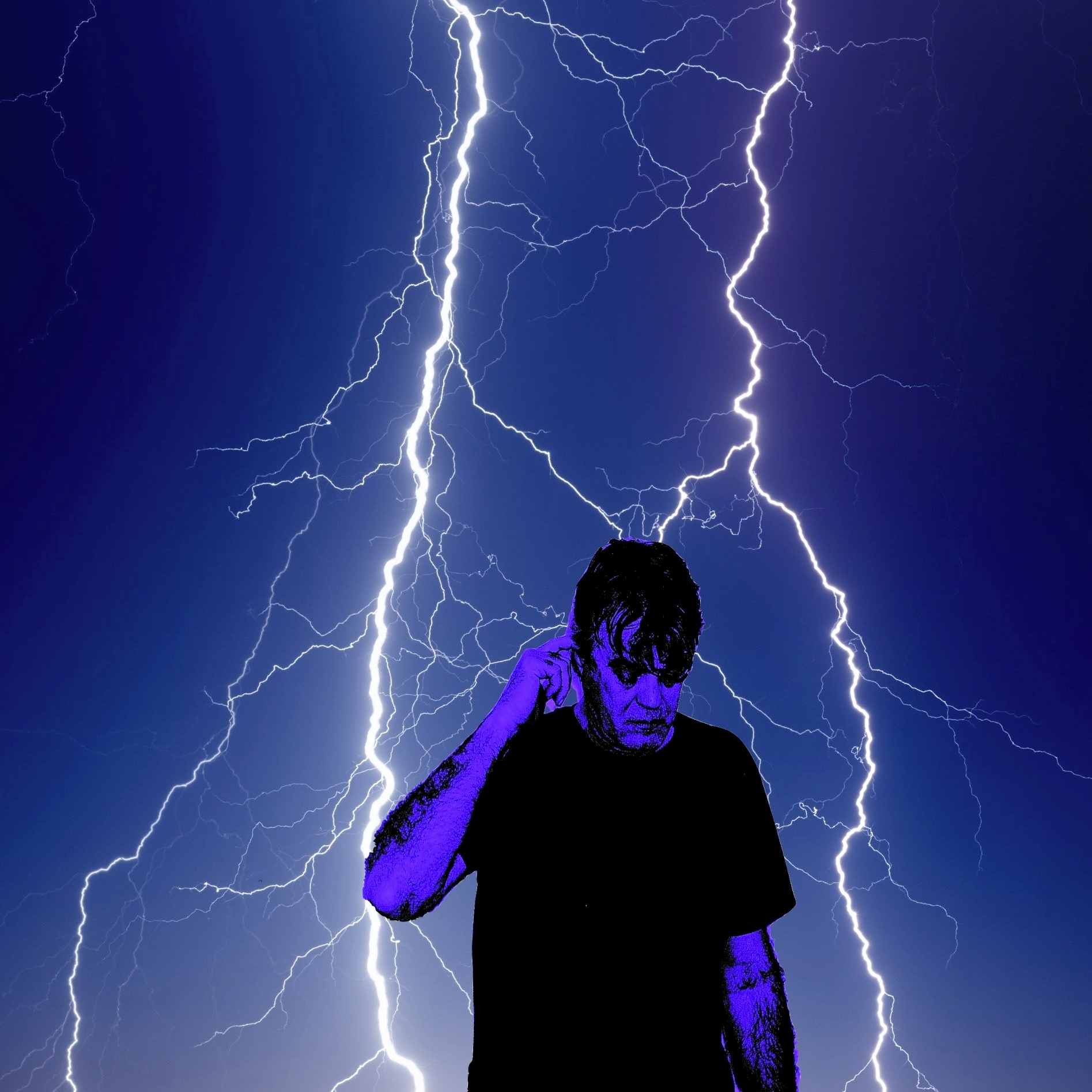
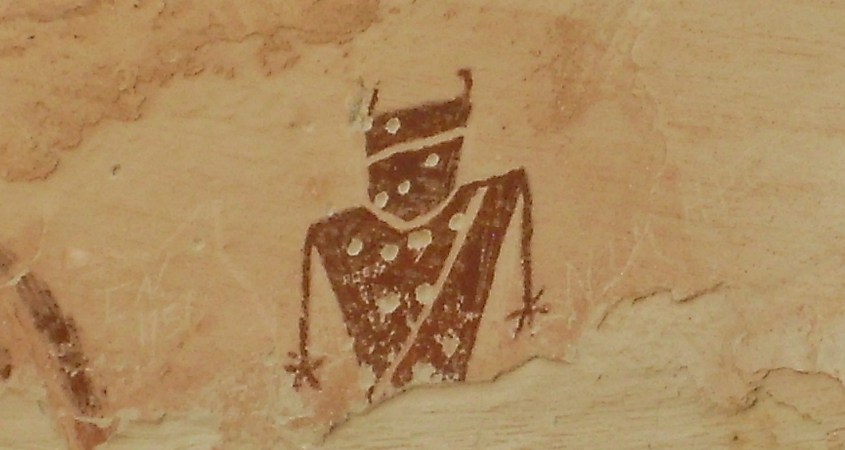

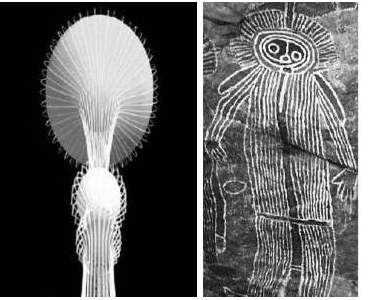
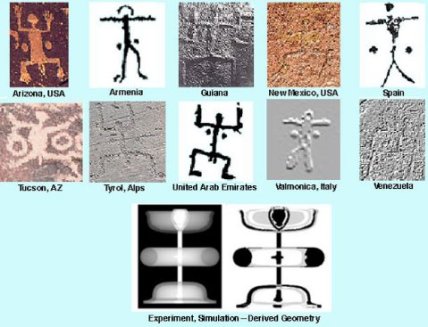
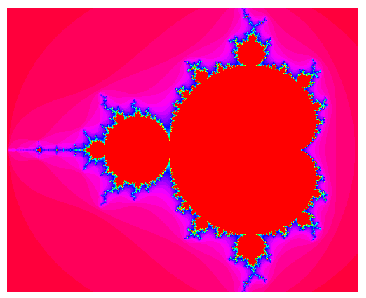
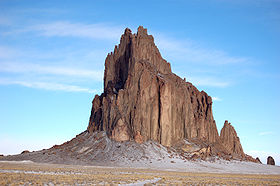
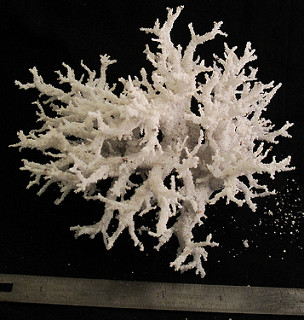


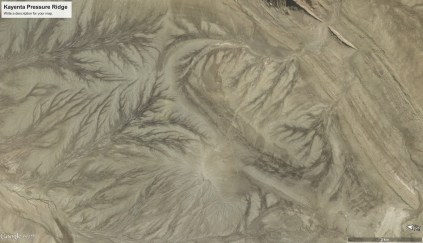


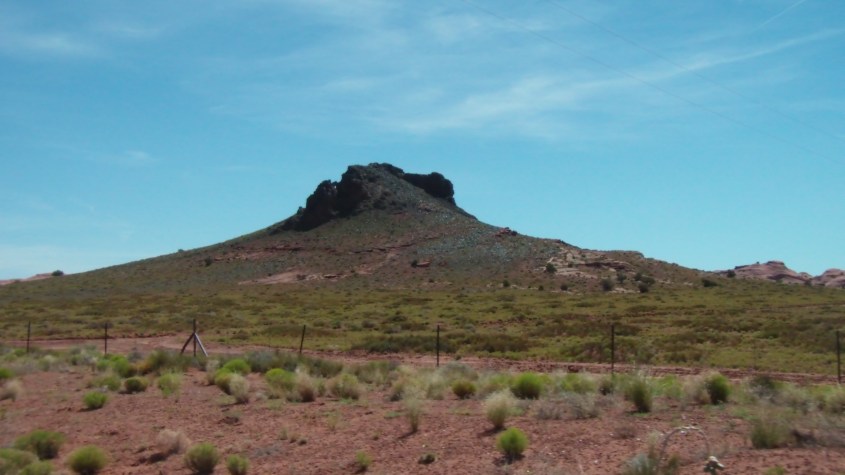
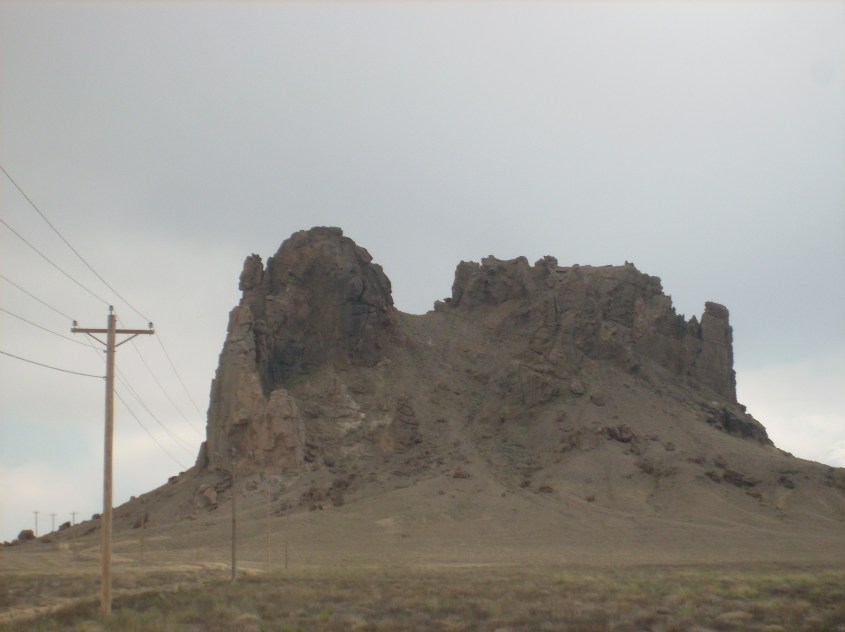
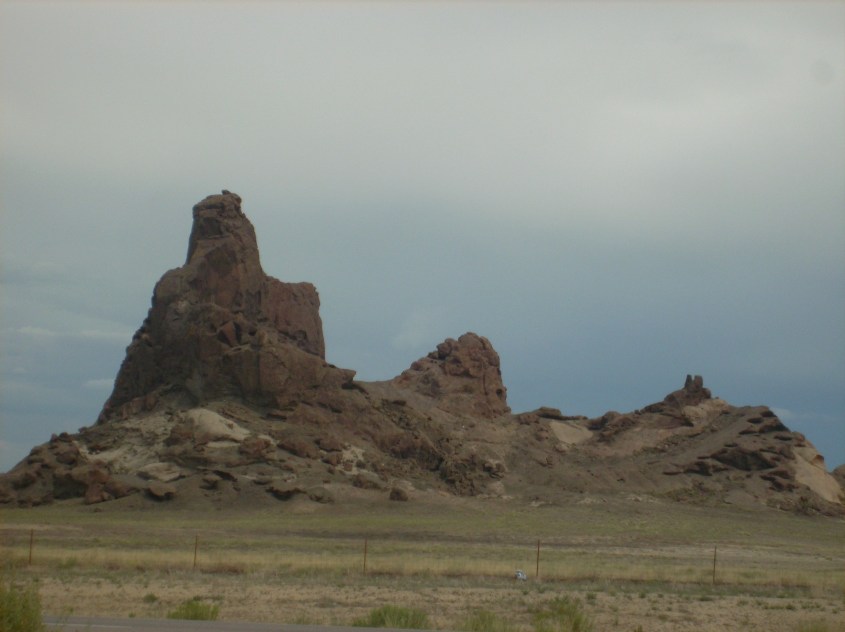


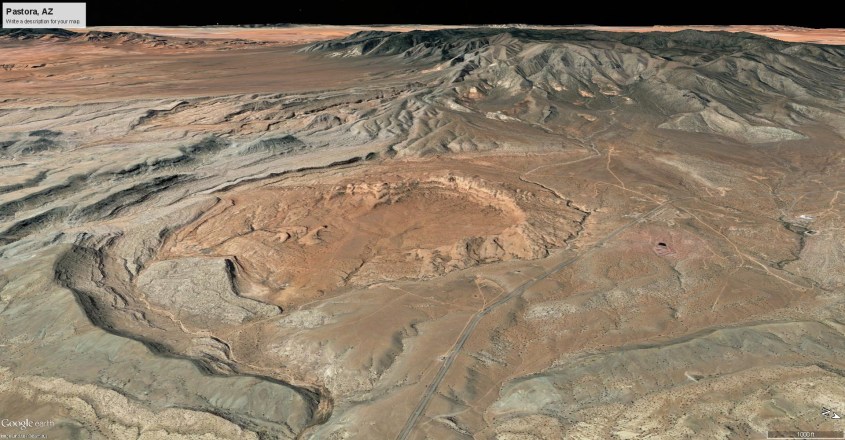

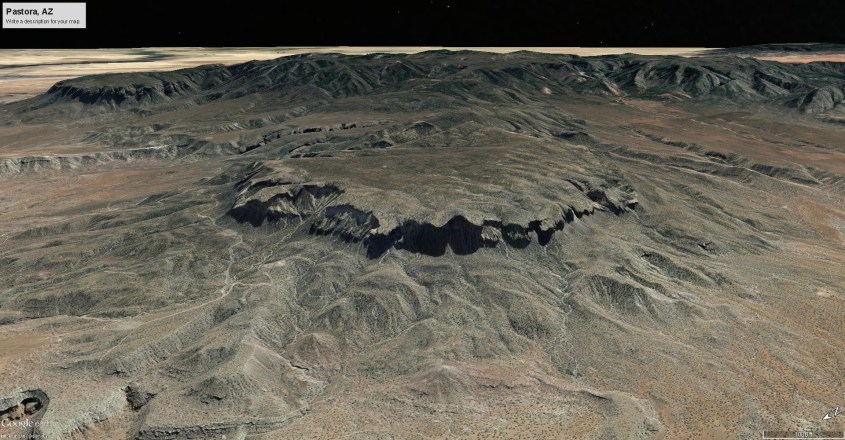
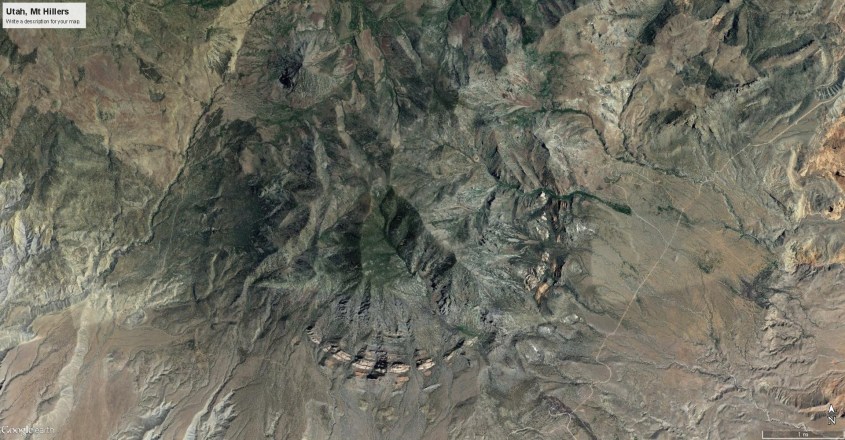

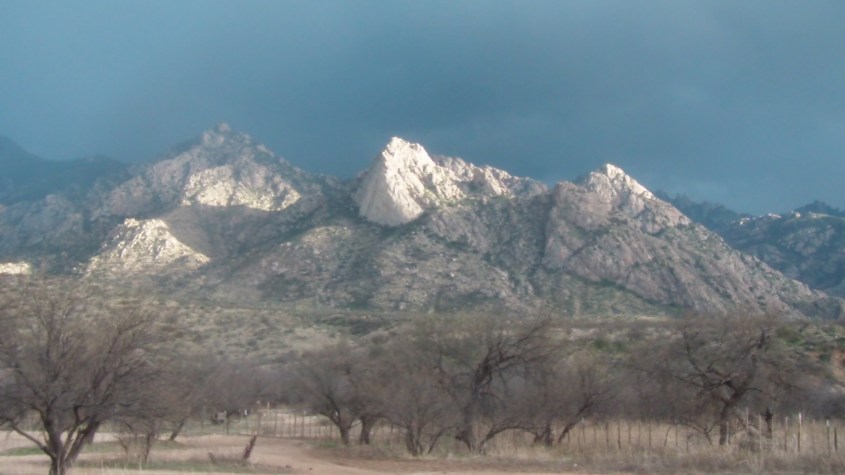
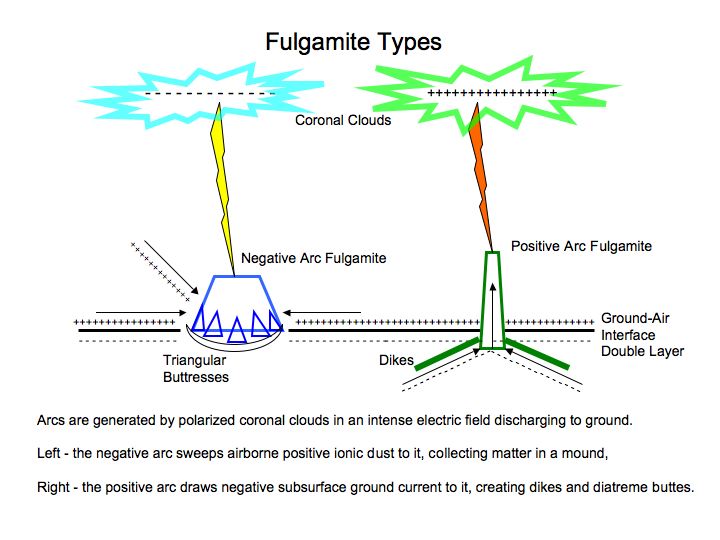
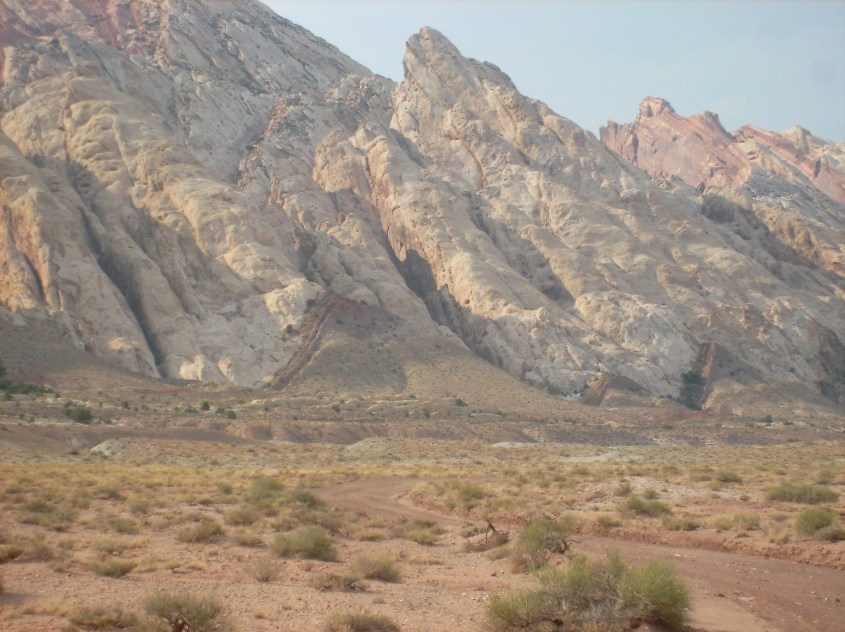
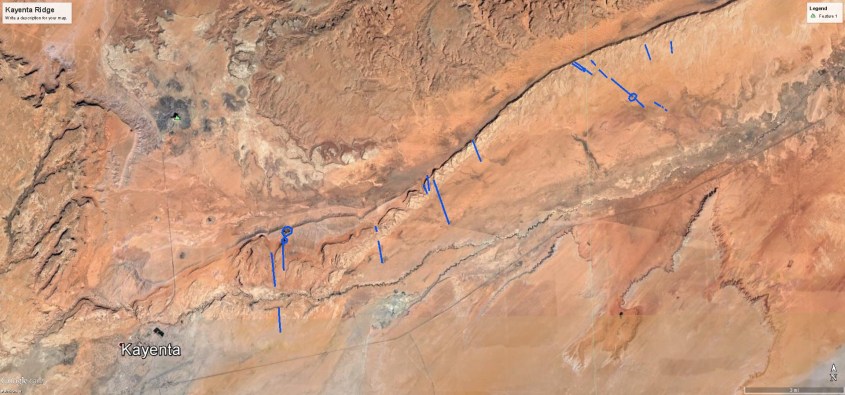
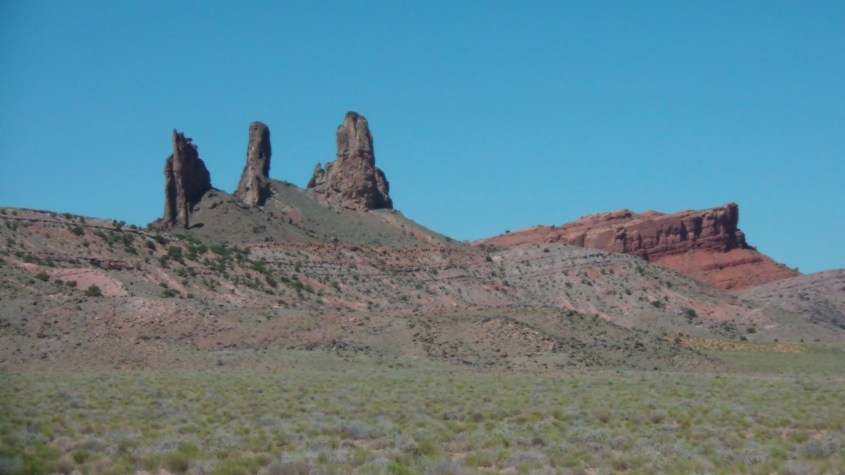

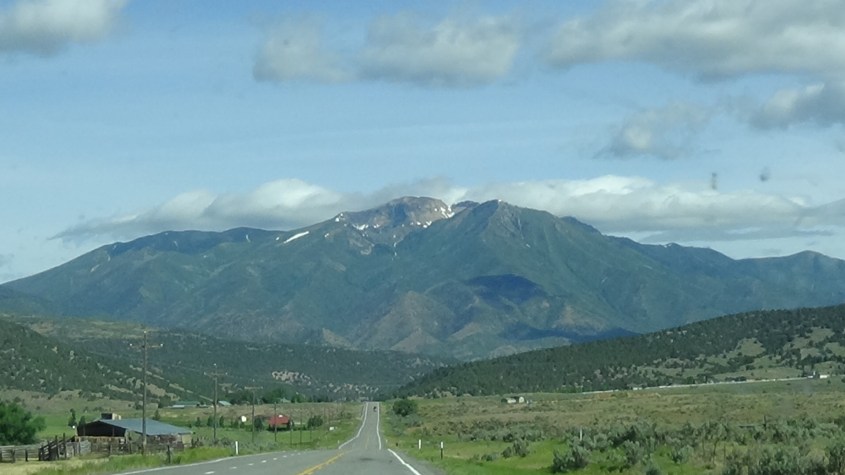
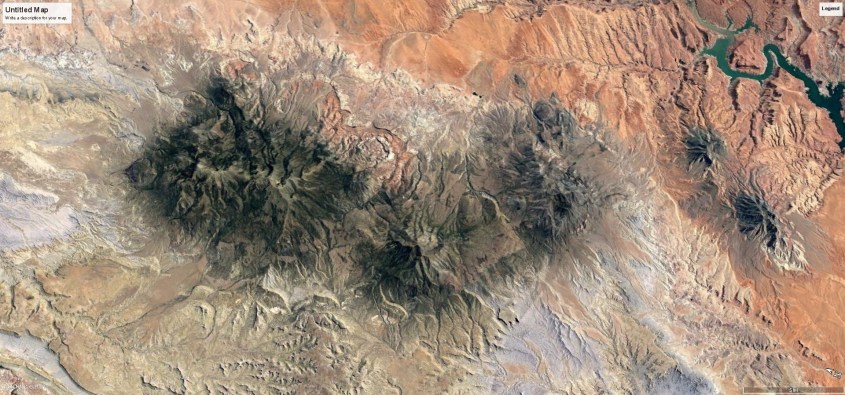
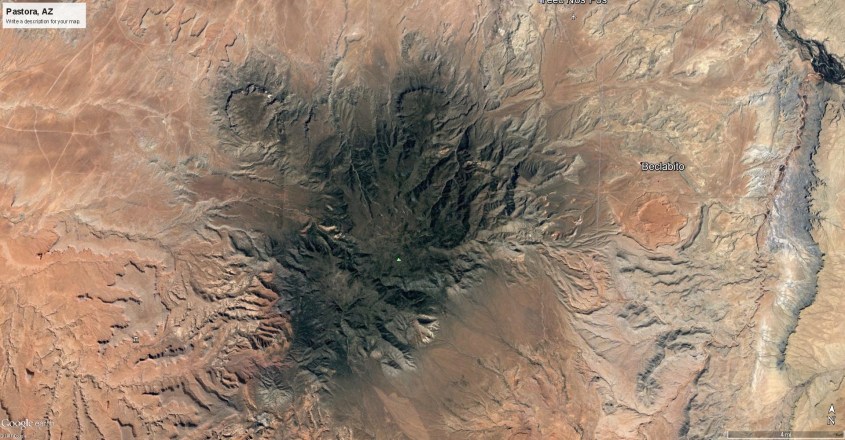
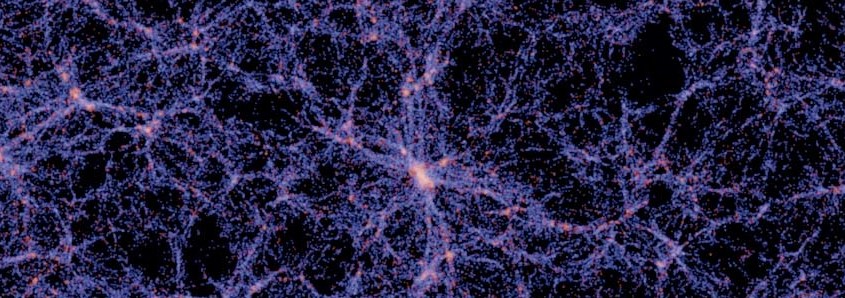
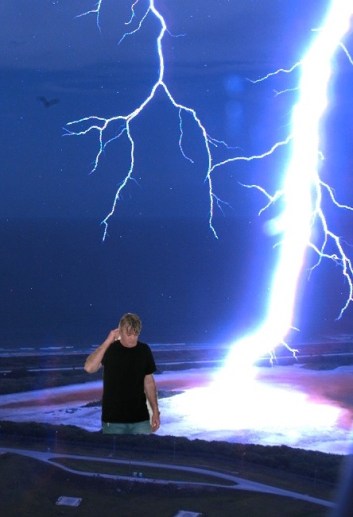 Your getting it straight from the trailer park were I live, which is a pretty humble perspective. An unvarnished, earthy reflection on what is really important, which is a perspective I have because I don’t spend my time like most. I’ve taken to a semi-hermetic lifestyle that allows me to contemplate the Big Questions in the sublime quietude of a retiree’s mobile home park.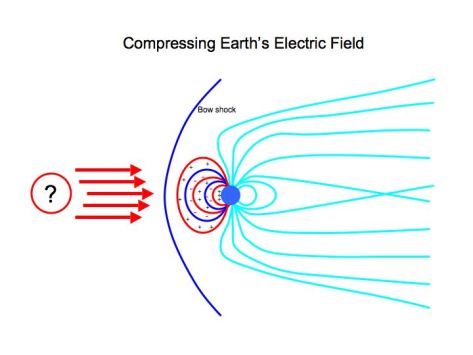
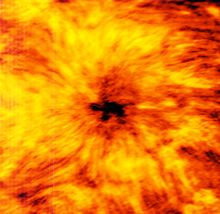
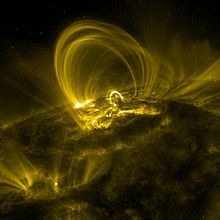
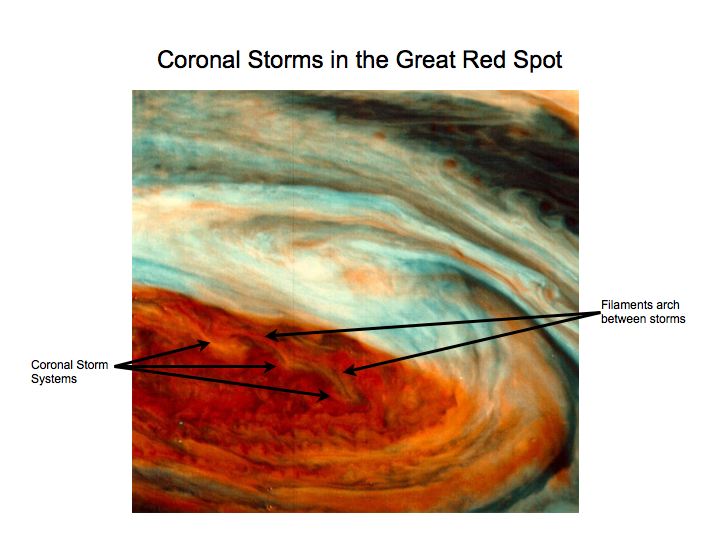
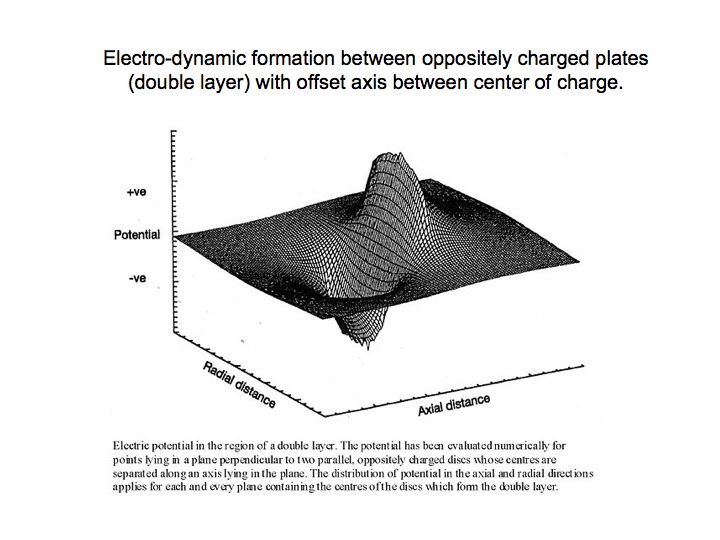
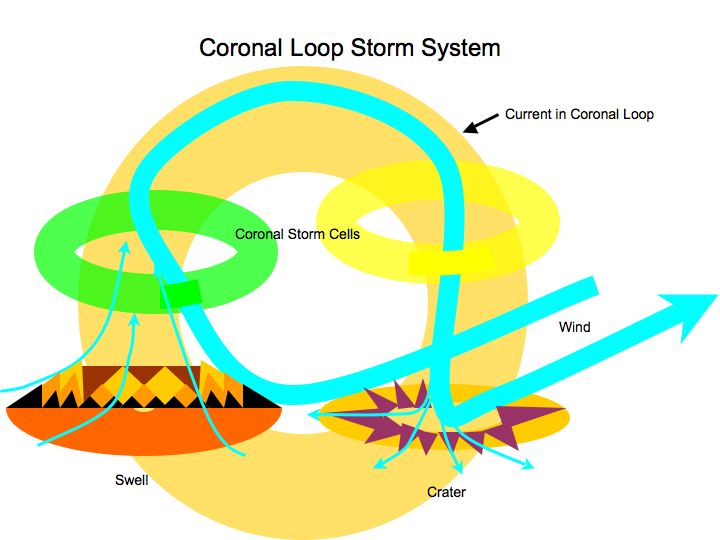
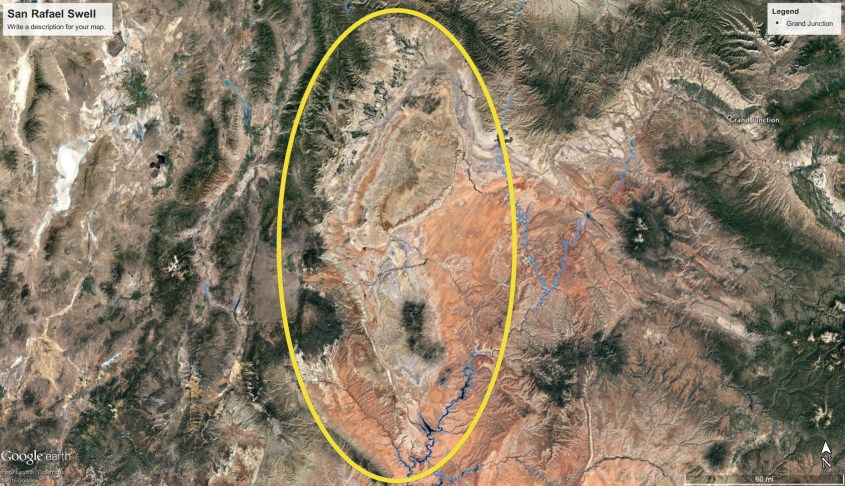
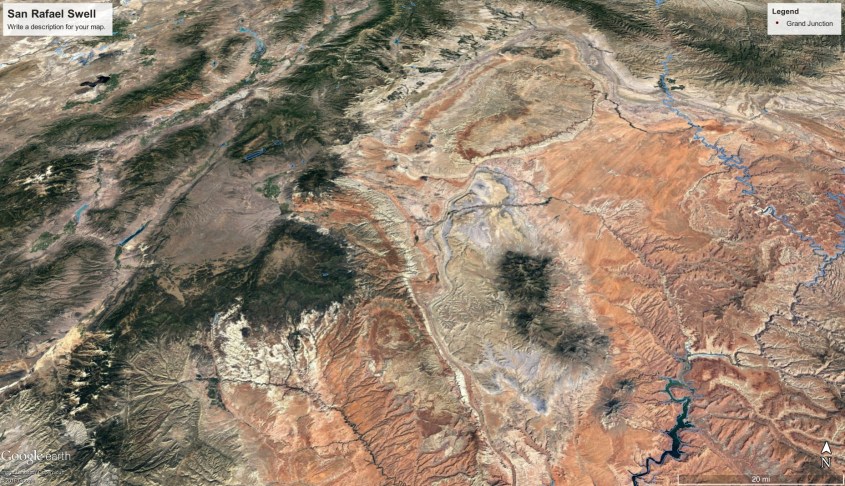
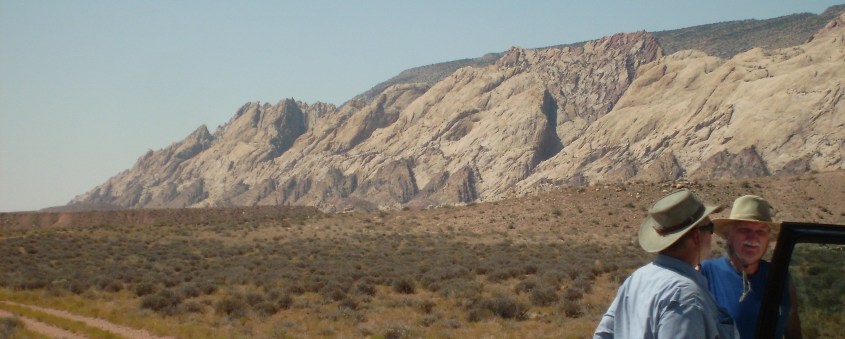
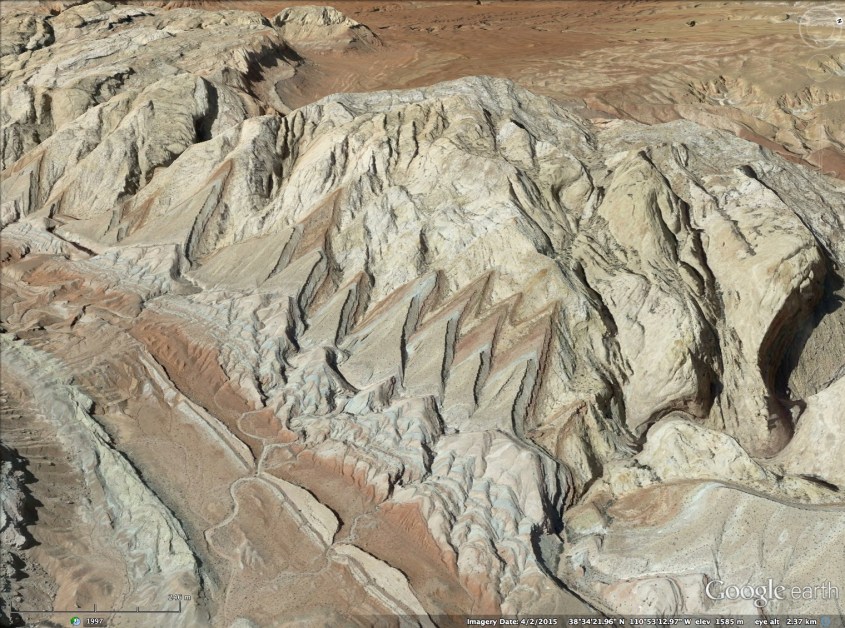
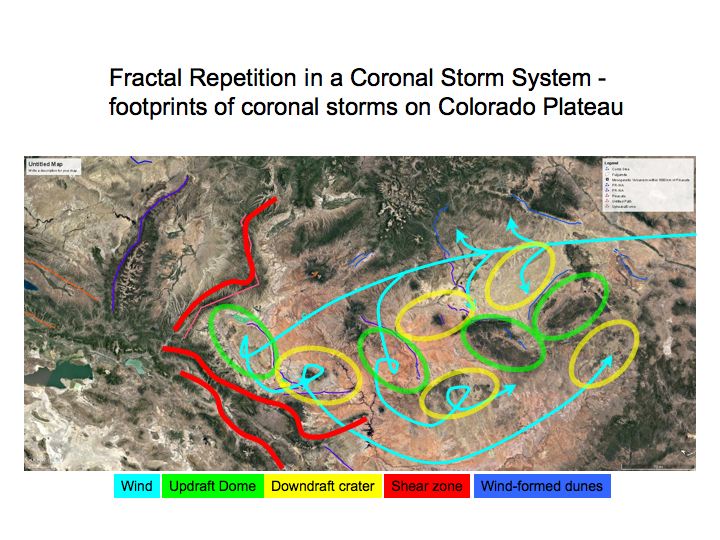
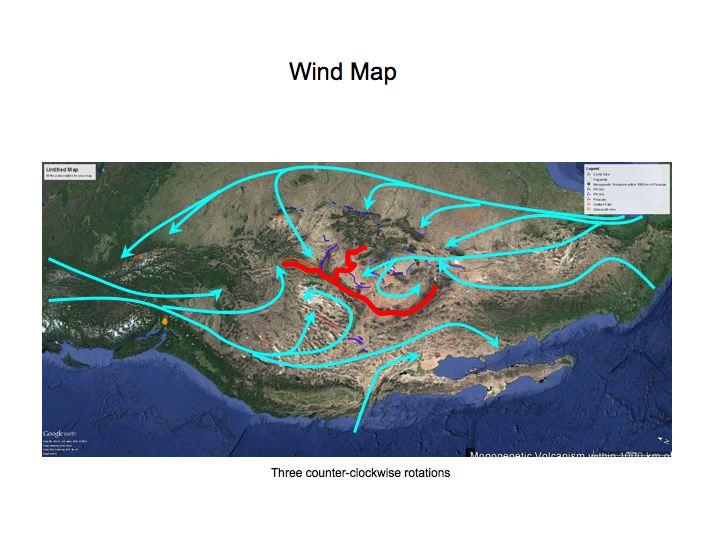
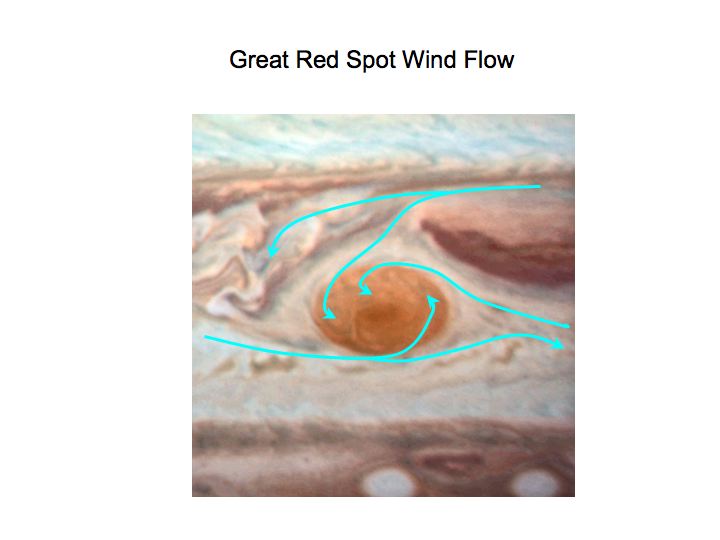
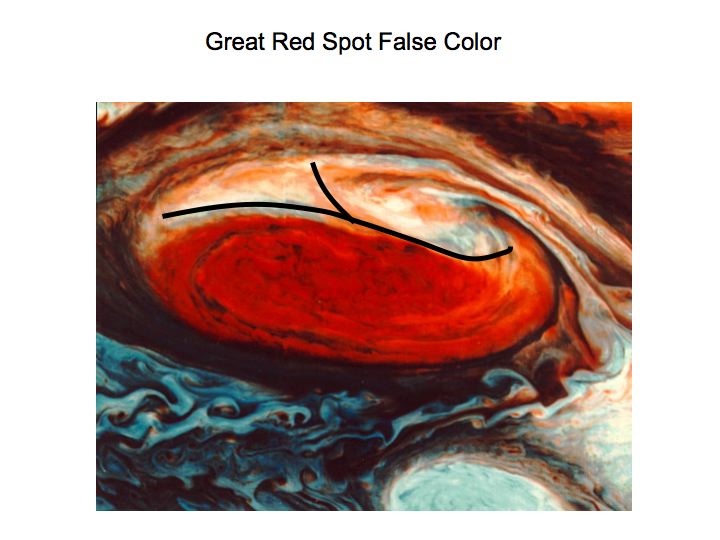
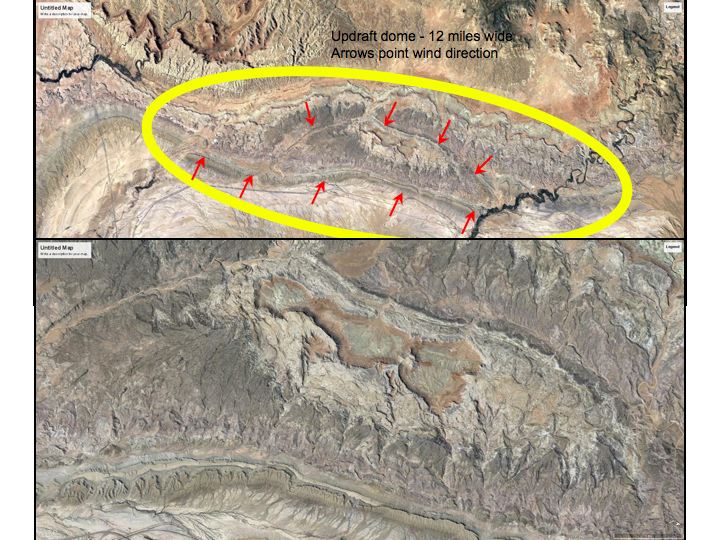
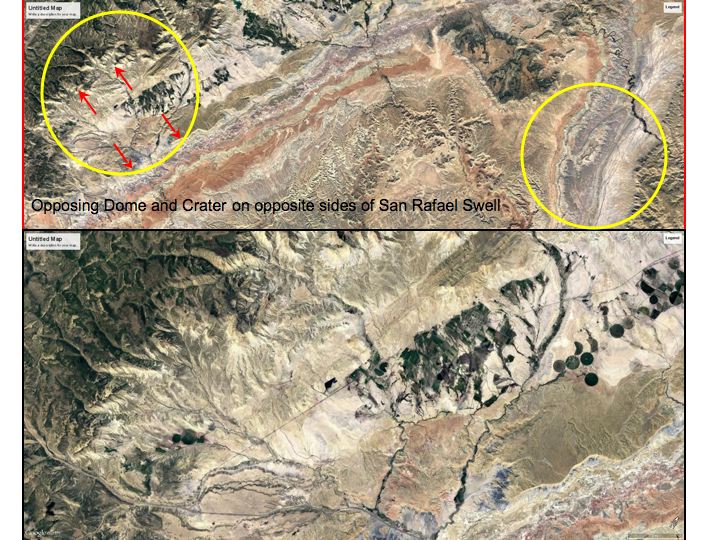
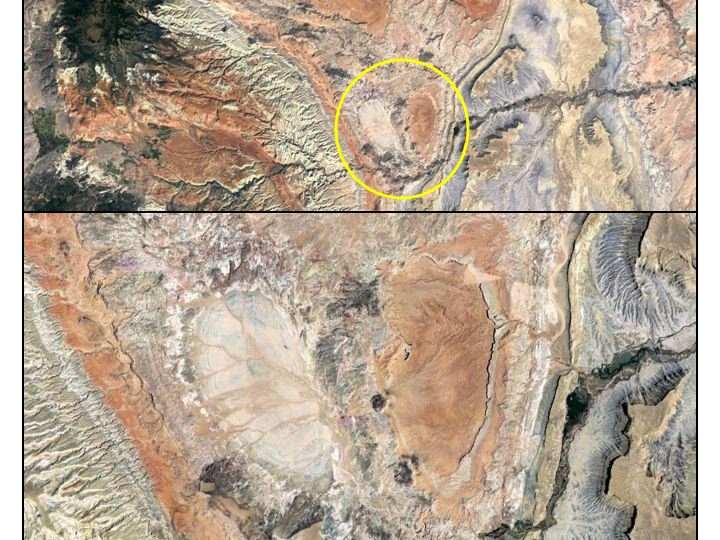
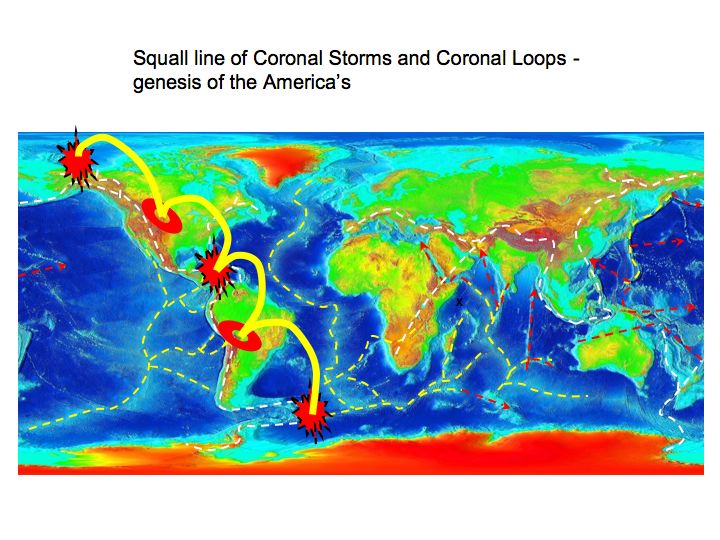
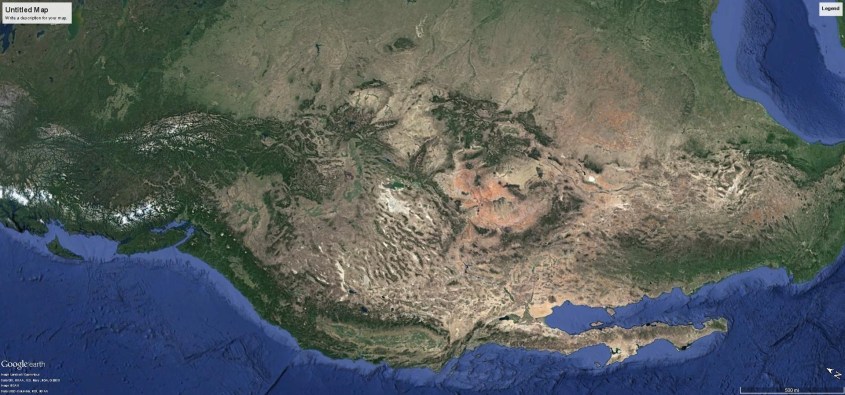
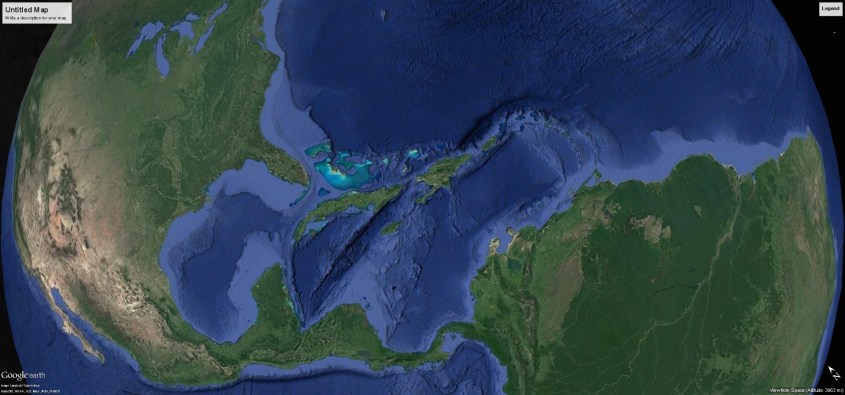
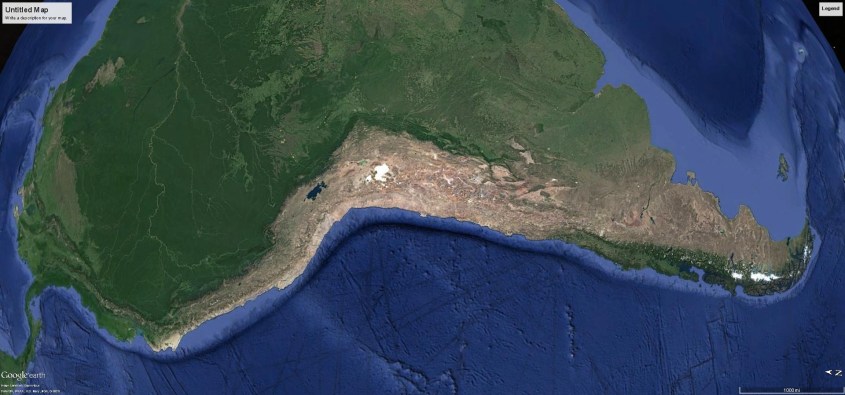
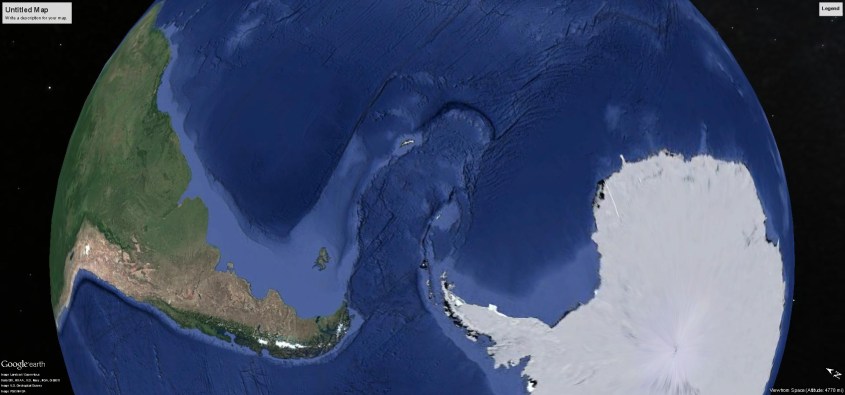
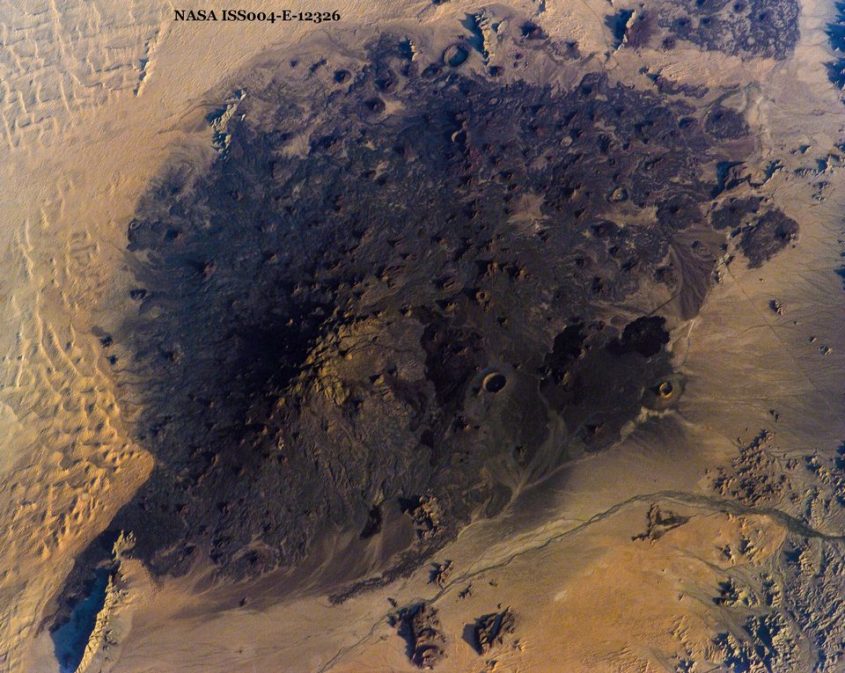
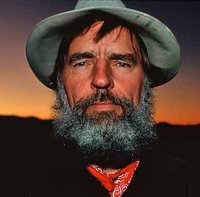 It’s location in the desiccated Altar Desert of Sonora is the reason it has remained pristine. As Edward Abbey wrote of the Altar: “This region is the bleakest, flattest, hottest, grittiest, grimmest, dreariest, ugliest, most useless, most senseless desert of them all. It is the villain among badlands, most wasted of wastelands, most foreboding of forbidden realms.” In other words, it was one of Abbey’s favorite places.
 Its many lava flows and tephra beds portray the Pinacate as the result of three volcanic periods. First it developed as a shield volcano, raising the mountain that gives the field its name.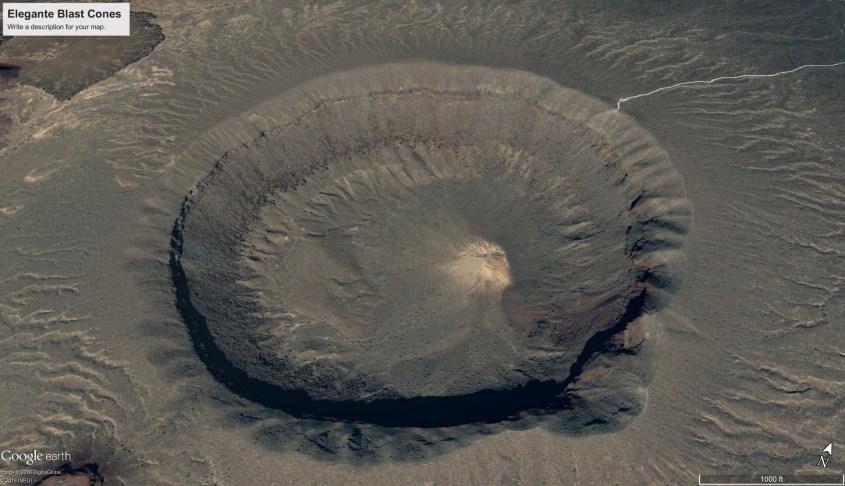
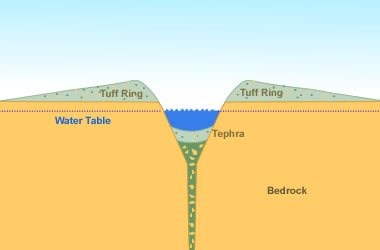
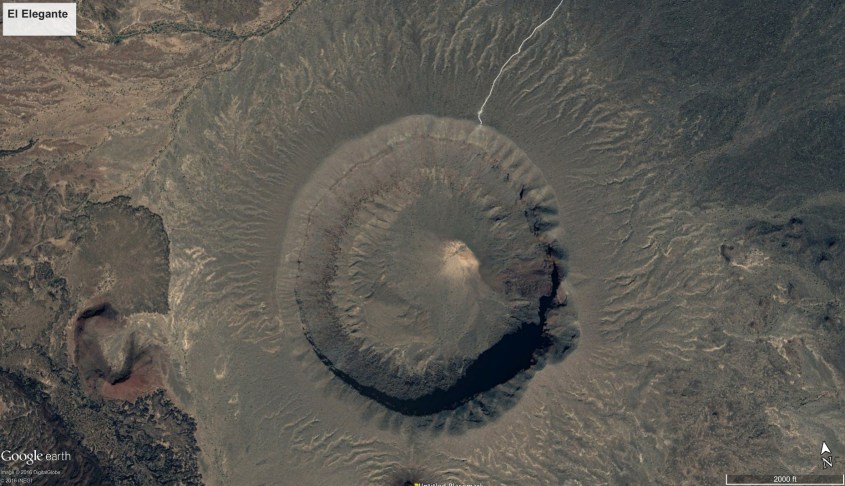
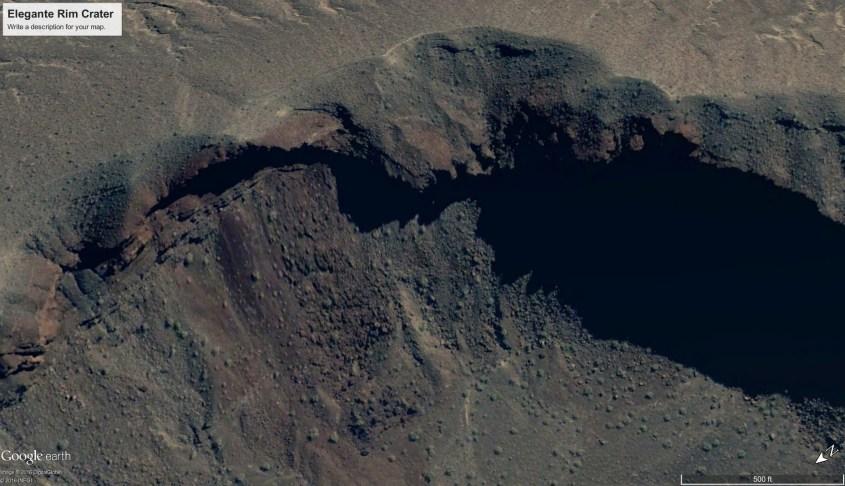
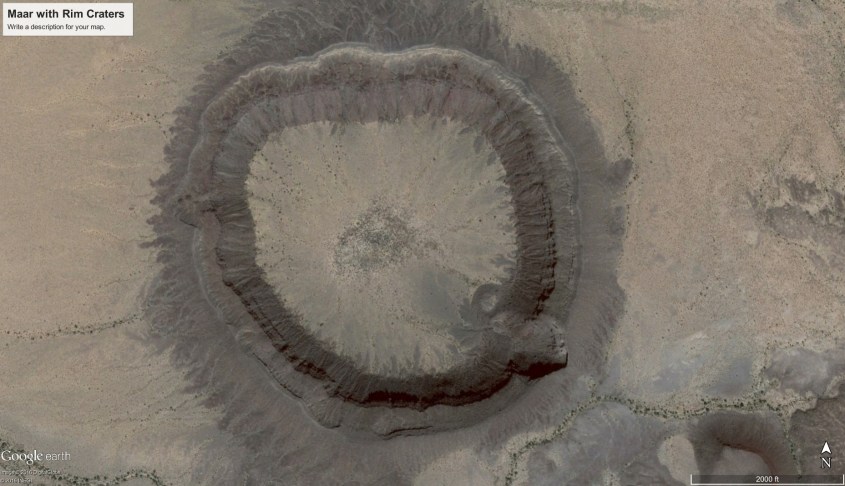
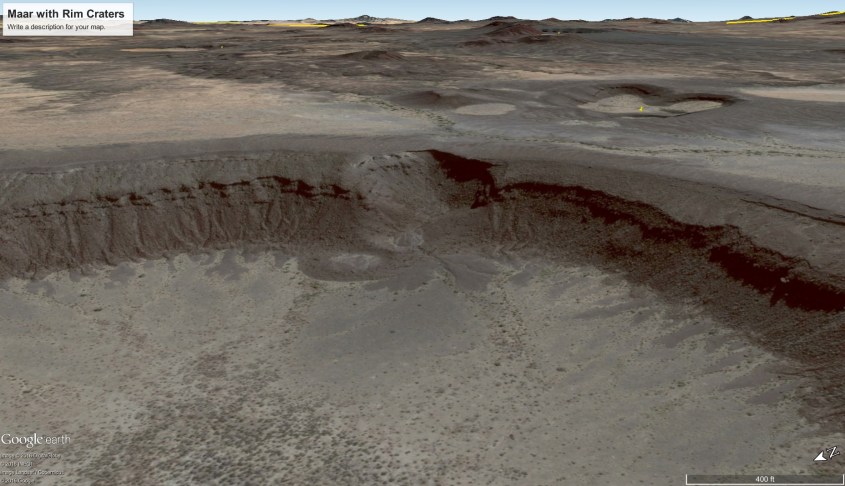
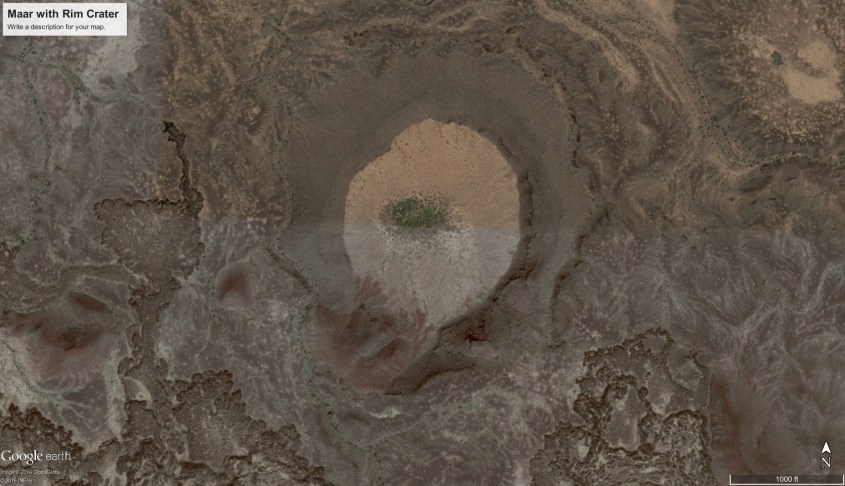
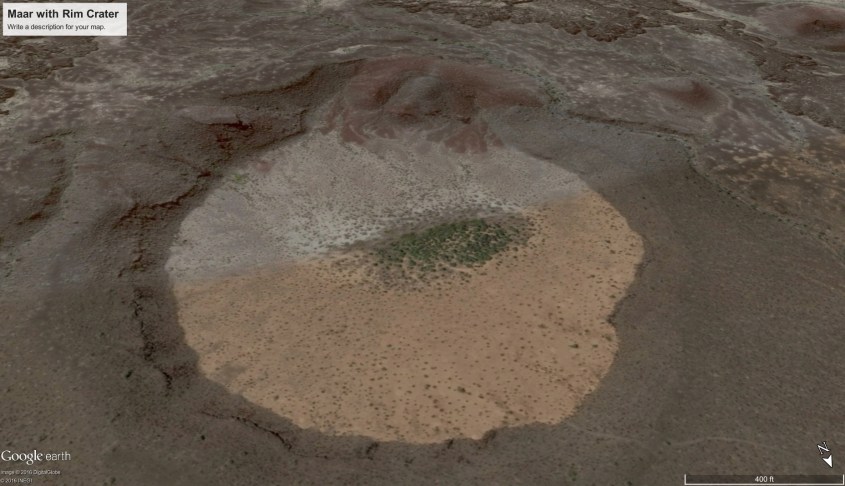
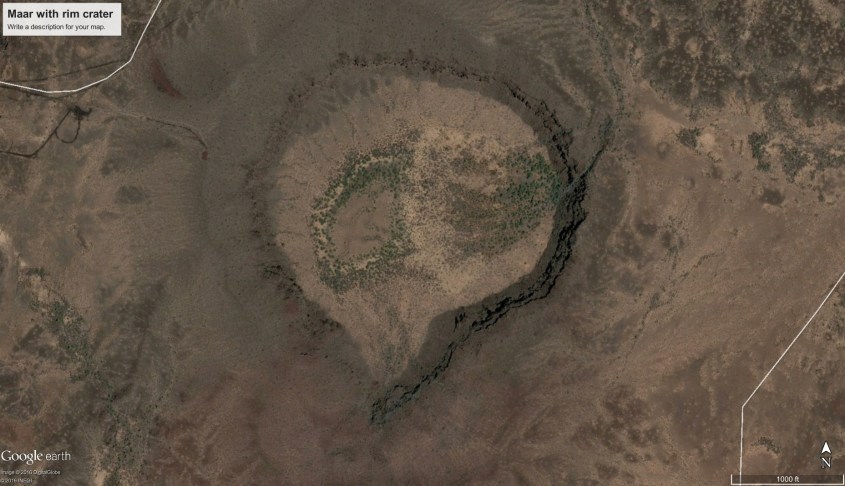
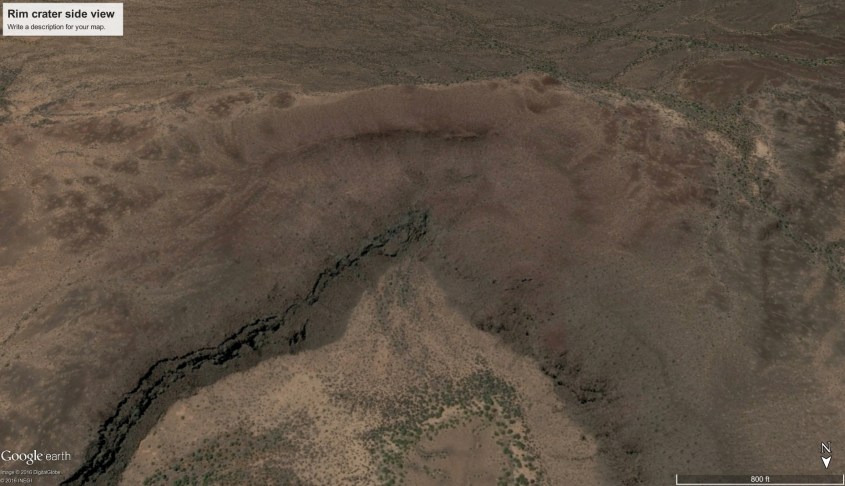
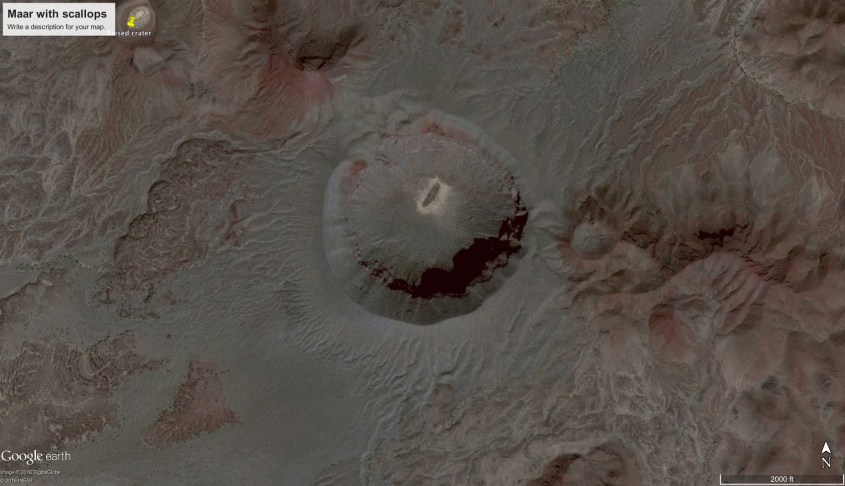
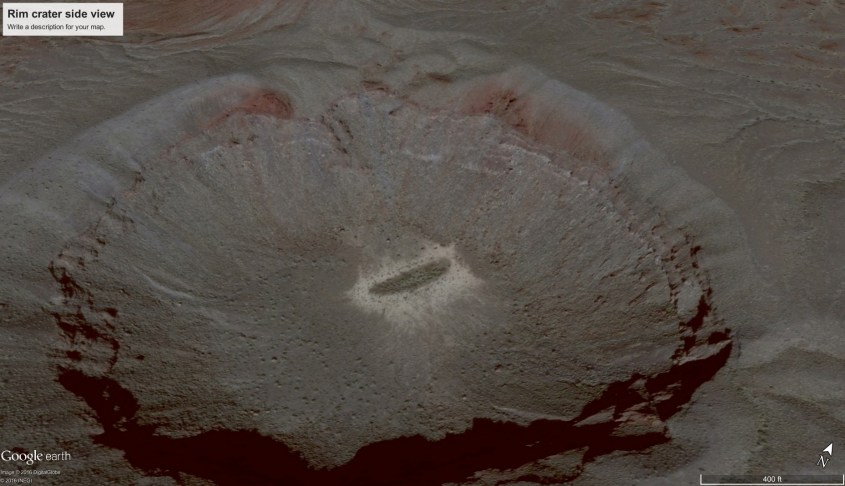
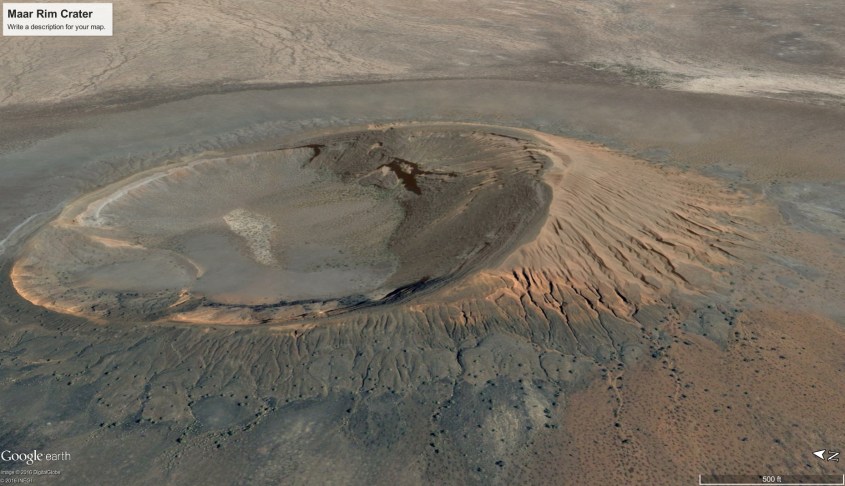
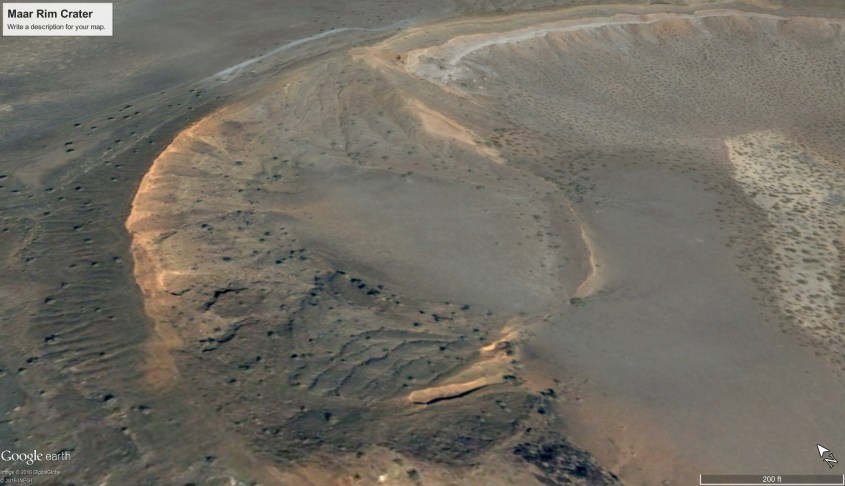
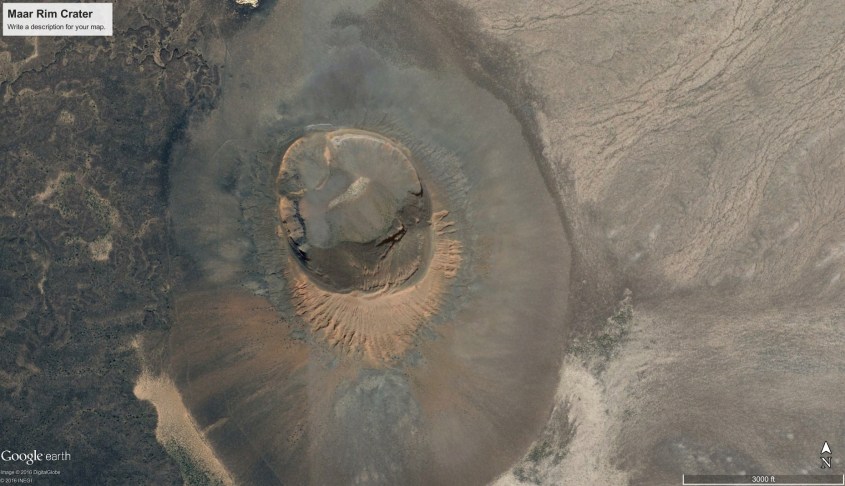
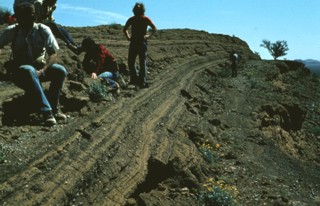
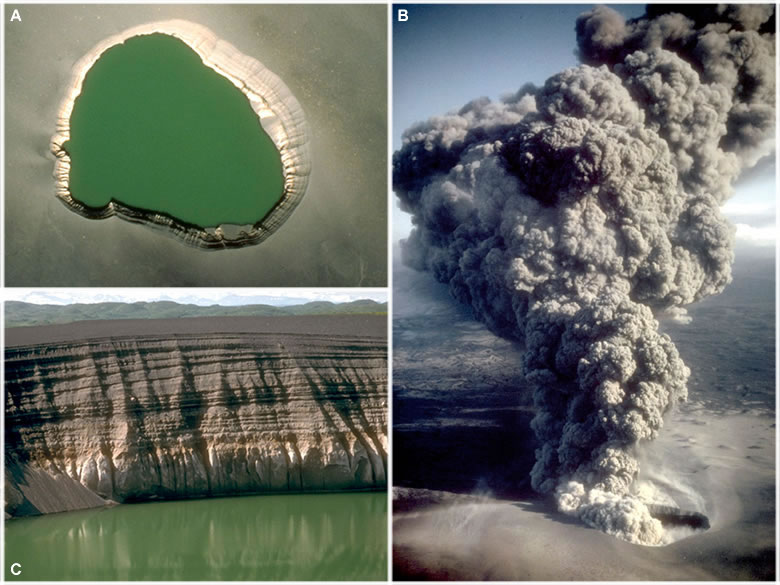


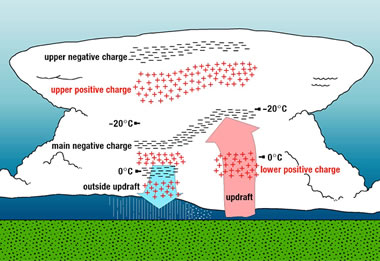
 The study indicates updraft winds won’t produce much lightning until they reach 10 to 20 mph. Then strike frequency escalates with updraft speed. From 20 to 50 mph wind speeds, lightning frequency might be 5 to 20 strikes per minute, whereas above 90 mph, the flash rate can exceed one strike per second.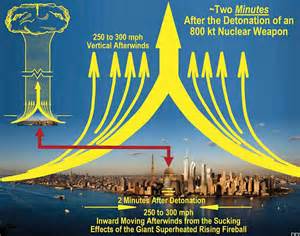
 Consensus science has concluded there are two forms of volcanic lightning. Researchers led by Corrado Cimarelli, a volcanologist at Ludwig Maximilian University in Munich, Germany, studied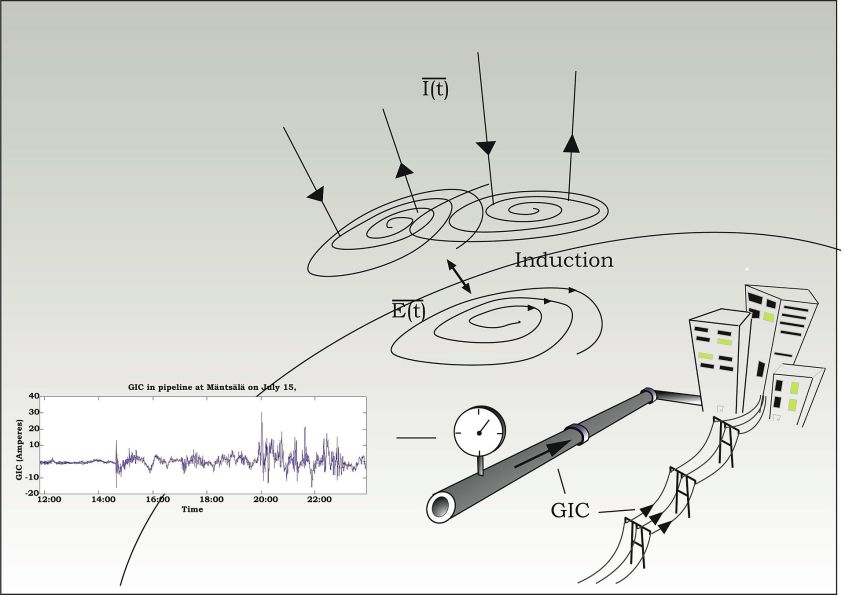
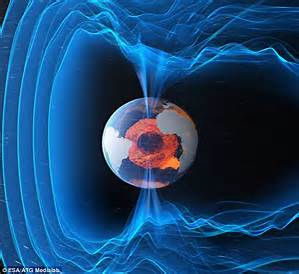 GIC may not be the only source of electrical current on and under the ground. After all, the rush of lava and gases through vents in Earth’s crust would seem to require a lot of things rubbing and colliding. It seems necessary this would build static charge and cause discharges deep within the earth, even by consensus reasoning.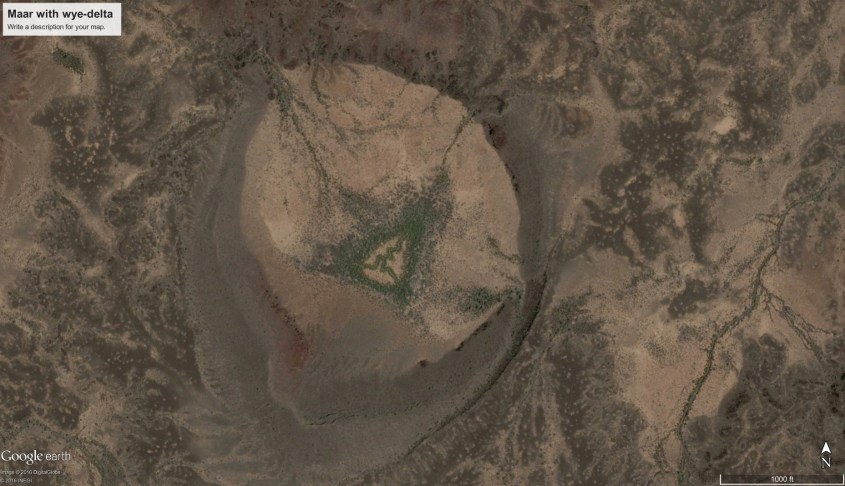
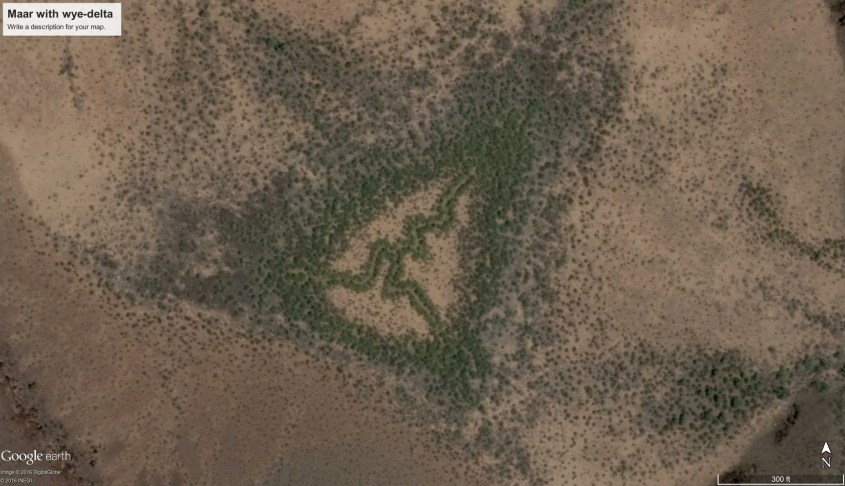
 Deep craters at the polar regions of the moon never see sunlight. Within these eternally dark and frozen craters, cosmic rays are bombing the surface, creating a double layer of opposite charge, because it is theorized, electrons penetrate to the subsurface, while positive ions hit and collect at the surface – it’s always the collision thing.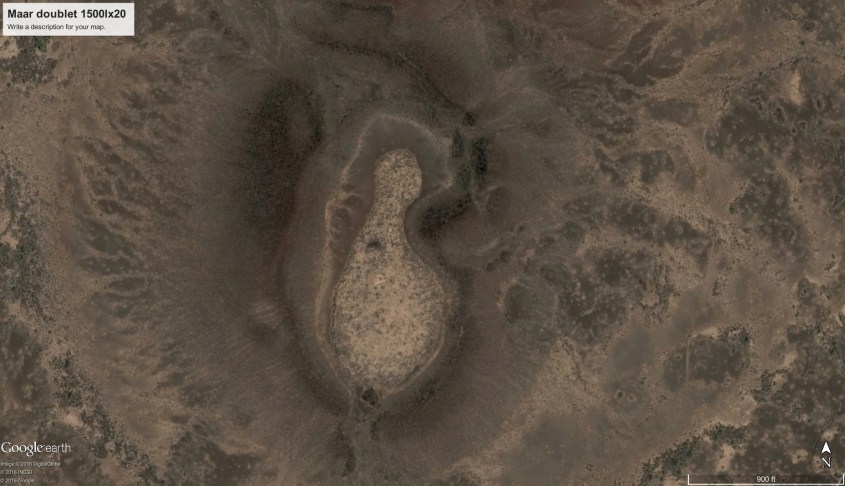
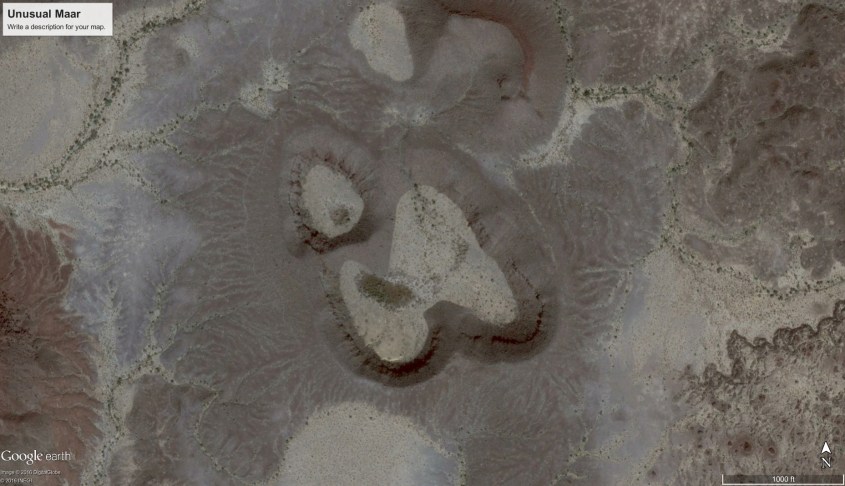
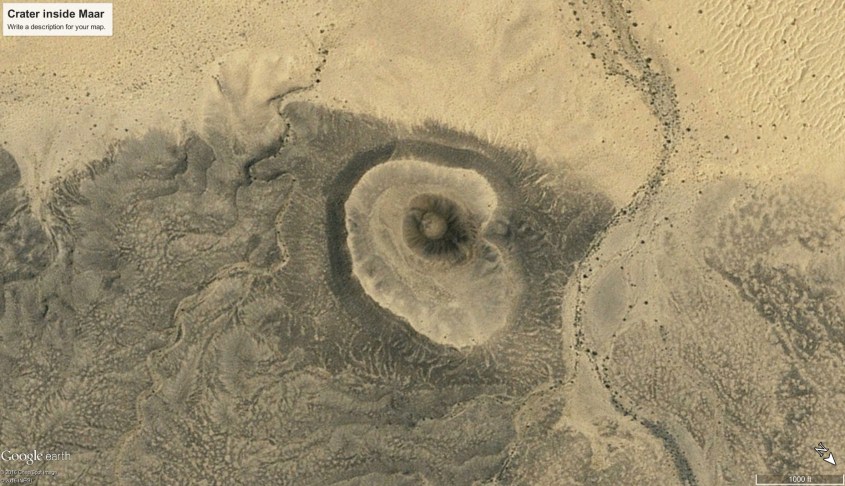
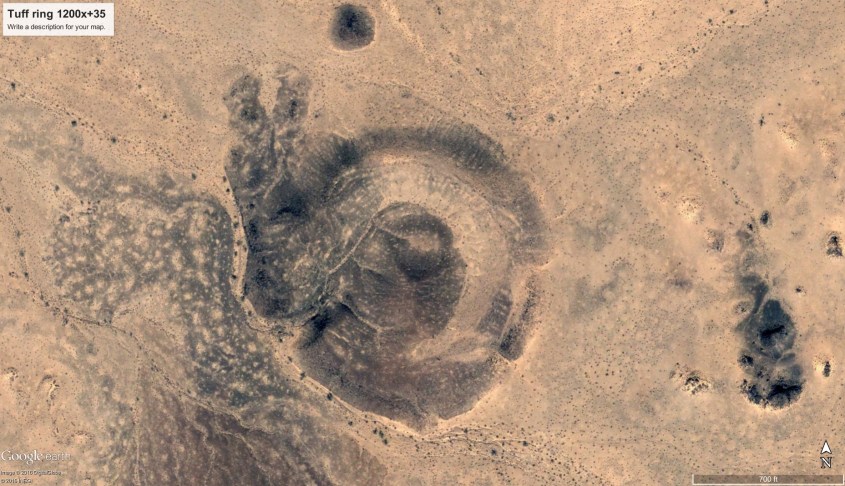
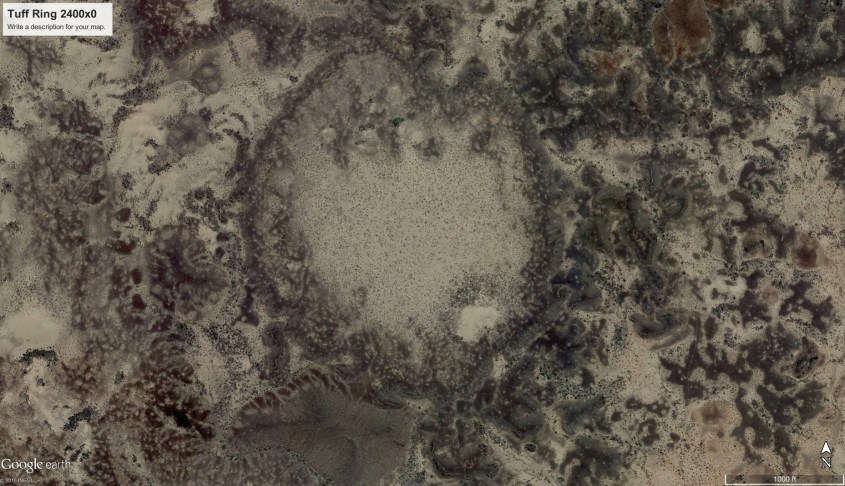
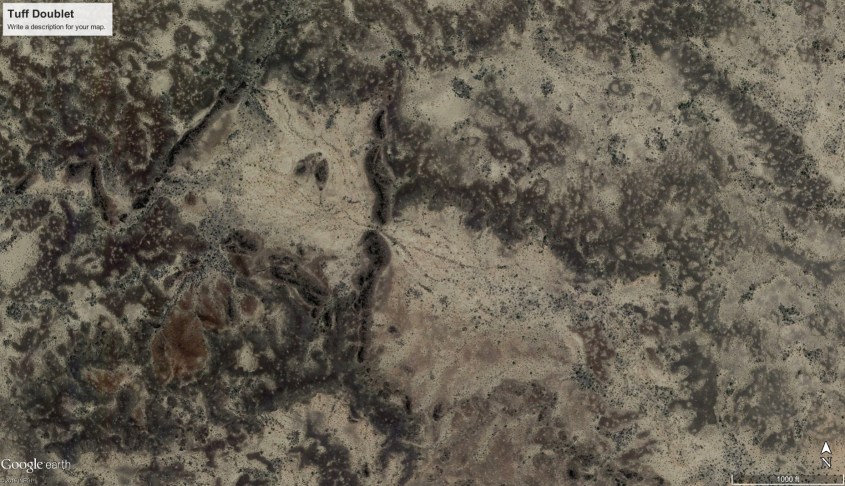
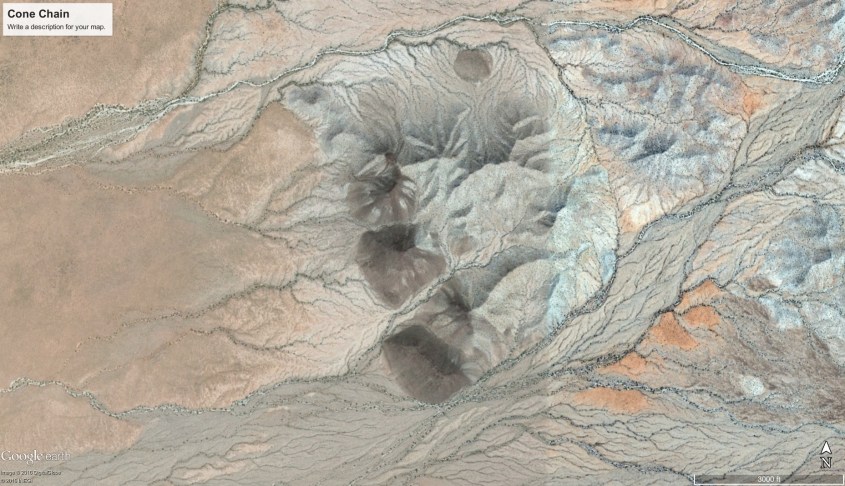
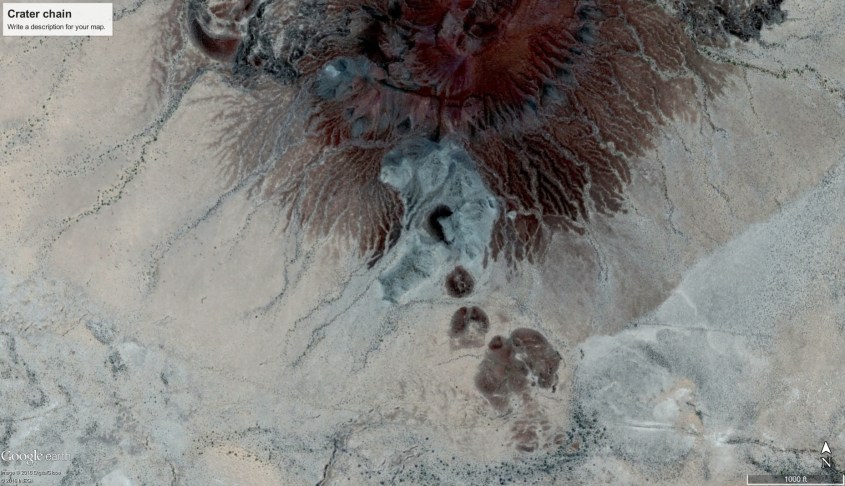
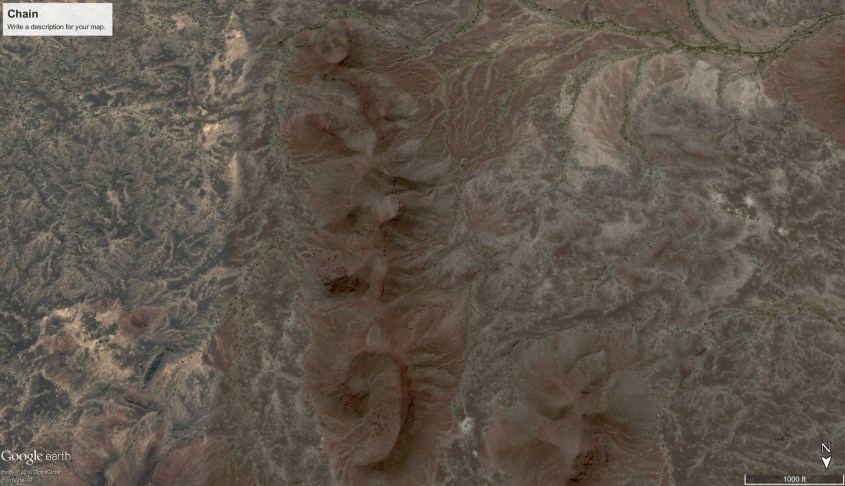
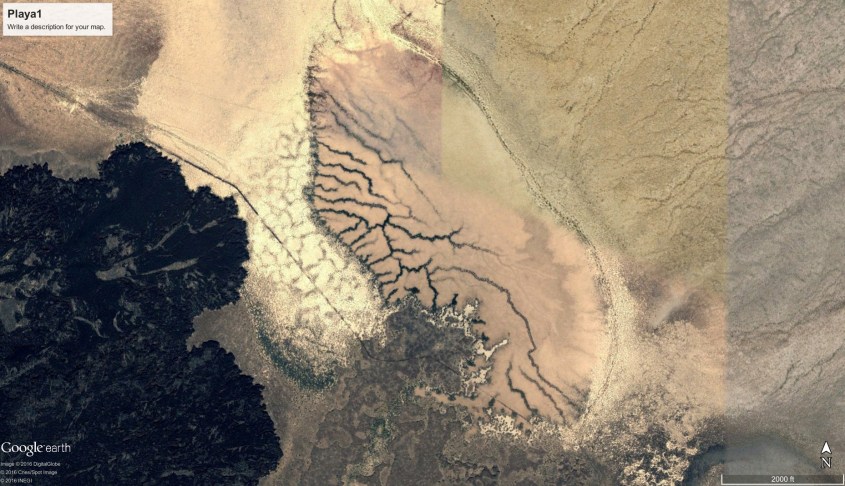
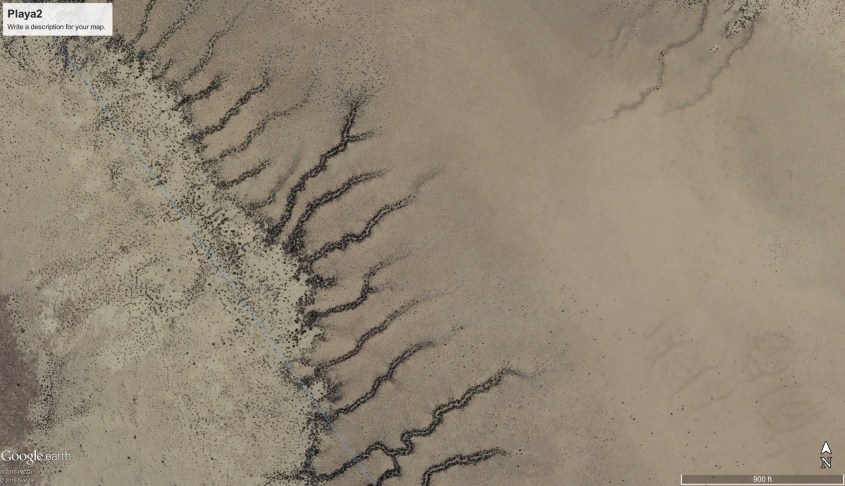
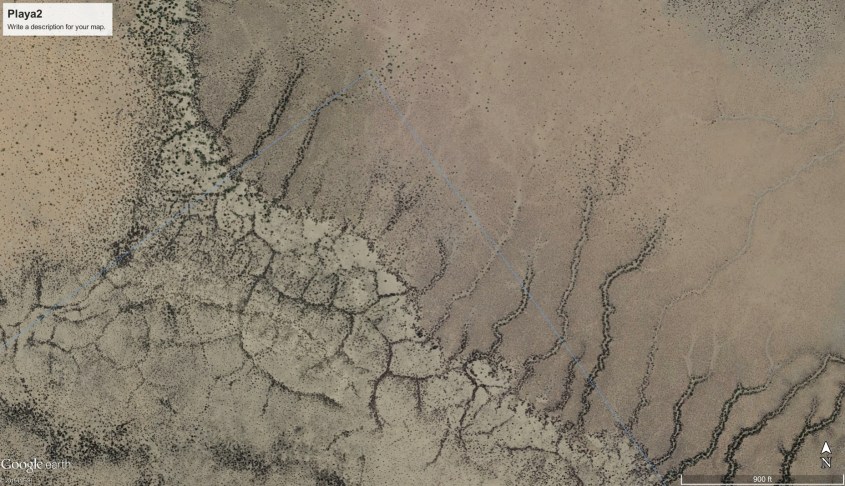
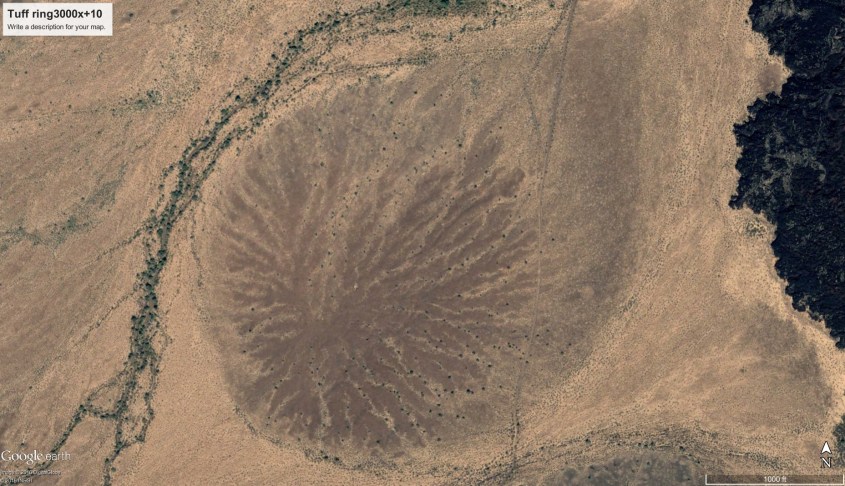
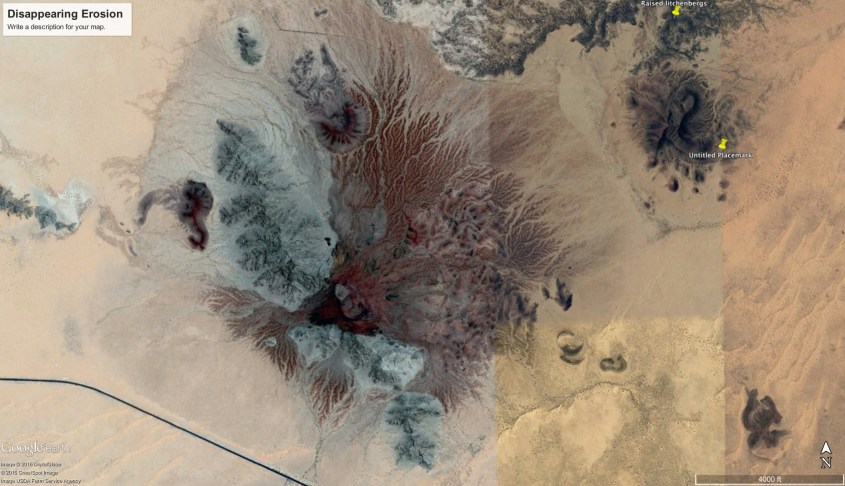
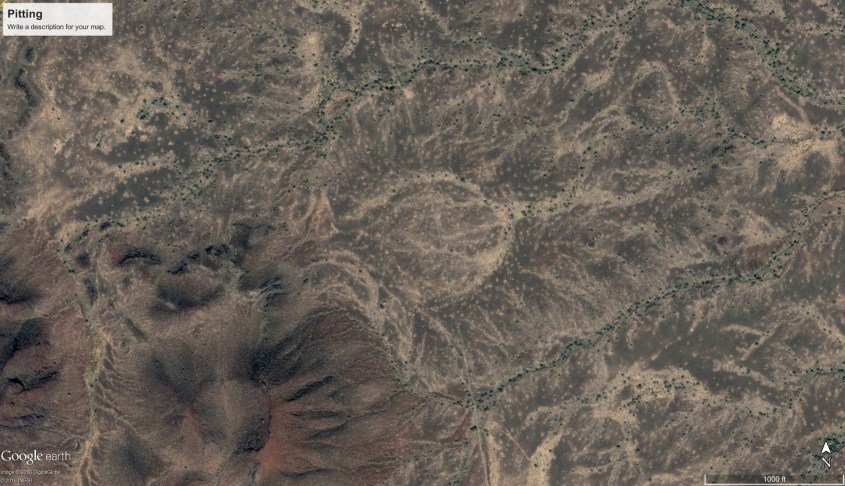
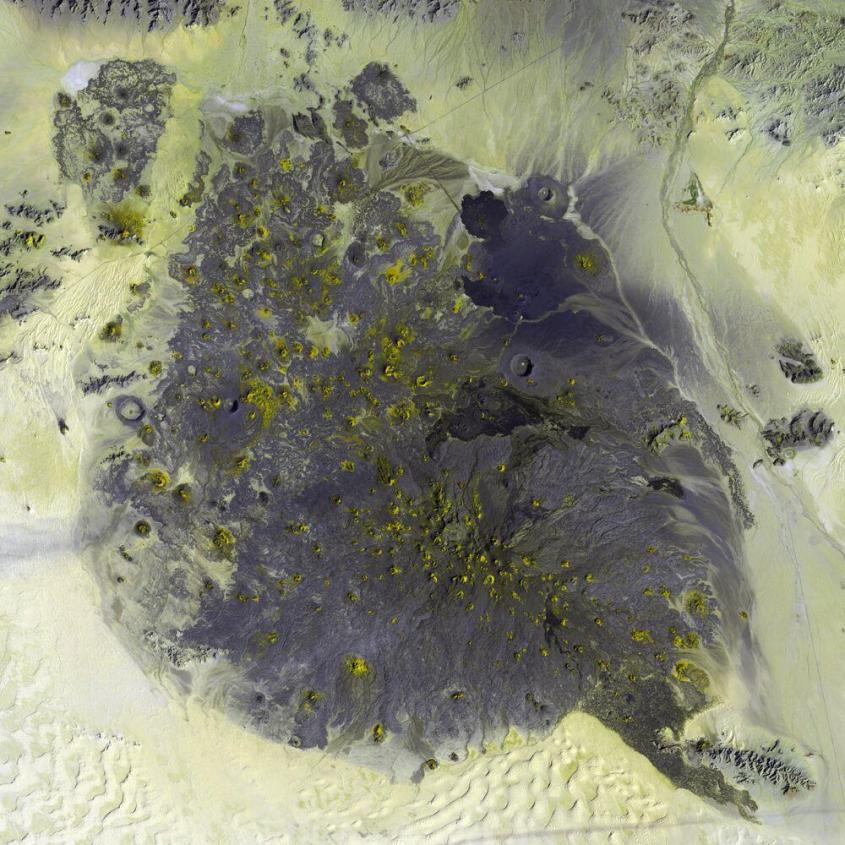



 Arizona isn’t the first place people think of when Bigfoot is the subject. This is one paradigm people should get over. They are not isolated to the Pacific North-West; the Cascades, the Rockies, or this, or that…they are closer than you think.
 The term “
 My technique is simple. I go light and alone except for my dog. I hike straight up a path of tree leans, quickly and quietly. I choose trails that lead a short distance to a ridge, or peak, where there is likely to be evidence of their presence. There is also the possibility of an encounter.


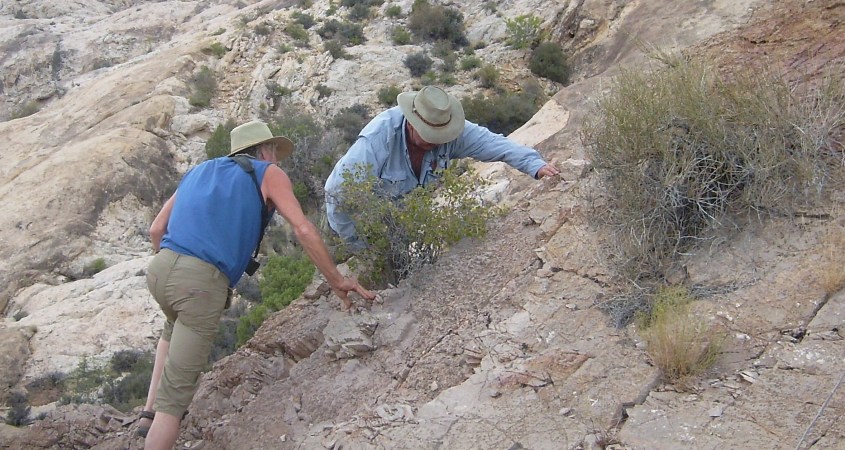


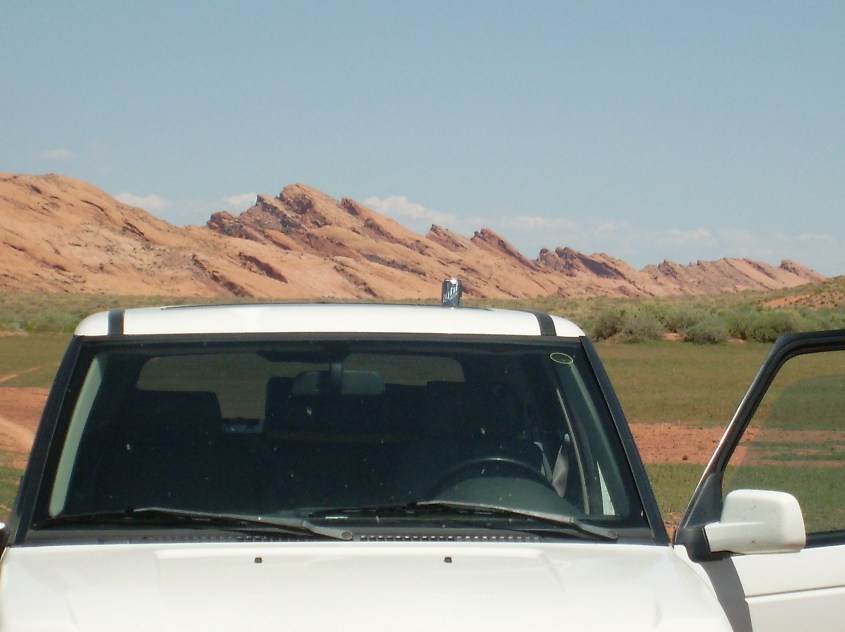
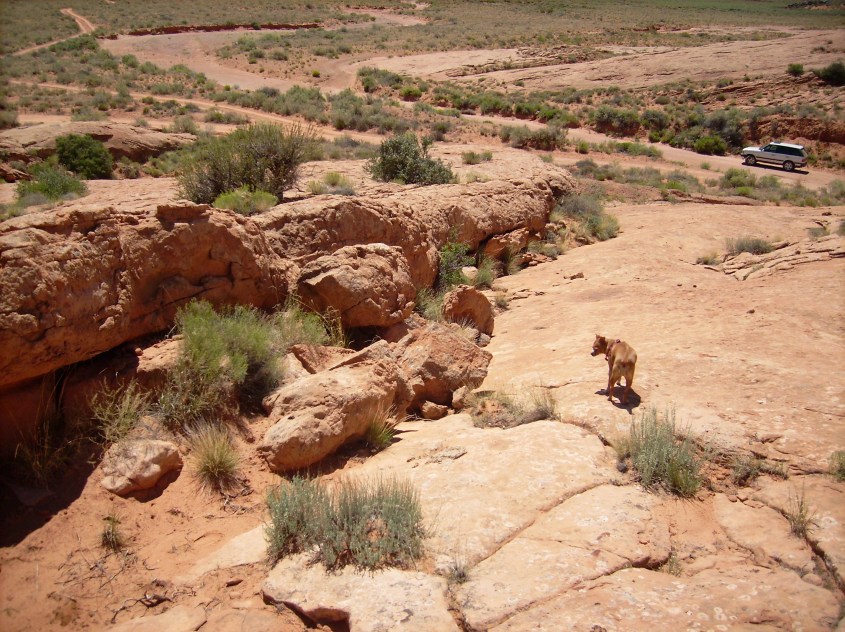


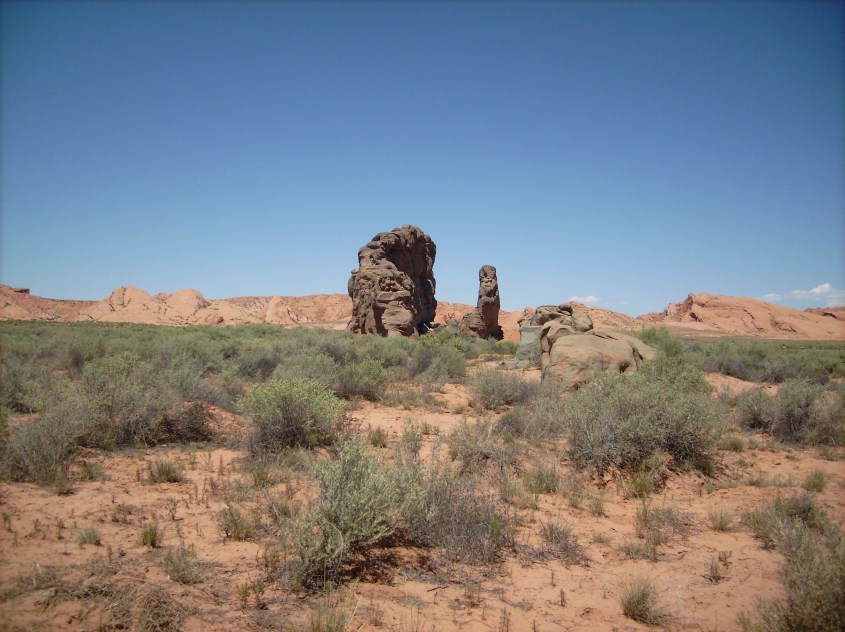
 Down river we drove, surveying each campsite along the way. Here, the river cuts through a deep walled chasm favored by rock climbers. So the camps were full of these spider people; a strange, underfed and insular cult, festooned with colorful webbing.
 I watched the sun angle below canyon walls, wondering how long until it cooled inside the tent to be bearable. I paced back and forth in smoke to foil the mosquitoes, my skin cooking from fire, my insides cooking in vodka, and fever in my brain from both.


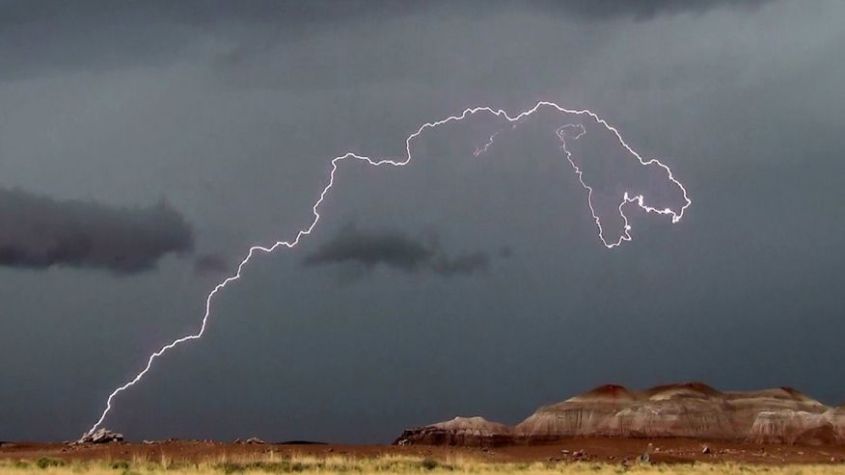
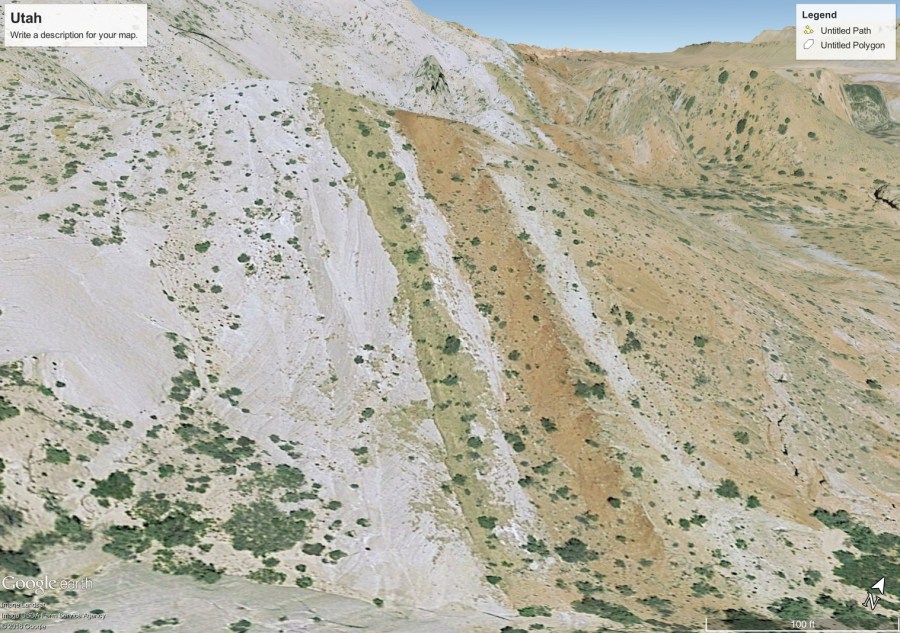


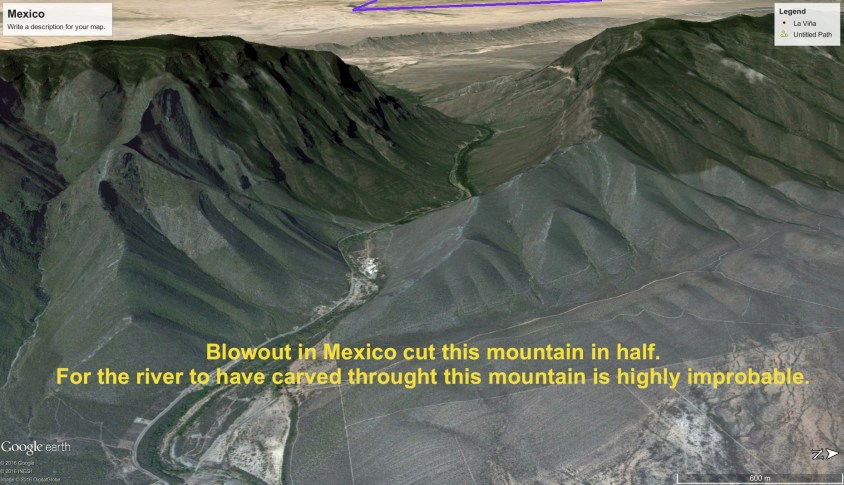
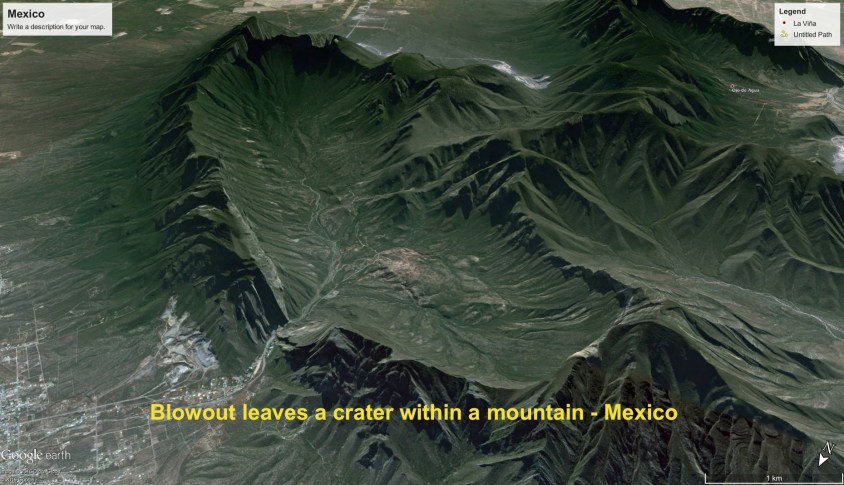
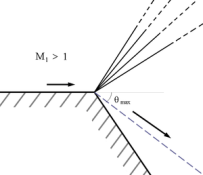
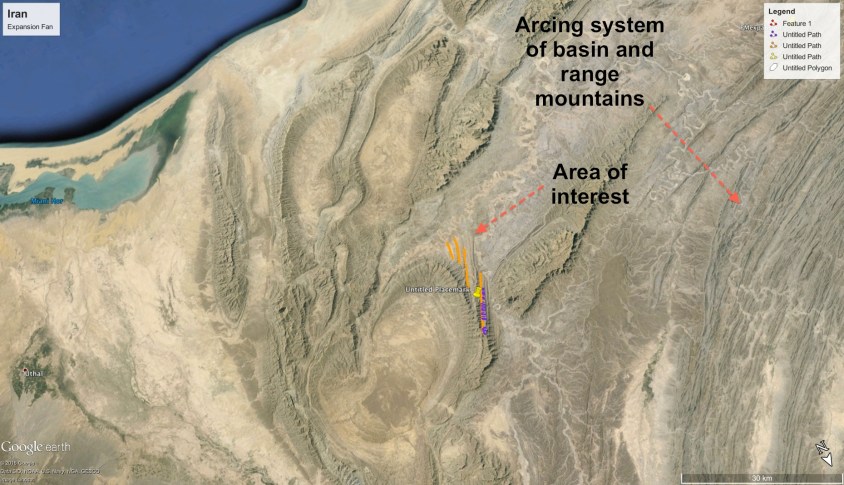
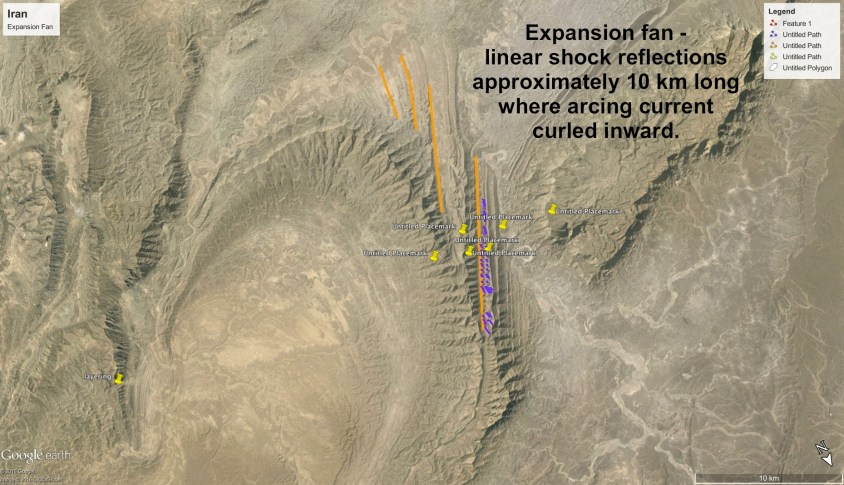
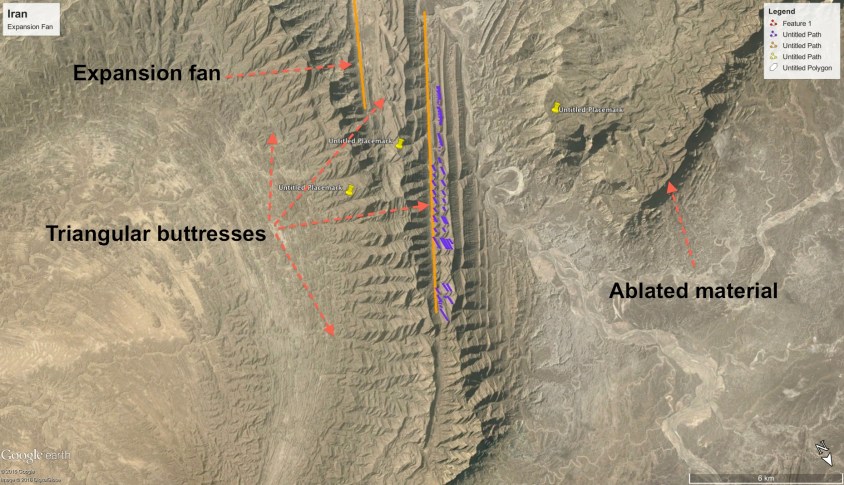
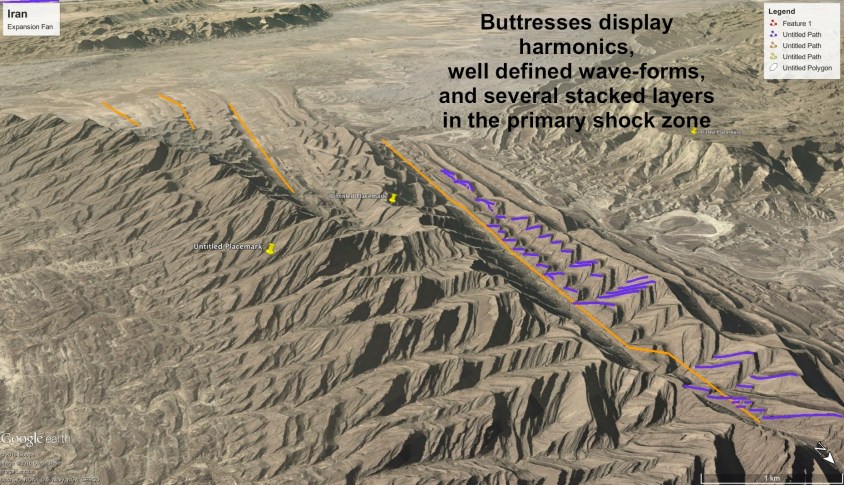

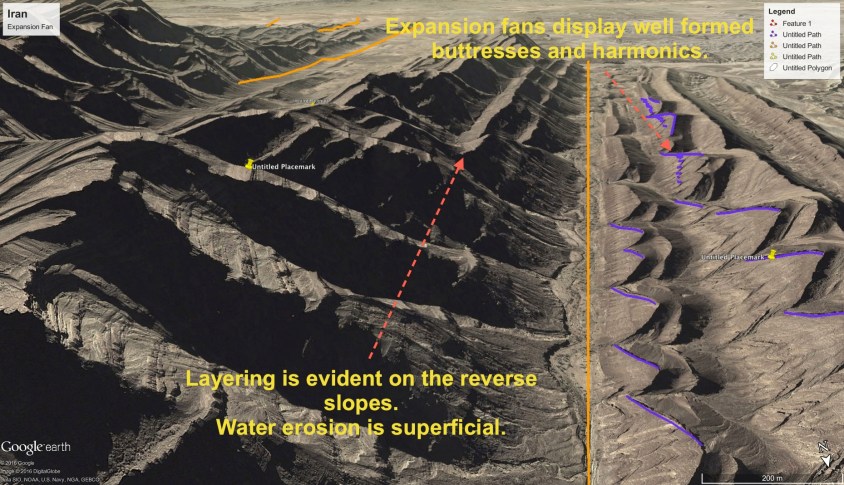
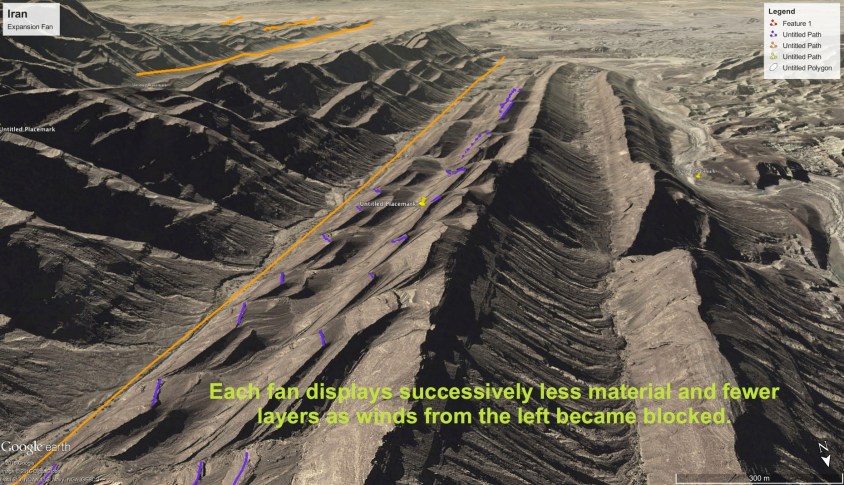
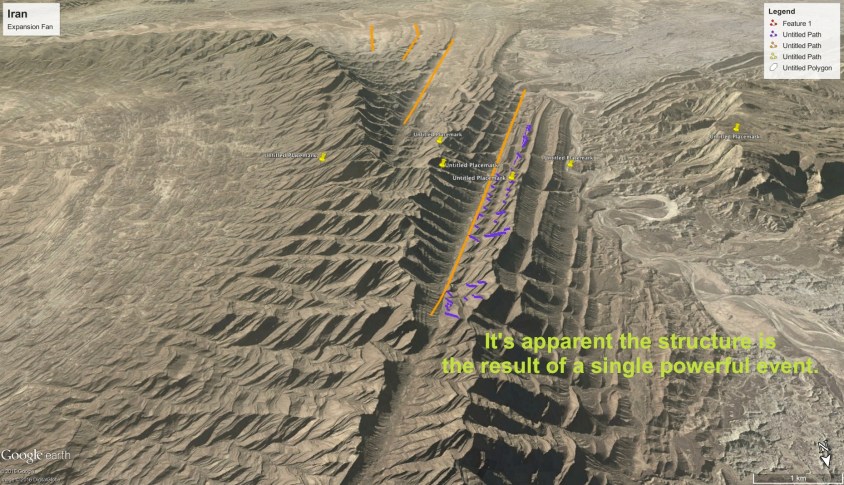
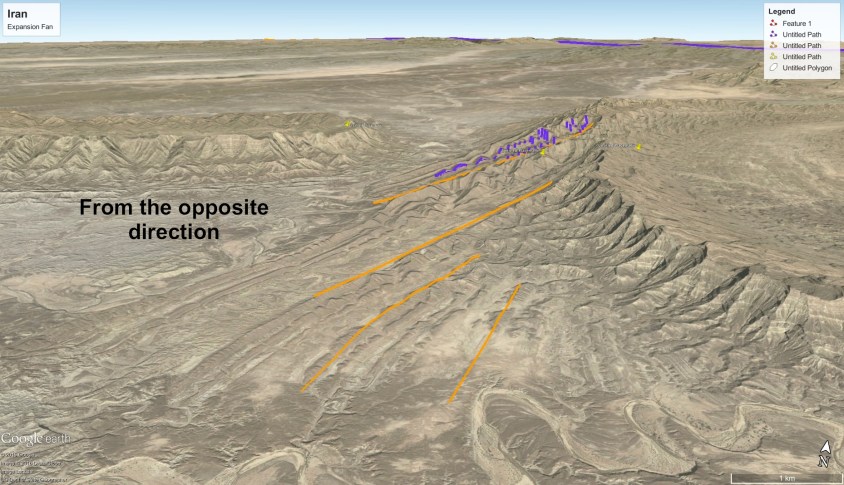

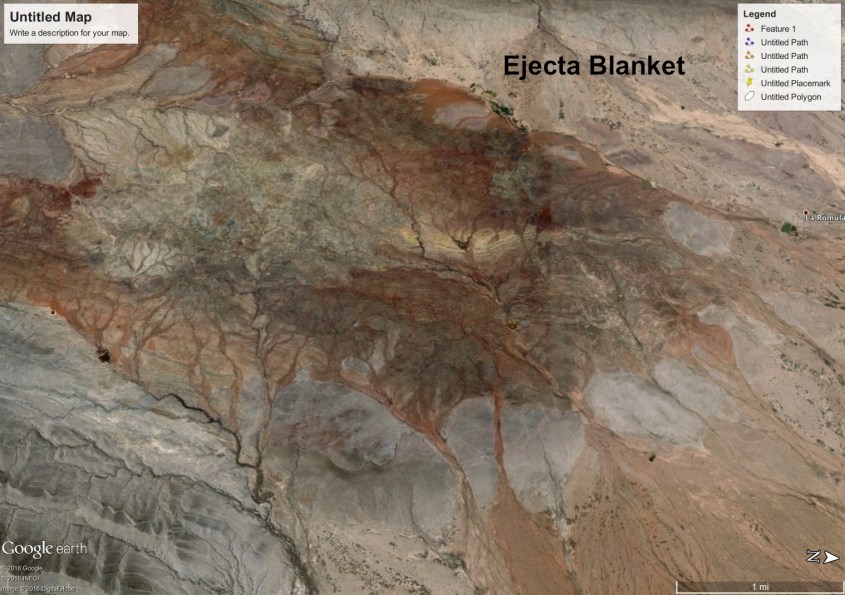
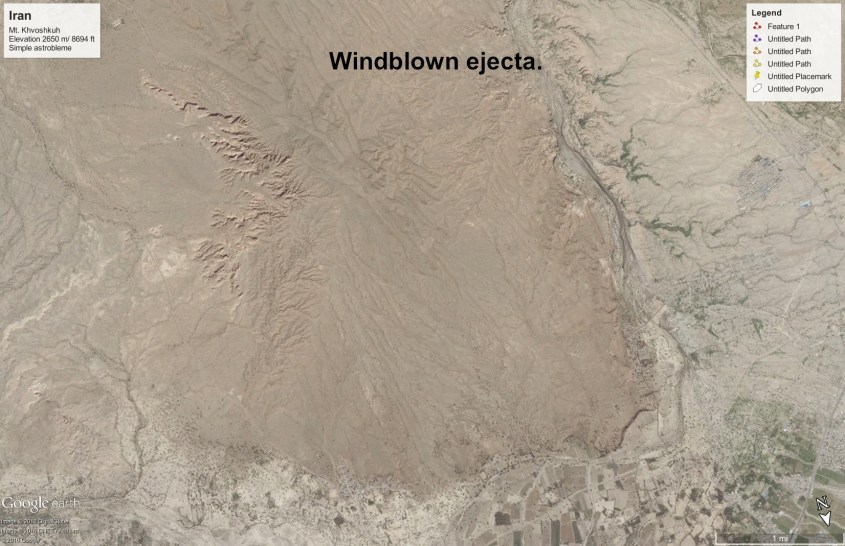
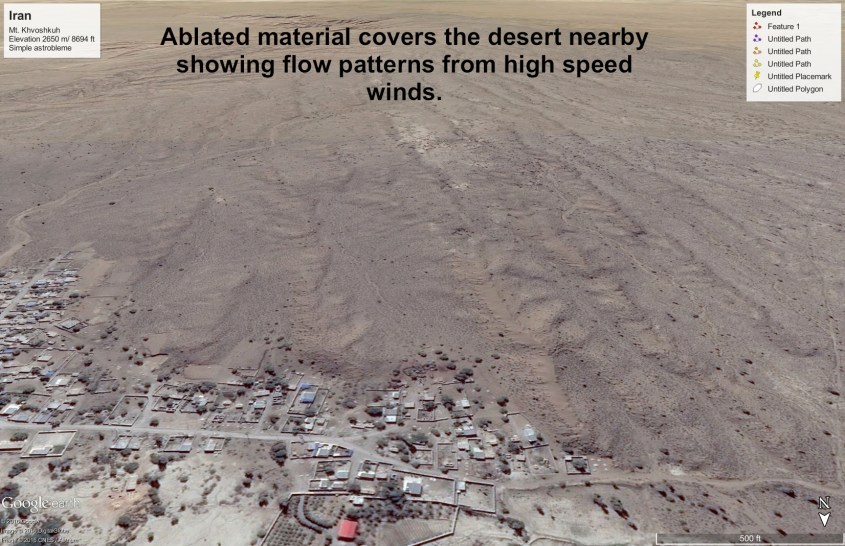

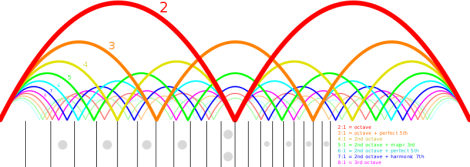
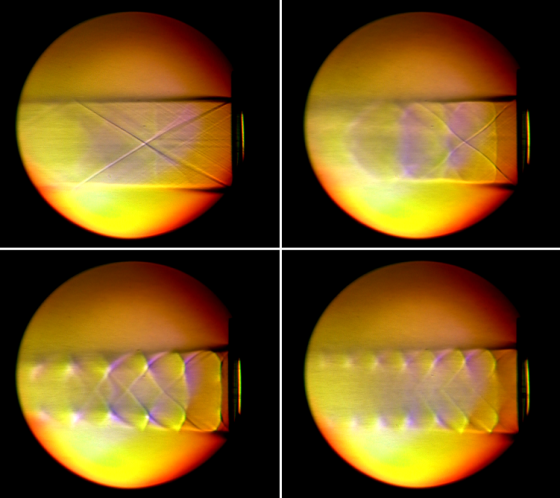
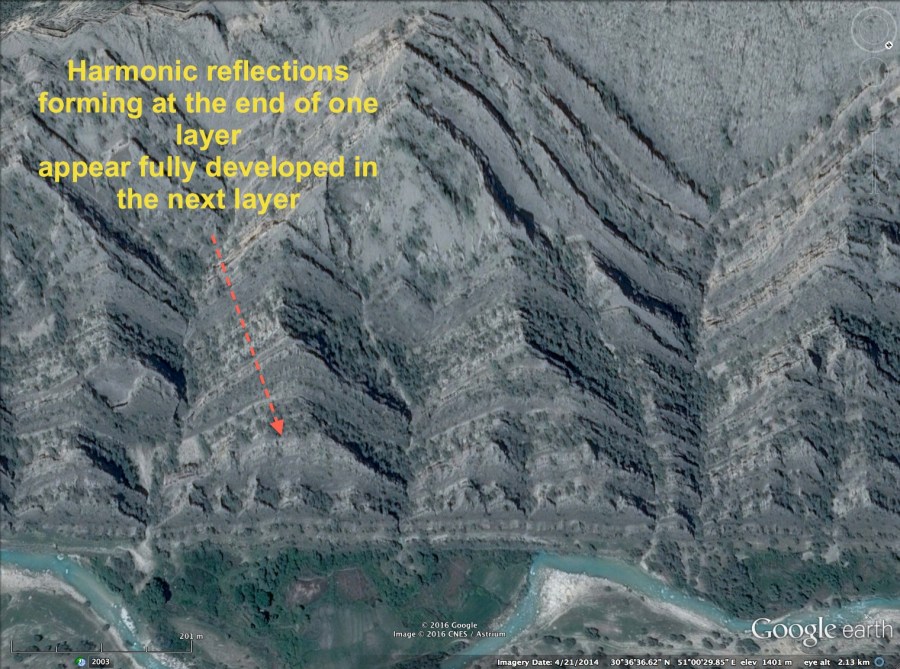
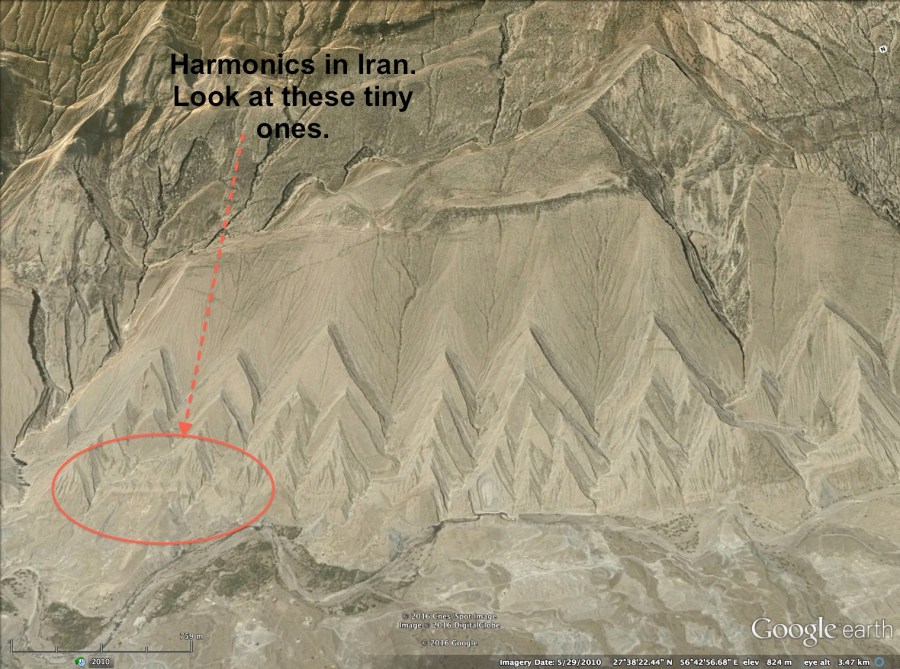
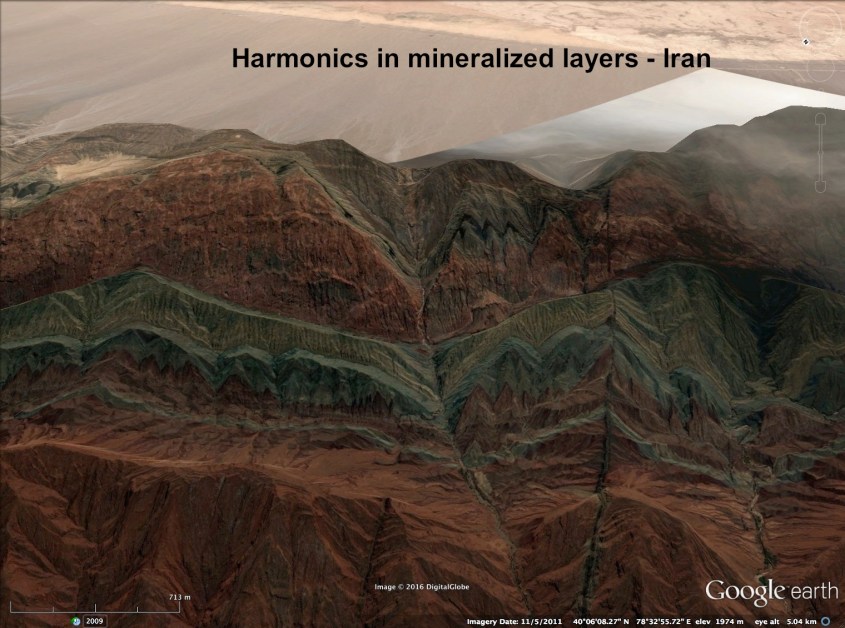
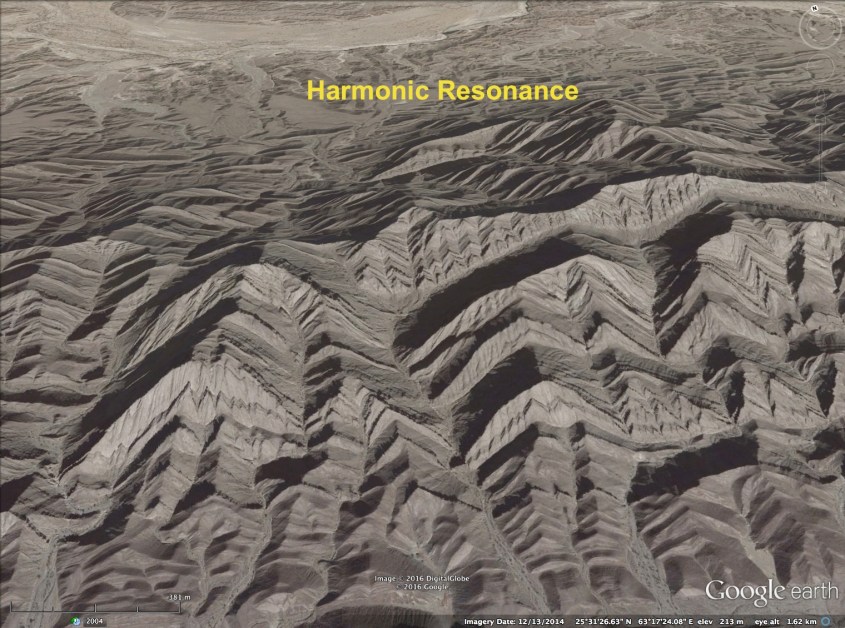
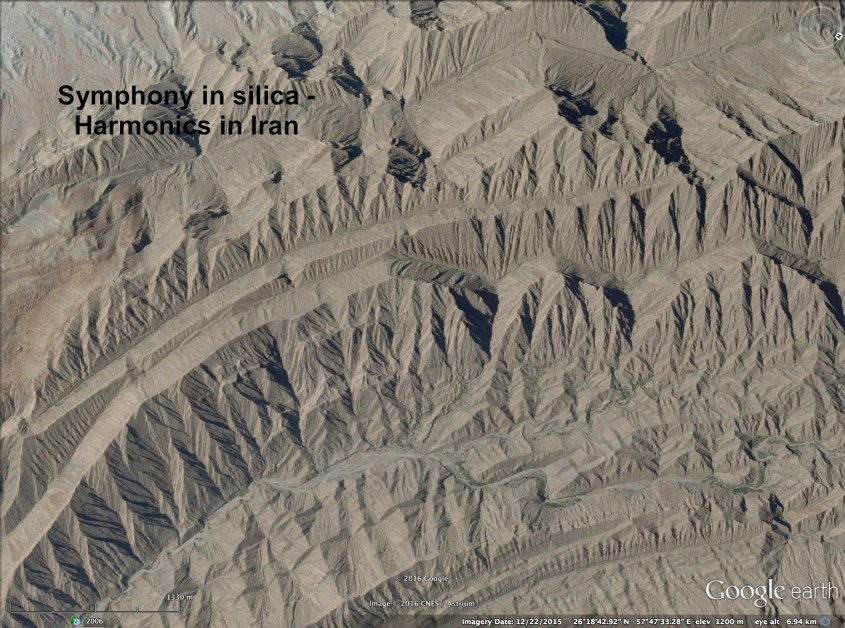
 Transients in wind speed, Mach angle and multiple reflections create instabilities in the wave-forms. Unstable waves segregate and fan away from each other under expansion, fragmenting the wave-forms.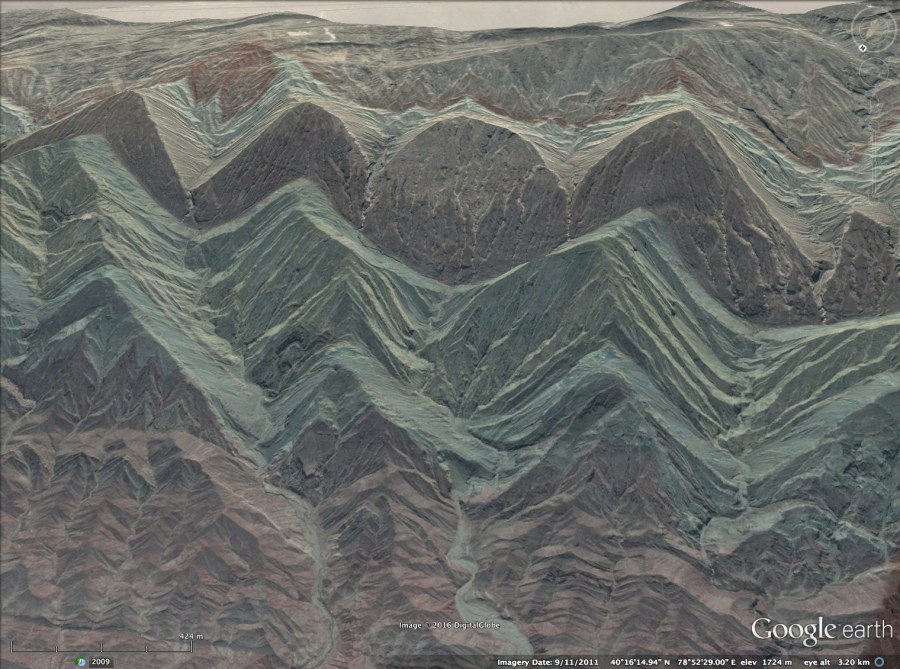
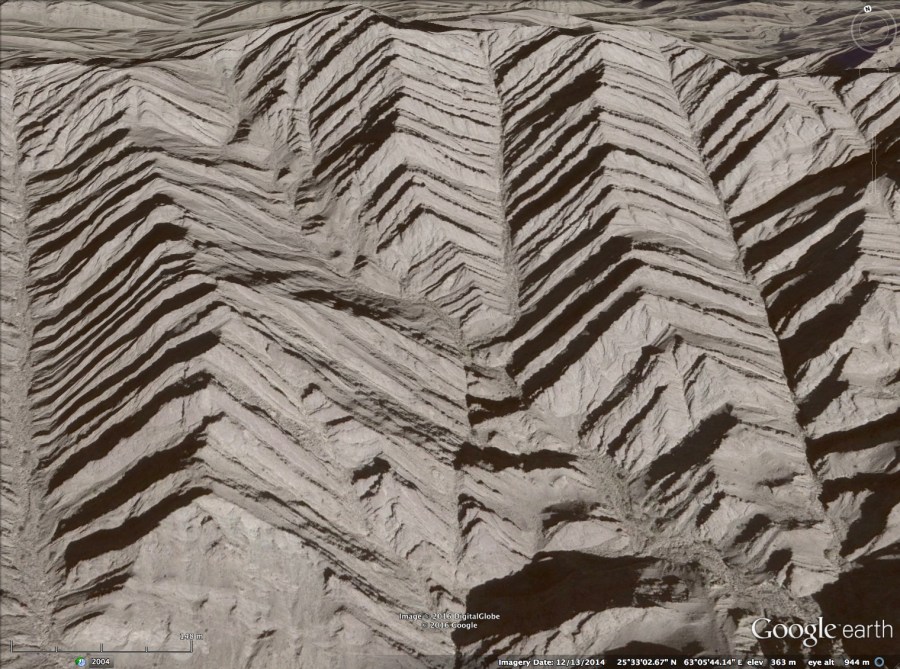

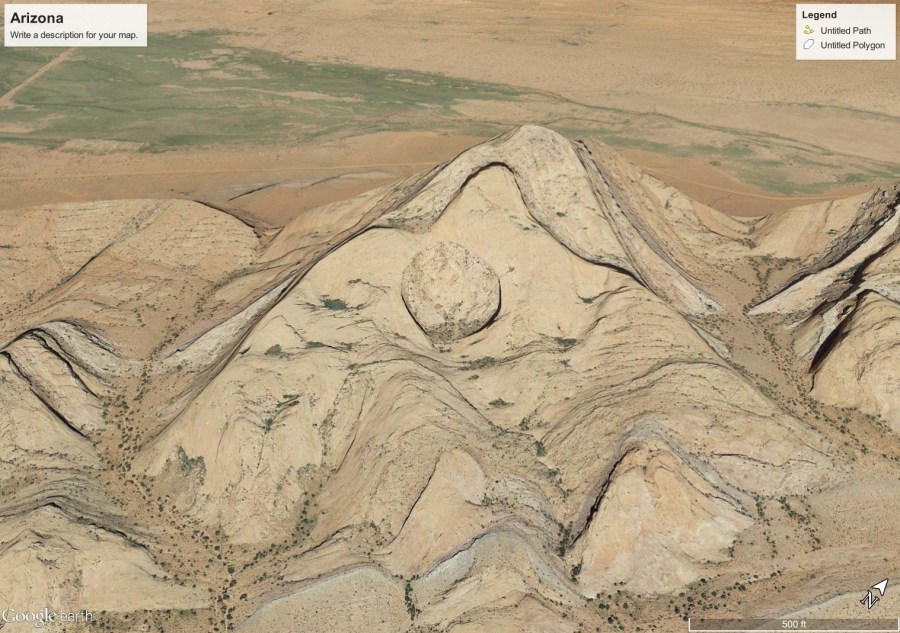
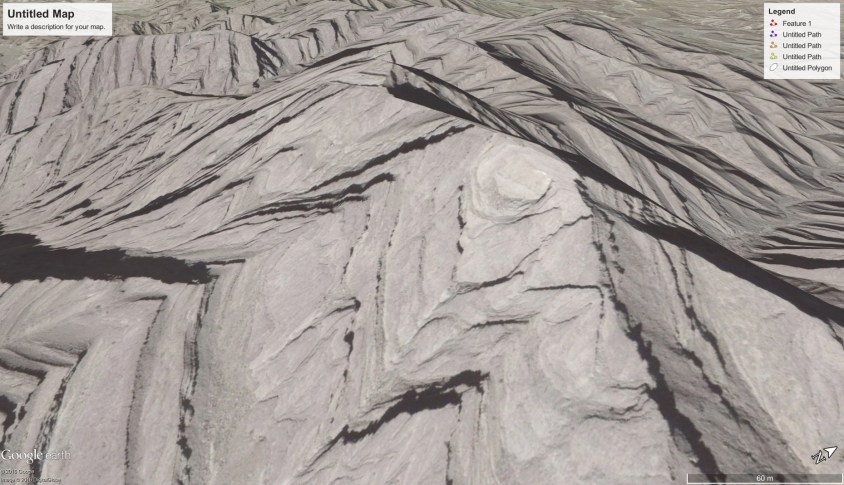

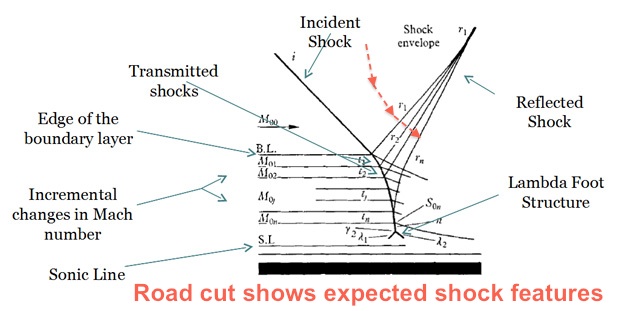
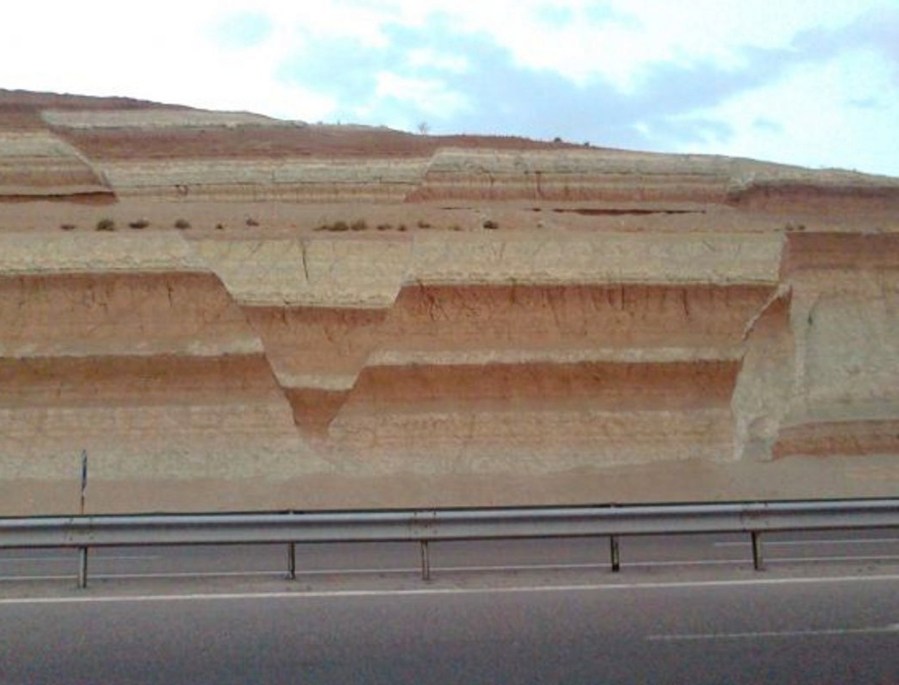
 The Daily Plasma