One of the most compelling aspects of Electric Universe cosmology is that it is visually apparent. A person can see a Peratt column in a petroglyph and reasonably conclude that our ancestors viewed a different sky than we do.
Or look at a telescope image of planetary nebula and recognize the hourglass shape of plasma current contracting to form a star.
Or view the red-shifted quasars inside Halton Arp’s “unusual galaxies” and determine for yourself if they are really the distant objects we’re told by conventional astronomy.
In fact, through Electric Universe eyes, you can see that patterns in nature, from galactic to nuclear, are coherent, fractal, and electric.
The planets and moons of our own solar system provide some of the most accessible and compelling visual evidence of all. Hexagonal craters, rilles and the odd distribution of these features, often concentrated near the poles, or in one hemisphere, attest to an electrical formation. One can imagine the vortex of discharging plasma that carved them.
The central pillar of Mt. Fitzroy
Earth should also show electrical scarring – in an Electric Universe it has to be the case. But it’s not intuitively apparent.
Unlike the Moon, or Mercury, Earth doesn’t display a carpet of hexagonal craters. There are some craters we know that are ancient and eroded, but their formation remains controversial.
There does exist proof of electrical scarring on Earth, however, and it’s in abundance. You can say it’s staring us in the face. This article will discuss how to recognize it.
First however, recognize that what distinguishes Earth from a planet like Mercury, or the Moon, is its atmosphere and geomagnetic field. This changes the electrical character of the Earth entirely. It doesn’t respond like a bald, rocky planet in an electric current, drawing lightning bolts from a region of space that carries a different electrical potential.
Earth acts like a gas giant, integral to the circuitry, with current flowing through, as well as around it. But Earth’s current flows in a liquid plasma – the molten magma below the crust. In the event the system is energized, current discharges from within.
The evidence is in the extensive volcanism on Earth. Volcanoes straddle subduction zones at the edges of continental plates, rift zones and mid-ocean ridges. They betray the flow of current beneath the crust.
Surface evidence is in the mountains. Basin and range, mountain arcs, and mountain cordilleras are all proof of electrical discharge. To understand the visual evidence, however, requires looking beyond the simple concept of a lightning bolt from space. The reason is the Earth’s atmosphere.
When electrical discharge occurs in an atmosphere, it creates sonic-hydrodynamic effects. We experience the effect when we hear thunder – the sonic boom of a lighting bolt. It’s the sonic and hydrodynamic effects, in a dense, viscous atmosphere, that leave their mark on the landscape at the grandest scale.
In a previous article, “Surface Conductive Faults”, we discussed the concept of a surface conductive double layer providing a path for arc flash. The surface conductive path is the cloud layer, where we can see that ions collect to produce thunderstorms.
Imagine a lightning bolt of immense proportions, sheets of lightning, in fact, arcing horizontally in this region that is roughly five, to fifty thousand feet above the land. The focus of this article is the hydrodynamic effects of the resulting arc blast. Arc blast is the consequence of arc flash in a surface conductive current discharge.
Four Steps to Build a Mountain…
The following image (annotated by the author) from Los Alamos Laboratories shows a shock wave being created by a supersonic projectile passing over water. The colors display density; highest in the red, lowest in the blue. Purple is the baseline of the atmosphere. It provides a very good analogy for the way a mountain is built.
The result of the arcs passing is embossed on the land by shock waves that act almost precisely as those made by the projectile.
The difference being the shock wave is plowing land, not water, and it has the hyper-sonic velocity, heat and power of an arcing current – much more energy than a simple projectile.
The bow shock is an anvil of many thousands of psi, at a temperature many times that of the sun, carrying charged electric fields. In a dense, viscous environment, fluid mechanics, shock effects and electromagnetism align in phase and frequency with the arc that creates them.
In Region 1, the bow shock vaporizes, and melts the ground, plowing an oblong crater.Region 2 is a reflected shock wave blasting into the atmosphere, pushing an exploding cloud of vaporized debris into a Richtmeyer-Meshkov instability, more commonly known as a mushroom cloud.
The cloud is not shown in the projectile over water because that simulation did not involve the explosive effects of expanding gases heated instantaneously by an arc flash.The mushroom cloud rises behind the shock wave with a supersonic vacuum at its core. The updraft of expanding gases generates in-flowing ground winds that scream like banshees across the ablated surface of the blast zone, attaining supersonic speeds as they funnel to the core of the updraft, dragging clouds of molten rock and dust.
The ground winds are directed perpendicular to the primary shock wave. Keep this in mind, because it is very important evidence in the geometry of mountains.
In Region 3, a low pressure updraft forms, like the rooster tail behind a speedboat. The rooster tail pulls ablated melt from the crater. It forms the core of the mountain.
In Region 4, multiple shock reflections form triangular wave-forms. Note, the reflected wave bounces from the surface. The base of the triangle forms on the surface that reflects it.
The multiple shock reflections in Region 4 are standing waves. Standing waves don’t travel. The wave-form stays in place with the energy coursing though it. Reflected waves multiply, like in a hall of mirrors, repeating harmonic wave-forms to the nth degree, until the energy of the shock dissipates.
The reflected shock waves are rigid and stable when the energy is high, creating a shock ‘envelop’ over the ablated land. The energy does not dissipate quickly, because the vacuum of the mushroom cloud above is punching a hole through the atmosphere, drawing supersonic winds through the shock envelope like a cosmic vacuum. This is a source of free energy to the shock wave that keeps it alive.
Shock waves are highly energetic. They are razor thin sheets of pure energy, entire tsunamis in a sheet of glass. Like steel plates animated with resonate energy that derives from the original bow shock.
The incoming ground winds funnel through triangular plenums formed by reflected shock waves. The entire envelop of reflected waves acts as a coherent entity, with structural stiffness, resonating with the vibrations of the parent shock and the supersonic winds screaming through it.
It rides on the surface of the land, spread across the entire impact zone of the bow shock, like a multi-manifold vacuum cleaner, hosed to a hole in the sky above.
The winds plaster the mountain core with layered triangular buttresses.
Supersonic Wind Effects…
Shock reflections form at 90 degrees to the path of the shock wave that made them, so they emanate radially from the impact as seen in the Schlieren image of a bullet impact.
Reflected shock waves from a bullet impactHence, the orientation of triangular wave-forms holds information on the path of the initial shock.
It also vectors the supersonic wind flow, which layers the buttress in place. Therefore, wind direction is perpendicular to the stratified layers of the buttress and can be determined.
Examination of the coherent orientation of triangular buttresses dispels any notion they were made by random influences of wind and rain over the eons. The non-random, radial orientation of wave-forms is, in fact, impossible to explain except as the result of a single shock event that produced winds unlike anything we experience today.
When a shock wave dissipates, the inflow of winds doesn’t necessarily stop, but they slow down and are no longer constrained to the path formed by the shock fronts. The final layers of material deposited often lose coherence and exhibit sub-sonic flow patterns.
The layered material on buttresses is deposited in a hot, molten state. Patterns of deposition display evidence of molten fluidity at the time they were made.
Reflected Shock Waves…
Supersonic shock waves display particular behaviors that have been studied by aerospace engineers since the beginning of the jet age. These characteristics must be understood to design airplanes, missiles and rockets. We know a great deal about their behavior.
The angle that the initial shock wave makes is directly related to the Mach speed of the wave, so it is called the Mach angle. Hence, the Mach angle holds information on the speed of the shock wave that made it.
The triangular reflected wave form is an inevitability of supersonic flow. It forms when the initial shock wave hits a surface and reflects.
The reflected wave will have an equal, but opposite angle incident to the surface from the shock wave that made it, assuming the plane of the surface and trajectory of the wave front are parallel.
When the incident angle between the shock trajectory and the reflecting surface change, more reflected waves are created in predictable ways. Hence, the reflected angle holds information on the trajectory of the shock wave that made it.
The amplitude and wavelength of the reflected waves diminish over time as the energy dissipates. Hence, reflected waves hold information on the energy of the event that made them.
The shock wave travels on a transverse carrier wave called the “propagating wave”. This vibrates the land, seismically, from the hammer blow of the shock wave.
The land will reflects some of the shock and absorb some of the shock, as a function of its modulus of elasticity.
Hard rock will reflect better than sandstone, because the sandstone will absorb much more of the shock. Uneven surfaces will also modify the wave-form. This contributes to the variety of wave-forms we see.
Supersonic shock waves are longitudinal waves. Instead of vibrating up and down in a sinusoidal vibration, longitudinal waves compress and expand back and forth, like an accordian.
Transverse waves, like the propagating wave, travel up and down.
The result is longitudinal and transverse waves super-positioning. Except inverted to the super-positioned wave shown below, with the fixed boundary above, fixed to the point in space the shock originated from, and wave motion amplified near the ground.
The static image in pink shows the standing waveform that results. Compression results in a higher frequency of small amplitude, short wavelengths, and expansion results in low frequency, high amplitude, long wavelengths. Triangular buttresses are the molded product of these shock waves, frozen in time as supersonic winds fused them in place on the mountain core.
Take a look:
These wave-forms had to be created from above. A wave needs a surface – an interface – with a medium of higher density to reflect. Pure seismic waves shaking and rolling the ground from below are unbounded above. The atmosphere can’t reflect a seismic shock and create a reflected wave-form on a mountain side. The shock waves came from above.
Our ancestors had a name for them… Dragons.
Conclusions…
Triangular buttresses form on the sides of mountains in the shape of reflected supersonic shock waves.
They are layered onto the mountain, so they are not caused by seismic waves.
They are layered perpendicular to the wind direction, consistent with supersonic winds created by shock waves.
The triangular wave-forms are parallel to the primary shock pattern, consistent with reflected shock waves.
The triangular wave-forms exhibit less energy and more transient effects on softer substrates; and higher energy, sharper angles on hard substrates.
They are not layered sediments from an ancient beach, or waterway since triangles are a consistent feature around the world and do not conform to any motion of random water waves.
They are formed in all types of rock, including granite, so they are not formed by eons of normal winds.
The triangular wave-forms exhibit compression and expansion from superimposed longitudinal and transverse waves that came from a source above.
Triangular buttresses are an imprint of the Dragon’s teeth, formed by supersonic winds and shock waves caused by an arcing current in the atmosphere. In Part Two of Arc Blast, we’ll examine more evidence of the hydrodynamic forces that shaped our planet.
Evidence of harmonic resonance,
Effects of wave super-positioning and cancellation,
Normal shocks and features of density variation and expansion fans,
Boundary layer features of reflected waves in the substrate of the blast zone.
Okay, I’m serious about Bigfoot. It may not make some people happy that I’m mixing the classical physics of Electric Universe with a crypto-legend like the hairy-man, but from my perspective, I’ll be seen as crazy by fewer people for believing in Bigfoot than in a Grand Unified Electrical Theory. Nobody understands magnetism, not even physicists, but everyone gets the boogey-man. My approach is to go for the truth and damn the torpedoes.
Besides, I saw one…it’s leg anyway. It screamed like a banshee and scared the shit out of me. So, how can I undo that. Enjoy the story.
The Bigfoot Hunter
What? You thought it was me? Not on your life. There isn’t a gun big enough to make me feel safe. I send Ginger out. She’s fearless – just look at that face. Here she is in her element:
Ginger on the trail of Bigfoot
You can see the determination. See the furrow in her brow… look out, Bigfoot! I have a theory they avoid people like the plague because we keep dogs. The hairy-men hate dogs.
The Hunt
Ginger and I traveled to a little known place in Arizona where the creatures are known to make an appearance now and then. I’m not saying where it is, but it’s a large mountain that looks like this one. We arrived and found a beautiful camp by the lake.
Now I need to give a little back-story as to why we came to this particular place. That is, besides the many reported sightings, encounters, local legends and Apache lore that attest to its presence.
I camped at this lake a few weeks ago with my friends, Bean and Bobblehead. During the night, around two or three AM, a pick-up truck left a campsite across the lake from us and roared past in a hurry. This woke me up.
A few minutes later I heard loud banging across the lake from the direction the truck came from. Each campsite is equipped with a steel bear-proof food storage container – you can see it in the picture of the campsite. The banging sounded like someone was taking a baseball bat to one of these steel boxes. There were three, or four loud bangs, a pause, more bangs, another pause and more bangs. Then a high pitched, “hoo, hoo” like a chimpanzee shout.
Soon after, Ginger crawled out of the sleeping bag and looked at the tent door. I thought she needed to potty, or get water, so I unzipped the tent. She immediately crouched low, dropped her ears and tail, and growled with deep, serious intent out the opening. She almost never growls and I’ve only heard her do that when fending off a mean dog, or one of the meth addicts in our neighborhood. I don’t know how she can tell a meth addict from anyone else. Same way we do, I guess, because they’re scary.
Anyway, she then turned around and slunk into the bottom of the sleeping bag. I didn’t hear anything, but I shut the tent real quick.
Now, I know this could have been some inconsiderate campers. Nevertheless, on the drive down the mountain I kept my eyes out for any strangeness. Deep, dark, old growth forests have plenty of weird things going on. Humans don’t generally notice because we are as incompetent in the woods as some presidential candidates are with State secrets. But there is strange and there is high strangeness. I saw high strangeness.
So did Ginger. She was the one who had to go back and see more. See, she’s been watching Bigfoot YouTube videos with me for years now. She fashions herself a canine BoBo.
It all started after my own encounter in California (read the “Encounter” if you want that story). When I began to research Bigfoot, Ginger was in my lap, soaking-up all the same information. It’s really quite astounding if you take the time with an honest, open mind to look into it. I know that is almost impossible to do – have an open mind that is – because most people don’t look into anything. They are told everything.
What everyone is told is that the “credible people” who say they’ve seen a Bigfoot are simply mistaken. They likely saw a bear and the “other people” are just nuts. Well there are those, no doubt. But what they don’t say is the improbability of so many hunters, hikers, sheriffs, forest rangers; people educated both in the woods and in schools, who swear they have seen one, or experienced some encounter that isn’t otherwise explicable.
Plus the fact there is absolutely no ecological, or biological reason they can’t exist. After all, we have fossils of large bipedal hominids and apes, we carry Neanderthal and Denovisan DNA in our genes, we have living gorillas, orangutans, chimps, several other apes, and more still being found as recently as the last couple decades, so it isn’t even improbable.
The other thing that pisses me off to no end is every time someone does a documentary on Bigfoot, they bring out some Biology professor in a bow-tie to tell us all how wrong we are to think there is an undocumented ape in the woods. I’ve never seen one of these professors who looked like they could keep a campfire lit, let alone find their way back from the privy without a GPS. We have millions of undocumented people in this country. Who’s to say there aren’t a few thousand hairy ones living where few people dare to go.
Well, Ginger knows all this. That is why she insisted we go camping at that lake again. We couldn’t take Bean, or Bobblehead and their dogs, because they just drink beer and this was to be all business as far as Ginger was concerned. I agreed, because I knew I could take some great photos of the Arc Blast features on the mountain. Besides, there is no saying “no” to Ginger.
We chose this particular campsite because it was the location we heard the banging. It was the farthest down the road, next to the dam and at least a hundred yards from the next campers.
We left on the fourth of July. This was strategic on two counts. First, all the holiday campers would be leaving that day and we like our solitude. Second, all the Bigfoot should be ready to raise hell now that the firework wielding, beer soaked campers were gone. We thought the Skeezamen ( a local name) might even venture to the lake now that it was quite after the long weekend. I can’t help but think that crawdads would be one of their favorite snacks – its one of mine.
The camp-site was outstanding, the closest to the lake, with a view and even a little landing next to the dam. Behind us the hill climbed to a peak forested with big Ponderosa and lots of fallen wood for the fire.
Our calculations were excellent as far as timing. We passed dozens of trucks going down the mountain. When we arrived at the lake there were only four other campers in the entire campground. We met our closest neighbors, who were staying over from the previous day. They kind of looked happy to see someone else in the campground.
After the usual chores of setting up camp, collecting wood and starting a fire, Ginger sniffed flowers while I relaxed with a cold refreshment and watched the setting sun turn the ripples on the lake monochrome. The evening was cooling, but I was still okay in a tee-shirt.
Two people were fishing the opposite shore in a canoe as I walked down to the landing to enjoy the breeze in the fading light. It was then I heard the chimps again. That’s when I took this picture with the camera pointing in the direction the screams were coming from. I tried to record the sounds, but all I captured was my own breathing.
The time before, what I heard was a “hoo, hoo” yell, like a playful chimp might make. This wasn’t playful. It was screaming, hoots and occasional low grunts that went on for about twenty minutes.
As I listened, Ginger sniffed flowers until I said, “Do you hear that?” She finally perked up and listened. Across the lake, the people in the boat were jostling about, trying to row back to the boat landing. I can’t say whether it was because of the screams, or because it was getting dark, but they seemed to be trying to hurry away from the other shore.
I heard other campers from that direction blowing air horns, as if to chase off a bear. The air horns were no louder than the screaming.
The noise ended. It was not coyotes. I cannot believe it was humans. It was way too loud and continuous. Who screams and hoots and growls for twenty minutes. I don’t think a human can even make some of the sounds we heard.
I built-up the fire and began fixing dinner. We didn’t hear anything else that night, except a skunk that invaded the camp and made a stink.
In the morning, I fired up a big coffee and loaded Ginger in the StRange Rover. It was time to go searching. As we drove out of the campgrounds, we passed by the creek that fed the lake. That was where the screams came from. It was dense forested wetlands that an army could hide in.
We drove about five miles to the end of the road and then followed a four wheel drive trail to some undeveloped campsites. This was a pretty wild area, but I didn’t see anything out of ordinary. We drove back another ten miles the other way. Here is where I saw the strangeness before. For about a five mile stretch near the lake, there were unusual tree breaks and tree structures I noticed the previous trip.
Strangeness
Trees fall over. Trees break; blown by winds, hit by lightning, wounded by fire. There are many ways a tree can fall and be left leaning against another, especially in an ungroomed, old growth area like this one. But there seemed to be a pattern.
Ginger and I scouted several areas where the trees seemed arranged non-randomly. There were several areas where there were these crosses formed from broken tree trunks. They faced the road squarely with lots of other disturbance around them; a profusion of broken limbs, stumps and trunks leaning against other trees.
Often, the trees were wedged between other trees.
So, yes..that can happen naturally, but what about this?
This one is wedged and bent sideways between trees. Here are more views of the same tree. It did not fall this way without help.
The top left picture shows the base of the tree stuck in the ground. The bottom left shows the broken tip wedged between the bigger trees. The big picture show how it crosses like a barrier next to the road.
There were more elaborate structures, too. These trees are bent to the ground and held down by logs.
There are two trees still rooted and bent over in arches, another laid over in the same direction and one pressed against the trunk of the center tree like a spring. Two logs are laid over all four to hold them down. Well, it seems odd to me. Ginger wouldn’t get out of the car. She was bored with tree structures.
I was fascinated though. My engineer mind tried to decode a plausible natural cause. It couldn’t. Here is another that defies logic.I suppose this could have fallen in a wind this way. If it was the only one like it I would even assume so, but there are several broken, bent or wedged in improbable positions like this in clusters. Note all the other leaning trees nearby. Here are more views of the same trees.Ginger was getting annoyed I was looking at trees. She wanted to look for Bigfoot. She doesn’t make the connection with trees because she’s a dog. Dogs don’t look up. If it had been a turd on the ground, or something fun to pee on, she’d have been more interested.
Here is another.Notice how the leaning trees are held down by the broken tree? They should not have been in the line of fall if this had been wind or snow. That’s how they always seem to fall in this particular area though.
Of course I didn’t get a picture of the best one I found. It was a large trunk of a tree wedged into a standing trio of live trees, but it had branches that wrapped both direction behind the other trees. In other words, it could not have fallen there without snapping those big branches. It looked like it was shoved between the trees, bottom first.
As I examined it, looking for the right camera angle, rock clacking began in the woods not far away. I left without a picture.
So all of this was pretty interesting to me, but Ginger wasn’t impressed. She wanted something to growl at. After an exhausting day searching the forest, we returned to camp and settled down for the evening. At least I did. Ginger wandered off on her own.
Bad Daddy
After all that time I walked in the forest, she sat in the StRange Rover and slept. Now she wanted to go hunting for the Skeezamen. What the hell, I thought. I’m pooped. I wasn’t too nice about corralling her back to the campsite. I even spanked her and it made her mad. So she trotted up the hill and disappeared.
It was dusk, so this action worried me. I climbed the hill after her, all the way to the top. The reverse side of the hill was a cliff. It dropped all the way to the valley floor. I’m talking a drop of about five thousand feet, nearly vertical. It was like looking into the Grand Canyon. If she went down that slope, I knew she wasn’t coming back up.
Not only are these woods legendary for the Skeezamen, but it has the largest bear concentration in the State, not to mention cougars, bobcats and venomous things of all types. I was worried.
Twice more I combed the mountain in the dark with a flashlight. I really didn’t care about any chimp noises at this point. I didn’t hear anything anyway. I even turned the light out to listen – for some reason I seem to hear better that way. Nothing.
I crawled into the tent and left the flap open and the fire burning so she could find her way back. I woke at first light to the sound of a crow. Crows are ubiquitous in these mountain. They caw all the time, part of the forest background noise. This crow was being answered by another. Every time it cawed, another answered. Only the answer was more of a cow than a caw.
It is said that Bigfoot like to mimic animal calls and even people talking, only they aren’t very good at it. They make the right tones, but can’t get the inflections right. I have wondered if this is true, or just an excuse made by TV Bigfoot hunters who don’t have any other “evidence” to point to – you gotta make a show.
This crow made me think twice about that. But I was in no mood to ponder. Ginger had not returned. I climbed the mountain three more times, crossed the dam and followed the stream as far as I could. No sign of her.
By eight AM, other campers were up cooking breakfast. I hoped she’d found shelter with one of them and was at their camp waiting for bacon. For a little dog, she can eat lot of bacon. I packed my kit and drove to each one. No one had seen her.
Brave Ginger
Ginger and I are very attached. She’s a weird dog, but also the smartest, warmest dog I’ve ever known. By warm, I mean warm. Mexican aristocrats bred Chihuahuas to sleep with because they were better than hot water bottles. This is how we sleep, with her curled against my back to keep us warm.
I returned to the empty camp despondent. I feared at this point she must be dead. There were too many wild and hungry things out there a city dog had no notion of. She’s never slept a single night outside of a bed.
I could not bear the thought of her lost on that vast mountain, alone, defenseless and scared. I could not bear the thought of leaving and never knowing. I realized, I would need to notify the Forest Service, the Humane Society and post flyers around the campground – all in futility. I decided I would wait until noon before leaving for the nearest town.
And then a miracle happened. She slunk out of the tall grass a few feet from me, head down, a bit torn-up and bloody and terribly frightened. I wiped my tears as she came to me. I thought she was afraid I would be mad. I wasn’t of course and promised her I’d never spank her – or any dog – again.
I don’t think that is what made her scared. After driving home with her in my lap, she was still subdued for days. She wouldn’t leave my side. I think she was traumatized being lost in the woods.
I don’t know where she slept that night. One camper who I’d talked to flagged me down as I left the campground and asked if I’d found her. He said she had approached his camp just after I’d been by earlier and he was looking to tell me. I said, thanks she was with me now and wondered from which direction she’d come. He pointed to the opposite side of the lake from the campground.
Apparently, she’d been lost in the ravine below the dam and came up on the wrong side, then circled the lake to get back. It was a close thing. She was really lost and likely only found her way back by the sounds and smells of the campground that morning. Really a miracle considering all the creatures out hunting food like her at night.
More Bigfoot hunting will have to wait for the fall. I don’t think I’ll take her next time. I’m investing in a .44 magnum and a hot water bottle instead. She wasn’t much good at finding the wild Skeezamen anyway. Or was she?
This was to be my first EU conference. As I left Tucson on I-10, the temperature was hot. Arizona in June is like Venus. Temperatures always hover above 100ºF, but when it exceeds 110ºF, it’s life threatening.
First, you seem to stop sweating. You still release sweat, but it evaporates immediately and you remain dry as a bone. There is no moisture in the air. No matter how much water is consumed, lips chap, pee turns orange and scratchy salt crusts form in armpits.
It got hotter and dustier as I traveled north into the Phoenix basin. When I arrived in Mesa at noon, it was 120ºF in the shade.
Since I was a speaker and a last minute addition to the roster, I went straight to the auditorium to get checked out on the A/V system. I needed to know how it worked right away, because I didn’t have my presentation committed to memory. I needed to know if I could read my notes on the screen at the podium, or if I’d need to carry a sheaf of papers, or simply stand up there and look foolish. The last time I gave a presentation, flip charts were the state of the art.
Before I could do that, I found Susan Schirott. She took me under wing, stray cat that I was, and gave me the low-down on the conference.
Susan introduced me to the EU. I found Thunderbolts while surfing the web, became convinced for reasons too numerous to get into now and contacted Susan to pitch a guest blog. Susan gave me that opportunity and made everything else happen. I simply had to write what I learned and she handled the rest. Susan is the engine of Thunderbolts, but made time to make sure I was taken care of.
We’d had a bit of drama over adding my presentation at the last minute, including my own moments of high anxiety. Susan let me know the current status and that things were okay. She got me settled in and at ease.
The A/V system turned out to be a piece of cake and gave me all the capability to present that I could hope for, if I could just remember which buttons to push. So, unable to stand there forever pushing buttons to get used to the mechanism, I retired to the bar to relax and trust to fate.
Conference bars are where the action is, in my humble opinion. You have to see the presentations, of course. At least most of them. And you have to socialize in the halls and workshops, but the bar is where people let down their shields. I was to be here for three days, followed by the geology tour for another two days. I hardly knew anyone in the EU community. This seemed the best place to be.
My first encounter was with a young couple from the Phoenix area. Since I wore a speaker ribbon on my name tag, but few people had heard of me, I had a brief advantage. It rose people’s interest, which I need since I’m an introvert. But they didn’t know what to ask since they didn’t know what I was there to talk about. It allowed me attention and still a comfortable anonymity.
I was vague about my presentation, simply saying it had to do with geology and some electrical features. This raised the mystery. They assured me they would watch me speak. So far things were working well – two attentive listeners would be at my talk and I hardly had to do anything. They even bought my beer.
Then a bloke bounded up to our table and began hugging everyone around. I’ll call him Leo. In fact, I’m going to call everyone in this story Leo. I have to protect the innocent. More importantly, I have to protect myself.
Every Leo was different. Every Leo was interesting. Every Leo is my brother and sister, now, but that is getting ahead of the story. Leo came from British Columbia, Montreal, New Brunswick, Colorado, California, UK, Australia, Belarus, Germany, Tibet and at least one from another planet. Leo wore tattoos and buzz cuts; tie-dyeds and chinos; safari hats and bandanas; piercings and goatees; or in one case, a beaded, braided fu-manchu. All points on the globe, all types of people, representing a common interest in our Electric Universe.
This Leo was from the UK. UK Leo sat down and immediately ordered a beer, and I ordered a second. Little did I know at the time, UK Leo would be at the bar every time I went there. UK Leo, I recognized eventually, was a professional beer drinker.
As we got acquainted, a certain cadence set into our discussion. His thick accent was impossible to understand. So I would say, “uh huh”, when I thought he’d made a point. He would reply, “eehah, mate?” because he couldn’t understand me either. In other words, we were perfect drinking partners – the burden of making sense wasn’t on us.
The young couple left. I don’t think they understood UK Leo either. He and I talked nonsense through our beers and then I left to circulate. At the bar I spotted Southern Comfort Leo. Southern Comfort Leo was someone I wanted to get to know, because I’d seen him present in a video of the previous year’s EU conference. His topic had direct bearing on mine. He held court at the corner of the bar, a place only a talkative person would take.
I sidled up beside him to see if I could start a conversation (it’s not something I’m very good at). I call him Southern Comfort Leo, because when I asked where he was from, he listed every southern State he’d ever lived – which was all of them. He said he’d “been around.” Much to my surprise, starting this conversation was easy, and he bought my beer.
I still had the advantage of anonymity, so the talk centered around him and his work. I simply listened to the fascinating work he did and the kind of information he got from it. Others joined us. We held court like Norm Petersen and Cliff Claven at the corner of the bar. But as the evening wore on, the crowd dwindled until there were just four of us left. Room Mate Leo, Boorish Leo, Southern Comfort Leo and me.
As I found with all EU conference participants, they are fiercely independent thinkers who fear no topic. In this case, our conversation turned to God and the relative merits of belief in HIS existence. Dangerous ground for a late night at the bar.
Leo held a belief in God’s existence, while the other Leo disagreed. As it became heated, Southern Comfort Leo wisely took his leave, begging the need to rest for his morning presentation. I was to speak in the afternoon, so I stayed.
Having been raised by a devout Christian mother, I have a respect for most beliefs provided it doesn’t involve hacking heads off. So I attempted to mediate the rougher edges in the conversation, but to no avail. Boorish Leo launched into a devastating destruction of Room Mate Leo’s character flaws, which the younger Leo had guilelessly laid bare for our examination.
We finally agreed to disagree around four AM. Leo and I, being room mates dragged ourselves, shirttails hanging, to the room. The emotions scraped bare at the bar were still bleeding however. Leo and I continued to talk in the room, he giving me intimate glimpses into his troubled yet valuable life. Valuable because he’s brilliant, curious and courageous – the earmarks of an EU scholar. Troubled because he carries baggage – we all do.
I noticed the sun was shining through a gap in the curtain. I sealed the gap before we finally gave up talking and went to sleep. I woke in time to catch Southern Leo’s talk mid-morning.
The conference room was a comfortable place. Dark, with a casual and attentive audience and the most interesting subjects to hear about, delivered by some of the most knowledgeable people in the world. What could be better. I lost myself in the ambience, surprisingly relaxed, without any building apprehension for my own talk that afternoon.
In fact, my talk went well. I think. Except the lights were blinding my sensitive eyes, which were only closed for an hour and a half that morning. Remember that when you watch the replays on Thunderbolts.
I did almost electrocute myself trying to drink some water with the microphone at my lips. It could have been a great display of Arc Blast – the subject of my talk, had I thought of it. I didn’t trip at the podium, or say anything stupid as far as I can remember.
Following the talks, I and my brother Richard, who was attending the conference to graciously provide moral support, and even more gratifying to me – learn more about our Electric Universe, met-up with Susan. Our timing was perfect, because she and David were heading to dinner with another speaker and an attendee who seemed to have a long association with the EU.
It was a delightful dinner. My brother, a former PR and public affairs professional, enjoyed trading anecdotes about conference organization with Dave and Susan while I stuffed my face with baked grouper. Dave Talbott is a sincere and gentle-hearted man who kept the conversation light and engaging. He suffered a dozen questions about Velikovsky and EU that he must have answered a zillion times before, but he spoke with absolute enthusiasm about the things he champions.
After dinner, of course, Rich and I retired to the bar, while the sensible people went about other business, like sleep. After one drink, my brother left to meet his son in Scottsdale, leaving me with the Leo’s again. It was pretty much the same crew, UK Leo, Southern Comfort Leo, Roommate Leo and me. Many other Leos were there, too.
This night was less talk and more drinking. Those of us who were speakers had finished our talks and were ready to unwind. Everyone else was just ready. Michael Claridge-Leo strode in with an electric bicycle to show off. The evening was a hoot, everyone in cheery little clusters around the bar and outside at the pool..
The day had been hot and it began to take its toll. People drifted away to bed, leaving only dead-enders. You know us by now. Leo and I had both shifted from beer to vodka at this point, so my recollection may be out of sequence. What I recall is that Leo began speaking gibberish.
We were having a perfectly rational conversation when he suddenly became agitated, and in perfectly articulated English said something that made absolutely no sense. It was as if Neil DeGrasse Tyson had entered his body. I hadn’t the foggiest notion what he was talking about, but it seemed urgent. Then he simply walked away.
The remainder of us carried the night to a quiet conclusion after the waiters stacking chairs refused us any more post closing drinks. We retired to our rooms, confident that, except for the hotel staff, we were the last people standing and our duty had been satisfied – to be the last people standing – somewhat stooped, but standing.
When I arrived in the room, I found Leo. Leo was passed out in the bathroom, undressed, pants around his ankles. This was not the behavior I expected from Leo. I immediately became suspicious. There was a pool of fluid on the floor. I shook him by the shoulder and called his name. He slid to the floor like a greasy snake, taking the toilet seat with him.
I won’t go into any more detail. It took a good two hours to get him to bed. There was a period of time he simply stood, incapable of moving. Dehydration, heat stroke and vodka don’t mix. I gave him water.
Leo was only the first of the heat casualties. The sun was peaking through the blinds again when I finally laid down. The damn thing wouldn’t stay down. It was already up and blazing people into an ultraviolet-brain cooked stupor and I hadn’t had a wink of sleep yet.
Eight AM came , literally, in the blink of an eye. I met my brother and we enjoyed the talks, seeing almost every one. Incredibly, I never felt tired even though that auditorium could lure a meth addict to sleep. All of the talks were good.
After the banquet there was a gathering at the bar. I happened to join in. Imagine that… Leo was there, too. All of the Leos, in fact. This was the big finale. It wound down as the sun rose and it was too late, or perhaps too early…whatever, to buy beer at the Circle K. I spent my time engrossed in conversation with a charming Leo from UK, this one a female, about documentary film making.
There wasn’t much point in sleep now, since the Geology tour was leaving in less than two hours. UK Leo said he’d just wait-up. I slept until the vans were running downstairs. I had time to simply bundle my kit in a wad and run downstairs and throw it in the StRange Rover. The vans were just loading, so I ran back inside to Starbucks. I wanted to kill the person in front of me ordering a triple mocha hoopla-drip machiacappucinoamericano hand-blended smoothy with sprinkles. After what seemed like a month, I ordered my BIG coffee (I refuse to say Grande) and shuffled out to the StRange Rover and fired her up. I pulled into last place in the caravan and waited.
There is a mathematical rule that relates the number of people in a party to the time it takes that party to actually do anything. It is called the ‘milling factor’. The more people there are, the larger the milling factor becomes by logarithmic scale. If there are enough people, the milling factor will prevent anything from happening and the situation devolves to chaos. With well over twenty people the milling factor was enormous.
As I watched light refract through heat blistering off the hood, the StRange Rover’s vinyl dashboard disintegrated before my very eyes in the UV, X-ray and gamma radiation from the Sun. The organizer and leader of our caravan, Herr Leo, was circling the vans attempting to get people inside and strapped in.
Some folks refer to this as ‘herding cats’. I disagree. Cats tend to scatter and move. High milling factor creates a kind of paralysis where people just stand and stare at each other, waiting for someone else to make a move. Milling has a more bovine nature to it. My BIG coffee was almost finished when the vans actually started rolling. Now I had to pee. I held on because I wasn’t about to run inside when everyone else was finally ready, so we took off on the Geology tour.
Southern Comfort Leo joined me in the StRange Rover at the first stop. It was my first chance to pee and survey the group I was with – in that order. I noticed all of the essential Leo’s, meaning the drinking ones, were on the geology tour. We must run in crowds, I thought, mutually attracted by intense heat, miles of driving, lack of sleep and an excuse to party every night.
As I focused my bleary eyes (I don’t think Leo would have climbed in with me if he knew how much sleep I’d had in the past three days) I saw geologic features I’d written about. I was going to point them out to Southern Comfort Leo, when Leo pointed out to me what he’d been noticing. Leo in the car ahead was swerving off the road occasionally.
Why would Leo do that, I wondered. We found out a few miles later, when on a steeply diving switchback road with no shoulder, Leo in-the-car-ahead, swerved off road and punctured his tire. As it happened, he was passing-out from dehydration and heat. Apparently he came from a place where air conditioning is not a life support system.
He was bundled in the back of a van to re-hydrate and sleep, while someone else took over command of his car, now driving on a spare. We spent a couple of hours getting a new tire for Leo in-the-car-ahead and ended up split into two groups somewhere in Verde Valley because of lunch preferences. We regrouped in Oak Creek Canyon, just past Sedona. Here, everyone cooled their feet in the water under the shade of cottonwoods at Oak Creek’s shore.
The heat, the fact we hadn’t made it to Meteor Crater that day, Leo in-the-car-ahead’s travails, all melted away as the group laughed and splashed in the creek. It was a fine moment. All of the Leo’s felt better. We were all Leo now. Regrouped and refreshed, the caravan drove on to Flagstaff.
As the group checked-in to the motel and got settled, Southern Comfort Leo and I walked to the bar/restaurant across the parking lot to have a cold one. UK Leo joined us next, then others drifted in. I hadn’t paid much attention, but did notice an older gentleman sitting alone drinking beer at a table in the back.
The Leos and I stood at the bar, while all the other Leo’s congregated at a table behind us. I heard a commotion and turned around to see the distinguished looking gentleman sprawled on his back. Several of our Leo’s were attending to him.
I said, “who’s that guy?” to our little group at the bar, but they paid me no attention, struggling as they were to understand each other – Southern drawl vs. UK soccer slang. I sipped my beer and surveyed the situation. The man was still prostate, being given wet towels and water. Someone was calling 911. What else could I do. I sipped my beer. “Do you guys see what’s happening behind us?” I asked. This time I broke through and they turned to look. “Why that’s Seattle Leo,” said Southern Comfort Leo.
I vaguely knew we were to meet Seattle Leo in Flagstaff. I didn’t know details though, so hadn’t connected the distinguished man at the back table with being a Leo. As the paramedics wheeled him away, I said something lame like “take care” and laid my hands over his. They were cold as ice. Our third victim of heat stroke.
One part of our group driven by Colorado Leo, or as I thought of him: the spitting image of Jeff Bridges, were eclectic Leo’s from around the world. They decided to camp-out in the National Forest instead of staying at the motel. They were a lively and entertaining bunch, so some of the motel Leo’s and I decided we’d visit their camp for a few beers.
They were camped somewhere in Coconino National Forest. Since Coconino National Forest covers approximately 1.8 million acres, I thought our prospects of finding them dubious. Nevertheless, we took two cars, bought some beer and departed Flag for the ‘campground’ they were supposedly at. They weren’t. The location was the Forest Service headquarters. No campground in sight.
This called for an unmanly admission that we didn’t know where we were going and needed directions. A cell phone was produced. I’m not sure if it was a bad connection, or if UK Leo was doing the talking. In any case the directions seemed uncertain.
We tried, but eventually gave up and parked in a dense, dark forest of Ponderosa and Spruce. I kept my eye out for bears and Sasquatch. At least we had beer and other essentials among us, and we stood in the dark and talked about magnetism, mountains and made a toast to Michael Steinbacher. A freight train roared past within a hundred yards of where we stood. It must have been a mile long and it left us feeling pumped from the noise and vibration.
I was driving, so only sipped on my beer. Still, lack of sleep had me seeing pinpoints of light in the corners of my eyes as we drove back to the motel. I followed Room mate Leo as he missed the exit and drove around the longest way conceivable to get back on track. I was almost beside myself thinking we’d entered a never ending road somewhere in the twilight zone. The Leo’s in my car had turned into bobble-heads and didn’t seem to notice we were being sucked back to Sedona, no doubt by the vortex.
I got a solid night’s sleep, rooming with Sacramento Leo. It’s usually a little strange to sleep in a room with a stranger, but in this case my head hit the pillow and didn’t lift until Leo belatedly advised me the vans were ready to roll in five minutes.
No time to shower – day three. I was beginning to stink. Well, not really. I stunk. You either stink or you don’t, there’s really no ‘beginning to’. I felt some pity for my StRange Rover-mate, Southern Comfort Leo.
After that first devastating day of heat, others began to notice – in addition to how bad I smelled – how I always parked in shade if I could find it, or aim the car away from the sun so the seats didn’t blister my ass when I got back in. At 120ºF, a car’s interior surfaces exposed to sun can reach 195ºF. By comparison, pork is considered safe to eat at 145ºF. I don’t comb my hair either, otherwise I’ll get a sunburned part. Tricks of the desert rat.
Our intrepid leader, Herr Leo, stepped up to a major feat of organization at meteor crater, advising us of the time to regroup. Things went smoothly until I had the sudden urge to (once again) use the bathroom at the last minute, hence I was the one who held up the group. It’s no fun walking out of a restroom, zipping up your fly, while thirty people sit in a parking lot staring at you.
I learned a lot about Michael Steinbacher on the trip. What a vagabond life he led, and how many loyal friends he had who gave him a couch, or bed, and traveled with him to rocky, windswept corners of the southwest, looking at evidence of the vast catastrophic forces that shaped our planet.
It gave me a tremendous morale boost. I recognized in the stories about Michael something I’ve found to be true for me. To truly clear the eyes of mud… to see things clearly for what they are, demands a rejection of convention.
I gave up income, home and stability to find the Electric Universe. Hanging on to what people expect of you will keep you locked into their paradigm forever. All notion that theoretical science explains anything at all had to be discarded and understood as a gross misinterpretation of the physics that govern our universe. I had to disconnect to see that.
Michael understood and looked at landscape in a way no one else had really captured. His inspirations inspired many more. We came to spread his ashes at the Southern Rim of the Grand Canyon. Herr Leo had selected Geology Point as an appropriate place. It was.
Being a generally agnostic group to begin with, and knowing Michael was too, there was not much in the way of spiritual context. Herr Leo and a couple of the female Leo’s took a moment to reflect on Michael’s influence in their lives and his appreciation for truth.
Truth does exist. We could see it with our own eyes in the canyon. The obvious carving of scalloped edges in the ninety degree, boxed side canyon we stood above spoke more to the validity of Michael’s interpretation of geology than anything anyone could have said.
I spoke with Michael’s friends about the formation of the Grand Canyon. I agree with Michael’s assessment, in general. The canyon was carved by an explosive current locked to the river’s channel. I’d looked into, and written about breccia pipes; karst-like formations of broken rock that fill vertical tunnels emanating from a limestone formation above the inner gorge. These breccia pipes emerge from the ground all over the south rim, concentrated along the rim and even split open in places along the canyon wall.
My belief is these were the result of current flows from the inner gorge that blasted out the stubby, 90 degree angled side canyons by coursing through the limestone aquifer and up through the crust, forming the breccia pipes. Everything I saw standing over Geology Point confirmed my intuition, and Michael’s hypothesis, which I think conforms with mine. It made me feel good we laid his ashes there.
The canyon left me uplifted, but feeling small, knowing how few are the people who even fathom what we could see.
Herr Leo took the caravan speeding down an empty two lane road to Utah, past miles of open country I wanted to walk through. Shallow canyon fingers dipped right away from the roadside, to disappear into dark cavernous gorges that led a mile deep to the Colorado. How were they formed – not by water erosion. There is no evidence of water erosion on the walls of the Grand Canyon – anywhere, except the very lowest reaches of the inner gorge – the only place the river has ever flowed.
The only evidence given for water erosion creating the canyon is that there is a canyon there. Ergo, typical mainstream circular logic says it must have been carved by water. It ain’t evident in the rocks though. A fact neatly and blithely ignored by geologists.
We crossed the Little Colorado and skirted the Navajo Nation, heading north. At Cameron, Arizona we stopped for lunch. It made sense, since one of our Leo’s was named Cameran-Leo; wrong spelling, but close enough to earn a sandwich. This was also where I departed, leaving to drive home to Tucson through the best part of Arizona, Highway 191. I’ll tell about that in a moment.
I hate goodbyes. This one didn’t hurt though. I knew I would be seeing these Leo’s again.
Every Leo hugged me. There wasn’t a single hand shake, or fist bump. Just hugs. It was a striking moment for me, when Sacramento Leo gave me a memento from Michael. Something Michael raised on his own, infused with his love of life and our world. I fired it up as I drove alone to Kayenta.
As the StRange Rover hummed along, the sun began to set on a landscape I could only imagine had been etched. Magnificent undulating, layered and cap-rocked dunes scalloped and gouged around the edges. A different electrical scarring than I’d been studying. Something to look into in the future.
Near Kayenta is where Dave Talbott’s photo of a petroglyph was taken. The one Tony Perratt identified as a plasma instability – rock hard evidence of an aurora in the ancient sky that our ancestors witnessed. I marveled to myself that his paper had been published over a decade ago and so few people had even noticed. Yet it gave up so much truth. It was the very thing that had brought me to look into EU.
As I drove through Tsegi, I looked into the canyon. Tsegi Canyon holds deep mystery for me. This is where the Kayenta Anasazi – the Pueblo people of Northern Arizona spent their final days in cliff dwellings, before, in sudden diaspora they fled to Mexico. Something like the Exodus.
What happened? Why did they live in the cliffs? Mainstream theories of drought and infertile crops is simply a weak and unintelligent answer to the true plight of the Pueblo people of the Four Corners area. Scientists blame everything on climate change now – that’s the paradigm. Something else happened to the Pueblo in 1100 to 1300 AD, when after living in the open for centuries, they turned to living under rocks before simply leaving the area, en masse.
They were either hiding from something from above, or below – lightning perhaps, or a swarm of hungry bigfoot (cannibal demons in the native Hopi) come down from the San Juan’s. I don’t know which yet, but I’m going to Tsegi some day to figure it out and write a novel about it.
As I looked into the deep reaches of the canyon, the setting sun shone through, framed by the vertical, black canyon walls and sheets of illuminated virga hanging from the clouds above.
It was damned ominous looking, but spectacular. A few miles beyond Kayenta, there is a mountain feature visible from the road I had used an image of in my presentation. I knew it was there and hoped to see it under the full moon. I couldn’t see it though, because storm clouds blocked the light. Too bad.
I continued non-stop through Navajo lands because I had to. There are no Motel 6’s on the Res. Nor is there any alcohol. Two reasons to keep driving. As I drove South from Four Corners past Canyon De Chelly, the StRange Rover rolled over giant fingers of the Chuska mountains that stretched across the desert. In the sky, the clouds made giant feathered strokes of lichtenberg figures. I knew the land under my feet looked the same, and it was no coincidence.
After a night in a cheap motel along I-40, where I closed thick drapes and slept late, I departed on my final day. This I knew would be an epic drive. Highway 191 (renamed because Highway 666 seemed to disturb some people) runs down the eastern edge of the State. It is an age-old corridor for migration and trade. The Anasazi traded with the Aztecs along this route. It led to the region’s giant center of trade, Chaco Canyon. The Puebloans retreated on this route during the diaspora.
It was used by Coronado and the conquistadors, when they came as the first tourists to the Grand Canyon. Renegades and outlaws used this trail in the days of Apache wars and stage coach robberies.
Squatter Man
It climbs into the White Mountains through lava fields and hills that appear like huge, low windblown dunes. Near St. John there is a lake right off of the highway, named Lyman Lake. I turned in to look at the State Park campsites and take a break. As I drove in a sign pointed to a road that said “Petroglyph Trail.” I made the turn and parked at the trail head.
It led into some small hills on a peninsula in the lake. The hills have a cap rock that is black with patina on the top surface. Broken blocks of it are scattered down the hillsides. On these I found a perfect ‘squatter man’ pecked into a flat, patina covered block.
I also noticed the patina appeared to be burnt onto the rock’s surface. There were marks of hot ablation, as if a sheet of flame had seared the cap rock from above. I wondered if it was a thing people had witnessed. Perhaps that is why they chose this place to commemorate the auroras that surely would have preceded such a flash.
A few miles further up the road, I passed volcanic cinder cones and rode over vast lava flows. On the lava flows, lightning began to strike. It flashed with an almost constant frequency, close enough to hear the peel of thunder, but far enough to enjoy the show. I pulled to the side on a hill and lowered my tailgate to watch – the reason I drive the StRange Rover is it has a classic drop-down tailgate – essential for such moments. I also celebrated Michael’s green thumb again as I watched the lightning strike and listened to the thunder. It was a fitting spectacle to end the journey and my formal introduction to the Electric Universe.
Thanks to Leo’s gift of Michael’s homegrown, I missed my turn in Springerville, and drove fifteen miles into New Mexico on Highway 60 before I realized I was going downhill when I should be going up. Things were going too well, I suppose. Where I turned around was a dirt road to Luna, New Mexico. I was in a curious feature of land I had spotted on Google Earth before. The dramatic sweep of land before me was a shallow valley, closed in by windswept dunes of sandstone. The name Luna was appropriate. This trip just kept giving surprises. I didn’t take the road, but committed to coming back, to Luna, to the Leo’s and to uncovering the simple majesty of our Electric Universe.
StRange Rover Leo.
Update: Leo is now engaged to Leo. I have confirmation, so feel free to announce it. And I thought I was having fun…apparently not as much as those two.
One of the most compelling aspects of Electric Universe cosmology is that it is visually apparent. A person can see a Peratt column in a petroglyph and reasonably conclude that our ancestors viewed a different sky than we do.
Or look at a telescope image of planetary nebula and recognize the hourglass shape of plasma current contracting to form a star.
Or view the red-shifted quasars inside Halton Arp’s “unusual galaxies” and determine for yourself if they are really the distant objects we’re told by conventional astronomy.
In fact, through Electric Universe eyes, you can see that patterns in nature, from galactic to nuclear, are coherent, fractal, and electric.
The planets and moons of our own solar system provide some of the most accessible and compelling visual evidence of all. Hexagonal craters, rilles and the odd distribution of these features, often concentrated near the poles, or in one hemisphere, attest to an electrical formation. One can imagine the vortex of discharging plasma that carved them.
The central pillar of Mt. Fitzroy
Earth should also show electrical scarring – in an Electric Universe it has to be the case. But it’s not intuitively apparent.
Unlike the Moon, or Mercury, Earth doesn’t display a carpet of hexagonal craters. There are some craters we know that are ancient and eroded, but their formation remains controversial.
There does exist proof of electrical scarring on Earth, however, and it’s in abundance. You can say it’s staring us in the face. This article will discuss how to recognize it.
First however, recognize that what distinguishes Earth from a planet like Mercury, or the Moon, is its atmosphere and geomagnetic field. This changes the electrical character of the Earth entirely. It doesn’t respond like a bald, rocky planet in an electric current, drawing lightning bolts from a region of space that carries a different electrical potential.
Earth acts like a gas giant, integral to the circuitry, with current flowing through, as well as around it. But Earth’s current flows in a liquid plasma – the molten magma below the crust. In the event the system is energized, current discharges from within.
The evidence is in the extensive volcanism on Earth. Volcanoes straddle subduction zones at the edges of continental plates, rift zones and mid-ocean ridges. They betray the flow of current beneath the crust.
Surface evidence is in the mountains. Basin and range, mountain arcs, and mountain cordilleras are all proof of electrical discharge. To understand the visual evidence, however, requires looking beyond the simple concept of a lightning bolt from space. The reason is the Earth’s atmosphere.
When electrical discharge occurs in an atmosphere, it creates sonic-hydrodynamic effects. We experience the effect when we hear thunder – the sonic boom of a lighting bolt. It’s the sonic and hydrodynamic effects, in a dense, viscous atmosphere, that leave their mark on the landscape at the grandest scale.
In a previous article, “Surface Conductive Faults”, we discussed the concept of a surface conductive double layer providing a path for arc flash. The surface conductive path is the cloud layer, where we can see that ions collect to produce thunderstorms.
Imagine a lightning bolt of immense proportions, sheets of lightning, in fact, arcing horizontally in this region that is roughly five, to fifty thousand feet above the land. The focus of this article is the hydrodynamic effects of the resulting arc blast. Arc blast is the consequence of arc flash in a surface conductive current discharge.
Four Steps to Build a Mountain…
The following image (annotated by the author) from Los Alamos Laboratories shows a shock wave being created by a supersonic projectile passing over water. The colors display density; highest in the red, lowest in the blue. Purple is the baseline of the atmosphere. It provides a very good analogy for the way a mountain is built.
The result of the arcs passing is embossed on the land by shock waves that act almost precisely as those made by the projectile.
The difference being the shock wave is plowing land, not water, and it has the hyper-sonic velocity, heat and power of an arcing current – much more energy than a simple projectile.
The bow shock is an anvil of many thousands of psi, at a temperature many times that of the sun, carrying charged electric fields. In a dense, viscous environment, fluid mechanics, shock effects and electromagnetism align in phase and frequency with the arc that creates them.
In Region 1, the bow shock vaporizes, and melts the ground, plowing an oblong crater.
Region 2 is a reflected shock wave blasting into the atmosphere, pushing an exploding cloud of vaporized debris into a Richtmeyer-Meshkov instability, more commonly known as a mushroom cloud.
The cloud is not shown in the projectile over water because that simulation did not involve the explosive effects of expanding gases heated instantaneously by an arc flash.
The mushroom cloud rises behind the shock wave with a supersonic vacuum at its core. The updraft of expanding gases generates in-flowing ground winds that scream like banshees across the ablated surface of the blast zone, attaining supersonic speeds as they funnel to the core of the updraft, dragging clouds of molten rock and dust. A simulation of such an event created by an air-burst meteor is portrayed in this video by Dr. Mark Boslough of Sandia Labs.
The ground winds are directed perpendicular to the primary shock wave. Keep this in mind, because it is very important evidence in the sacred geometry of mountains.
In Region 3, a low pressure updraft forms, like the rooster tail behind a speedboat. The rooster tail pulls ablated melt from the crater. It forms the core of the mountain.
In Region 4, multiple shock reflections form triangular wave-forms. Note, the reflected wave bounces from the surface. The base of the triangle forms on the surface that reflects it.
The multiple shock reflections in Region 4 are standing waves. Standing waves don’t travel. The wave-form stays in place with the energy coursing though it. Reflected waves multiply, like in a hall of mirrors, repeating harmonic wave-forms to the nth degree, until the energy of the shock dissipates.
The reflected shock waves are rigid and stable when the energy is high, creating a shock ‘envelop’ over the ablated land. The energy does not dissipate quickly, because the vacuum of the mushroom cloud above is punching a hole through the atmosphere to space, drawing supersonic winds through the shock envelope like a cosmic vacuum. This is a source of free energy to the shock wave that keeps it alive.
Shock waves are highly energetic. They are razor thin sheets of pure energy, entire tsunamis in a sheet of glass. Like steel plates animated with resonate energy that derives from the original bow shock.
The incoming ground winds funnel through triangular plenums formed by reflected shock waves. The entire envelop of reflected waves acts as a coherent entity, with structural stiffness, resonating with the vibrations of the parent shock and the supersonic winds screaming through it.
It rides on the surface of the land, spread across the entire impact zone of the bow shock, like a multi-manifold vacuum cleaner, hosed to a hole in the sky above.
The winds plaster the mountain core with layered triangular buttresses.
Supersonic Wind Effects…
Reflected shock waves from a bullet impact
Shock reflections form at 90 degrees to the path of the shock wave that made them, so they emanate radially from the impact as seen in the Schlieren image of a bullet impact.
Hence, the orientation of triangular wave-forms holds information on the path of the initial shock.
It also vectors the supersonic wind flow, which layers the buttress in place. Therefore, wind direction is perpendicular to the stratified layers of the buttress and can be determined.
Examination of the coherent orientation of triangular buttresses dispels any notion they were made by random influences of wind and rain over the eons. The non-random, radial orientation of wave-forms is, in fact, impossible to explain except as the result of a single shock event that produced winds unlike anything we experience today.
When a shock wave dissipates, the inflow of winds doesn’t necessarily stop, but they slow down and are no longer constrained to the path formed by the shock fronts. The final layers of material deposited often lose coherence and exhibit sub-sonic flow patterns.
The layered material on buttresses is deposited in a hot, molten state. Patterns of deposition display evidence of molten fluidity at the time they were made.
Reflected Shock Waves…
Supersonic shock waves display particular behaviors that have been studied by aerospace engineers since the beginning of the jet age. These characteristics must be understood to design airplanes, missiles and rockets. We know a great deal about their behavior.
The angle that the initial shock wave makes is directly related to the Mach speed of the wave, so it is called the Mach angle. Hence, the Mach angle holds information on the speed of the shock wave that made it.
The triangular reflected wave form is an inevitability of supersonic flow. It forms when the initial shock wave hits a surface and reflects.
The reflected wave will have an equal, but opposite angle incident to the surface from the shock wave that made it, assuming the plane of the surface and trajectory of the wave front are parallel.
When the incident angle between the shock trajectory and the reflecting surface change, more reflected waves are created in predictable ways. Hence, the reflected angle holds information on the trajectory of the shock wave that made it.
The amplitude and wavelength of the reflected waves diminish over time as the energy dissipates. Hence, reflected waves hold information on the energy of the event that made them.
The shock wave travels on a transverse carrier wave called the “propagating wave”. This vibrates the land, seismically, from the hammer blow of the shock wave. The land will reflect some of the shock and absorb some of the shock, as a function of its modulus of elasticity. Hard rock will reflect better than sandstone, because the sandstone will absorb much more of the shock. Uneven surfaces will also modify the wave-form. This contributes to the variety of wave-forms we see.
Supersonic shock waves are longitudinal waves. Instead of vibrating up and down in a sinusoidal vibration, longitudinal waves compress and expand back and forth, like an accordian. Transverse waves, like the propagating wave, travel up and down.
The result is longitudinal and transverse waves super-positioning. Except inverted to the super-positioned wave shown below, with the fixed boundary above, fixed to the point in space the shock originated from, and wave motion amplified near the ground.
The static image in pink shows the standing waveform that results. Compression results in a higher frequency of small amplitude, short wavelengths, and expansion results in low frequency, high amplitude, long wavelengths. Triangular buttresses are the molded product of these shock waves, frozen in time as supersonic winds fused them in place on the mountain core.
Take a look:
These wave-forms had to be created from above. A wave needs a surface – an interface – with a medium of higher density to reflect. Pure seismic waves shaking and rolling the ground from below are unbounded above. The atmosphere can’t reflect a seismic shock and create a reflected wave-form on a mountain side. The shock waves came from above.
Our ancestors had a name for them… Dragons. We now examine more, compelling evidence.
Harmonics…
The images below are color enhanced Schlieren photographs of reflected shock waves in a wind tunnel.
Wind tunnels typically show supersonic flow between two surfaces. The initial shock reflects from both walls, creating two triangular wave-forms adjacent to each other. The diamond patterns that form between the triangles are often called ‘shock diamonds’.
In the case where a supersonic shock wave is created in the air, it is unbounded above, so the only surface reflecting it is the ground, and it creates a row of triangles instead of two opposing rows.
The initial wind speed in the first frame (top left) is Mach 2. It shows the shock wave producing one and a half diamonds.
The wind tunnel is charged with gas in a pressure vessel, so as the gas flow progresses, the pressure and mass flow decrease from the pressure vessel, lowering the Mach speed of the wind.
The subsequent frames shows instability in the shock waves as the winds slow. The wave-forms compress and the angles of the primary and reflected waves grow less acute.
Vertical shock waves form, called normal shocks, which travel through the triangles, distorting their shape where the normal wave crosses the reflected wave, causing more reflections. New smaller triangles form and replace the original standing wave. This is harmonic reflection of the primary shock wave.
In the final frame (bottom, right) the wind speed has slowed, the triangular wave-forms are smaller and higher frequency. There are seven shock diamonds where there were initially one and one half.
This sequence of harmonic reflection as the energy of the shock wave dissipates is evident on the triangular buttresses stacked on the sides of mountains. As seen in the images below, triangles are stacked upon triangles in harmonic multiples as the successive layers of material were deposited by supersonic winds, tunneled by the reflected shock waves.
The first image in this group is most instructive. In it, the lower-most layers of harmonic waveform can be seen to have begun to form at the outer edge of the preceding layer.
Instability, Interference and Cancellation…
Transients in wind speed, Mach angle and multiple reflections create instabilities in the wave-forms. Unstable waves segregate and fan away from each other under expansion, fragmenting the wave-forms.
Or they bunch together in compression, pressing waves against each other. Shock waves don’t cross, but fold against each other, like magnetic fields interfering.
As wave-fronts compress, the wave-form can be squeezed and cancelled-out. In this image of a mountain in Iran, three wave-forms compress, distorting into curves where the waves, pressed against each other, bend the center wave-form almost circular. In the following layers, the pinched wave has cancelled altogether and the surrounding wave-forms have joined, stretching wavelengths to close the gap.
A similar wave cancellation has occurred in the next image. Here the center wave-form is cancelled by neighboring wave-forms, and they have expanded to fill the wavelength. A diagonal shock line appears cutting the mountain where the cancellation occurs. It crosses in a step-wise fashion, a few layers at a time, causing it to zig-zag. Note the ruler straight shock lines that divide the adjacent triangular buttresses.
Complex Wave-forms…
Complexity is found within the shock fronts, inside the triangles themselves, as pressure and density variations.
Note the density variations form a circular feature near the top of this Schlieren image. The same feature is on the distorted triangular buttress found in Northern Arizona, shown below.
Also, note how the edges of the triangle draw in towards the circle, just as the waves near the top in the Schlieren image do. The three small buttresses below the hole show a striking similarity to the size and location as those on the wave-forms in the same position in the Schlieren image.
Here is another hole created in a triangular buttress. This one is in Iran.
The Lambda Foot…
This road cut is in Iran and is sometimes described as the slip fault that created the ‘horst-graben’ or basin and range region where this is found.
That isn’t the case. This slice in the ground was left by the primary, or incident shock (left side of the ‘V’) and its reflected shock (right side of the ‘V’).
This is the boundary region where the initial shock meets and reflects from the ground. The incident shock curves sharply downward, and the reflected shock is nearly straight. Where the reflected shock and incident shock meet, there is a feature called the lambda foot.
Note, the incident shock curvature and the particular dip of the sedimentary layers within the ‘V’. They are similar to the angled transmitted shocks shown in the ‘V’ of the diagram. Here is another image with a broader view. In this view, the lambda foot is easier to discern.
Also, a feature not originally shown on the diagram, the cut in the center top of the ‘V’ which results from a shock that curves downward, normal to the expanding corner of the reflected shock, annotated in red on the diagram.
This shock feature is along the side of a hill that can be seen stacking in layers to the left. It should define the outer boundary of the initial shock wave. If so, it should form a ring around the mountain. A similar ‘V’ shaped cut should be found on the opposite side of the hill. If true, the incidence angles, and distance between this ‘V’ and the predicted ‘V’ on the opposite side, hold information about the height of the apex of the passing wave.
Harmonic repetition is undeniably evident on triangular buttresses – proof they resulted from a sonic shock event. It’s proof they were created in a single, coherent event, and could not possibly be the result of time and erosion. Wave-form instabilities and boundary layer effects, like the lambda foot, imprinted on the landscape with such exact form, are beyond statistical happenstance.
Vectors…
Let’s be very clear on this, the wave-forms have no physical explanation in mainstream geology. The wave-form shapes, reflections, harmonics, expansions and contractions dictate a shock event that came from above.
A large comet, or asteroid that atomizes in an air burst could produce a plasma that sears the land, creating a crater, or astrobleme. But such an event would produce a linear, oval, or circular blast zone. Several fragmented bolides from a comet would produce a grouping of astroblemes, but they would necessarily be aligned to the comet’s trajectory.
Only an electrical arc has the ability to make turns in it’s path. The following images demonstrate what I am showing is not the result of any type of rock from space. Future articles will discuss more on the nature of an arc flash.
This one 100 mile long – SyriaAimed in different directions – IranIn Iraq, near KirkukThey seem to turn bends – Iran
Electromagnetic Effects…
The Angry Photographer – magnetic fields
The stratified layers of triangular buttresses are often segregated by mineral composition. This is evidence of dielectric forces.
The arc flash that creates the mountain is essentially a lightning bolt, traveling in an ionized double layer in the atmosphere. An electric field will ionize particles. A magnetic field will sort them. An arc flash necessarily has an electromagnetic field surrounding it.
In fact, the arc is just the intense current flow of electrons at the core of the electromagnetic field. The field itself expands away from the core with the shock wave.
The sock waves are energized with current. The shock wave is a highly stressed region – a dramatic shear zone of pressure, density and temperature the ionized winds can’t penetrate. Ionized material flows with the winds in the low stress triangular region between the shock waves. The shock wave itself is a conduit for current. Current coursing through thin shock waves molds the electromagnetic fields in the coherent form of the reflected shock and sorts material according to its dielectric properties.
Blowouts…
Another dramatic signature of an electrical nature is a feature we’ll call a blowout. Blowout occurs when the arcing current makes direct contact with the ground.
The arc flash follows the most conductive path available. It travels in the ionized atmosphere, especially in arid regions where soils are dry and non-conductive compared to the ionized atmosphere above ground. When a conductive surface feature is available the arc will fork to ground.
The conductive feature may be a mineral deposit, or water in a stream, aquifer or wetland. The result is a crater that blasts away a portion of the mountain being formed. The images below show a blowouts in the center of a mountain. It is apparent the crater significantly modified the form of the mountain.
Expansion Fans…
The images to follow are from a complex formation of astroblemes in Iran. They are on the outside, or convex bend in a large mountain arc.
One unusual crater shows shock effects as the apparent arc trajectory changes. The feature annotated is an example of an expansion fan, which is a set of reflected waves that occur on the outside of a bend (convex) when the source of the shock makes a change in direction. The fanning shock waves have produced linear hills that radiate from the bend.
Ejecta and Ablation Zones…
Material ablated from the blast forms layered hills and pressure ridges on the surrounding area. Layering indicates material was blown away from the blast, instead of being drawn toward it by the suction of the mushroom cloud. Evidence of high speed winds is seen where they form fingers of conical flow, dunes and pressure ridges.
Summary…
What we have seen:
Triangular buttresses form on the sides of mountains in the shape of reflected supersonic shock waves,
They are layered onto the mountain, so they are not caused by seismic waves,
They are not layered sediments from an ancient beach, or waterway since the sharply angled triangles are a consistent feature around the world and do not conform to any motion of random water waves,
They are formed in all types of rock, including granite, so they are not formed by eons of normal winds,
The triangular wave-forms exhibit compression and expansion from superimposed longitudinal and transverse waves,
The triangular wave forms exhibit harmonic repetition consistent with reflected shock waves,
The triangular wave-forms exhibit super-positioning and cancellation under compression consistent with reflected shock waves,
The triangular wave-forms are parallel to the primary shock pattern, consistent with reflected shock waves and perpendicular to the wind direction, consistent with supersonic winds created by a shock wave,
The triangular wave-forms exhibit less energy and more transient effects on softer substrates, and higher energy and sharper, more defined angles on hard substrates,
Triangular wave-forms exhibit transient reflections, normal shocks and features of density variation consistent with supersonic reflected shock waves,
The blast zones show concentric rings of pressure ridges, layered in the direction of the winds,
The winds within the blast zone are directed normal to the central mountain, or crater (outward blown winds), as indicated by surface layering on pressure ridges and buttresses,
Boundary layer features of reflected waves can be found in the substrate of the blast zone, as seen in the road cut in Iran,
Land surrounding the blast zone is blanketed with ejecta that exhibits flow patterns from high speed winds.
Future articles will examine more evidence for the effects of arc flash on the landscape:
The ‘rooster tail’ and how big mountains are built,
Following winds and how Kelvin-Hemholtz instability can modify a mountain ridge,
Complex mountain forms and mountain arcs,
The interrelation between volcanoes and mountains,
The connection between shock waves, fractals and Lichtenburg landscapes,
How rocks form,
The cause and nature of an arc flash,
Sub-sea canyons, trenches and rifts,
Examples from the archeological and mythological records of mankind.
What is proposed here can be verified. In fact, mountains are the most tangible evidence for the Electric Universe model available. The evidence is under our feet. There are already reams of geologic data waiting to be re-interpreted.
Geophysics, applied to evaluate geology as the consequence of electromagnetic and hydro-dynamic forces, will some day bear this out. You may even have the ability to bring that day closer. Your comments are invited.
The proposed theory of arc flash and arc blast and the effects on the landscape are the sole ideas of the author, as a result of observation, knowledge of shock and hydrodynamic effects, and simple deductive reasoning. The Electric Universe cosmological model provides the proper scientific context. Credit to Dr. Mark Boslough’s simulation of an air burst meteor, which provided significant insight into the mechanism of a shock wave. His simulation can be viewed on YouTube: Mark Boslough.
A mountain’s form is like a brush stroke on the landscape. To understand it, all one has to do is look. But it helps to know a little mechanical engineering.
What…you thought the study of mountains was called geology? Not in the Electric Universe. In the Electric Universe, conventional geology belongs in the ash bin, along with Big Bang theory and climate science.
In the Electric Universe, the pedantic view that all things are particles pulled by gravity must be cast aside, and everything looked at with fresh eyes. Electromagnetic fields govern everything we see and experience.
Everything Is Electric…
From the atom, which is a “cloud” of electrons around a positive nucleus; to the chemistry of molecules that compose matter; to the workings of organic cells that animate life, it’s all manifest by electromagnetic forces.
Everything we see in space, beyond the dust and debris of rocky planets, is plasma.
Our own star, the Sun, is a ball of electromagnetic activity that pervades the solar system with a current that influences the Earth’s geomagnetic field. Even the largest things we see in space, the plasma filaments that string galaxies together, and the galaxies themselves, carry electric current in cosmic proportion.
So, to not consider the possibility that, what is beneath the resolution of our microscopes, and beyond the reach of our space probes, might also be electromagnetic in nature, would be, well… unscientific.
“Science” has kicked this notion aside, however, preferring to invent things they are more comfortable with, because electromagnetic fields are weird and hard to comprehend. It is much easier to imagine particles as billiard balls in a clockwork, deterministic cosmos.
And when that doesn’t explain things, because it is based on false assumptions, it is easier to invent things no one can ever see than it is to rethink the entire premise. If it can’t be seen, tested, or reproduced in a lab, no one can ever disprove it. How convenient.
That is why we have the invented dark forces – black holes, dark matter, dark energy and virtual particles – stuff we never see and never will – and none of it has a shred of real proof behind it. There is much use of Latin terminology as a form of intellectual hand-waving – a way to keep the unwashed masses from asking uncomfortable questions. And there is much circular argument – ‘dark matter exists because our equations don’t work without it, therefore we know it exists’ – type of thing. In fact, what they would have us believe is that 97% of the Universe is composed of invisible stuff.
That is what geology has been doing for a couple of hundred years, as well. Only it doesn’t even have the math behind it. It’s a guess, based on a worldview that doesn’t include electromagnetism.
The geologist considers electromagnetic properties of rock all the time, but not as a means of formation. Geology has imagined rocks are made deep inside the Earth, where enough heat, pressure and time can be conjured to weld silica with other compounds to make a rock. Yet rocks of every structure, from the clay that binds sandstone, to hard crystals like quartz, are bound by shared electrons at the atomic level.
The Earth carries a ground potential. Every electrician knows this. Those who forgot aren’t around anymore. So, one might consider in true scientific fashion, that if rocks are structured by electrical bonds, and the Earth has inherent current, there might be a cause and effect relationship. But no, geology does not consider electromagnetic forces at work in rock formations.
Instead they have created a narrative of ancient trolls and demons beneath the Earth.
The trolls roll the continents about, crashing them into each other and squishing their edges to form mountains. Shards of rock stick up like broken glass from the land. The trolls are called ‘Plate Tectonics‘ and ‘Subduction‘.
Demons help the trolls stretch and pull the land like taffy, until it resembles an accordian. The demons are called, ‘Slip Faults‘ and ‘Horst and Graben‘.
All of these trolls and demons are ancient, and died millions and billions of years ago, conveniently unavailable for questioning.
The land thus created sits many millions of years and erodes. This is where geology begins to get things right, because we can actually watch water and wind and landslides erode the landscape. Pack a lunch and sunscreen to witness – it takes awhile.
And then there are volcanoes. Real demons of the deep that rise to form mountains we can see in the making. Cinder cones rise, magma flows, pyroclastic ash and lahars spread over the land. Geology is right about volcanoes, except for what causes them, but that is a subject for another article.
Volcanoes provide a baseline for studying erosion on other mountains, however, because the theory you are about to read will be excused as an act of erosion, the ‘marvels of chaos’ and the author’s dementia by those who prefer not to believe their own eyes. So let’s tackle one issue first.
Mt. Fuji
Mt. Rainier
Mt. Vesuvius
Mt. St. Helens
These are volcanoes. They are exposed to the same influences of wind and rain, avalanche and landslide, glacier, snow melt and seismic shock that other mountains are exposed to. Yet, except for the conical shape of the cinder cones and craters, nowhere on their flanks, or between their stream beds, is there evidence of any pattern of repeated harmonic land-form of any kind. They are beautiful, but they look like melted candles.
This is important and provable, in case anyone wants to make a survey of every true volcano to verify it.
Mountains, on the other hand, display harmonies. This question has haunted my conscience since I was a child: Why do mountains display harmonies?
You will learn why in the next forty-five hundred words and many pictures. All you need to do is believe your lying eyes.
You will see that mountains are made by hydrodynamic forces – I have come to recognize this because I’m a mechanical engineer. But hydrodynamics is ultimately a result of electromagnetic fields. How could it be otherwise in an Electric Universe?
You will never look at a mountain the same way again, but don’t fear. They will only impress you more when you recognize the grandeur of their creation.
And the fact they were made by electric dragons.
The Dragon’s Flight – How A Mountain Is Made…
The following images from Los Alamos Laboratories shows the shock waves created by a supersonic projectile passing over water. The colors display density; highest in the red, lowest in the blue. Purple is the baseline of the atmosphere.
We will look at the final frame of the fully formed shock wave for detail. It provides a very good analogy for the way a mountain is built, even though this image depicts a projectile in air over water. To build a mountain requires the energy of a surface conductive arc flash. To learn more about these, you should first read Surface Conductive Faults.
This article is about the mountains they create, so the projectile is imagined as an arc flash, searing through a surface conductive layer over the land. The surface conductive path is the cloud layer. The same conductive region where ions collect and generate the electrical storms we see today. From roughly five, to fifty thousand feet where thunderstorms live, is where the arc flash occurs. Only it is a lightning bolt of immense proportions.
The result of its passing is embossed on the land by shock waves that act almost precisely as those made by the projectile.
The difference, instead of a projectile, is a hyper-sonic flash of arcing current creates the shock wave, and the shock wave is plowing land, not water. And it has far more energy than a simple projectile.
It is an anvil of many thousands of psi, at a temperature many times that of the sun, carrying charged electric fields. Plasma obeys the hydrodynamics of shock waves.
In Region 1, the bow shock vaporizes, and melts the ground, plowing an oblong crater.
Region 2 is the reflected shock wave blasting into the atmosphere, pushing an exploding cloud of vaporized debris into a Richtmeyer-Meshkov instability, more commonly known as a mushroom cloud.
The cloud is not shown in the projectile over water because that simulation did not involve the explosive effects of expanding gases heated instantaneously by an arc flash.
In our case, it does. The mushroom cloud rises along the length of the shock wave strike zone, trailing a reflected shock wave with a supersonic vacuum at its core.
The cloud is orders of magnitude larger than a hydrogen bomb. It is made of a massive quantity of vaporized rock, which has instantaneously increased its volume fifty thousand times. The word explosion is an understatement.
The updraft generates massive in-flowing ground winds that scream like banshees across the ablated surface of the blast zone, attaining supersonic speeds as they funnel to the core of the updraft, dragging clouds of molten rock and dust.
The ground winds are directed perpendicular to the primary shock wave. Keep this in mind, because it is very important evidence in the sacred geometry of mountains.
In Region 3, a low pressure updraft forms, like the rooster tail behind a speedboat. This rooster tail pulls ablated melt from the crater. It forms the core of a mountain.
Region 4 is the rarefaction zone where multiple shock reflections form triangular wave-forms. This image shows only the first reflections. Note, the reflected wave bounces from the surface. The base of the triangle forms on the surface that reflects it.
The multiple shock reflections in Region 4 are standing waves. Standing waves don’t travel. The wave-form stays in place with the energy coursing though it. Reflected waves multiply, like in a hall of mirrors, repeating harmonic wave-forms to the nth degree, until the energy of the shock dissipates.
The reflected shock waves are rigid and stable when the energy is high, creating a shock ‘envelop’ over the ablated land. The energy does not dissipate quickly, because the vacuum of the mushroom cloud above is punching a hole through the atmosphere to space, drawing supersonic winds through the shock envelope like God’s own Hoover. This is a source of free energy to the shock wave, keeping it alive, so to speak.
Shock waves are highly energetic. They are a razor thin sheet of pure energy, an entire tsunami in a sheet of glass. Like steel plates, animated with resonate energy that derives from the original bow shock.
The incoming ground winds funnel through triangular plenums, walled in by the reflected shock waves. The entire envelop of reflected waves acts as a coherent entity, with structural stiffness, resonating with the vibrations of the parent shock and the supersonic winds screaming through it.
It rides on the surface of the land, spread across the entire impact zone of the bow shock, like a multi-manifold vacuum cleaner, hosed to a hole in the sky above.
The winds plaster the mountain core with layered triangular buttresses. We will see that these buttresses are as predictable as the stain in Daisy May’s panties.
The Dragon’s Breath – Supersonic Wind Effects…
Reflected shock waves from a bullet impact
Shock reflections form at 90 degrees to the path of the shock wave that made them, so they emanate radially from the impact as seen in the Schlieren image of a bullet impact.
Hence, the orientation of triangular wave-forms holds information on the path of the initial shock.
It also vectors the supersonic wind flow, which layers the buttress in place. Therefore, wind direction is perpendicular to the stratified layers of the buttress and can therefore be determined.
Examination of the coherent orientation of triangular buttresses dispels any notion they were made by random influences of wind and rain over the eons. The non-random, radial orientation of wave-forms is, in fact, impossible to explain except as the result of a single shock event that produced winds unlike anything we experience today.
When a shock wave dissipates, the inflow of winds doesn’t necessarily stop, but they slow down and are no longer constrained to the path formed by the shock fronts. The final layers of material deposited often lose coherence and exhibit sub-sonic flow patterns.
The layered material on buttresses is deposited in a hot, molten state. Patterns of deposition display evidence of molten fluidity at the time they were made.
Simple Mountains and Craters – Examples…
This mountain in Iran is 50 km north of Bandar Abbas, on the Straights of Hormuz. It is a simple astrobleme created by a shock wave and in-flowing (towards the center of the blast zone) supersonic winds. Let’s look at some of its features.
This slideshow requires JavaScript.
This next simple astrobleme, in Mexico’s Sierra Madre Occidental, has only a small central hill. It is a crater with raised rims. Here, the winds blast outward, and supersonic winds form triangular buttresses on the inside of the crater rim.
This slideshow requires JavaScript.
The Dragon’s Teeth – Reflected Shock Waves…
Standing triangular wave forms made by reflected shock waves in supersonic flow
Supersonic shock waves display particular behaviors that have been studied by aerospace engineers since the beginning of the jet age. These characteristics must be understood to design airplanes, missiles and rockets. There are a lot of smart engineers and physicists who spend entire careers studying the hydrodynamics of supersonic flow.
The angle that the initial shock wave makes is directly related to the Mach speed of the wave, so it is called the Mach angle. Hence, the Mach angle holds information on the speed of the shock wave that made it.
The triangular reflected wave form is an inevitability of supersonic flow. It forms when the initial shock wave hits a surface and reflects.
The reflected wave will have an equal, but opposite angle incident to the surface as the shock wave that made it, assuming the plane of the surface and trajectory of the wave front are parallel.
When the incident angle between the shock trajectory and the reflecting surface change, more reflected waves are created in predictable ways. Hence, the reflected angle holds information on the trajectory of the shock wave that made it.
The amplitude and wavelength of the reflected waves diminish over time as the energy dissipates. Hence, reflected waves hold information on the energy of the event that made them.
The shock wave itself travels on a transverse carrier wave called the “propagating wave”. This vibrates the land, seismically, from the hammer blow of the shock wave. The land will reflect some of the shock and absorb some of the shock, as a function of its modulus of elasticity. Hard rock will reflect better than sandstone, because the sandstone will absorb much more of the shock. Uneven surfaces will also modify the wave-form. This contributes to the variety of wave-forms we see.
Supersonic shock waves are longitudinal waves. Instead of vibrating up and down in a sinusoidal vibration, longitudinal waves compress and expand back and forth, like an accordian. Transverse waves, like the propagating wave, travel up and down.
Longitudinal waves
Transverse waves
The result is longitudinal and transverse waves super-positioning. Except inverted to the super-positioned wave shown below, with the fixed boundary above, fixed to the point in space the shock originated from, and wave motion amplified near the ground.
Superpositioned wave
Shock wave
The static image in pink shows the standing waveform that results. Compression results in a higher frequency of small amplitude, short wavelengths, and expansion results in low frequency, high amplitude, long wavelengths. Triangular buttresses are the molded product of these shock waves, frozen in time as supersonic winds fused them in place on the mountain core. Take a look:
The Dragon’s Song – Harmonics…
The images below are color enhanced Schlieren photographs of reflected shock waves in a wind tunnel.
Wind tunnels typically show supersonic flow between two surfaces. The initial shock reflects from both walls, creating two triangular wave-forms adjacent to each other. The diamond patterns that form between the triangles are often called ‘shock diamonds’.
In the case where a supersonic shock wave is created in the air, it is unbounded above, so the only surface reflecting it is the ground, and it creates a row of triangles instead of two opposing rows.
The initial wind speed in the first frame (top left) is Mach 2. It shows the shock wave producing one and a half diamonds.
The wind tunnel is charged with gas in a pressure vessel, so as the gas flow progresses, the pressure and mass flow decrease from the pressure vessel, lowering the Mach speed of the wind.
Frame 2, (top right) shows instability in the shock waves. The waveform is compressing and the angles of the primary and reflected waves less acute.
Vertical shock waves are forming, called normal shocks, which travel through the triangles, distorting their shape where the normal wave crosses the reflected wave and causing more reflected waves.
Inside the triangles, new minor triangles form. This is harmonic reflection of the primary shock wave.
In frame 3 (bottom left) the shock waves have a new standing wave configuration with triangles that are now smaller and higher frequency. The triangles are again well defined, but now there are five wave-forms, where at Mach 2 there were only one and half wave-forms visible.
In the final frame the wind speed has slowed more and the triangular wave-forms are correspondingly smaller in wavelength and amplitude. There are seven shock diamonds where there were initially one and one half.
This sequence of harmonic reflection as the energy of the shock wave dissipates is evident on the triangular buttresses stacked on the sides of mountains. As seen in the images below, triangles are stacked upon triangles in harmonic multiples as the successive layers of material were deposited by supersonic winds, tunneled by the reflected shock waves.
The first image in this group is most instructive. In it, the lower-most layers of harmonic waveform can be seen to have begun to form at the outer edge of the preceding layer.
The Dragon’s Footprint – The Lambda Foot…
This road cut is in Iran and is sometimes used to confirm the myth of the ‘horst-grabben’. It is said these are the ‘slip faults’ that separate the ‘horst’ from the ‘grabben’.
But this is a fairy tale. How could this loosely consolidated, cobbled dirt part with such fine precision that this chunk would just slide down like a sweaty pole dancer?
This slice in the ground was left by the primary, or incident shock (left side of the ‘V’) and its reflected shock (right side of the ‘V’). In this boundary region where the initial shock meets and reflects from the ground, the incident shock curves sharply downward, and the reflected shock is nearly straight. Where the reflected shock and incident shock meet, there is a feature called the lambda foot.
Note, the incident shock curvature and the particular dip of the sedimentary layers within the ‘V’. They are similar to the angled transmitted shocks shown in the ‘V’ of the diagram. Here is another image with a broader view. In this view, the lambda foot is easier to discern.
Also, a feature not originally shown on the diagram, the cut in the center top of the ‘V’ which results from a shock that curves downward, normal to the expanding corner of the reflected shock, annotated in red on the diagram.
This shock feature is along the side of a hill that can be seen stacking in layers to the left. It should define the outer boundary of the initial shock wave. If so, it should form a ring around the mountain. A similar ‘V’ shaped cut should be found on the opposite side of the hill. If true, the incidence angles, and distance between this ‘V’ and the predicted ‘V’ on the opposite side, hold information about the height of the apex of the passing wave.
Interference and Cancellation…
As wave-forms compress, they squeeze and interfere with each other. Shock waves do not cross, but fold against each other, like a magnetic field.
In this image of a mountain in Iran, three wave-forms compress, distorting into curves where the waves, pressed against each other, bend the center wave-form almost circular. In the following layers, the pinched wave has cancelled altogether and the surrounding wave-forms have joined, stretching wavelengths to close the gap.
A similar wave cancellation has occurred in the next image. Here the center wave-form is cancelled by neighboring wave-forms, and they have expanded to fill the wavelength. A diagonal shock line appears cutting the mountain where the cancellation occurs. It crosses in a step-wise fashion, a few layers at a time, causing it to zig-zag. Note the ruler straight shock lines that divide the adjacent triangular buttresses.
Electromagnetic Effects…
Image of electromagnetic vorticity, courtesy of the Angry Photographer
The stratified layers are often segregated by mineral composition. This is evidence of electromagnetic forces.
The arc flash that creates the mountain is essentially a lightning bolt, traveling in an ionized double layer in the atmosphere. An electric field will ionize particles. A magnetic field will sort them. An arc flash necessarily has an electromagnetic field surrounding it.
In fact, the arc is just the intense current flow of electrons at the core of an electromagnetic field. The field itself expands away from the core with the shock wave. The science behind this is called magneto-hydrodynamics which we won’t attempt to discuss (where is a plasma physicist when you need one) except for one aspect.
The sock waves are energized with current. The shock wave is a highly stressed region – a dramatic shear zone of pressure, density and temperature the ionized winds can’t penetrate. Positively charged ionized material must flow in the low stress region between the shock waves. The shock wave itself is a conduit for electrons. Current coursing through thin shock waves molds the electromagnetic fields in the coherent form of the reflected shock and sorts material according to its dielectric properties.
Gansu Province, China
Shock currents course through the very bones of the rock, leaving ruler straight slices and “inclusions” of quartz and often minerals and elements. Iron, gold and silver appear in “veins” with quartz, while the native rock around it may be devoid of mineral concentration. Rock rheology will be explored in future articles.
Complex Wave-forms…
Complexity is found within the shock fronts, inside the triangles themselves, as minor shock fronts vibrate and jostle each other. Note the density variations form a circular feature near the top of this Schlieren image. The same feature is on the distorted triangular buttress found in Northern Arizona, shown below. Note how the edges of the triangle draw in towards the circle, just as the waves near the top in the Schlieren image do. The three small buttresses below the hole show a striking similarity to the size and location as the wave-forms in the same position in the Schlieren image.
Do you believe your lying eyes yet? This isn’t the only funny hole in a triangular buttress. The existence of triangular buttresses on mountains, including features like this can be found as reliably as an unpaired sock in the laundry.
Summary…
Let’s recap what we have seen:
Triangular buttresses form on the sides of mountains in the shape of reflected supersonic shock waves.
They are layered onto the mountain, so they are not caused by seismic waves.
They are not layered sediments from an ancient beach, or waterway since the sharply angled triangles are a consistent feature around the world and do not conform to any motion of random water waves.
They are formed in all types of rock, including granite, so they are not formed by eons of normal winds.
The triangular wave-forms exhibit compression and expansion from superimposed longitudinal and transverse waves.
The triangular wave forms exhibit harmonic repetition consistent with reflected shock waves.
The triangular wave-forms exhibit super-positioning and cancellation under compression consistent with reflected shock waves.
The triangular wave-forms are parallel to the primary shock pattern, consistent with reflected shock waves and perpendicular to the wind direction, consistent with supersonic winds created by a shock wave.
The triangular wave-forms exhibit less energy and more transient effects on softer substrates, and higher energy and sharper, more defined angles on hard substrates.
Triangular wave-forms exhibit transient reflections, normal shocks and features of density variation consistent with supersonic reflected shock waves.
The blast zones show concentric rings of pressure ridges, layered in the direction of the winds.
The winds within the blast zone are directed normal to the central mountain, or crater (outward blown winds), as indicated by surface layering on pressure ridges and buttresses.
Boundary layer features of reflected waves can be found in the substrate of the blast zone, as seen in the road cut in Iran.
Land surrounding the blast zone is blanketed with ejecta that exhibits flow patterns from high speed winds.
There is one error I have conveyed. It was a trick for anyone who took up the challenge to survey volcanoes. Volcanoes do have triangular buttresses inside craters and regions where hot gases blow. Like those on mountains, they are created by high velocity winds and shock waves, but they come from the volcano itself. Volcanoes are known to spew shock waves on occasion.
Whether you choose to believe this concept, or not, you now know more about how the earth is shaped than a PhD in geology.
But there is much more to learn. And as I figure it out I will continue to write about it and fill you in, even before the book is written.
Future articles will examine more evidence:
The ‘rooster tail’ and how big mountains are built.
Following winds and how Kelvin-Hemholtz instability can modify a mountain ridge.
Complex mountain forms and mountain arcs.
The interrelation between volcanoes and mountains.
The connection between shock waves, fractals and lichtenburg landscapes.
How rocks form.
The cause and nature of an arc flash.
Sub-sea canyons, trenches and rifts.
Examples from the archeological and mythological records of mankind.
A flare on the Sun – what a big arc flash looks like.
There have been times the earth was wrapped in flames. Cosmic energies electrified our planet. Sparks flew. And those sparks scarred the face of the Earth indelibly. We can read the landscape and understand, not just with our lying eyes, but with the tools of science.
What is proposed here can be verified. In fact, mountains are the most tangible evidence for the Electric Universe model available. The evidence is under our feet. There are already reams of geologic data waiting to be re-interpreted.
Geophysics, applied to evaluate geology as the consequence of electro- and hydro-dynamic forces, will some day bear this out. You may even have the ability to bring that day closer. Your comments and input are invited.
When high voltage electrical circuitry is sufficiently overloaded, or damaged, the current will seek alternative conductive paths to discharge to ground. It causes a dangerous event called an arc flash. Arc flash occurs when the current discharges in an arc through the atmosphere.
The result is explosive. Arc heat far exceeds the surface temperature of the Sun, in excess of 35,000 °F (19,400 °C). It’s hot enough to vaporize copper conductors, producing an expanding plasma with supersonic shock-wave pressures over 1000 psi. It releases radiation across the spectrum with such energy, it will vaporize, melt and ablate materials far from the arc itself. No contact is required with an arc burn. Damage occurs from the searing hot blast.
An arcing fault discharges to ground along the path of least resistance the same way a lightning bolt does. It is conducted through plasma formed by ionized air. Like a lightning bolt, it can be a single spark, or it can fork into a sheet of filaments that jump across gaps and craze across surfaces. The reason arcs tend to craze a surface has to do with a thing called surface conductivity.
Surface conductivity is a highly conductive path, where, in a charged environment, solids collect a layer of counter ions around them. The ions build-up near current flows and highly conductive materials, such as minerals and water, due to a phenomena called the Corona Effect. The layer of ionic concentration that results, surrounds the solid surface in a plasma double layer, providing a pathway for arcing currents.
Arcing, surface conductive currents can be shown to be a significant influence in Earth’s geology. But one must imagine an arc of truly colossal size…
Earth bears the scars of many surface conductive fault events. This article presents evidence that astroblemes caused by surface conductive faults are found around the world and are easily identified once it is understood how they form.
Astrobleme is a term for an ancient crater. Typically, craters are recognized as round depressions with raised rims and central peaks, commonly thought to be caused by meteorite impacts. Another type of astrobleme can be created by an air-burst meteor, when no rocky meteorite material actually impacts the ground. Instead, the meteor explodes in the upper atmosphere and its solid matter atomizes to form a bolide of plasma.
The plasma fireball carries the same speed, trajectory and energy as the original meteor, and essentially blow-torches the earth, creating the astrobleme. The “crater” in this case is typically a teardrop, or butterfly blast zone of ablated material with a hogback hill down the center. The long hogback is analogous to the central peak in a round crater, and is thought to be formed by blast melt sucked inward by supersonic winds in a central updraft, like those in the ‘stem’ of a thermonuclear mushroom cloud. This central hill, or blister, defines the path of the plasma bolide as it streaks down at an oblique angle.
Meteor researchers, Dr. Mark Boslough, and team at Sandia National Laboratory, have simulated the effects of an air-burst meteor. Dr. Boslough is a noted expert on air-burst meteors, having researched events such as Chelyabinsk and Tunguska. At 21 seconds into this video, their simulation records the fireball’s downward blast of hot plasma, pushing a shock wave with heat and pressure that melts and ablates the ground below.
When the shock-wave rebounds violently upward, rising winds shear a column of updraft opposite to the downward blast. This supersonic updraft, Dr. Boslough theorizes, vacuums molten ejecta into the strike zone, leaving a characteristic air-burst astrobleme – a linear hill with a sharply peaked ridge and distinctive triangular buttresses on the flanks, surrounded by an outwardly blasted zone of molten ejecta.
The astrobleme characteristics, and in particular, the distinctive triangular buttress features that distinguish them, is explained by rogue geophisicist, “Craterhunter,” in this well written article, A Catastrophe of Comets.
The Sandia simulations show how a bolide, screaming into the atmosphere at a low angle, can blister a mountain in a searing instant. These mountains are seen all over the world. It is a bold and unconventional theory that realistically describes these types of hills much better than conventional geology.
The Surface Conductive Fault Theory…
The defining feature of the astrobleme is the repeating pattern of triangular buttresses that display harmonic repetition in shape, size and frequency. They flank linear hillsides all over the world, across slopes from near horizontal to vertical, and across rock types from sandstone sediments to schist and granite, yet they display the same harmonic patterns.
Harmonics are evident where multiple wave-forms are “nested” within larger wave-forms. When nesting waves occur in whole integer multiples of the larger wave-length they are nested within, it is a signature of harmonic resonance. The triangular buttresses appear to be harmonic waves similar to the patterns of reflected waves a linear resonator would make. No Uniformitarian process of random faulting, subsidence, uplift, slumping, and eons of wind and rain can account for harmonics.
Look close and try to count how many octaves are present on these mountain sides:
Triangular buttresses are a consequence of reflected shock waves – interference patterns of super-positioning pressure ridges formed by shock waves from the passing bolide. The chevron pattern of the reflected waves can be discerned in the atmosphere trailing the F-18 in the photo below. Shock waves travel in any medium; gas, liquid, or solid, as well as, electromagnetic fields and plasma. Supersonic ionic-winds, heavily clouded with molten rock and dust, form a plasma medium that is molded by the reflected waves. The shock waves fuse these buttresses to the mountain as it’s built by the supersonic in-flowing winds.
Conventional theory of seismic shock-waves can’t explain…
Earthquakes produce shock waves, too. So, there is a conventional theory of how triangular buttresses can be formed by surface waves from an earthquake. The “Love Wave” and similar models could theoretically cause faulting that produce a triangular buttress. It’s a simplistic model that is inadequate to explain the complexity of features actually seen in nature, however.
Surface wave theory – USGS
Reflected shock waves from a bullet impact
For one thing, the type of faulting predicted by surface waves is not evident on many buttress formations. Instead, they have a melted, layered appearance, as if consecutive layers of molten material were molded to the flanks of the mountains by supersonic winds – which is exactly what we theorize happens to form an astrobleme.
Seismic surface waves radiate from an earthquake. This suggests a surface wave would have to roll beneath the mountain to create triangular features. But triangular buttresses are found oriented radially from the center-line of the hill, indicating that is the direction of the shock wave’s source. Buttresses are found curving around the ends of hills and craters, vectored away from the local blast zone, not from a rolling seismic surface wave.
Nor does any conventional theory explain the surrounding areas of ablated ejecta blown away from the astrobleme crater. Ejecta blankets also show the evidence of supersonic winds, displaying conical flow patterns oriented away from the blast zone.
Each of these features; triangular buttresses of layered melt, radially vectored buttresses, and surrounding regions of molten ejecta, are highlighted in the following Google Earth images:
Dr. Boslough’s work demonstrates how a plasma bolide can sear the Earth, leaving an astrobleme with these features. It falls short however, in providing a complete explanation. The idea they are created by meteors from space doesn’t hold-up. Surface conductive fault currents complete the picture of how these astroblemes were formed.
A rain of bolides from comet fragments, or an asteroid, will travel in a specific trajectory – that’s physics – they can’t land at odd angles to each other, or follow sinuous paths across hundreds of miles of terrain. Yet that is what is seen:
These scars are not produced by fragments of comets, or asteroids. Surface conductive fault currents made these blisters. In some cataclysmic geomagnetic event, Earth’s normal current discharge through the atmosphere – the constant flow of energy through hurricanes, thunderstorms, earthquakes and volcanoes – overloaded, and essentially, short circuited. Sheets of lightning and plasma bolides, arcing through surface conductive paths above the ground, left these blisters.
Ground level inflow carries material to form linear hills. Reflected shock waves mold harmonic patterns of triangular buttresses – A. D. Hall.
Unlike a meteor bolide, electrical current doesn’t fly straight, yet it has the extreme energy to create the same temperatures and pressures as a bolide created by an air-burst meteor from space.
As it arcs across the land it is drawn to conductive soils; minerals and moist regions, to skip, branch and gouge divots. Ionized material it carries fires-off as bolides that strike land and leave teardrop astroblemes.
Magnetic fields around the plasma current induce rotation along the horizontal axis of its flight, modifying the speed of the winds. This effect causes some hills to be pushed over, shallower on one side and steeper, with more distinct triangular buttresses on the other. It blows the ejecta blanket asymmetrically, and it may carve a valley longitudinally down the center of the hill. These are all features typically seen and are the result of violent electromagnetic, supersonic blast events.
To understand more about how the Earth’s internal currents are induced by the electromagnetic environment of the solar system, see EU 2015 speakers Bruce Leybourne and Ben Davidson explain theories of our electromagnetic environment and the hot spots of current welling inside the Earth. Now imagine those currents amped-up until they short circuit and produce surface conductive faults. The consequences are apparent in the features of astroblemes. But astroblemes only scratch the surface in the story of surface conductive currents. Other startling evidence will be explored in future articles. Your questions, comments and ideas concerning how surface conductive faults can help re-define our understanding of geology are welcome.
The stories in the Bible present a fascinating picture of mankind’s worldview in ancient times. We tend to apply our worldview when interpreting the stories, which makes the stories seem unreal. Catastrophic floods that covered mountains, storms raining brimstone from the sky. And Leviathan, rising from the sea, shooting fire and lightning – it seems ridiculous. The events are portrayed affecting the entire known world and nearly wiping out its inhabitants.
Regional disasters occur all the time. Typhoons and earthquakes kill thousands every year, but it’s thankfully, almost always, someplace else. We can say, chances are it won’t happen here. We rally to support the victims, clean up the mess, then try to forget. Only the victims retain a fear and memory of the true horror.
The local impact on early agrarian civilizations might have seemed as though the world had come to an end. Science generally attributes the ancient stories to regional disasters like we experience today. James Hutton, a Scottish geologist in the eighteenth century, many refer to as the “Father of Modern Geology”, originated the prevailing paradigm that Earth’s crust was formed by slow natural processes identical to those we see today over geologic time. Myths of catastrophe don’t fit the paradigm, so are regarded as the unreliable product of superstitious imaginations.
The paradigm is called Uniformitarianism. Through observation and reasoned inference, Hutton theorized Earth’s geologic history could be determined by understanding how processes such as erosion and sedimentation work in the present day. His concept, that “the present is the key to the past” as a consequence of subtle influences acting over billions of years, has been challenged ever since by catastrophists.
Catastrophists look at diffuse geological evidence that can’t be explained by subtle forces acting over billions of years – events that would have impacted mankind greatly – and treats mythology as a body of corroborating evidence. The accounts recorded in the Bible are just one set of stories repeated through time by cultures around the world. Their paradigm is “the past is the key to the present… and the future”.
Catastrophists commonly attribute cometary impacts, or supervolcano eruptions as the destructive forces behind the stories. These are phenomena consistent with the mainstream scientific view since they are phenomena science acknowledges has occurred in Earth’s past. Their ideas primarily depart from the mainstream over the notion any such events occurred in Mankind’s experience.
Electric Universe theory establishes a different paradigm altogether because it recognizes and accounts for electromagnetic effects in it’s cosmology. It also recognizes the stories as witness accounts of real events that can be understood with scientific inquiry using classical, empirically verifiable physics. It presents new possibilities to explain the stories of mythology and understand the environmental context of the ancient’s worldview.
Mythology presents a consistent story…
In Norse mythology, Ragnarok is the story of apocalypse, and it echoes many aspects of Revelations. Rangnorok is also presaged by signs. First, three years of uninterrupted winter, called “Fimbulvetr” when the world is plagued by immorality, famine, and wars that set brother against brother. The wolf Skoll devours the sun, his brother Hati eats the moon and the stars disappear. A red cock appears to herald “the end” while a second rooster crows to the gods and a third rooster raises the dead. Heimdall blows his horn and signals that Rangnorok has begun.
The Norse dragon from the sea, Jormungand
The Norse armageddon takes place on the plains called Vigrid, where man and gods battle until Jormungand, the furious serpent, emerges from turbulent seas spitting fire and lightning onto the Vigrid plains, dragging huge waves as it writhes its tail and sprays poison. Earthquakes break the bonds of the wolf Fenrir, freeing it to wreak death and destruction across the land.
It’s almost exactly like Revelations in many of its descriptions of natural calamities, including lightning-spitting dragons from the sea dragging tidal waves behind. The Bible even repeats stories first told by the Sumerians. Sumerians first recorded the story of Gilgamesh and the great flood, Sodom’s destruction and others almost identical to those in the Bible.
Plato tells of “destruction of the things on the earth by fierce fire” in the Timaeus. He attributes a world-altering event to “a shifting of the bodies in the heavens, which move ’round the earth.” The Iranian Bundahish says, “planets ran against the sky and created confusion.” The Chinese attribute catastrophe to planets moving “out of their courses.” Ancient obsession with changes in the sky; fear and awe of the planets, and attribution of godly power to them; and the belief those gods wreaked destruction on Earth – are sentiments universal to ancient cultures.
Yet, look outside at the night sky. Can you even tell which of the pinpoint lights up there are planets? Do they even stand out among the stars? Except for the brightness of Venus and that planets move in different patterns and don’t twinkle, there isn’t much remarkable going on. In a Uniformitarian cosmos the crazy actions attributed to the gods of myth seem like a big stretch of the imagination. But things were happening then that we don’t understand.
In Part One, the visions of prophets as real visual occurrences caused by highly energetic auroral events in the earth’s magnetosphere were examined. Plasma instabilities produced, or simulated in the laboratory by Anthony Peratt are the “Rossetta Stone” to understanding the visions, stories and iconography of the past that recorded those electromagnetic storms.
What caused them may have happened in a number of ways and it may have happened a number of times. A Langmuir sheath like that surrounding the Earth – the magnetosphere – forms a double layer of magnetic fields with plasma current sheets sandwiched between. The sheath protects Earth from direct electrical interactions, shielding us from cosmic radiation and solar flares. However, if a foreign body such as a planet, or comet with a different electrical charge penetrates the double layer, electrical discharge will occur.
The interactions can occur at huge distances. The magnetosphere is stretched into a teardrop by the flow of Solar winds. The Earth’s plasma sheath forms a tail which stretches all the way to the moon. Comets likewise have tails of plasma streaming away in the solar wind, as do the other planets and moons in the solar system. Electromagnetic interactions begin when the plasma sheaths interact, meaning the foreign body can be millions of miles distant when its plasma sheath interacts with the Earth’s.
Solar effects may aggravate the event further, adding unwanted energy to the magnetosphere, because the Sun, too is reacting to the foreign body. Dramatic evidence of the electromagnetic effect of two bodies of dissimilar charge coming together is obvious in this short NASA video of a comet striking the Sun:
The Sun issued a massive electromagnetic discharge (coronal mass ejection) in response to the comet which was just a tiny spec in relation to the Sun’s size and mass. This is due to the extreme energy released by the electrical potential of the bodies as they connected. There is no other way to explain the energies involved. This isn’t the only time this has been witnessed.
In fact it happens a lot. Here’s one more from BPEarthwatch.
Any close pass of a large body within the planetary region can generate severe electromagnetic storms on Earth without impacting Earth, or even scraping the atmosphere.
The electromagnetic geometry inside the Earth is less well known…
Current enters at the polar cusps (the magnetic poles) and is also induced by currents in the magnetosphere. Increased current in the magnetosphere will increase current within the Earth as well – it’s all connected circuitry.
An electric field, along which current flows, is like water in that it takes the path of least resistance. But unlike water, electricity does not obey gravity. It’s force is 39 orders of magnitude greater than gravity, so gravity is inconsequential. For electricity, the path of least resistance is the path of highest conductivity.
In solids, conductivity is greatest in solid metals like silver and copper, because they feature an atomic lattice structure with an abundance of free electrons. In ionic material, like water containing salts, ionized gases, or compounds of molten fluid metals, a net motion of charged ions can occur. This is electric current by ionic conduction – also known as plasma.
Inside the earth, magma is a conductive plasma…
Volcanic lightning is evidence of the electrical nature of volcanoes. The cause of volcanic lightning is thought to be static charge buildup in the ash cloud, similar to how thunderstorms are believed to result from static charge buildup from colliding ice particles. But according to Martin Uman, co-director of the University of Florida Lightning Research program, based on his observations, static buildup can’t explain the energies involved:
“As the plume started going downwind, it seemed to have a life of its own and produced some 300, more or less, normal [lightning bolts] … The implication is that it has produced more charge than it started with. Otherwise [the plume] couldn’t continue to make lightning.”
The energy for the lightning is coming from ionized magma. This is apparent in the following video of Sakurajima Volcano in Japan, which shows sustained lightning as the plume forms only moments after eruption.
Because magma is a plasma, the paths of least resistance for current through the crust are the magma chambers that produce volcanoes. In fact, a volcano should be considered the blister of an anode carrying current.
During a severe geomagnetic storm, whether caused by the passing of a large comet, a planet, or a solar super-flare, currents ramp-up throughout the system. Magnetic fields intensify and voltage differentials increase. The normal paths of electrical discharge between earth’s crust and its conductive plasma sheath respond. Conductive paths in crustal faults stimulate earthquakes. Magma becomes energized, heating and expanding, causing volcanoes to erupt. Thunderstorms and destructive winds are amplified. These are the catastrophic disasters that follow signs in the heavens.
But what of Leviathan – the lightning spewing dragon from the sea…
To begin, note that earthquakes and volcanoes congregate along the seams of Earth’s tectonic plates.
The rift zones along tectonic plates look like the seams on a baseball, sinuously winding, more or less, north to south between the polar regions. According to theories of earth currents, including those of Nicolai Tesla, the Earth’s circuitry naturally forms three phase currents. Three phase implies a Wye connection develops for inductive current between the earth and space. The typical morphology of subduction trench and rift zones supports this.
Trenches form where subduction occurs at the edges of continental plates, as the seafloor dives beneath the continent. The common features according to the current accepted tectonic theory is shown below. The trench is straddled by volcanic regions where offshore, volcanic magma chambers are excited by convection currents in the molten core. Magma feeding continental volcanoes is excited by the friction-heat caused by subduction. What causes tectonic plate movement, or for that matter, volcanoes, is not well understood. Mantle plumes are believed to be the primary cause, but recent studies don’t provide much evidence to support the theory and it’s become a controversial issue.
Accounting for electricity leads to an entirely different understanding of Earth’s geology as part of a solar system circuit. Theory of how Earth’s internal circuits work is summarized in this brief Thunderbolts.info video:
The key take away is current flows through the Earth’s core from the poles, and forms inductive Wye connections at hot spots, reaching up like sea urchin spines from the core. Different hot spots are energized based on dynamics of the whole system. Assuming the Wye connections emerge as volcanoes in Earth’s plasma circuit and some very interesting ideas emerge.
Rising magma can be understood as the current path of the Wye connection to surface, creating volcanic blisters that straddle the plate boundary.
Enormous energy is naturally and continuously discharged by thunderstorms, demonstrating electrical coupling between Earth and the Solar System.
Normally, discharge through the atmosphere to the plasma environment in space is seen as lightning, sprites and gamma ray bursts – they are displays of the electrical coupling of Earth and space.
In the violence of an extreme geomagnetic storm, current in the plasma sheath and plasma currents in Earth’s crust become energized, raising potential differences between the regions to billions of volts. As charge builds it manifests additional, more extreme discharge phenomena.
The Wye connections on a modern induction transformer are carefully engineered for perfect electrical balance, to withstand surge currents and to prevent harmonic resonance. Earth’s currents are imbalanced. In the “normal” times that we live, the energy is dissipated by the largely non-threatening continuum of thunderstorms, earthquakes and volcanoes around the world.
In a major power surge, the imbalance becomes amplified, overloading the circuits and causing a new phenomena to occur: Leviathan.
To understand Leviathan, two more simple electrical concepts are important to understand: surface conductivity and arc burn. Also, remember that electric fields follow the paths of least resistance – paths of greatest electrical conductivity.
Surface conductivity is a highly conductive path in the vicinity of solid surfaces where a layer of counter ions of opposite polarity collect in a charged environment. Ions build-up near current flows and highly conductive materials, such as minerals and water due to a phenomena called the Corona Effect. A layer of ionic concentration results, surrounding the solid surface. The self-organizing, electromagnetic properties of plasma forms a double layer over the surface of the solid, providing a pathway for arcing currents. Surface conductivity is why electric arcs preferentially craze across the surface of an object. Lightning discharges skirt the outside skin of an airplane for the same reason.
Surface arcs shorting insulators
Arc burn occurs when an arcing fault, or short circuit current passes through air and ionic gases, as it does in a surface conductive path. Arcing generates temperatures over 35,000°F. Extreme pressure is generated by the near instant thermal expansion of air in the arc stream as it’s heated to four times the surface temperature of the Sun. The vaporization can cause an explosive blast and pressure wave in excess of 1000 psi. No contact is required with an arc burn as the electricity ionizes air particles to complete the circuit. Damage occurs from the searing hot blast.
To get a visual idea of a surface conductive discharge on a stellar scale, watch this video of a solar flare and note the following details:
The bright, giant looping feature and sprays are electric currents. Astronomers unschooled in plasma and electricity often refer to these as magnetic field lines, but the magnetic fields surround these currents and are not visible. These are electrical currents discharging in arc mode – in other words, solar lightning bolts.
Note the arcing discharges that seem to come from nowhere above the surface charge on the right of the loops. They alternate direction to and from the source and fire large plasma bolides at the surface.
Note the rain of flaming plasma falling from the loop current. These are not falling due to gravity, the loop diameter is much bigger than Earth. The raining drops are dense plasma flows in the current sheet “dropping” to the surface much faster than gravity could accelerate them.
The huge spray of plasma shooting horizontally to the right, skimming just above the photosphere is a lightning bolt in a surface conductive layer. This is a Solar Leviathan. Put it on full screen, it’s the coolest video ever.
Leviathan on Earth is barely a spark in comparison, but an Earth scale arcing plasma would have devastating results, leaving indelible marks as evidence. In a fault current between volcanic anodes, lightning would streak horizontally along a surface conductive path.
In the sea, the path follows the hard mineralized bedrock of the seafloor, beneath layers of non-conductive silt. The explosive energy of rock and seawater vaporizing around it would blast the silt layers away, exposing the bedrock.
At land’s edge, it breaches the water, streaking across land in a searing sheets of lightning to the volcanic field on the continent. As it leaves the sea, it drags with it a tsunami of water, sand and rocks.
Arcing across land it throws off charged whirl-winds of ionic dust and bollides of molten rock. The preferred path is where water flows. Mineralized water contains ionic material, is highly conductive, vaporizes easily to form a plasma and provides an interface with bedrock where a surface conductive path can form.
The discharge follows rivers and streams, arcing through valleys and canyons. It dives below ground to follow subsurface channels, explosively ripping away the land leaving giant divots surrounded by hills of ejecta. It arcs through ionized air over arid, waterless deserts, searing the ground and launching meteor-like bollides of dense, intensely hot plasma.
This is precisely the description of Leviathan. Physical evidence for surface conductive fault currents can be found on Google Earth.
Sub-sea canyons are one trace of Leviathan’s passage…
Subsea canyons exist all along the continental margins. Originally assumed to be carved by river outflows, geologists eventually realized most canyons don’t actually connect with rivers. They generally occur miles from shore behind regions of undisturbed sediments. Current theory says they are formed by sand falls and land slides on the sloping sea floor. As the sand falls, water entrains with the falling sand to form a dense plug of fast moving turbidity that erodes the seafloor down to the hard basement rock.
This slideshow requires JavaScript.
Sand falls do occur and turbid waters have been witnessed flowing through sub-sea canyons. There are even sand deltas at bends in some of these canyons as proof. But deltas are not always found, in fact they usually aren’t, and the deltas that are known don’t relate in size to the volume of sediment carved from the canyon. So what came first, the canyon, or the sand fall?
Turbidity can’t explain common features of canyons either, such as their length. Many canyons extend for hundreds of miles. They commonly follow extremely sinuous paths, display odd networks of tributary channels and often extend well beyond the steep slope of trenches to meander miles across the shallow slope of the abyssal plain. Turbid water scraping the seafloor will create friction, warming as it dives into deeper, much colder water along the seafloor. The temperature difference should cause the warmer water to diffuse into the surrounding cold, reducing its density and causing sands to fall out. It begs the imagination that turbid water currents could maintain coherence for several hundred miles into the icy depths of the abyss.
Most significant of all, however, is the way they are attracted to volcanoes. Almost invariably they extend into a zone of sub-sea volcanoes and seamounts (ancient volcanoes). Turbidity can’t explain that, since the turbid water theory has the canyons leading to the volcanoes, not away from them.
This slideshow requires JavaScript.
The canyons are actually emanating from the sub-sea volcanoes, reaching for shore and the continental volcanoes at the other terminal of the Wye. The evidence of their passage continues on land.
Astroblemes are the scars of the Dragon’s bite…
Astrobleme is a term for an ancient crater. Typically, craters are recognized as round depressions with raised rims and central peaks, thought to be caused by meteorite impacts. Another type of astrobleme can be created by an air-burst meteor, when no rocky meteorite material actually impacts the ground. Instead, the meteor explodes in the upper atmosphere and its solid matter atomizes to form a bolide of plasma. The plasma fireball carries the same speed, trajectory and energy as the original meteor, and essentially blow-torches the earth, creating an astrobleme. The “crater” in this case is typically a long oval blast zone around a hogback hill. The hill is built by supersonic winds being sucked upward more violently than the central updraft of a thermo-nuclear mushroom cloud.
Meteor researcher, Dr. Mark Boslough and his team at Sandia National Laboratory have simulated the effects of an air-burst meteor. At 21 seconds into this video, the simulation records the plasma fireball’s downward blast, which melts the ground with forty-thousand degree plasma, pushing a shock wave that impacts with thousands of psi.
The center of the fireball rebounds violently upward, shearing a column of updraft in the opposite direction to the blast. This supersonic updraft, Dr. Boslough theorizes, vacuums molten ejecta into the strike zone, leaving the characteristic air-burst astrobleme – a linear hill with a sharply peaked ridge and distinctive triangular buttresses on the flanks, surrounded by an outwardly blasted zone of ejecta. The phenomena is discussed in great detail by “Craterhunter,” a non-uniformitarian geophysicist who wrote this well written article, A Catastrophe of Comets.
His simulations and research show how a bolide, screaming into the atmosphere at a low angle, can blister a mountain in a searing instant. These mountains are seen all over the world. It is a bold and unconventional theory that realistically describes these types of hills much better than conventional geology.
Conventional theory
The conventional geologic explanation for hills such as these is the Horst-Grabben theory. Horst-Grabben is the Uniformitarian explanation for basin and range lands found around the world. Regions of parallel curva-linear hills and valleys, according to mainstream theory, are created by tectonic expansion – in other words, the region is pulling apart – and then subsiding into deep valleys. The hills are remnants of the former land elevation, left due to oddly banked fault lines and shaped by millenium of assumed sedimentation, craton expansion, grabben subsidence, uplift, folding, slumping and erosion to arrive at these odd basin and range landscapes.
Triangular buttresses – Mexico
Dr. Boslough has tossed this theory on its ear by correctly identified the distinguishing feature of a bolide astrobleme – triangular faces of repeating dimensions that are not adequately explained by any slow, Uniformitarian process.
The repeating pattern of triangular faces display fractal-like repetition in shape, size and frequency. They flank linear hillsides all over the world, across slopes from near horizontal to vertical, and across rock types from sandstone sediments to igneous and metamorphic, yet they keep the same basic patterns. The repeating patterns are in no way random. They show harmonic geometric progressions in size and shape. The following slides of arid mountains in Iran should dispel any notion these features are the result of eons of random wind and rain:
This slideshow requires JavaScript.
Dr. Boslough’s work demonstrates how a plasma bolide can sear the Earth, leaving an astrobleme with these features. It falls short however, in providing a complete explanation. Electromagnetism is needed to complete the analysis of the marks of a Dragon’s teeth, as the Daily Plasma prefers to call these triangular buttresses.
Dragon’s teeth are a consequence of reflected shock waves – interference patterns of super-positioning pressure ridges formed by the shock waves of the passing bolide. The chevron pattern of the reflected waves can be discerned in the atmosphere trailing the F-18 in the photo above. Shock waves travel in any medium; gas, liquids, solids as well as electromagnetic fields and plasma.
Shadowgrams of two small explosive charges encased in solid containers. Shock propagation (left) and reflected shock patterns (right). Photographs courtesy of Gary S. Settles.
Reflected shock waves create the chevrons, plain and simple. Supersonic flow produces harmonic reflected shock patterns as the waves reverberate the medium in interference patterns of temperature, pressure and density. No random process of geologic faulting, rain and wind, over millions of years, could possibly produce these nearly identical harmonic chevron patterns in the diverse variety of climates and rock strata they are found on around the world. Dragon’s teeth can only be the result of a violent supersonic blast event. The idea they are created by meteors from space doesn’t hold-up, either.
A rain of bolides from comet fragments, or an asteroid will travel in a specific trajectory – that’s physics – they can’t land at odd angles to each other, or follow sinuous paths across hundreds of miles of terrain. Yet that is what is seen.
This slideshow requires JavaScript.
These are the scars of Leviathan, not comets or asteroids. Surface conductive fault currents made these blisters. They occur where the fault current, after following the sea-floor and blasting sub-sea canyons, emerged on shore with a tidal wave and locked its path to the plasma rich environment of rivers and wetlands, seeking volcanic fields inland. To cross arid lands, the path of least resistance is the surface conductive double layer that forms in the atmosphere. The arid desert is where Leviathan spits plasma jets across the land, searing blisters and blasting divots.
Electromagnetic forces produce additional effects…
Ground level inflow carries material to form linear hills. Reflected shock waves mold harmonic patterns of Dragon’s teeth
Unlike a meteor bolide, electrical current doesn’t fly straight, yet it has the extreme energy to create the same temperatures and pressures as a large meteor from space.
As it arcs across the land it will be drawn to conductive soils; minerals and moist regions, to skip, branch and gouge divots. Ionized material it carries will fire-off as bolides that strike land and leave teardrop astroblemes.
Magnetic fields around the plasma current will induce rotation along the horizontal axis of its flight, modifying the speed of the winds. This effect will cause some hills to be pushed over, shallower on one side and steeper, with more distinct dragon’s teeth on the other. It blows the ejecta blanket asymmetrically, and it may carve a valley longitudinally down the center of the hill. These are features typically seen.
So, let’s return to the Levant in Biblical times, to see the evidence for Leviathan…
The primary Earth currents involved come from the Indian Oceanic Central Ridge, where the Indian and Somalia tectonic plates meet. The current forks its path, up the Persian Gulf where it arcs onshore, forking again to follow the Tigris and Euphrates rivers. On the opposite side of the Arabian plate, the other fork follows the rift of the Red Sea, where it hits land and forks at the gulfs of Suez and Aqaba.
This slideshow requires JavaScript.
The current rose from the sea, seeking to discharge to volcanic fields ashore. The huge Harrat Ash volcanic field in Syria was active around 2500 B.C.
The sword of the LORD is filled with blood, it is made fat with fatness, and with the blood of lambs and goats, with the fat of the kidneys of rams: for the LORD hath a sacrifice in Bozrah, and a great slaughter in the land of Idumea. And the unicorns shall come down with them, and the bullocks with the bulls; and their land shall be soaked with blood, and their dust made fat with fatness. For it is the day of the LORD’S vengeance, and the year of recompence for the controversy of Zion. And the streams thereof shall be turned into pitch, and the dust thereof into brimstone, and the land thereof shall become burning pitch. It shall not be quenched night nor day; the smoke thereof shall go up for ever: from generation to generation it shall lie waste; none shall pass through it for ever and ever. Isaiah 34: 6 – 10.
Idumea lies between the Gaza strip and the Dead Sea, stretching south to the Negev desert.
It isn’t the only mention of burning pitch and brimstone in the area. Most scholars agree Sodom and Gomorrah, and allied cities Admah, Zeboim and Bela, were on the plains north, or south of the Dead Sea, or along its southeastern shores. Several archaeological digs contend to be the fabled cities. Evidence of catastrophe has been found, including tektites and balls of pure sulfur burnt into mud walls – conclusive evidence for a rain of brimstone.
A chain of astroblemes across the northern Sinai and Negev deserts explains the holocaust. As charge built in the two forks of the Red Sea current, they tried to bridge, shorting across the land in bolides of thermonuclear hot plasma. Take the tour:
This slideshow requires JavaScript.
The Bowls of Wrath…
And I heard a great voice out of the temple saying to the seven angels, Go your ways, and pour out the vials of the wrath of God upon the earth. And the first went, and poured out his vial upon the earth; and there fell a noisome and grievous sore upon the men which had the mark of the beast, and upon them which worshiped his image. And the second angel poured out his vial upon the sea; and it became as the blood of a dead man: and every living soul died in the sea. And the third angel poured out his vial upon the rivers and fountains of waters; and they became blood. And the fourth angel poured out his vial upon the sun; and power was given unto him to scorch men with fire. And the fifth angel poured out his vial upon the seat of the beast; and his kingdom was full of darkness; and they gnawed their tongues for pain. And the sixth angel poured out his vial upon the great river Euphrates; and the water thereof was dried up, that the way of the kings of the east might be prepared. Revelations 16: 1- 12.
Current surged up the Tigris and Euphrates river valleys to volcanic fields in Turkey. These are still active volcanoes, with evidence of latest activity around 1,500 B.C. As the discharge dissipated near the ends of the forks, bolides of ionic matter splattered across ancient Babylon:
This slideshow requires JavaScript.
…And he gathered them together into a place called in the Hebrew tongue Armageddon.
And the seventh angel poured out his vial into the air; and there came a great voice out of the temple of heaven, from the throne, saying, ‘It is done’. And there were voices, and thunders, and lightnings; and there was a great earthquake, such as was not since men were upon the earth, so mighty an earthquake, and so great. And the great city was divided into three parts, and the cities of the nations fell: and great Babylon came in remembrance before God, to give unto her the cup of the wine of the fierceness of his wrath. And every island fled away, and the mountains were not found. And there fell upon men a great hail out of heaven, every stone about the weight of a talent: and men blasphemed God because of the plague of the hail; for the plague thereof was exceeding great. Revelations 16: 13-21.
Armageddon – the plains of Megiddo – the final battle. The Suez current arced across the floor of the Mediterranean. Two paths are apparent, the Beirut Canyon, leading to beach at Tripoli, and the Akhziv Canyon, landing on the plains of Megiddo. The current sheet flashed across the plains, dragging a tidal wave of sea and sediment, carving canyons across the plains with the back-flow. The current sheet connected with current flowing up the Jordan valley, near the Sea of Galilee, and seared across the desert of Syria, leaving long, snaking astroblemes.
This slideshow requires JavaScript.
In that day the LORD with his sore and great and strong sword shall punish leviathan the piercing serpent, even leviathan that crooked serpent; and he shall slay the dragon that is in the sea. Isaiah 27: 1
The surface faults wreaking havoc in the Levant had to finally make connection to space. That lordly lightning bolt dissipated the charge and halted further calamity.
The psychology of near extinction; the profound sorrow, fear and guilt of the survivors that resonates through history and shapes our minds today, derives from these events. The history of the Bible and other ancient mythology should be taken seriously. It tells the historical context of real events to those capable of removing the blinders of convention. Because there is profound truth within reach, quite obvious proof, when one sees the universe is electric.
Nature manifests energies we can only imagine. We have never experienced its full wrath. But understanding the cause, and that it’s not God’s wrath, might help us get over the guilt we did something wrong. Electromagnetism has its own laws and they are based solidly in science.
Their research is published in the January 1, 2015 issue of Geomorphology. Their findings contradict the standard belief that ice and heat are the main forces shattering rocks on the Drakenberg summits.
Lightning can generate temperatures over 52,000 ºF (30,000 ºC.) Hot enough to create an explosion, instantly melting basalt and vaporizing water in rock pores and fissures.
Lightning may be positive, or negative in polarity, depending on where it originates in the cloud to ground discharge. Negative strikes are from the negatively charged cloud-bottom to ground, whereas positive strikes connect the anvil cloud-tops to ground. Positive lightning occurs only five percent of the time, but carries five to six times the current and voltage of a negative strike.
Lightning leaves behind an indelible magnetic signature.
Which makes finding past strikes fairly easy. Even paleo-lightning strikes have been identified by archeologists.
One group in Nevada found a lightning bolt petroglyph thousands of years old, and used a magnetometer to ascertain the rock had actually been struck, and that the paleo-indian who witnessed it faithfully recorded it’s shape. Ironically, lightning is also believed to deposit manganese and other minerals on rock surfaces, producing the patina rock artists chipped away to form petroglyphs of the type Dr. Anthony Peratt recognized as depictions of aurora plasma discharge.
Lightning-zapped rock exhibits vitrification from heat and can be covered in natural glass called lechatelierite. Lacherelierite is melted quartz that forms the foamy, glassy interior of fulgurites. In a new study, researchers found “shock lamellae” beneath the glassy quartz – a thin layer of warped quartz crystals – induced by the high pressure of the strike. The warped layer consists of parallel straight fractures revealed under intense magnification.
To create these shock lamellae, researchers calculate a force of 10 gigapascals. The only other event that creates such force, and leaves shock lamellae is believed to be a large meteorite impact. This is another similarity between an electrical event and a meteor, or comet impact that makes them hard to distinguish.
Not only does lightning shape mountains, but it shows preference where it strikes. H. Roice Nelson of the American Association of Petroleum Geologists (AAPG) and colleagues have discovered strikes cluster in patterns that repeat over time. He correlated strike patterns obtained from the National Lightning Detection Network with geologic and mineral exploration maps, and found compelling correlations with Telluric, or natural currents Earth and the presence of conductive materials.
Magnetometers are typically used to find a lightning strike.
NASA/JPL – Houston, where is the long extension cord?
It will show a dipole anomaly, usually at higher strength than remanent magnetism from other causes.
Next year, NASA intends to send the Insight mission to Mars for geologic and tectonic evaluation of the planet’s structure and formation. It will carry a magnetometer to investigate patterns of lightning activity. This provides an opportunity for EU theorists to make predictions.
Imagine the surprise when data comes in. Will there be a giant swirling dipole surrounding Valles Marinaris? The polarity pattern around Olympus and the Tharsis Mons might be similar to a washing machine plug – because that is what they look like.
If the formation of the surface of Mars is the result of electrical events, as EU theory suggests, there should be a significant magnetic signature for it.
Magnetic anomalies are sometimes used as a prospecting tool to find mineral deposits.
Breccia pipes exist by the hundreds on the lower Colorado Plateau, from the Arizona strip north of Grand Canyon, to the edge of the Mogollon Rim. Originally interpreted as volcanic artifacts, the breccia pipes are now considered to be solution-collapse formations – essentially, sinkholes caused by water dissolving a deep layer of subsurface limestone. Overburden collapses leaving a vertical pipe, filled with broken rock.
USGS – Coconino Plateau Breccia Pipe
Some are as deep as 1,800 feet and 200 to 400 feet in diameter at the surface. They appear as a round surface feature of reduced vegetation, discoloration, and either a slight mound, or hollow over the actual pipe. Around the pipe, the ground is typically slumped in concentric circles enclosed with a raised rim, although some are flat ground and hard to detect at all.
Three types of sinkhole exist in the region, differentiated by the type of karst formation that formed them, producing different depths, ages and other properties. Of interest to these researchers were mineral bearing formations in breccia pipes thought to be the result of solution-collapse of the Mississippian Redwall Limestone.
These have potentially commercial ore deposits of high grade uranium, copper, zinc and other minerals. The Breccia pipes of Northern Arizona yield the most compact source of high grade Uranium in the U.S. and are extensively mined.
The thrust of the article however, was on the use of magnetometers to find them, since they were found to have dipole anomalies at the surface of the pipes. The magnetic anomaly is typically at the surface, over the cemented breccia chimney itself, and can extend into the pipe fifty feet or more in depth. They did not perform extensive below ground testing.
All of this brings to mind the work of Micheal Steinbacher and some of his theories about the geology of the Four Corners region. In particular, the Grand Canyon. Breccia pipes appear in clusters and alignments. Many of them are concentrated along the canyon walls, especially on the South Rim, where some are exposed – sliced open on one side by the canyon – providing a vertical cross section of the entire pipe.
There is nothing implausible in the idea these are karst formations – water will dissolve limestone and create a sinkhole, and these pipes are apparently filled with what sloughed off the walls. What is curious is how they cluster on the South Rim, where the plateau dips away from the canyon. Pipes should cluster farther south where the water flows.
Breccia Pipe exposed in Grand Canyon
The other concern is the minerals. High grade uranium, and varying amounts of a wide range of commercial metals. The breccia contains bitumen in pores and fissures. They exhibit extensive oxidation deep below ground. They have concentric rings surrounded by a raised rim like a crater. And there is the magnetic dipole. All of these features imply an electric formation.
The researchers speculated that the magnetic anomaly was from breccia fill from the Moenkopi formation, which has a slightly higher natural magnetism than the surrounding rock. In some cases, they felt the mineral deposits themselves might also contribute to the anomaly.
The notion these could be artifacts of thunderbolts would almost have to be in Micheal Steinbacher’s theory of canyon formation. He postulated a plasma discharge locked to the bedrock of the river below, while the plateau built around it, leaving the canyon behind.
In that scenario, the breccia pipes may be the artifact of huge ground currents from the discharge in the canyon that followed the Redwall, and looped upward to atmosphere, cleaving side canyons, and exiting the ground, leaving these giant holes.
If so, a study of the morphology of the breccia pipes could yield features particular to such an event that would inform future investigations. If the canyon was formed electrically, these pipes were likely formed electrically too, which may tell us something about the current that made them.
For more on Lightning and the role it plays in the Electric Universe, see these articles by Stephen Smith:
Part Two ended with the group split-up, and beginning to die.
Zina followed Slabodin’s footprints, but veered away in the clearing. She could see her destination – the tent above. She never saw Slabodin’s body, struck to the ground only meters away. She passed him oblivious to what waited ahead.
Igor followed, but could not stay on his frostbitten feet. He fell and crawled, trying to stay with Zina. The mental energy he’d expended to keep everyone together, thinking through the limited options to survive in circumstances he couldn’t comprehend. The strain of being the responsible leader. That burden kept him on edge, and now he was exhausted. Lethargy took over – even faster with stress, injury and shock. Like Yuri and Gyorgyi at the cedar tree, his energy expended. The heat in his life ebbed away. He couldn’t see Zina anymore.
The ravine platform.
Semen led Lyudmila down a slope to the bottom of a ravine. Aleksi and Niclolai helped him dig into a snowbank and lay branches for a floor. They made several trips up and down the ravine bank until they made a platform large enough for all of them to sit on. Then they sat on scraps of cloth to insulate themselves from the cold. The shallow cave in the snowbank shielded the wind and the view. They had no idea where the others were, now. They could only hope they would return with supplies.
“Semen, why are they bothering us?” asked Aleksi.
“They will leave when it’s light. Maybe they already left. I don’t hear them now,” he said.
“I heard some kind of snort just a minute ago,” said Lyudmila. “Do you think they will let Igor get back to the tent? I need my boots.”
“We just have to wait and see,” said Semen.
“Can we build a fire?” asked Nicolai.
“No, I think we lay low,” said Semen. “Bunch together and get warm. Put your feet in my lap, Luda. they won’t even know we’re here.”
“You think they will come here for us, Sascha? They’ve chased us from the tent. What do they want?” asked Nicolai.
“I saw one this morning before we left the pass. I told you. I took a picture. But I don’t think they live over there. I think they live over here, and that is why they want us to leave.”
“Is that why you talked Igor into setting camp on the mountain?” asked Aleksi.
“I didn’t know. It was my instinct. I was afraid we would see it again. I know what they can do. You didn’t believe me.”
“Did you really take a picture? Did you do something to anger them?”
“Anger them? I stabbed my knife in one up at the tent. If you stayed and helped me we could have chased them away.”
“You what? You stabbed a Snowman? No wonder they won’t leave us. They’ll kill us.”
“Not if they don’t find us. Shut up.”
“You let Igor and Zina go up there. You let Slabodin go, and they think they can walk past them to the tent like it’s Sunday morning,” said Aleksi.
“I don’t think they’ll make it,” said Semen.
“No thanks to you. Why didn’t you stop them?”
“They were beyond reason. When the cold has you, it is over. You’re going to be that way soon.”
“I’m going to build a fire. You said they are afraid of fire,” said Aleksi.
“I’m just guessing. We should not alert them to where we are.”
“We need a fire,” said Aleksi, as he climbed up the slope of the ravine. He came back immediately.
“I saw one,” he whispered. “It is a baby, I swear. Come see.”
Semen watched Aleksi’s feet climbing the slope again, and saw them just keep going into the air. “Oh no!” – he could barley whisper.
Aleksi came down from the sky and crumpled in front of Semen, trying to regain his breathing. He seemed to be choking. Semen saw a hairy foot take the slope in a step. He looked up into shining eyes. Lyudmila screamed.
The end.
The final days of journey for the Dyatlov party were strenuous. They complained of wet snow in the pass that made the work exhausting.
“Today the weather is a bit worse – the wind (west), snow (probably from pines) because the sky is perfectly clear. Came out relatively early (around 10am). Took the same beaten Mansi trail. So far we walked along the Mansi trail, which was passed by a deer hunter not long ago. We met his resting stop yesterday, apparently.
Today was surprisingly good accommodations for the tent, air is warm and dry, despite the low temperature of -18C to -24C. The walking is especially hard today. Visibility is very low. We walk for 1.52 km (1 mile) per hour. We are forced to find new methods of clearing the path for the skis. The first member leaves his bag on the ground and walks forward, then he returns, rests for 10- 15 minutes with the group. Thus we have a non- stop paving of the trail. It is especially hard for the second to move down the new trail with full gear on the back.
We gradually leave the Auspii valley, the rise is continuous, but quiet smooth. We spend a night at the forest boundary. Wind is western, warm, penetrating. Snow- free spaces. We can’t leave any of our provision to ease the ascend to the mountains.
About 4pm. We must choose the place for the tent. Wind, some snow. Snow cover is 1.22 meters thick. Tired and exhausted we started to prepare the platform for the tent. Firewood is not enough. We didn’t dig a hole for a fire. Too tired for that. We had supper right in the tent.
It is hard to imagine such a comfort somewhere on the ridge, with a piercing wind, hundreds of kilometers away from human settlements.”
Igor Dyatlov. January 31, 1959.
The final sentence is curious. Is that a voice of reluctance, knowing the following night will be spent above the tree-line? Or is that a voice of someone who has no intention of spending the night above the tree-line?
The final climb to the tent site.
On February 1, the group cached some of their spare gear and supplies on a platform known as a “labaz,” and traveled 2.5 miles from the pass to the final campsite on the flanks of Kholat Syakhl. It’s estimated setting the camp took an hour, from four, to five P.M. The sun set just after five.
Reports say the party veered off-course to camp on the slopes of the mountain, instead of descending from the pass into the trees. Speculation is they may have lost their way in the wind-blown snow and camped when they realized they were above the pass and losing daylight.
Photo’s from their film don’t indicate blinding conditions, however. More likely, they knew where they were, and chose to camp there. They could have come down-hill quickly – they were on skis. Did something compel them to stay far above the tree-line? There seemed to be some fascination with the tree-line in a series of photographs.
???? ??????????? 1959?
???? ??????????? 1959?
A separate entry, in the trek “newspaper,” where they typically “reported” humorous events, was this:
“From now on we know the Snowmen exist. They can be found in the Northern Urals, next to Mount Otorten.”
Zina with journal.
What brought up that subject? Theorists of the avalanche, infra-sound, espionage and UFO camps agree, this must be a humorous reference to the local Yeti legends.
At least it acknowledges the legends. It can be debated if this is humor, or a concise statement of facts – when, who, what and where.
We don’t know what the Mansi may have said about the Menk, or if they brought the subject up. If they did, and the group was making fun of it, it is even more pertinent that the Mansi mentioned the Menk. Perhaps they were warned.
Or did one of the party see something the others teased about, not having seen it themselves – something prompted the entry.
The injuries.
Much is made of the condition of Lyudmia Dubinina’s corpse, as it was found with damage far exceeding others of the group. Since her condition bears the most controversy, and complexity, this is the place to begin.
The examiner reported her death to be caused by impact from a large force that caused multiple, bilateral rib fractures that impinged on her heart and caused internal bleeding. Her chest cavity contained one and a half liters of blood.
Her tongue, eyes and parts of the soft tissues of her mouth were missing.
The missing tongue is one of the most often exaggerated facts of the case. It has been reported as cut out, torn out, or bitten off. Yet the medical examiner clearly stated in his report the tongue and soft tissues resulted from post mortem decay and decomposition.
She was found face down in water. Investigators believe the snow began to melt at least a week, or two before she was found, and she’d lain there for months.
The missing eyes and tongue are a red herring, but the violent impact that crushed her chest is not. The breaks were on either side of her chest and each rib had two fractures. The #2, 3, 4, and 5 ribs broken on the right side with two fracture lines visible and the #2, 3, 4, 5, 6, and 7 ribs broken on the left side with two fracture lines visible. No external injury to tissue associated with her chest wound was found.
Zolotorev, found in the ravine, also had his chest caved in. His eyes and some flesh had decomposed. He was found to wear several tattoos.
His death was caused by multiple rib fractures on the right side and internal bleeding into the chest cavity. His ribs had detached from the chest wall as a result of a heavy blow.
Like Dubinina, the #2, 3, 4, 5 and 6 ribs had two fracture lines and he exhibited no outward tissue damage associated with the mortal chest wound.
The autopsy also noted that the injuries to Zolotorev and Dubinina did not come from a single event, meaning they each received blows independently, with very similar results, but not from a common explosion, or other concussive blast. The blows were targeted to the sides of the chest.
Thibault-Brignolle’s death was caused by impact of a large force to the roof and base of the skull. It created a multi-splintered fracture, but no exterior tissue damage, although decomposition was evident.
These three individuals died a violent death from blunt impact. All of the others died of hypothermia.
Thibault-Brignolle would have been knocked unconscious by his wounds, so could not have received them at the tent and still walked a mile to the trees. Nor is it likely Zolotorev, or Dubinina could have walked anywhere with their wounds. The mortal wounds happened in the ravine.
Slabodin suffered a severe head injury, also. His body was found making his way back to the tent. The head injury didn’t kill him, however. He died from exposure, aggravated by the injury.
The injury was severe, but not immediately life threatening. It most likely put him into shock when it happened, and caused a loss of coordination. There was internal bleeding, indicating he lived with the injury for some time before freezing to death.
Other injuries included abrasions and bruising on the face and forehead, torn epidermis on the arms and bruises on the knuckles of his hands. Ice formed under his body, indicating he fell on the snow while alive and still warm.
Kolmegarova’s death was by exposure. Her fingers were frostbitten. She had a broad bruise encircling one side of her abdomen. The bruise was thought to be a result of a fall sometime after leaving the tent.
Dyatlov’s death was by exposure. His fingers were frostbitten. He had bruising and abrasion to the knuckles of his hands. A variety of abrasions and bruises also were found on his forehead, eyebrow, arms, legs and ankles. Examiners also speculated the bruising to be the result of a fall or blunt impact.
Dorovoshenko’s death was by exposure. His face and ears were frostbitten. His hair was burned. He had bruising and abrasions on his arms, elbow, shoulder and thighs. Torn flesh on his hands. The skin wounds were noted to be consistent with a fall, or impact. Pine needles and moss were found in his hair. A foamy grey fluid found on his cheek caused examiners to speculate he had been squashed, or taken a high fall.
Krivonishenko’s death was by exposure. His ears were frosbitten. His injuries included bruises on his forehead and around the left temporal bone, bruises on the right side of his chest, bruises on his hands, detached skin on the back of the left hand and a portion of the epidermis from the right hand was found in his mouth. He also had bruises and minor scratches on the thighs, a bruise on the left buttock and bruises and burns on the left leg.
Kolevatov was found in the ravine with the severely injured parties. Examination indicates he froze to death, likely the last of the group to die. There was a small open wound behind his ear and his neck was found to be deformed, long and thin in the area of the thyroid cartilage. He also suffered decomposition to soft tissues.
The final conclusion of the autopsies:
“As there was no evidence of a guilty party the reasons for the actions of the ski-team and their subsequent injuries is unknown. All that can be said is that they were the victims of a “Compelling Force”.
The Ravine
Zolotorev and Dubinina would have had to belly-flop onto rocks to receive their injuries – sharp enough to break bones, but not tear skin. There were no fractures to the extremities, which in a fall is typically the case, as one tends to break knees, collarbones, legs and outstretched arms.
Thibault-Brignolle could have hit his head in a fall, but it is still odd there was no external injury, and the impact seemed to be from the base, side of the skull, with fractures propagating upward. The probability of all three of them falling ten, to fifteen feet, and dying as a result of injuries so specific to certain areas without collateral damage to extremities, or external tissue, is very low. A fall from that height rarely causes lethal injury, let alone three in a row. By every appearance, the wounds were not the result of a fall, but of being hit by something that targeted the torsos and head.
Path to the trees from the tent- superimposed photos.
Slobodin also got hit in the head, hard. Everyone of them had bruising and injuries to head and hands. Slobodin and Dyatlov had abrasions to their knuckles consistent with hand-to-hand fighting injuries.
Many cuts and scrapes can be expected on an expedition ski trek. More cuts and scrapes would be expected from stumbling on frozen feet in the dark, as they made their way to the cedar tree and built a fire. Yet they looked like they were beat to shit. That is why investigators looked first for foul play. The Mansi were cleared and no other parties were in the area to anyone’s knowledge.
The idea people chased them from the tent, whether CIA, or KGB, or anyone else, and then waited hours in the freezing night for most of them to die of exposure – and then got impatient, let them scatter, and punched rifle butts into the remaining survivors, is hard to imagine. Why not just shoot, or strangle them and have done with it. They were alive for hours under the tree. The charred remains of wood attested to a fire burning for one, to two hours.
The fear of impending avalanche, or lightning could have made them leave the tent, whether the threat was real, or perceived. But it leaves the only explanation for injuries a fall, unless the lightning chased them to the ravine. Lightning is a more likely candidate for the type of injuries they suffered, at least the major ones.
Some burn marks were noted on trees nearby the cedar, but that could have come from a fire, or lightning at any time before the tragedy. Forest trees often bear such scars. And it’s still seventy-five yards from where the worst injuries were found. Aside from the burns on hands, feet and hair that apparently came from sitting nearly on top of the coals – not unlikely at near 20-below – it is hard to correlate their behavior with a lightning event.
Why would lightning keep them huddled around a fire in the trees for hours. Even in a storm, the risk of climbing to the tent to get boots and clothing would be less than just freezing in your socks. People experience lightning in the mountains all the time, and the percentages are still in favor of not being hit. Lightning storms don’t usually persist with great intensity for long in one area.
A lightning strike that could kill all of them – one blow – could have hit the ravine and killed the others at the tree, perhaps even blowing Zina halfway to the tent. It’s possible, I don’t think we recognize how powerful lightning can be, but such an event would blow the forest apart. Sorry, no evidence.
Bears are in hibernation in mid-winter. No injuries indicated the fangs from wolves, or the claws of a bear.
Once all the evidence and circumstances are looked at, the best fit theory is a Menk – the Russian Yeti.
There is one significant hurdle to the theory of a Yeti. We don’t know if they exist. At least the scientific community claims they don’t, and most people go along with that consensus. Yet the plausibility of the Yeti’s existence is scientifically supported. That isn’t to say it exists, but science provides proof they did at one time. It is a matter of not having current knowledge if they still live.
From the Dyatlov film.
The hominid family tree is known to have a variety of species, many living concurrently with humans quite recently. DNA confirms romance, or rape, between beauty and the beast occurred with Denovisovan’s and Neanderthal’s, as recently as the last ice age. So creatures that meet the Yeti archetype lived in the recent past, as confirmed by science. Whether any remnant species is more ape than human, a hominid relic, or a hybrid of human and beast, is hair-splitting until one is studied.
There is really no reason to believe they do not exist. Skepticism is warranted, not a dogmatic refusal to consider. By numerous reports of witnesses, including those of the North American Bigfoot, Australian Yowie, and other regional types, they are consistently witnessed in the wilderness, mountainous regions that provide habitat. They are never seen in uncharacteristic settings, as hallucinations are known to produce.
Alien abduction is a case in point. Victims are often accused of hallucination because a number of instances occur in the bedroom, where sleep phenomena are known to create hallucinatory effects, yielding alternative explanations for the victim’s perception. That is not the case with the Menk and it’s brethren. They appear where, and when one might predict, even following seasonal climate and game migration patterns, as expected of nomadic hunter-gatherers.
They shun and hide from humans – it is possibly their essential skill for survival. The reason is too obvious for discussion. It makes them hard to find, any contact is brief, and they are more aware in their environment than any human they contact. Rarely are they caught in situations when they do not control the encounter. Human hubris prevents many people from contemplating such a thing.
Most encounters are intimidation. Evidence of tree structures, fallen trees, tree breaks and other features attributed to the Menk imply signage, signifying claimed territorial boundaries. Rock throwing, branch breaking, tree shaking, screams, grunts and growls feature in a predominance of encounters, suggesting intimidation with the intent to cause the victim to leave.
Beyond the hundreds of documented reports of encounters, there is a large unspoken number of rock throwing and similar intimidation behaviors experienced in the middle of the night by people who camp, or fish in the wild.
Human activities are extremely limited in mountainous, forested areas. The footprint of towns and cities is tiny, compared to the footprint of the woods around them, and most people, even in these rural areas do not spend a significant percentage of time in the woods. Tourists herd into established grounds, never seeing a fraction of a forested region. Even industry, which has harvested forests continuously for centuries, only works in small areas at a given time, allowing for easy avoidance and ample alternative habitat.
Setting aside instances of hoax, and wishful thinking, the only challenge to the predominance of credible encounters is misidentification with bears. This no doubt happens…some of the time. Bears cannot explain rock throwing, or other associated behavior and artifacts.
The best assessment tools available are photos and film. Many examples can be clearly distinguished from bears.
The photo above is attributed to the “Diatlov Foundation” – the repository of the Diatlov memory – by the Discovery Channel. Discovery represents it as an overlooked shot from the Diatlov camera film rolls. Discovery Channel is known for bending facts to entertain its audience. Yet they do claim its credibility with an analysis establishing the photo is real and assurance it is from the Dyatlov film rolls. Nothing suggests the film is doctored. What it is film of, is less certain.
It appears to have been taken in a hurry, since the focus is very poor.
Superimposed here, is a member of the Dyatlov party, and one of the search party, next to the unknown biped. The biped does not appear to carry a backpack, ski poles, or show any obvious hem, or cuff anywhere. The arms and legs look skinny compared to the jacketed, and sleeved extremities on the men, as if naked. The head is large and the arms seem quite long. Unfortunately, the arms are crooked at angles that don’t allow assessing their length accurately.
Researchers and witnesses claim the North American Bigfoot’s arms are significantly longer with respect their torso, hanging to near the knee, as compared to a human. Other body ratios are slightly different, more ape-like, and these have been photographed and analyzed. This photo is too indistinct to obtain body ratios. Yet it looks like a powerfully built, nearly naked and slightly pot-bellied, bipedal creature, caught in a suspicious looking pose – like a stalker.
The compendium of data suggests the Dyatlov party were harassed by Yeti, scared from their tent and then, later killed, or left to freeze by the angered beast. Several injuries indicate fighting wounds and death blows from their adversary. They noted knowing Snowmen exist on paper and took a photograph of a spooky biped on the last day of the trip.
The last act in the tent before the panic appears to have been picture taking. A camera tri-pod was left set-up and the camera on the floor of the tent. Zolotorev carried another camera around his neck – no boots, but a camera. They cut slits all over before they abandoned the tent. They were apparently looking at, or for something they were trying to photograph. Certainly not an avalanche, or team of KGB. Lightning bolts perhaps?
The lack of Yeti footprints is one thing one can question as evidence against it. The Yeti left none. But if it followed typically observed behavior, it would have intimidated with yells and rock throwing, or in this case, snow from the heights above the tent. Those tracks could have been covered, or blown away in the weeks before the search party arrived, just as most of the parties footprints vanished, except for a stretch below the tent. The Yeti may have never been close to the tent. A hit by a Yeti snowball would scare the crap out of anyone.
Only after the party left the tent, but did not leave the area, and lit a fire instead, did the Yeti approach to kill them in a struggle in the trees. Many native Indian names for Bigfoot mean cannibal, or taker of children, or refer to some other violent behavior. There are historic reports of death by the beast.
They may have approached the Yeti’s own nest near the ravine. Perhaps he was protecting his young. They may have angered it, as Zolotorev did in our fictional story. In any case, a story about a tattooed war hero – ten years older than the college kids – being chased by a Yeti, needed to be told.
Subjectivity intervenes in any analysis. Assurance waits for the body of a Yeti. The subjective senses are influenced by fear. The Menk is the actual boogeyman of our fears, whether it lives in the forests, or not. He hides behind trees – the black shadow at twilight. The thing that flits past the corner of your eye. That is the main reason the Russian Yeti fits the Dyatlov story best.
Primary sources are linked below. Please leave a “like” – if you did. Thank you for reading.
Postscript: The Daily Plasma strives for truth. The story and essay has kept to the truth as far as could be verified, and noted speculation versus fact, but there are so many versions, unhinged theories and sensationalized, falsified details that it would be easy to accumulate a piece of misinformation. If an error is found please advise in the comments. It will be corrected in future edits if it does not mess up the storytelling. This is, after all, for entertainment.
The Dyatlov Pass Incident – a grim, yet tantalizing true mystery.
Semen Zolotorev pushed his face into the howling wind. Spindrift stung as he crawled out of the tent, standing as he cleared the flap.
“Close it,” he heard Lyudmila’s muffled shout.
“Ya,” he mumbled, as he pushed fabric into her reaching hand. She tied it shut, cutting out the dim light from within. He turned the flashlight on, found his way to the edge of the snow platform, and began the process of undoing three pairs of pants. He had to pee.
It took him some time, undoing the ski pants, then the second and third pair beneath. The temperature was -15°C, but shit, the wind! The soft leather burkas on his feet were getting covered in wet snow. He wanted to do this quick.
The scene from Kholat Syakhl.
He looked across the snowfield – the snow swirled and raced across the slope, hugging ground until catching and drifting against scrubby trees a few hundred meters below. He’d been watching those trees earlier.
His spine shivered with the cold. To his bladder, he said, “Ughh, come on, let go before we get frostbitten.” He felt strangely uneasy, but managed to make a stream. He enlarged the steaming hole, swinging his hips to widen it.
Something caught his eye – a dark motion in the trees. He turned to look directly at it, and saw nothing but trees in the wind.
The trees were sparse, dwarf pines growing along a drainage to the forest below. They were 200 meters away across an empty snowfield on the flank of Kholat Syakhl – the “Mountain of Dead” as the local Mansi tribesmen called it. The Mansi tried to persuade them not to come here.
On that day, Semen began thinking they were right. He saw a dark object move in the trees. Did I see that? he thought. He peered into the gloom, straining to see movement against the white gleam of snow at the tree-line.
“Huk,” his breath hitched as he saw something move against the wind. He turned off the flashlight. It’s beam only reflected blowing snow. “I see it.” He ran back to the tent, dropping the flashlight and pushed at the flap, bowing it inward until he found the tie and yanked it loose. He flipped it away and dove inside in one fluid motion.
Dyatlov Party on their final day of the trek.
“Hey, you Cossack. don’t run me over.” Lyudmila squeeled, closing the flap behind him and buttoning it against the wind.
“It’s out there!”
“What? Did you leave a turd?” asked Yuri.
“I saw it in the trees. I told you! It’s watching us,” Semen sat and stared at his eight comrades. His face was white.
“What did you see, Sacha?” asked Igor Dyatlov, the expedition leader. He used Semen’s nickname. Semen never liked his given name – “You know what that means in English?” he’d say.
“Yarwoooooooow”…a howl rose above the scream of the wind, trailed off, and then…”Yaaaaghhhh,” a gut-churning growl seemed to vibrate the tent.
Digging the platform to pitch the tent.
“Sacha, what was that,” asked Zina.
“I told you, it’s out there,” is all he said.
“I don’t believe it,” said Aleksi. “That was wind. Stop joking with us, Sascha.”
“It’s out there. You just heard it,” Semen said.
“What do we do?” said Zina.
Semen was digging in his backpack. He brought out a camera.
“Are you going back out?” asked Rustem. “Where is my camera – I want to see.”
“Don’t go out,” said Igor. “Did you really see it, Sascha? Are you sure?”
“You just heard it didn’t you? It’s down the hill in the trees.”
“What? It’s coming at us?”
“No, it’s down in the trees,” Semen pointed towards the pass they had traveled that afternoon.
The tent earlier in the trip.
“The sound came from above.”
“That’s what I heard, too. It came from above us.”
“Yaaaaaghh!”
“No, it’s that way. It’s getting closer.”
“Yaaaaaghh!”
“How many are there?”
“Yaaaaaghh!”
“Don’t open the tent.”
“Yaaaaaghh!”
“We need to see.”
“Cut a slit above your head.”
“I’m making a slit too. I hear something over this way…”
Of course, no one really knows what they said to each other. No one really knows what happened.
Igor Dyatlov – expedition leader.
The date is February 2, 1959. The place is a mountain-side overlooking a wooded valley that will come to be known as Dyatlov Pass. The party, nine trekkers led by 24 year old Igor Dyatlov, are four days into a ski trip to Mount Otorten, deep in Russia’s Ural Mountains. Camped on the snow-blown slopes of the neighboring peak, Kholat Syakhl, they intend to reach their goal on the following day. That day never comes for these nine trekkers. As Rod Serling would say – they had entered the Twilight Zone.
The story of the Dyatlov Pass incident was not widely known outside of Russia until the 1990’s. The Soviets didn’t allow information to escape to the west unfiltered, and there was no way to filter this story to make it look good. After the fall of the Soviet Union and the release of records, it is now widely known as the most disturbing and haunting mystery of modern times.
At first look, the story is uncomfortable. The nine healthy, young and experienced explorers left the safety and warmth of their tent and belongings, even their shoes, on a moonless, stormy night where temperatures are believed to have reached -18°C (-4°F) with a 20 to 30 knot wind. They then traveled a mile into the forest only to die of exposure and horrific injuries.
Avalanche is the rational culprit according to many. Why else would they abandon the tent in such a hurry without shoes. How else would the rib cages and skulls of three of them suffer blunt trauma, likened by the coroner to the energy of a high speed car impact. But searchers found virtually no physical evidence of an avalanche. What they did find only puzzled them more. In fact, each piece of evidence only added layers of mystery. The events that caused their deaths have become the focus of many theories, books, movies and documentaries.
The dramatization in this article is one possibility.
On February 26, a search party found the tent. Footprint evidence still remained of eight, or nine individuals leading from the tent down the slope in a more, or less, orderly trail. The searchers did not take care to preserve the scene properly, not yet realizing it was the scene of horrific tragedy – perhaps even murder.
The footprints of the Dyatlov group leaving the tent. Their feet compressed the snow and subsequent winds left the prints in bas-relief.
The footprints ended five hundred meters from the tent, the snow and wind having covered them beyond that point. The searchers saw no other footprints on the snowfield.
Two searchers looking for a place to camp near the treeline approached a promising clearing near a large cedar, where they would have a clear view of the tent above and the surrounding slopes. Under the cedar, they found another camp – occupied by two of the trekkers.
They were frozen stiff, laid side-by-side, wearing only underwear and no shoes.
Searchers using metal poles to probe the snow found two more bodies, between the cedar camp and the tent, as if these victims had died attempting to get back to the tent.
Another body was found between the two returning to the tent. Examination showed he had a cracked skull, but the injury wasn’t deemed fatal. It was determined all five of the trekkers died of hypothermia – frozen to death. This one must have fallen at some point, or been hit by something.
The tent as rescuers found it on Feb. 26, 1959. It had been cut open from inside, and most of the skiers had fled in socks.
The situation looked fairly obvious at first. The trekkers must have been buried by an avalanche – or heard one coming – and cut their way free of the tent to seek shelter in the trees. Because of the freezing temperatures, and the fact their cold weather gear was left in the collapsed tent, they quickly succumbed to the elements, unable to return to the tent on their frozen feet.
But if an avalanche hit them, why were their footprints still visible leading down the hill. Why was the tent still partially standing. Why were tent stakes and ski poles still standing, and the tent fabric – torn and collapsed – only covered with a small amount of snow. Why did they run straight downhill in the obvious path of any avalanche they were escaping. Why didn’t they run across slope to escape, as anyone experienced with avalanche knows. Why did they even camp so high on the mountain, instead of in the trees a mile away where there was shelter from the wind. Why did they keep walking a mile with no shoes, which likely took twenty, to thirty minutes under the conditions they were in. Avalanches happen in a few minutes, why did they go so far before attempting to go back to the tent. These questions must have begun to concern the searchers. And there were still four more trekkers to find. Where did they go?
The search expanded. Helicopters and government officials came to replace the volunteer search party. Two months passed and the weather warmed. On May 4, snow melt exposed a piece of fabric in a ravine, 75 meters from the cedar tree. The searchers brought in shovels.
Thirteen feet down in the ravine, under twelve feet of snow, the four missing bodies were found. The autopsy of these individuals turned the investigation on its ear.
They had built a small den in the ravine to get out of the wind, with a cedar platform to keep them off the snow. There were even patches of clothing to sit on. But they weren’t found on the platform. The bodies were huddled together, several feet away. Only one died of exposure, like his five comrades found earlier. The other three died a different way. Two had crushed ribs and one a crushed head. These injuries were fatal and appeared to have occurred in the ravine.
Surely an avalanche might have done this. Many believe that to this day. But to many, the evidence just doesn’t fit that theory. The evidence suggests a more gruesome scene.
If an avalanche hit their tent while they were inside, as they relaxed after their evening meal, the impact of the snow could have crushed three of the party, leaving the others to dig out and save them. But if that occurred, why would they leave shoes and heavy ski jackets behind. Surely, after the avalanche was over, they needed warm clothes.
Perhaps they heard another avalanche coming – or thought they did – and rushed away to safety. But how, if three of them had suffered fatal injury, were they able to walk away? Eight footprints were found, and likely a ninth, leading from the tent in an orderly file. Some prints deviated from the path, but rejoined. They could have carried one party, perhaps piggyback, but there were still eight of them able to walk.
The investigation indicates it is unlikely they were injured in an avalanche. What follows is a description of the victims, how they were found and the causes of death. The descriptions and photos are horrific, so put your spooky hat on.
Igor Dyatlov, 22
Expedition leader, experienced trekker and athlete. Igor studied Radio Engineering at the UPI University in Sverdlovsk. He designed the small stove that was used to heat the tent used on the trek. Igor was respected as a leader: thoughtful, methodical and well organized. He courted Zina Kolmogorova, another member of the trek.
The autopsy indicated Igor died on his stomach.
Igor was the third to be found. He wore a fur coat unbuttoned, a sweater, long sleeved shirt and ski pants over inner pants. He had only one pair of socks, woolen on the right and cotton on the left. No shoes. He carried a pocket knife and a photo of Zina Kolmogorova with him.
He was found 300 meters from the cedar, apparently on his way to the tent when he died of exposure. This photo shows his corpse as it was found, after the snow was removed. The autopsy indicates he died face down. There is no explanation why they found him on his back.
Georgyi Krivonishenko, 24
Graduated from UPI University in 1959, Krivonishenko was one of two bodies first found under the cedar tree. He was dressed in a shirt, long sleeved shirt, swimming pants, pants and a torn sock on his left foot. No shoes.
Doroshenko (left) and Krivonishenko.
He lay beneath the cedar next to Yuri Doroshenko. A camp fire was next to them that they apparently had trouble keeping lit in the wind.
The cedar itself had been climbed. Branches were broken-off fifteen feet high in the tree. Whether this was to supply firewood, or some other reason isn’t clear. Searchers reported there was adequate firewood on the ground.
Investigators noted the pattern of high broken branches appeared on one side of the tree, as if someone had broken them to clear a view to the tent.
Yuri Doroshenko, 21
The cedar tree camp.
The other body under the cedar, Doroshenko was a student of the UPI university. He once dated Zina Kolmogorova and remained good friends with her and Igor Dyatlov.
Doroshenko was found in a short sleeve shirt, vest, knit pants and shorts over pants. His pants were badly ripped with one large hole on the right and a smaller on the left. Pants had tears on the inside of the thighs. On his feet he had a pair of wool socks. The left sock was burned. He wore no shoes.
Because of some of his injuries, it is thought he was the tree climber, although others may have climbed it too. The tree had traces of blood and skin embedded in the bark. Residue of foamy grey fluid around his mouth led some investigators to speculate his chest had been compressed before death, which could have been the result of a fall. They did not conclude it contributed to his death, however. The cause of his death was hypothermia.
Both Doroshenko and Krivonishenko died of exposure. It is believed they were the first to die, because their bodies were still at the cedar tree, where it is believed they all congregated after leaving the tent. Others had removed some of their clothes and left to either attempt a return to the tent, or shelter in the ravine.
Zinaida Kolmogorova, 22
Zina got farthest from the cedar tree trying to reach the tent.
A student at the UPI University as a Radio Engineering Major, Zina was a tough, experienced hiker. Some speculate her relationships with the men may have caused a problem that led to the incident. There is no evidence to support this speculation and every evidence they were a level-headed group that got on well together.
Better dressed than the bodies beneath the tree, she wore two hats, long sleeved shirt, sweater, another shirt and sweater with torn cuffs. Plus trousers, cotton athletic pants, ski pants, a military mask and three pairs of socks. No shoes.
Zina got closer to the tent than anyone else. She was found 630 meters from the cedar – a third of the way back to the tent. Among minor injuries, she had a bruise that encircled her torso on the right side. Her cause of death was declared hypothermia due to violent accident.
Rustem Slobodin, 23
Rustem’s body was warm enough to melt the snow beneath where he fell.
Graduated from the UPI University in 1959, Slobodin was known as very athletic, honest and decent. He played a mandolin that he brought on the trek and left cached at a supply depot for the return trip. The group often sang to his mandolin.
Rustem wore a long sleeve shirt, another shirt, sweater, two pairs of pants, four pairs of socks. Unlike the others, he wore one boot on his right foot. His pockets had 310 rubles, a passport, a knife, pen, pencil, comb, match box and single sock.
He was the third trekker found making his way back to the tent, 480 meters from the cedar. He suffered a blunt trauma head injury, with a fracture to the side, frontal bones of his skull and hemorrhaging. Examiners deemed it non-lethal, however severe enough to cause loss of coordination due to initial shock following the blow. They determined he died of exposure aggravated by violent injury. Beneath Rustem, the ice had melted and refroze, indicting he was still warm when he fell. The other bodies did not exhibit this. Perhaps they never fell, crawling may have been the only way to move with frozen feet. Rustem at least had one boot.
Lyudmila Dubinina, 21
Lyudmila as found at the bottom of the ravine. Snow melt courses beneath her body.
A third year student in Engineering and Economics at the UPI University, Lyudmila took many of the trip pictures and recorded events in their journal. Once, she was accidentally shot during an expedition by another trekker cleaning a rifle, and endured the painful injury well. She was known to be very outspoken.
Lyudmila wore a short sleeve shirt, long sleeve shirt, two sweaters, underwear, long socks and two pairs of pants. The outer pair was badly burned and subsequently ripped. She also wore a hat and two pairs of warm socks and a third sock not paired. She had a piece of Krivonishenko’s pants that were cut away from his body. She’d wrapped a piece around one foot, another piece was found in the snow.
Her injuries included four ribs broken on the right side with two fracture lines visible and a massive hemorrhage in the right atrium of her heart. On the left, six ribs were broken, also with two fracture lines.
Semen Zolotarev, 38
Kolevatov (top) and Zolotarev.
He was the oldest and somewhat of an outsider to the group. He was a ski instructor who joined the expedition to gain performance points to achieve promotion to the rank of “Master” instructor. Born a Cossack, he distinguished himself in the brutal conditions of the Great Patriotic War a decade earlier. His real name was Semen, while everyone called him “Sasha,” or “Alexander”. No one knows why he chose to introduce himself by a different name.
The body of Semen Zolotarev was found with two hats, scarf, long sleeve shirt, black sweater and a coat with two upper buttons undone. The lower part of the body was protected by underwear, two pairs of pants and a pair of ski pants. He had a copy of newspapers, several coins, compass, and a few other items. His feet were protected by a pair of socks and a pair of warm leather handmade shoes known as “burka”. Zolotarev had a camera around his neck.
Zolotarev had five ribs broken along two fracture lines and the ribs detached from the chest wall. An open wound on the right side of his head exposed part of his skull. The chest injuries were fatal.
Aleksander Kolevatov, 25
Dubinina (top) and Thibeaux-Brignolle.
An experienced outdoorsman and scientist, Kolevatov was studying for a Major in Physics at the Sverdlovsk UPI institute and had already completed Mining and Metallurgy College. Known as a good student, he’d lived in Moscow working at the Ministry of Medium Machine Building, and later was engaged in producing materials for the nuclear industry. In 1956 he moved back to Sverdlovsk to study physics at the UPI Institute. He was respected as a leader, organized, methodical and diligent.
Medical examination found a deformed neck and an open wound behind the ear. His death was determined to be hypothermia.
Nicolai Thibeaux-Brignolle, 25
As they were found in the ravine.
Graduated in 1958, Nicolai majored in Civil Engineering at the UPI University. He was the son of a French Communist executed during the Stalin years and was born in a concentration camp for political prisoners. He was known as a friendly, caring and open person who often set aside his own comfort for the benefit of others.
Thibeaux-Brignolle had multiple fractures to the temporal bone of the skull, radiating to surrounding bone. He died from the wound.
Yuri Yudin
The tenth member of the Dyatlov party and the only survivor, Yudin was a student of UPI. Yuri left the expedition on January 28, before the tragedy struck due to medical reasons. He passed away on April 27th, 2013. He maintained an enduring curiosity for what caused his friends death throughout his life.
Timeline of the tragedy
Examiners used estimates of travel time, life expectancy after injuries, time for survival in the extreme cold, and the remains of undigested food in their stomachs to construct a probable timeline of events. The evidence indicates they died within six to eight hours after their last meal. Exposure at those temperatures can kill in three to six hours.
4 P.M., February 1 – Party arrives on the slopes of Kyolat Syakhl. They set camp high on the snowfield away from the tree-line, as recorded by photograph. Why they camped there is unknown, but Yuri Yudin, the tenth member of the party who had earlier turned back, believed they decided to camp there to either gain the experience of a high camp, or because they were reluctant to loose altitude they would have to re-climb the following day.
6 to 7 P.M. – Group prepared and ate a meal.
7 to 10 P.M. – Group relaxed in the tent with boots off and in various stages of undress. The implication is nothing was out of the ordinary at this time. The weather was believed to be -18°C at this time in the evening, and windy. At some point, someone urinated outside near the tent.
10:00 to 11:00 P.M. – The group, in various states of undress, used knives to cut through the sides of the tent and flee downhill to the forest. Tracks indicate the group was scattered at first, but came back together part way down the slope.
11:00 P.M. to 1:00 A.M. – The group hides under a large cedar tree inside the edge of the forest approximately one mile from the tent. They light a fire and remain for possibly two hours trying to keep warm. Various burns on clothing, skin and hair imply they crowded the fire for warmth and probably to shield it from the wind. The fire is situated behind the tree relative to the tent. Broken branches in the cedar suggest at least one of the team climbed it to view the tent on the slopes above.
12:00 to 1:00 A.M., February 2 – Two group members, Krivonischenko and Doroshenko die from cold exposure.
Three members of the team try and return to the tent. Dyatlov, Kolmogorova and Slobodin, already suffering hypothermia, fail to make it and collapse at various intervals. They are found separately at 985, 1,575 and 2,065 feet from the tree.
The four still alive take the clothes from the dead bodies of their comrades. Dubinina wraps her feet in trousers cut away from Krivonischenko’s body.
12:30 to 1:30 A.M. – Four of the skiers move 75 meters away to a ravine where they huddle together. Nicolas dies of head wounds. Dubinina dies from chest injuries and hypothermia. Alexander Zolotarev takes her coat and hat to keep himself warm.
12:45 to 1:45 A.M. – Zolotarev dies from a combination of chest injuries and hypothermia.
1:30 to 2:45 A.M. – Alexander Kolevatov, frozen and alone, dies of hypothermia.
If it could be determined an avalanche killed them, we wouldn’t have a mystery.
This is the puzzle for the avalanche theorists – the mortal injuries to Dubinina, Zolotorev and Thibeaux-Brignolle. If they were injured in the tent in an avalanche, it is highly unlikely they could have trudged a mile in snow with no shoes to the tree, and later to the ravine, apparently outliving members of the group who were not severely injured. The footprints say they walked away from the tent. There was no evidence of dragging, or anyone being carried.
Examination of the topology shows little chance an avalanche hit the tent. If it did, it could only have hit a glancing blow.
There was no evidence of an avalanche at the tent, either. No flow patterns, or debris from an avalanche were found. The slope angle was 23° where they pitched it, rising to 30° above and considerably shallower below. The location is not conducive to a snow build-up likely to avalanche according to terrain analysis, and even if it had, an avalanche would have missed the tent. No subsequent expeditions to the area have ever witnessed avalanche conditions at the site.
They built a platform, clearly seen in the photo shown, that left a protective cleft to shield them from snow slide – they were experienced at what they were doing. Tent poles and ski poles were found standing, with a small amount of snow not fully covering the tent.
Some have suggested an avalanche hit them after they left the tent, sweeping the four into the ravine. Such an avalanche would have also swept the other five bodies and damaged trees, for which no evidence was found. The other bodies were found with only a layer of atmospheric snow on them.
The ravine was surrounded by trees and relatively flat ground. The trees and brush at the ravine showed no evidence of avalanche.
Another theory holds they ran headlong into the ravine and broke their bones in the fall. The ravine was measured at 10, to 17 feet deep in the vicinity where the bodies were found. The slope into the ravine was at a thirty, to forty degree angle and the ravine measured 130 feet across.
The ravine.
The coroner concluded Thibeaux-Brignolle’s head injury to be consistent with impacting a rock as a result of a fall from a height of 6 to 10 feet, but not more. Any greater height should have broken the apex of the skull and Thibeaux-Brignolle had no apex damage. Hemorrhaging suggests that he was alive when he sustained the injury.
The broken ribs of Dubinina and Zolotorev were very similar in pattern and impact energy, as if the target of similar blows. There was little, or no external damage to tissue. Extremities most exposed to fracture in a fall, or avalanche, such as hands, arms, legs, or collar bones, were not broken.
Another speculation is the bones were perhaps fractured less severely and the weight of later snow finished the crushing as it accumulated over time. Medical examiners found the wounds to be complete before death, however. The damage was done while they were alive.
There was no physical evidence of an avalanche at the tent, or at the ravine, or having hit them in between. A fall into the ravine could have caused the injuries, but it is difficult to imagine a fall such as this. Three of four people tumbling down a forty degree slope, or breaking through ice into the ravine below is certainly possible, but the pattern of injuries is odd. Two of them suffering very similar impacts to the ribs at the sides of the chest, and one impacted on the side of the head. Three simultaneous mortal injuries from a fall that left no related external injury, or broken limbs.
In Part 2 we will examine more strangeness: more injuries and evidence, more circumstances and theories, more pictures and some journal entries – and the dramatization will continue.
 planetary nebula and recognize the hourglass shape of plasma current contracting to form a star.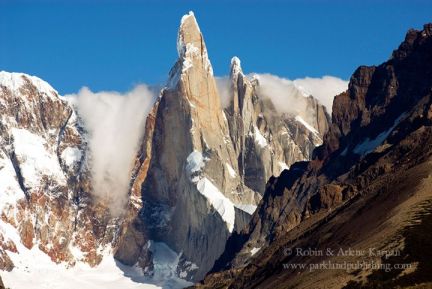
 When electrical discharge occurs in an atmosphere, it creates sonic-hydrodynamic effects. We experience the effect when we hear thunder – the sonic boom of a lighting bolt. It’s the sonic and hydrodynamic effects, in a dense, viscous atmosphere, that leave their mark on the landscape at the grandest scale.
 Region 2 is a reflected shock wave blasting into the atmosphere, pushing an exploding cloud of vaporized debris into a Richtmeyer-Meshkov instability, more commonly known as a mushroom cloud.
 The reflected shock waves are rigid and stable when the energy is high, creating a shock ‘envelop’ over the ablated land. The energy does not dissipate quickly, because the vacuum of the mushroom cloud above is punching a hole through the atmosphere, drawing supersonic winds through the shock envelope like a cosmic vacuum. This is a source of free energy to the shock wave that keeps it alive.


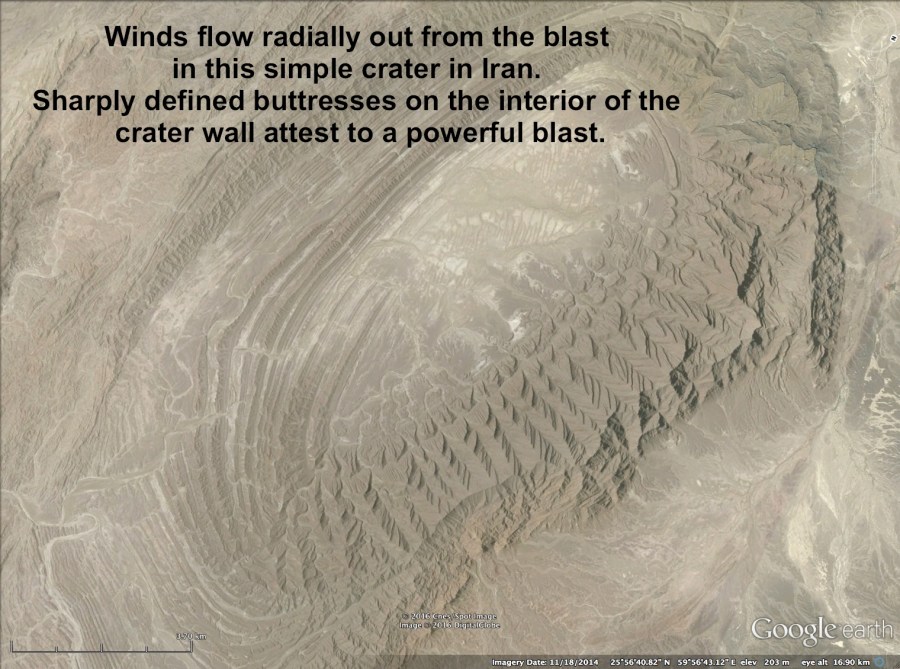


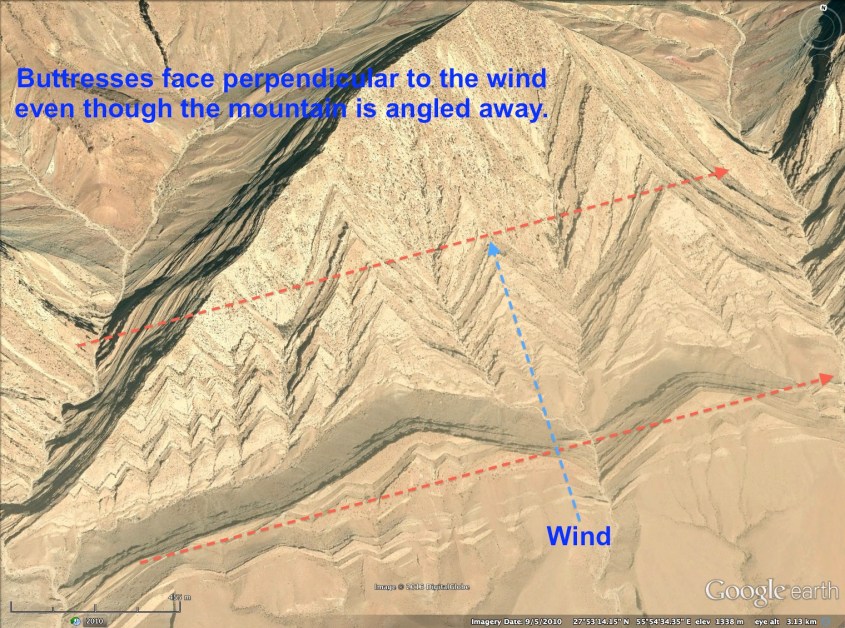
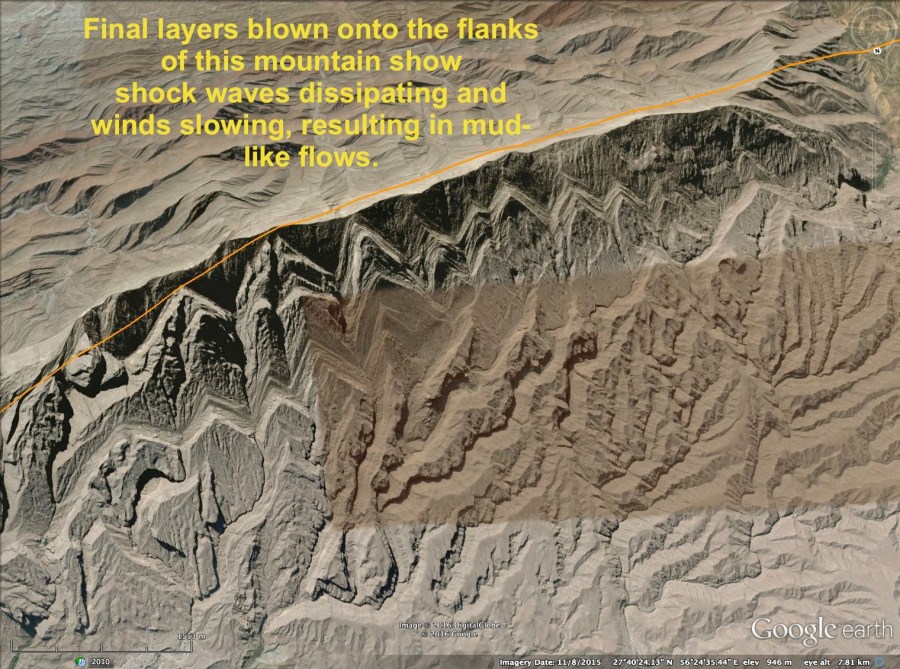
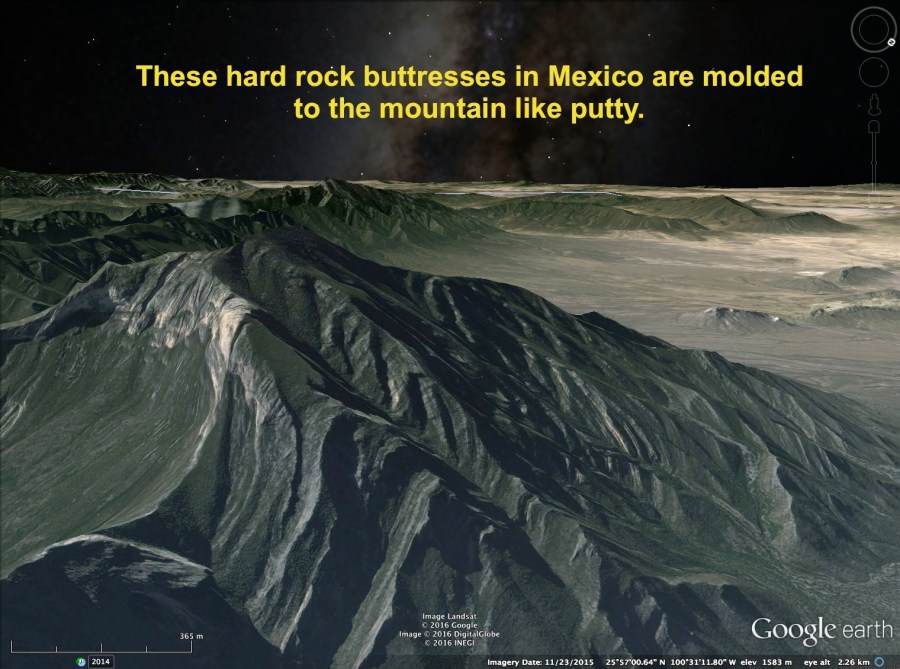
 it is called the Mach angle. Hence, the Mach angle holds information on the speed of the shock wave that made it.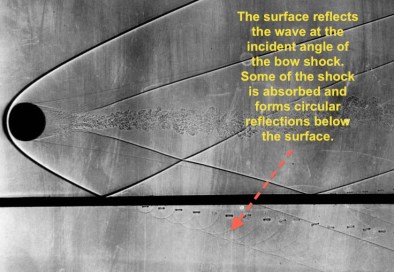
 reflects some of the shock and absorb some of the shock, as a function of its modulus of elasticity.

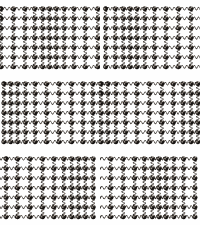 Transverse waves, like the propagating wave, travel up and down.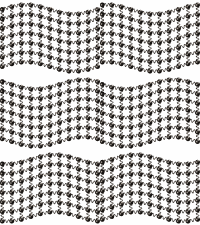
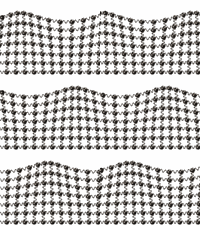
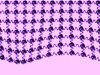
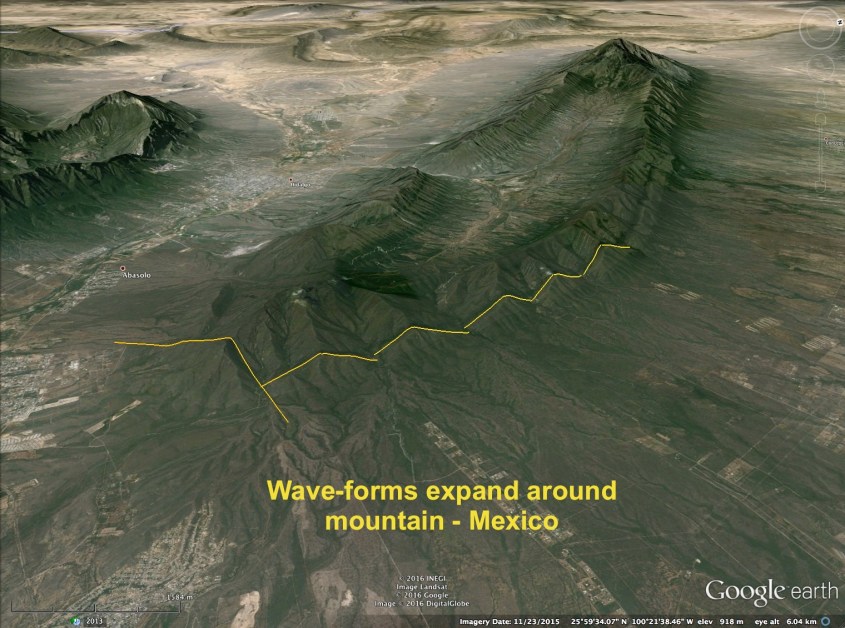
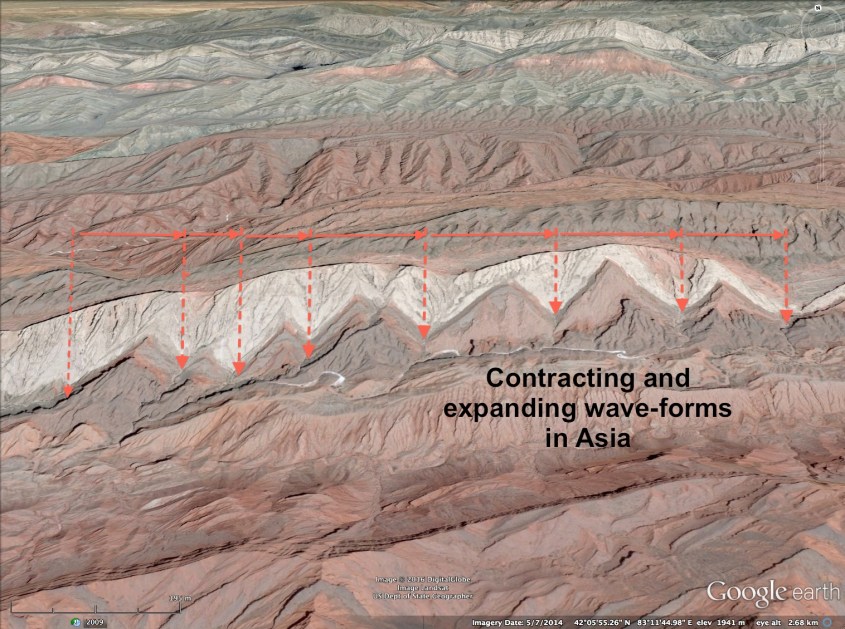
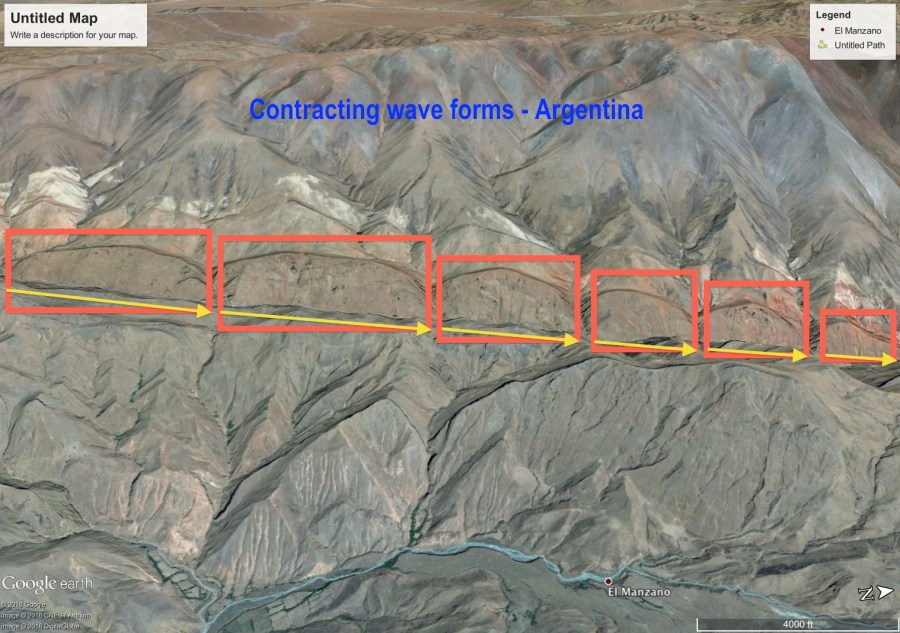


![IMG_1727[1]](https://thedailyplasma.blog/wp-content/uploads/2015/06/img_17271.jpg?w=845)
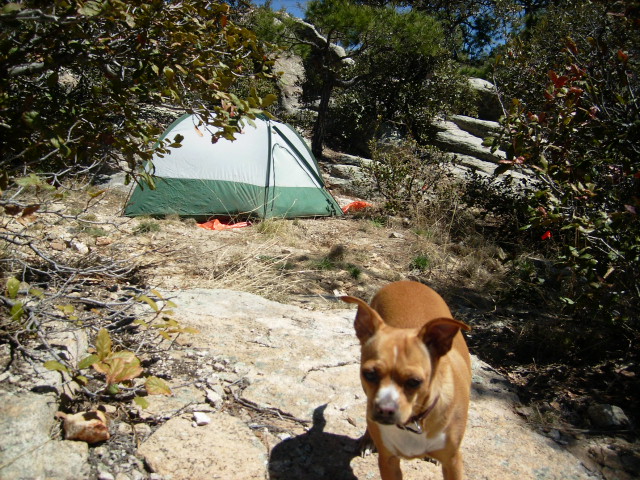
 Ginger and I traveled to a little known place in Arizona where the creatures are known to make an appearance now and then. I’m not saying where it is, but it’s a large mountain that looks like this one. We arrived and found a beautiful camp by the lake.
 Soon after, Ginger crawled out of the sleeping bag and looked at the tent door. I thought she needed to potty, or get water, so I unzipped the tent. She immediately crouched low, dropped her ears and tail, and growled with deep, serious intent out the opening. She almost never growls and I’ve only heard her do that when fending off a mean dog, or one of the meth addicts in our neighborhood. I don’t know how she can tell a meth addict from anyone else. Same way we do, I guess, because they’re scary.
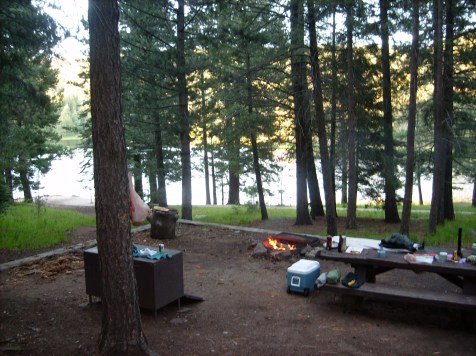 We left on the fourth of July. This was strategic on two counts. First, all the holiday campers would be leaving that day and we like our solitude. Second, all the Bigfoot should be ready to raise hell now that the firework wielding, beer soaked campers were gone. We thought the Skeezamen ( a local name) might even venture to the lake now that it was quite after the long weekend. I can’t help but think that crawdads would be one of their favorite snacks – its one of mine.


 Ginger and I scouted several areas where the trees seemed arranged non-randomly. There were several areas where there were these crosses formed from broken tree trunks. They faced the road squarely with lots of other disturbance around them; a profusion of broken limbs, stumps and trunks leaning against other trees.


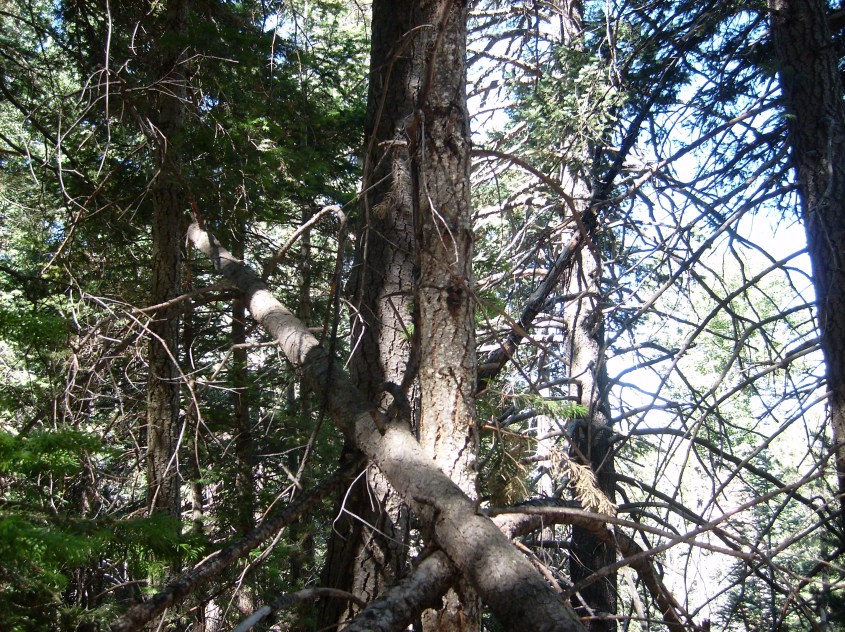
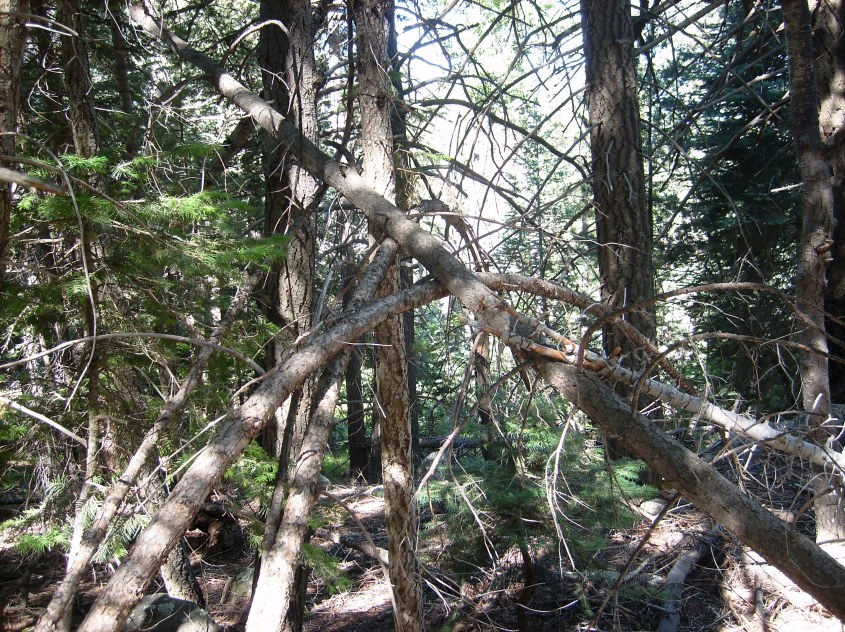
 There are two trees still rooted and bent over in arches, another laid over in the same direction and one pressed against the trunk of the center tree like a spring. Two logs are laid over all four to hold them down. Well, it seems odd to me. Ginger wouldn’t get out of the car. She was bored with tree structures.
 I suppose this could have fallen in a wind this way. If it was the only one like it I would even assume so, but there are several broken, bent or wedged in improbable positions like this in clusters. Note all the other leaning trees nearby. Here are more views of the same trees.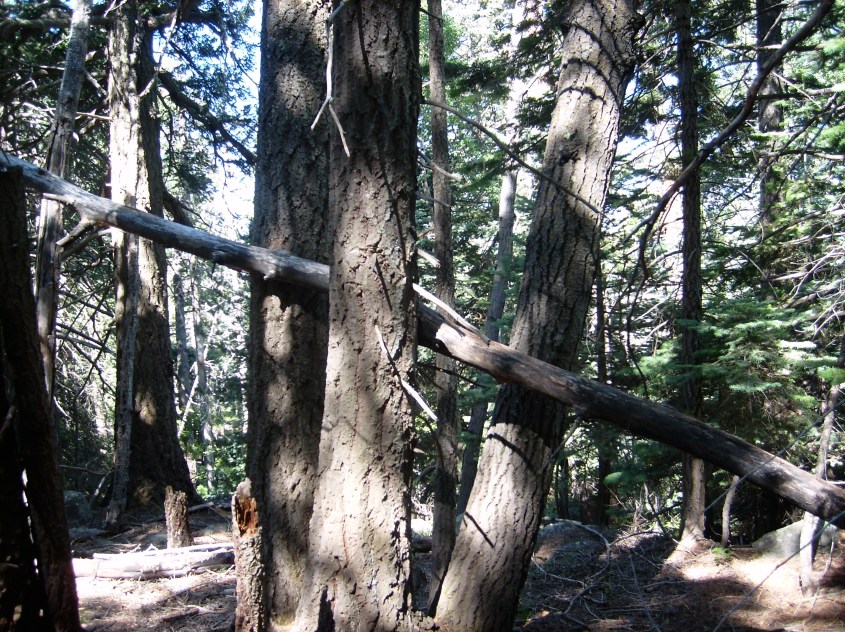
 Ginger was getting annoyed I was looking at trees. She wanted to look for Bigfoot. She doesn’t make the connection with trees because she’s a dog. Dogs don’t look up. If it had been a turd on the ground, or something fun to pee on, she’d have been more interested.
 Notice how the leaning trees are held down by the broken tree? They should not have been in the line of fall if this had been wind or snow. That’s how they always seem to fall in this particular area though.
 Ginger and I are very attached. She’s a weird dog, but also the smartest, warmest dog I’ve ever known. By warm, I mean warm. Mexican aristocrats bred Chihuahuas to sleep with because they were better than hot water bottles. This is how we sleep, with her curled against my back to keep us warm.
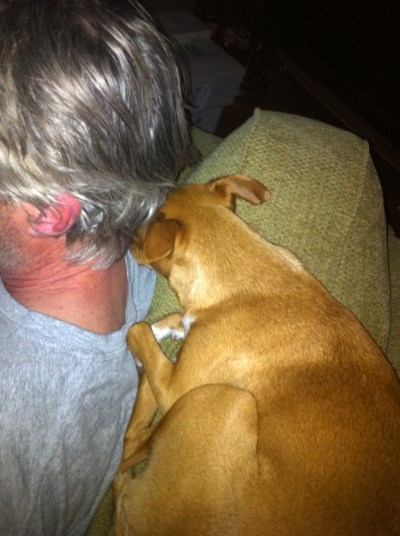 I don’t know where she slept that night. One camper who I’d talked to flagged me down as I left the campground and asked if I’d found her. He said she had approached his camp just after I’d been by earlier and he was looking to tell me. I said, thanks she was with me now and wondered from which direction she’d come. He pointed to the opposite side of the lake from the campground.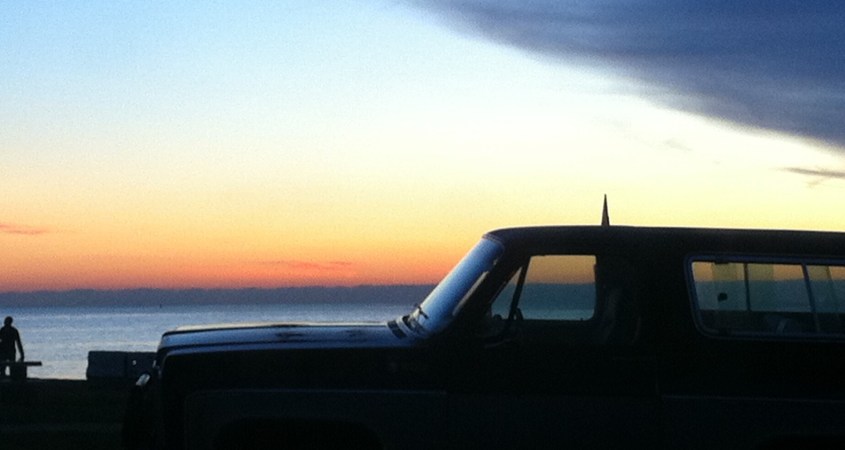
 This was to be my first EU conference. As I left Tucson on I-10, the temperature was hot. Arizona in June is like Venus. Temperatures always hover above 100ºF, but when it exceeds 110ºF, it’s life threatening.
 Susan introduced me to the EU. I found Thunderbolts while surfing the web, became convinced for reasons too numerous to get into now and contacted Susan to pitch a guest blog. Susan gave me that opportunity and made everything else happen. I simply had to write what I learned and she handled the rest. Susan is the engine of Thunderbolts, but made time to make sure I was taken care of.
 Every Leo was different. Every Leo was interesting. Every Leo is my brother and sister, now, but that is getting ahead of the story. Leo came from British Columbia, Montreal, New Brunswick, Colorado, California, UK, Australia, Belarus, Germany, Tibet and at least one from another planet. Leo wore tattoos and buzz cuts; tie-dyeds and chinos; safari hats and bandanas; piercings and goatees; or in one case, a beaded, braided fu-manchu. All points on the globe, all types of people, representing a common interest in our Electric Universe.
 The young couple left. I don’t think they understood UK Leo either. He and I talked nonsense through our beers and then I left to circulate. At the bar I spotted Southern Comfort Leo. Southern Comfort Leo was someone I wanted to get to know, because I’d seen him present in a video of the previous year’s EU conference. His topic had direct bearing on mine. He held court at the corner of the bar, a place only a talkative person would take.
 As I found with all EU conference participants, they are fiercely independent thinkers who fear no topic. In this case, our conversation turned to God and the relative merits of belief in HIS existence. Dangerous ground for a late night at the bar.
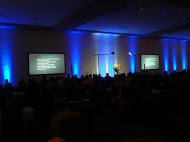 The conference room was a comfortable place. Dark, with a casual and attentive audience and the most interesting subjects to hear about, delivered by some of the most knowledgeable people in the world. What could be better. I lost myself in the ambience, surprisingly relaxed, without any building apprehension for my own talk that afternoon.
 After dinner, of course, Rich and I retired to the bar, while the sensible people went about other business, like sleep. After one drink, my brother left to meet his son in Scottsdale, leaving me with the Leo’s again. It was pretty much the same crew, UK Leo, Southern Comfort Leo, Roommate Leo and me. Many other Leos were there, too.
 The day had been hot and it began to take its toll. People drifted away to bed, leaving only dead-enders. You know us by now. Leo and I had both shifted from beer to vodka at this point, so my recollection may be out of sequence. What I recall is that Leo began speaking gibberish.
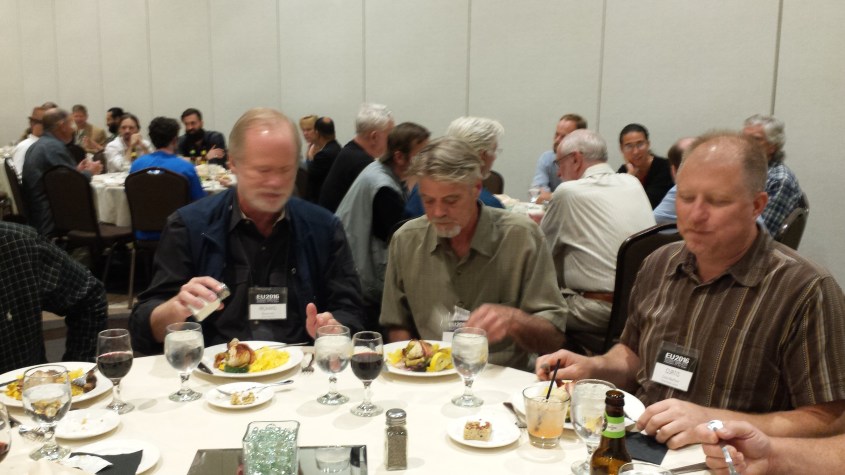 After the banquet there was a gathering at the bar. I happened to join in. Imagine that… Leo was there, too. All of the Leos, in fact. This was the big finale. It wound down as the sun rose and it was too late, or perhaps too early…whatever, to buy beer at the Circle K. I spent my time engrossed in conversation with a charming Leo from UK, this one a female, about documentary film making.
 There is a mathematical rule that relates the number of people in a party to the time it takes that party to actually do anything. It is called the ‘milling factor’. The more people there are, the larger the milling factor becomes by logarithmic scale. If there are enough people, the milling factor will prevent anything from happening and the situation devolves to chaos. With well over twenty people the milling factor was enormous.
 Some folks refer to this as ‘herding cats’. I disagree. Cats tend to scatter and move. High milling factor creates a kind of paralysis where people just stand and stare at each other, waiting for someone else to make a move. Milling has a more bovine nature to it. My BIG coffee was almost finished when the vans actually started rolling. Now I had to pee. I held on because I wasn’t about to run inside when everyone else was finally ready, so we took off on the Geology tour.
 He was bundled in the back of a van to re-hydrate and sleep, while someone else took over command of his car, now driving on a spare. We spent a couple of hours getting a new tire for Leo in-the-car-ahead and ended up split into two groups somewhere in Verde Valley because of lunch preferences. We regrouped in Oak Creek Canyon, just past Sedona. Here, everyone cooled their feet in the water under the shade of cottonwoods at Oak Creek’s shore.
 After that first devastating day of heat, others began to notice – in addition to how bad I smelled – how I always parked in shade if I could find it, or aim the car away from the sun so the seats didn’t blister my ass when I got back in. At 120ºF, a car’s interior surfaces exposed to sun can reach 195ºF. By comparison, pork is considered safe to eat at 145ºF. I don’t comb my hair either, otherwise I’ll get a sunburned part. Tricks of the desert rat.
 Michael understood and looked at landscape in a way no one else had really captured. His inspirations inspired many more. We came to spread his ashes at the Southern Rim of the Grand Canyon. Herr Leo had selected Geology Point as an appropriate place. It was.
 I spoke with Michael’s friends about the formation of the Grand Canyon. I agree with Michael’s assessment, in general. The canyon was carved by an explosive current locked to the river’s channel. I’d looked into, and written about breccia pipes; karst-like formations of broken rock that fill vertical tunnels emanating from a limestone formation above the inner gorge. These breccia pipes emerge from the ground all over the south rim, concentrated along the rim and even split open in places along the canyon wall.
 We crossed the Little Colorado and skirted the Navajo Nation, heading north. At Cameron, Arizona we stopped for lunch. It made sense, since one of our Leo’s was named Cameran-Leo; wrong spelling, but close enough to earn a sandwich. This was also where I departed, leaving to drive home to Tucson through the best part of Arizona, Highway 191. I’ll tell about that in a moment.
 As the StRange Rover hummed along, the sun began to set on a landscape I could only imagine had been etched. Magnificent undulating, layered and cap-rocked dunes scalloped and gouged around the edges. A different electrical scarring than I’d been studying. Something to look into in the future.
 Near Kayenta is where Dave Talbott’s photo of a petroglyph was taken. The one Tony Perratt identified as a plasma instability – rock hard evidence of an aurora in the ancient sky that our ancestors witnessed. I marveled to myself that his paper had been published over a decade ago and so few people had even noticed. Yet it gave up so much truth. It was the very thing that had brought me to look into EU.
 They were either hiding from something from above, or below – lightning perhaps, or a swarm of hungry bigfoot (cannibal demons in the native Hopi) come down from the San Juan’s. I don’t know which yet, but I’m going to Tsegi some day to figure it out and write a novel about it.
 After a night in a cheap motel along I-40, where I closed thick drapes and slept late, I departed on my final day. This I knew would be an epic drive. Highway 191 (renamed because Highway 666 seemed to disturb some people) runs down the eastern edge of the State. It is an age-old corridor for migration and trade. The Anasazi traded with the Aztecs along this route. It led to the region’s giant center of trade, Chaco Canyon. The Puebloans retreated on this route during the diaspora.
 A few miles further up the road, I passed volcanic cinder cones and rode over vast lava flows. On the lava flows, lightning began to strike. It flashed with an almost constant frequency, close enough to hear the peel of thunder, but far enough to enjoy the show. I pulled to the side on a hill and lowered my tailgate to watch – the reason I drive the StRange Rover is it has a classic drop-down tailgate – essential for such moments. I also celebrated Michael’s green thumb again as I watched the lightning strike and listened to the thunder. It was a fitting spectacle to end the journey and my formal introduction to the Electric Universe.
 Update: Leo is now engaged to Leo. I have confirmation, so feel free to announce it. And I thought I was having fun…apparently not as much as those two.


 Supersonic shock waves display particular behaviors that have been studied by aerospace engineers since the beginning of the jet age. These characteristics must be understood to design airplanes, missiles and rockets. We know a great deal about their behavior.
 The shock wave travels on a transverse carrier wave called the “propagating wave”. This vibrates the land, seismically, from the hammer blow of the shock wave. The land will reflect some of the shock and absorb some of the shock, as a function of its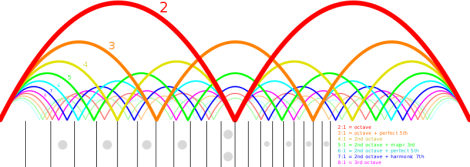
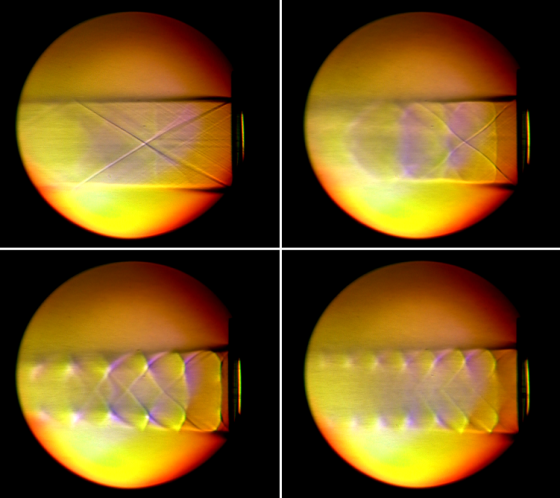 The initial wind speed in the first frame (top left) is Mach 2. It shows the shock wave producing one and a half diamonds.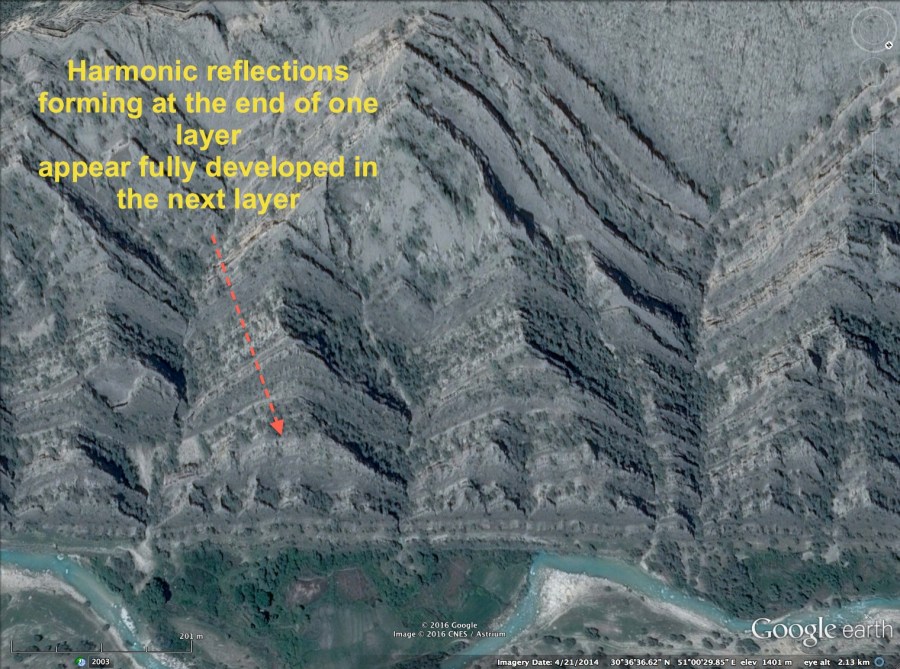
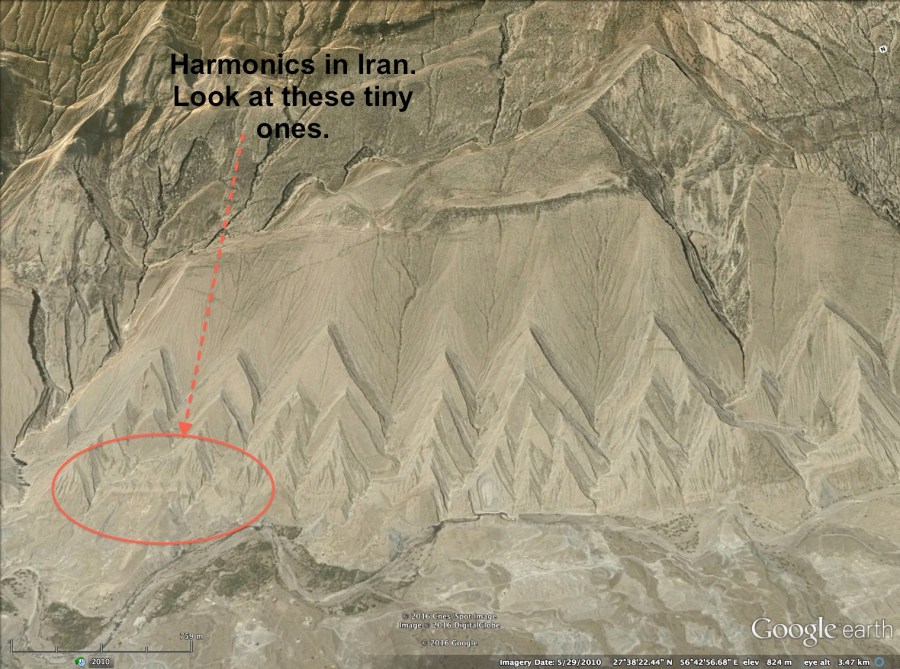
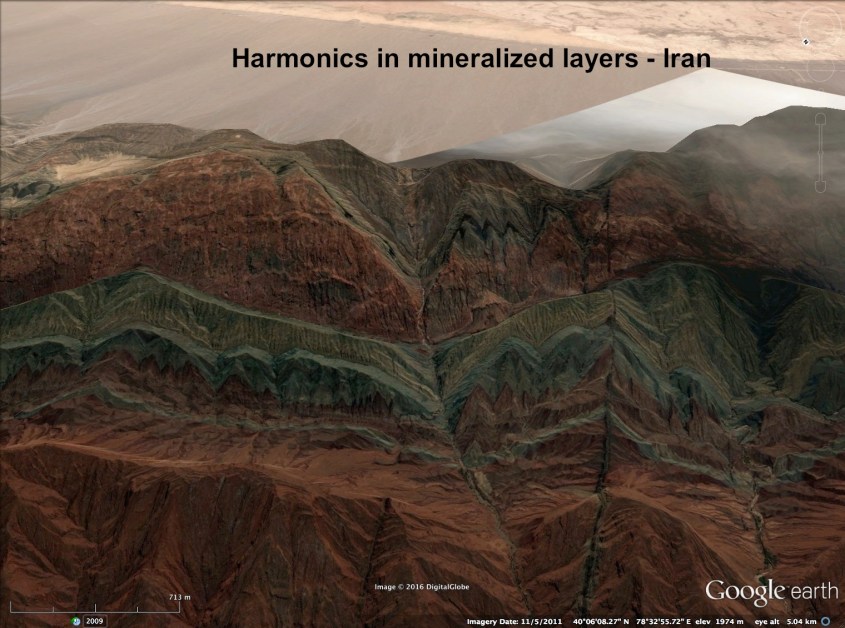
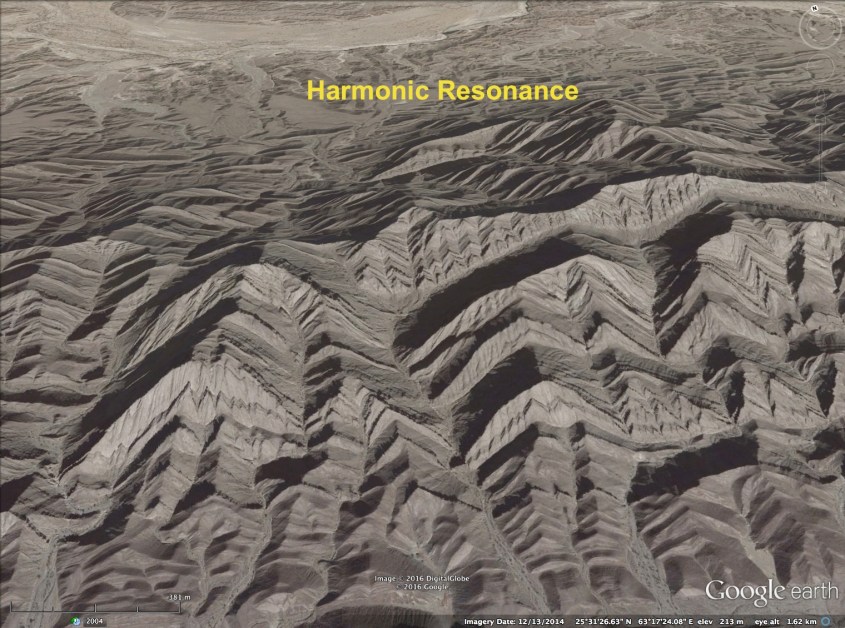
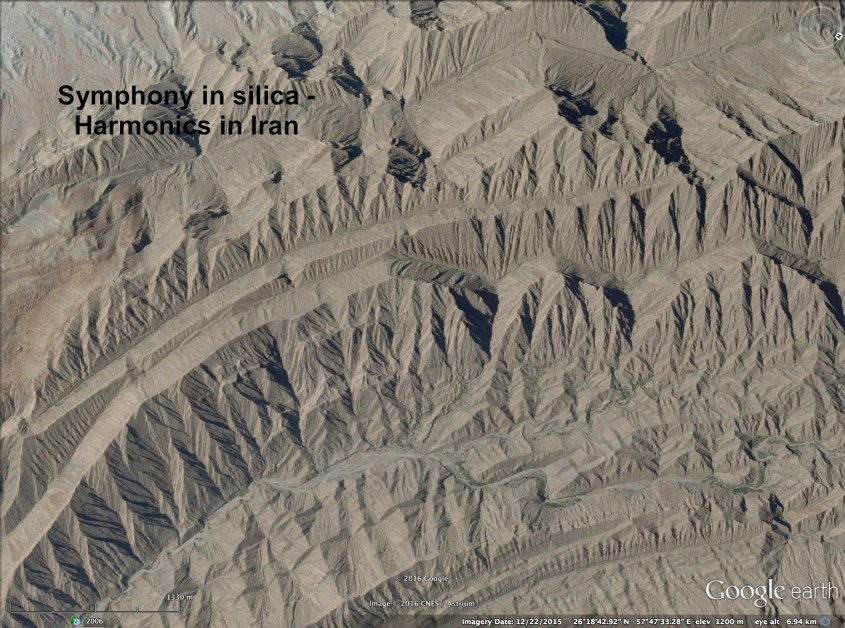
 Transients in wind speed, Mach angle and multiple reflections create instabilities in the wave-forms. Unstable waves segregate and fan away from each other under expansion, fragmenting the wave-forms.
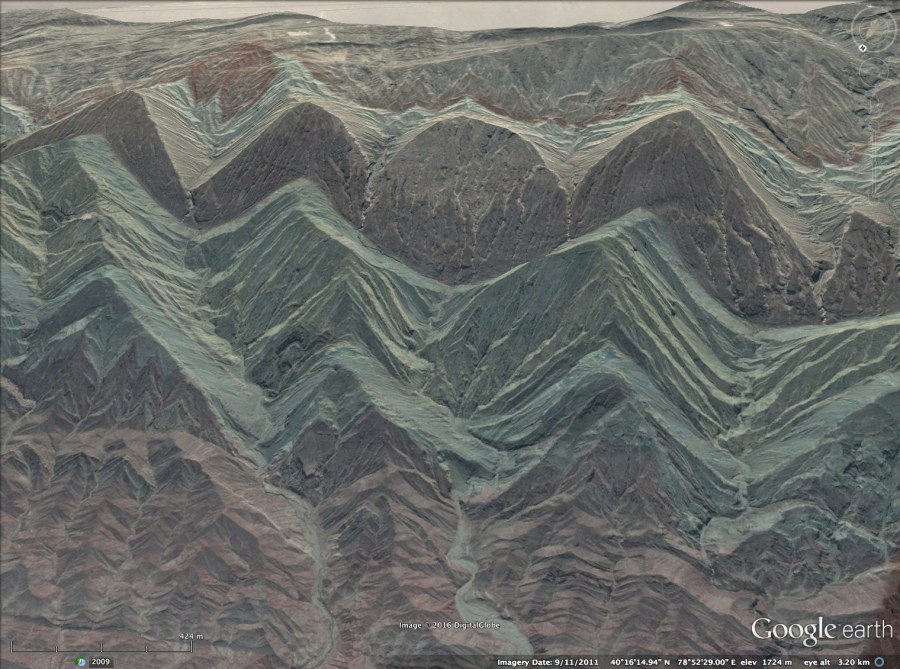 A similar wave cancellation has occurred in the next image. Here the center wave-form is cancelled by neighboring wave-forms, and they have expanded to fill the wavelength. A diagonal shock line appears cutting the mountain where the cancellation occurs. It crosses in a step-wise fashion, a few layers at a time, causing it to zig-zag. Note the ruler straight shock lines that divide the adjacent triangular buttresses.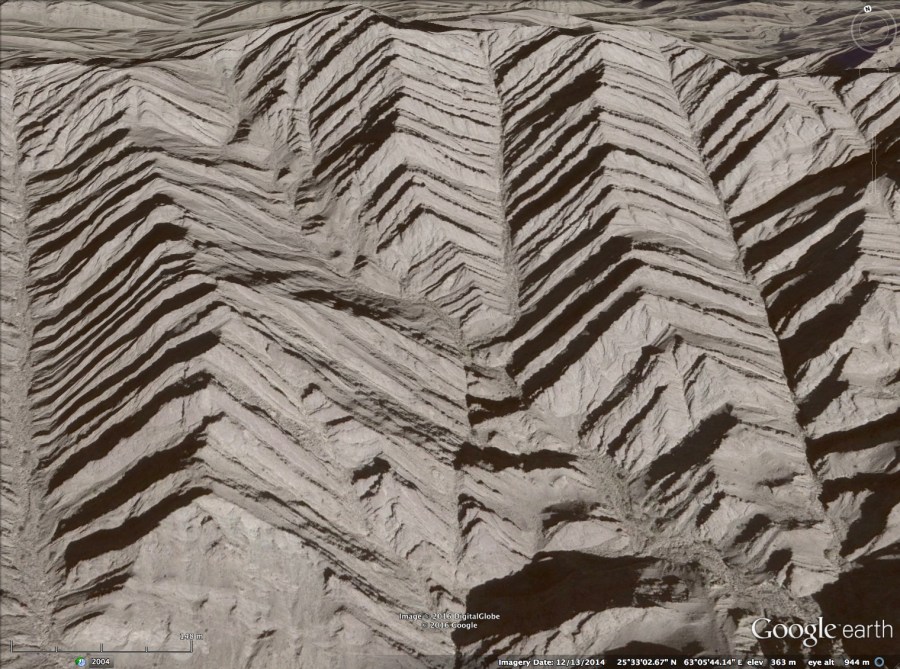

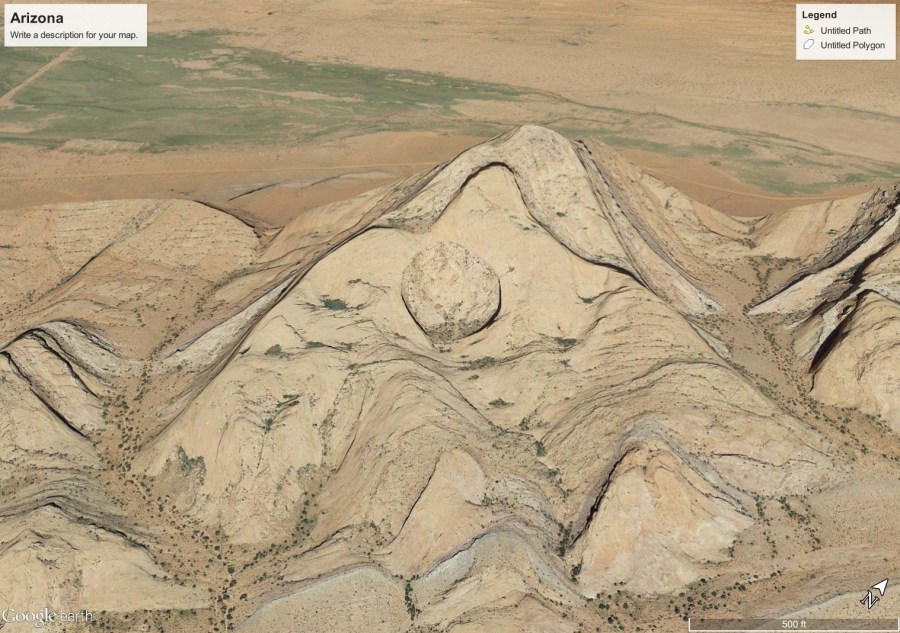 Here is another hole created in a triangular buttress. This one is in Iran.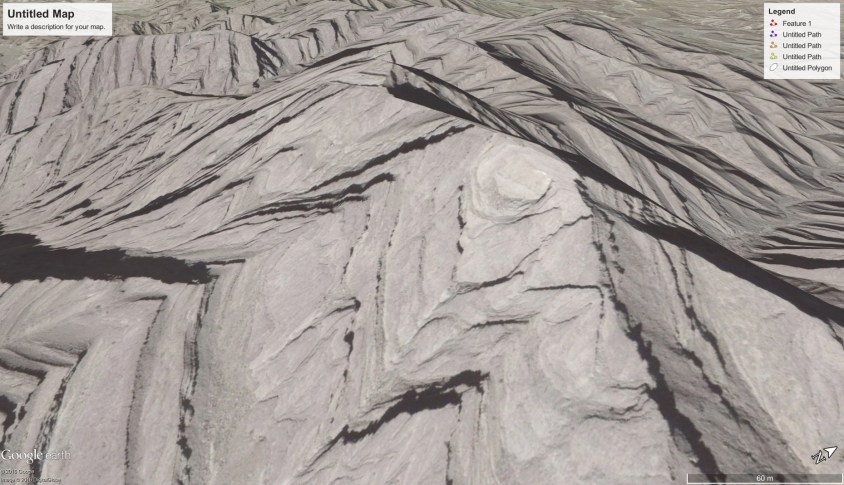

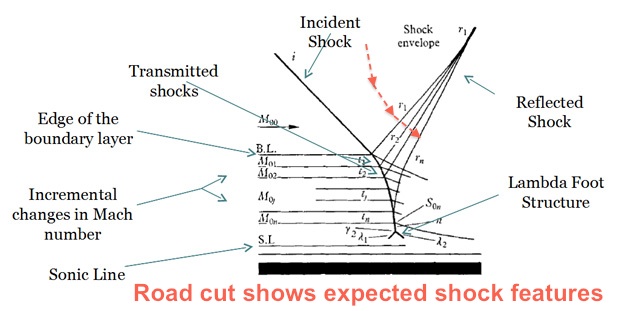
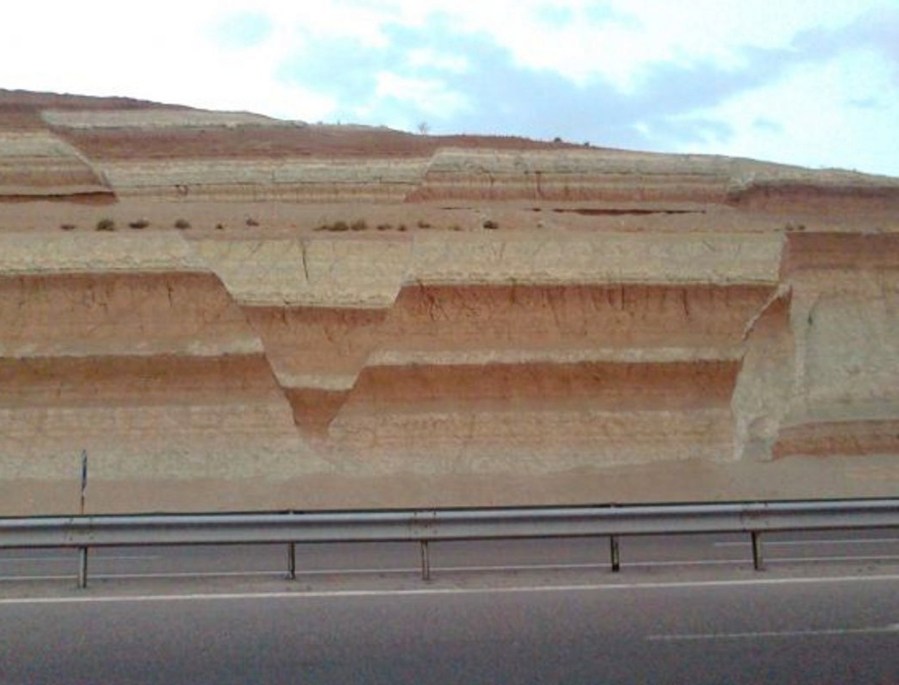


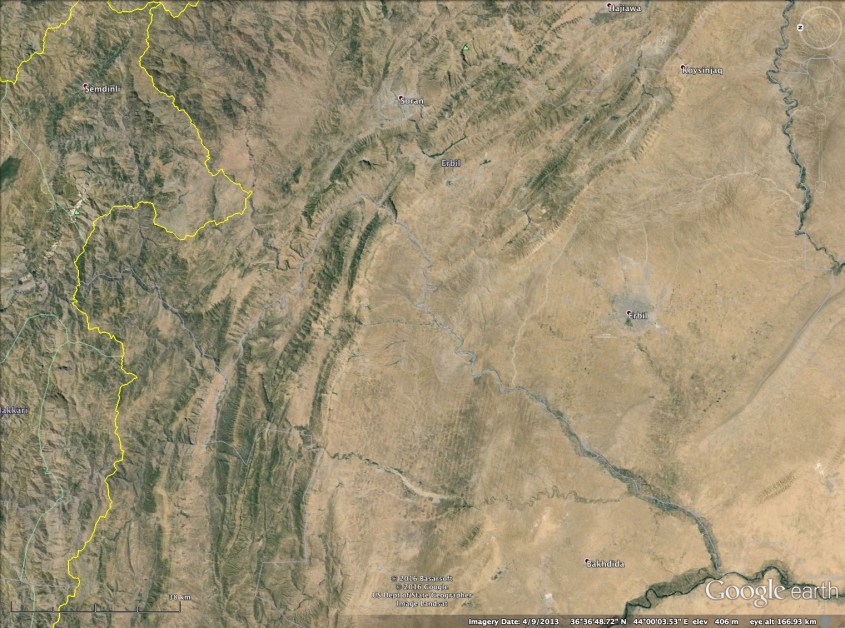

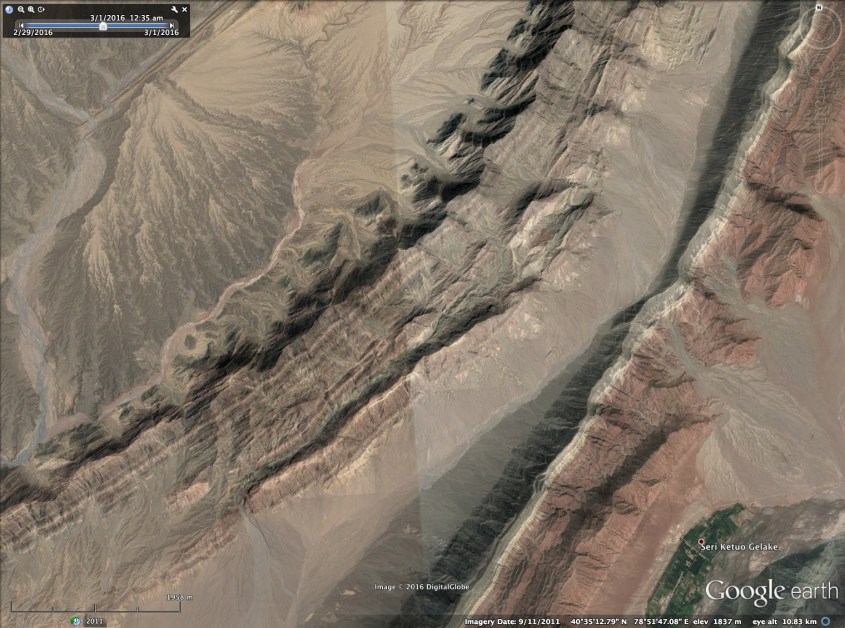

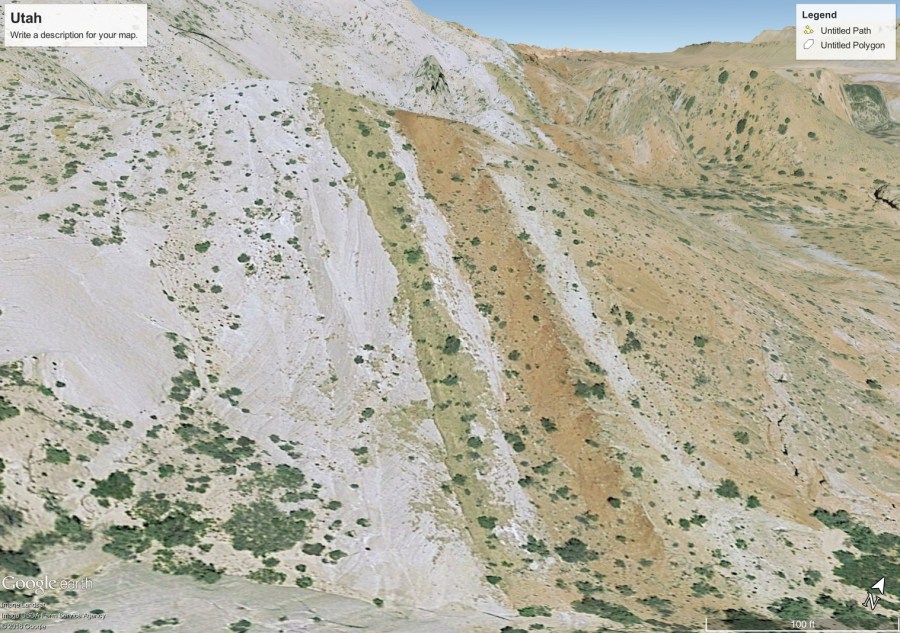


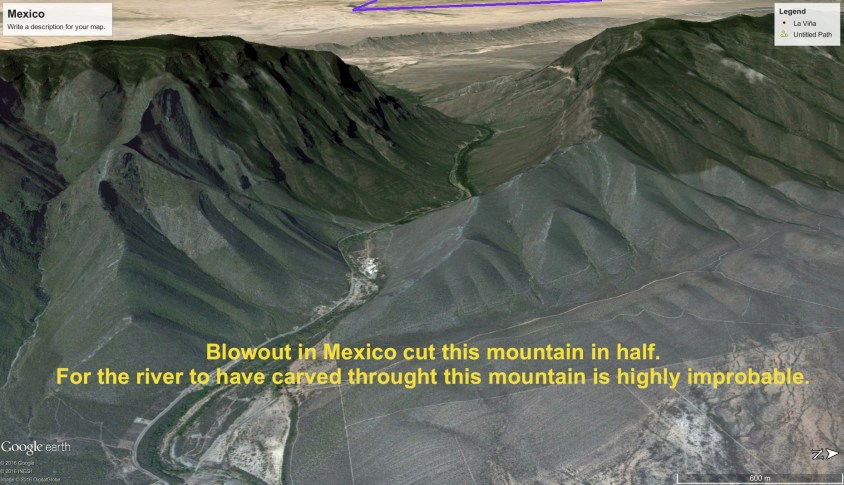
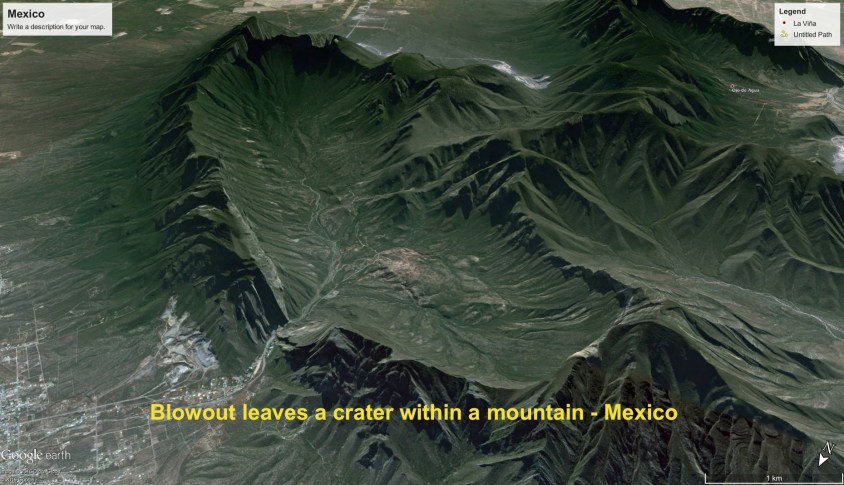
 The images to follow are from a complex formation of astroblemes in Iran. They are on the outside, or convex bend in a large mountain arc.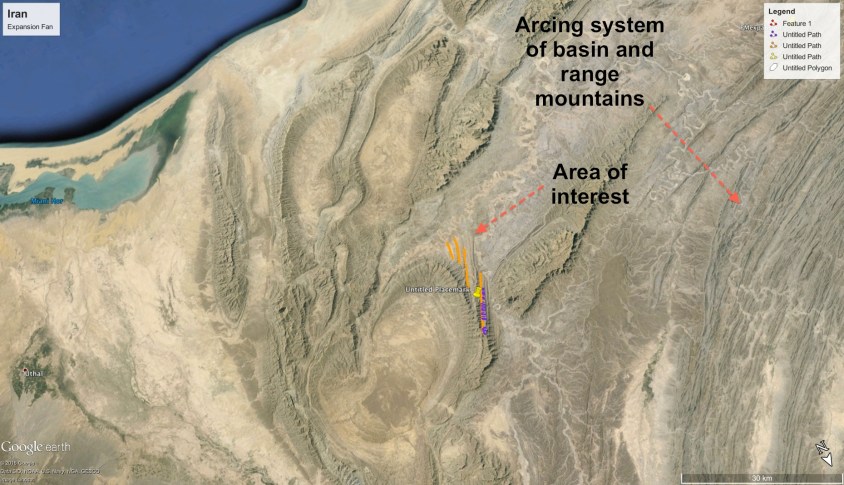
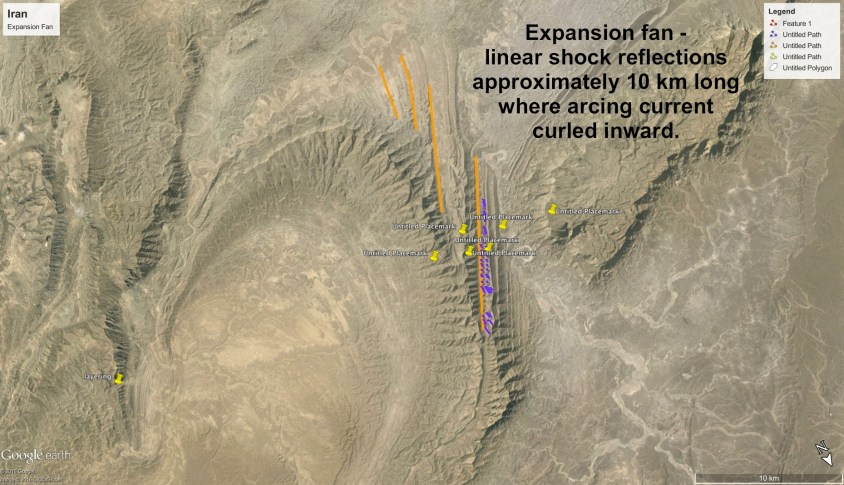
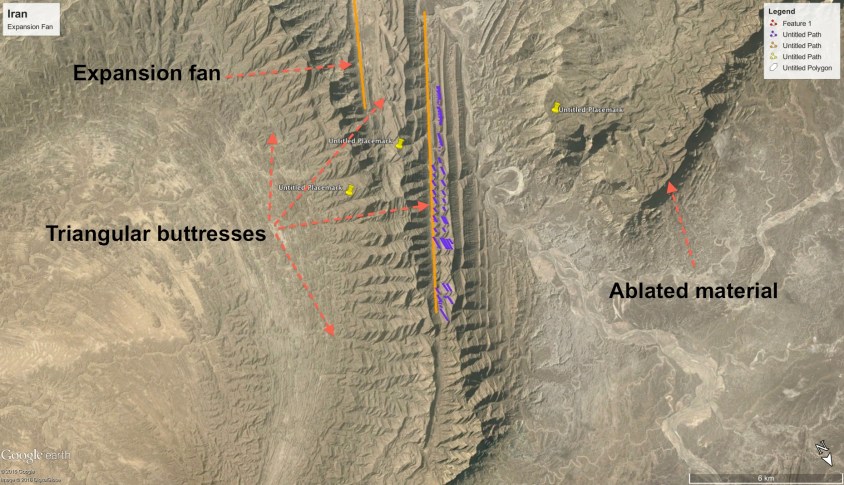
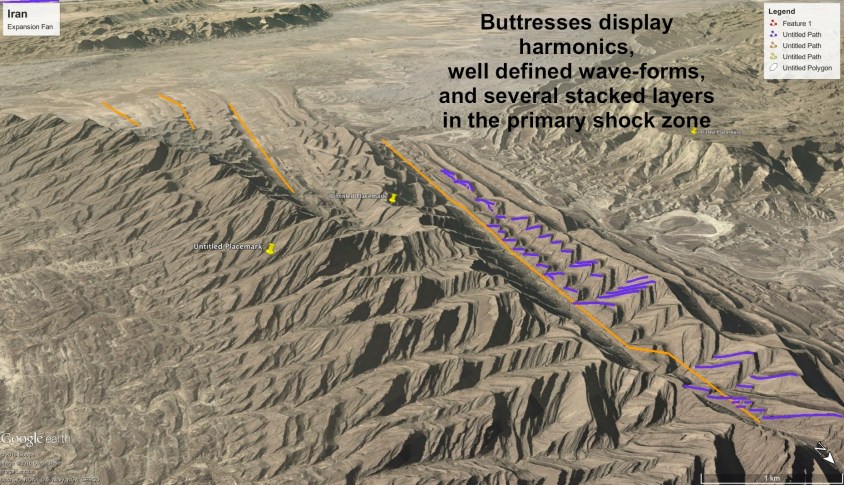

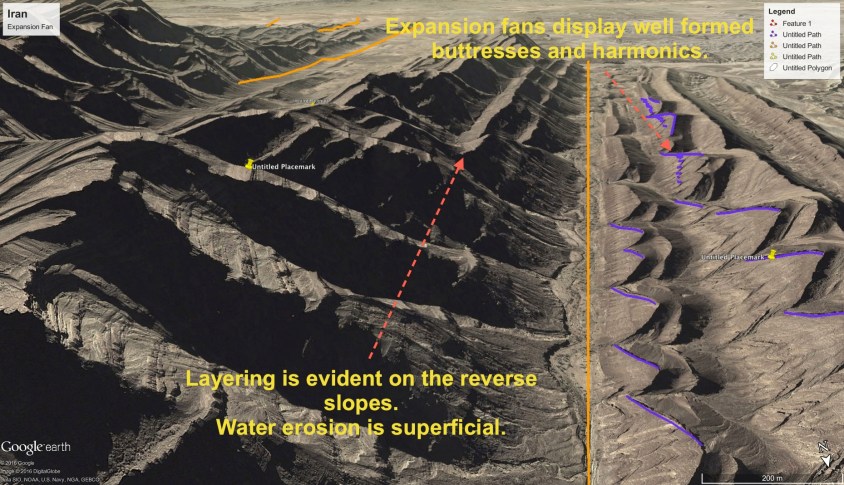
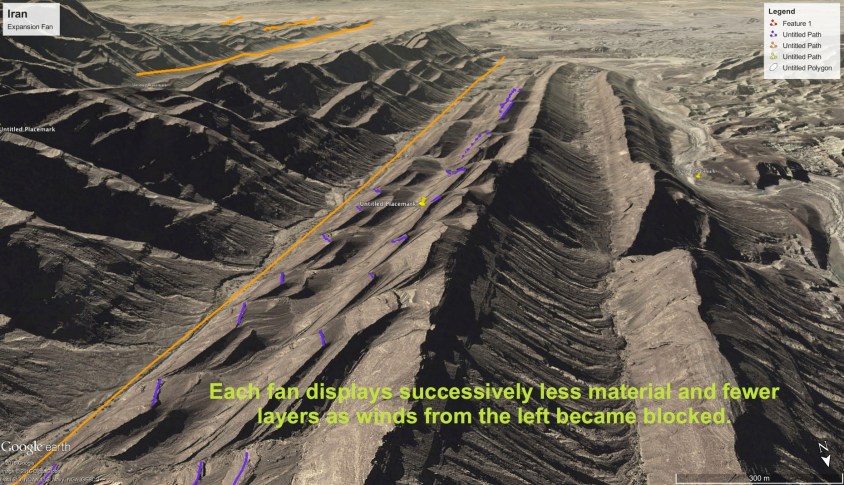
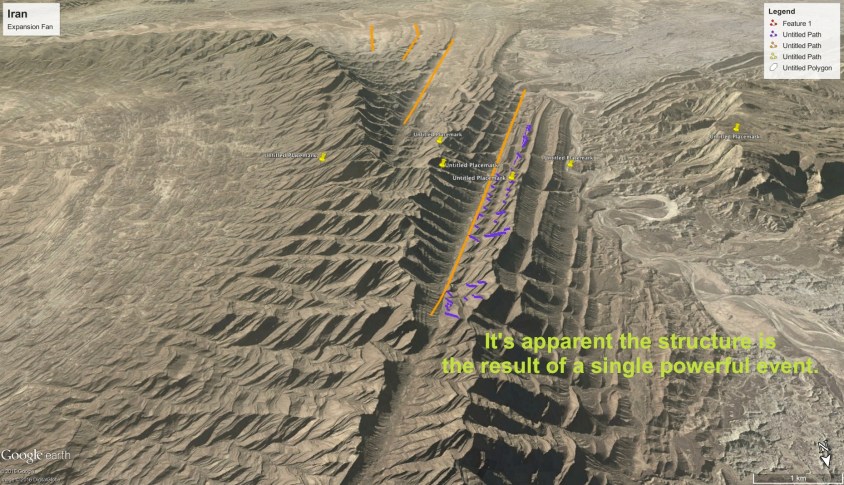
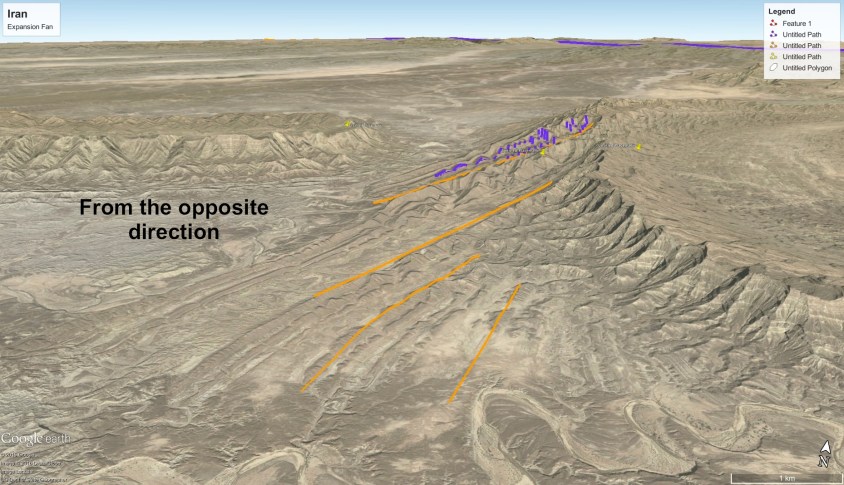

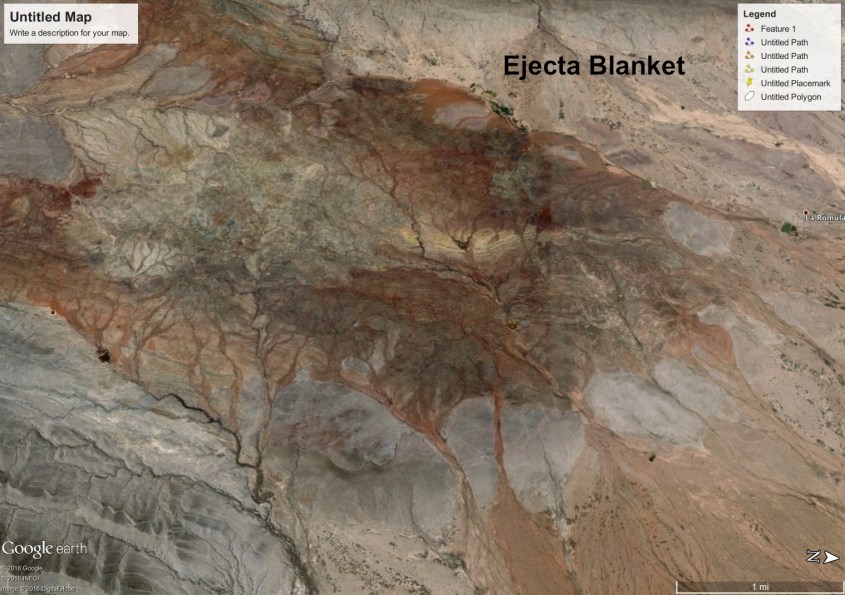
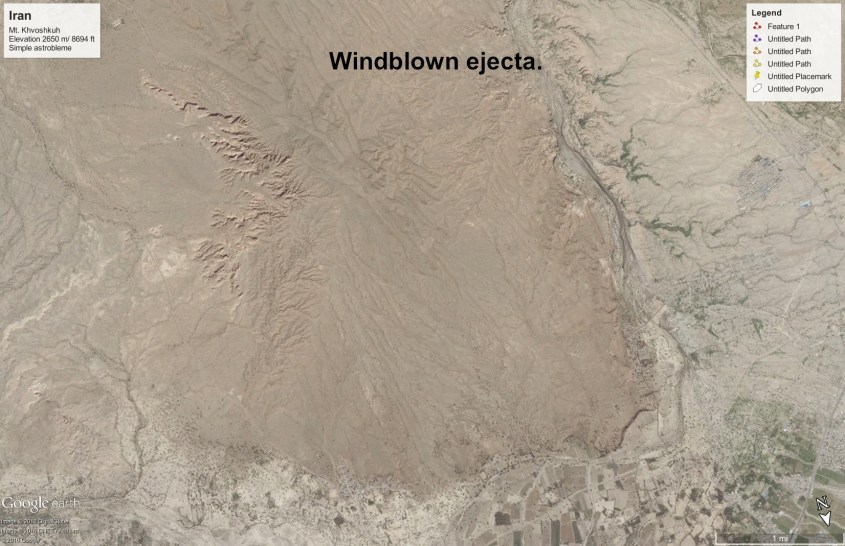
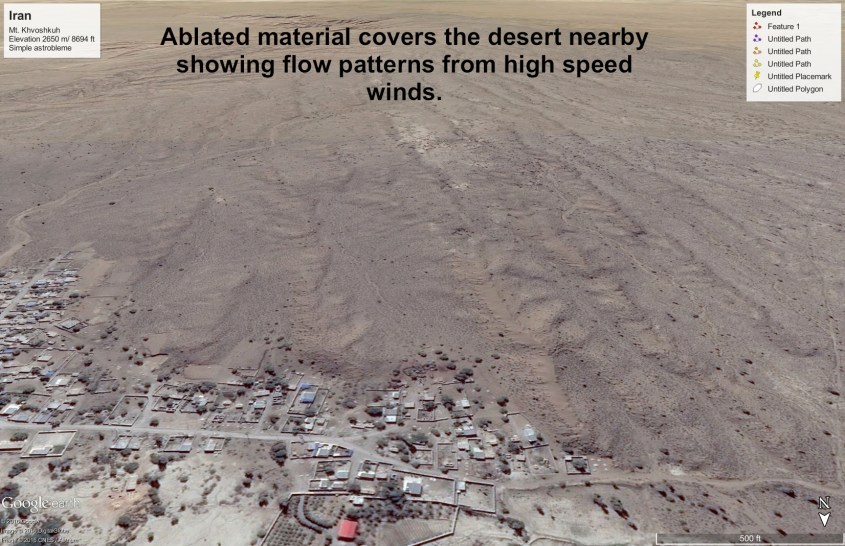


 Everything we see in space, beyond the dust and debris of rocky planets, is plasma.
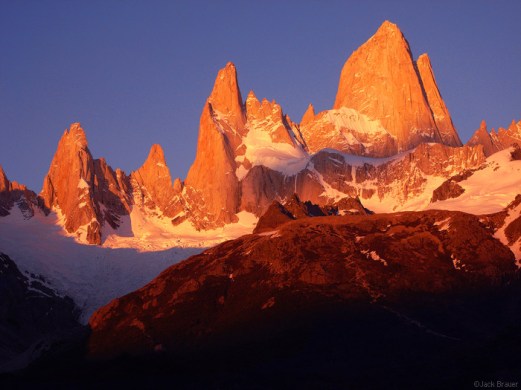 The trolls roll the continents about, crashing them into each other and squishing their edges to form mountains. Shards of rock stick up like broken glass from the land. The trolls are called ‘


 This is important and provable, in case anyone wants to make a survey of every true volcano to verify it.


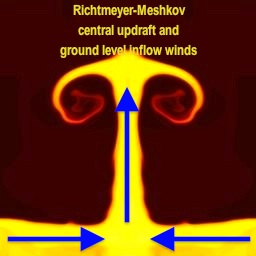

 The result of its passing is embossed on the land by shock waves that act almost precisely as those made by the projectile.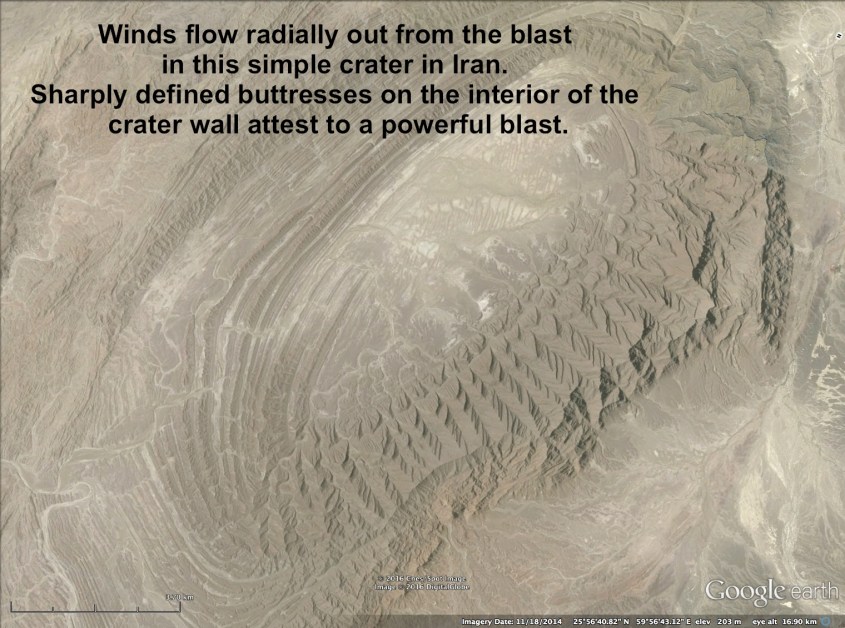
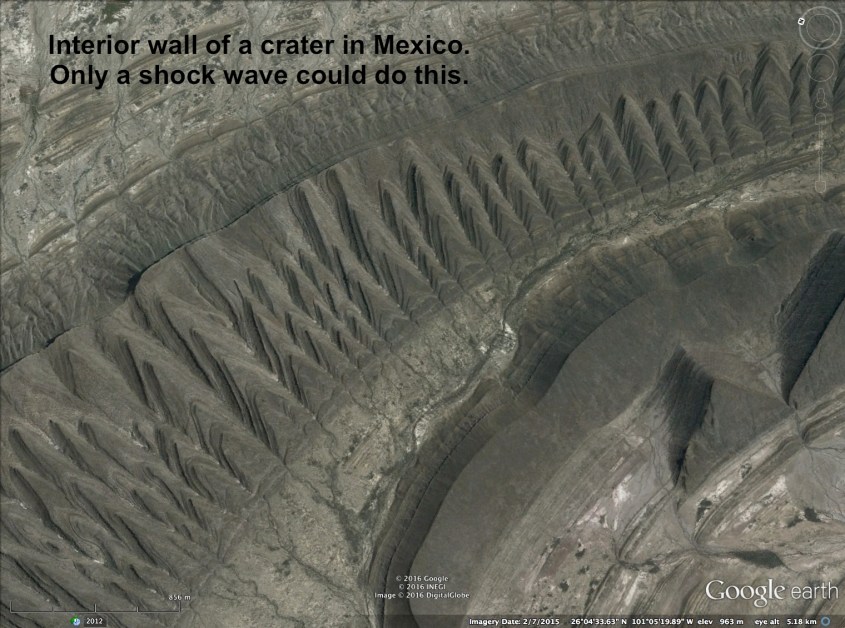
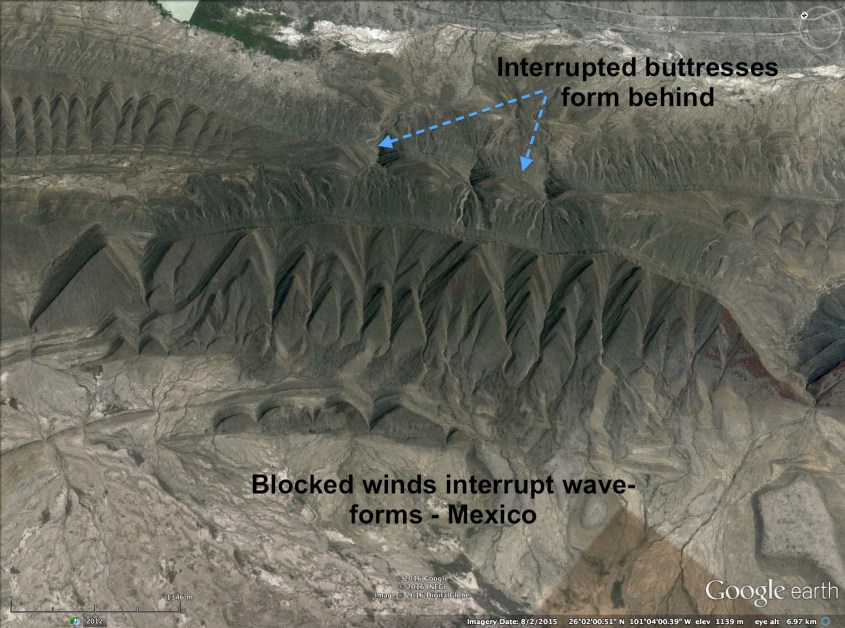
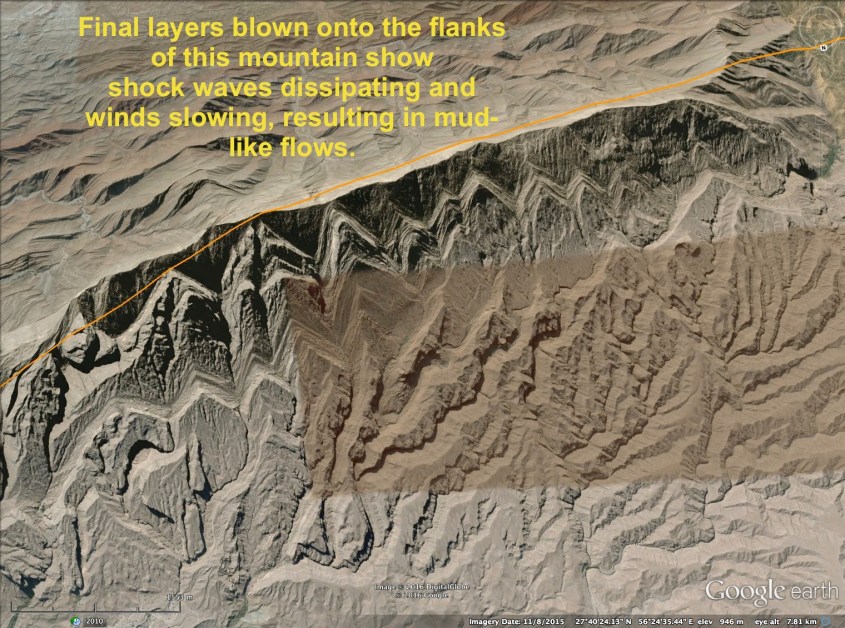


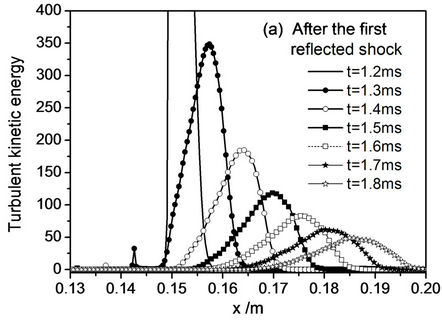

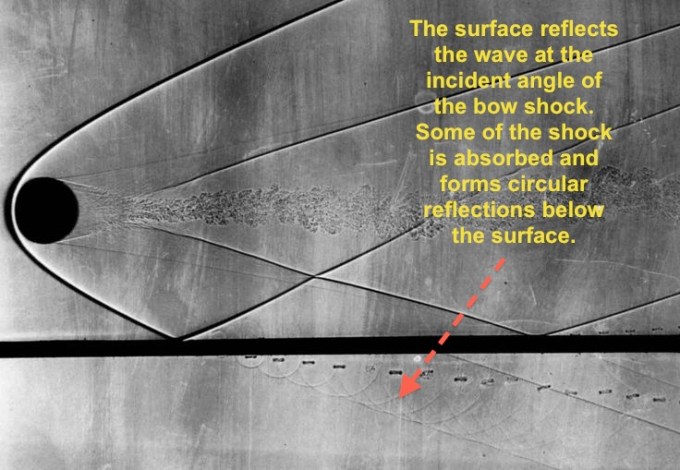
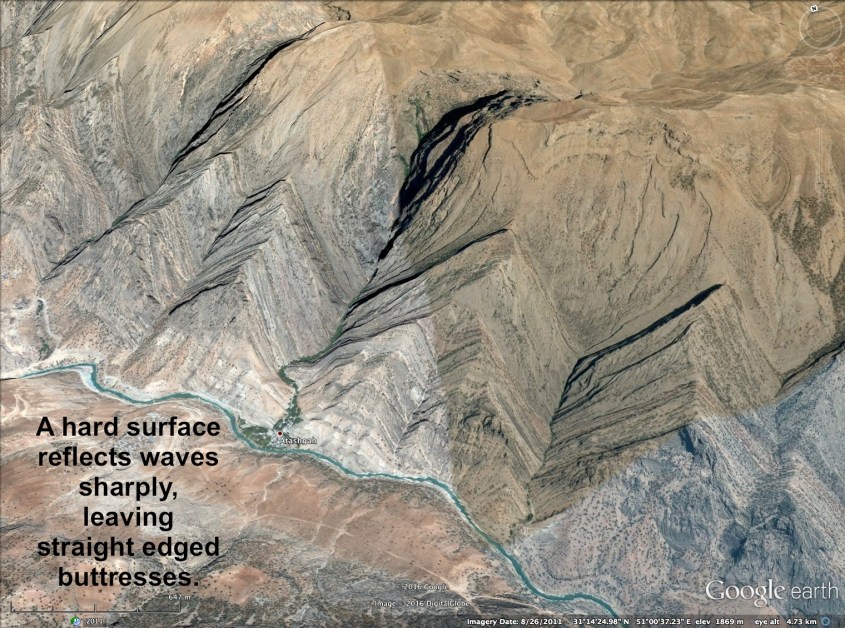


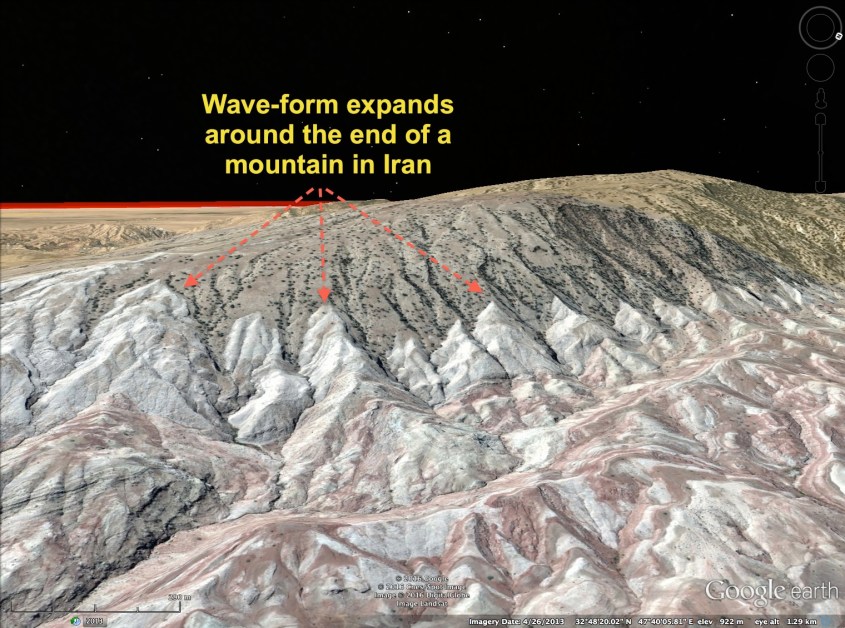
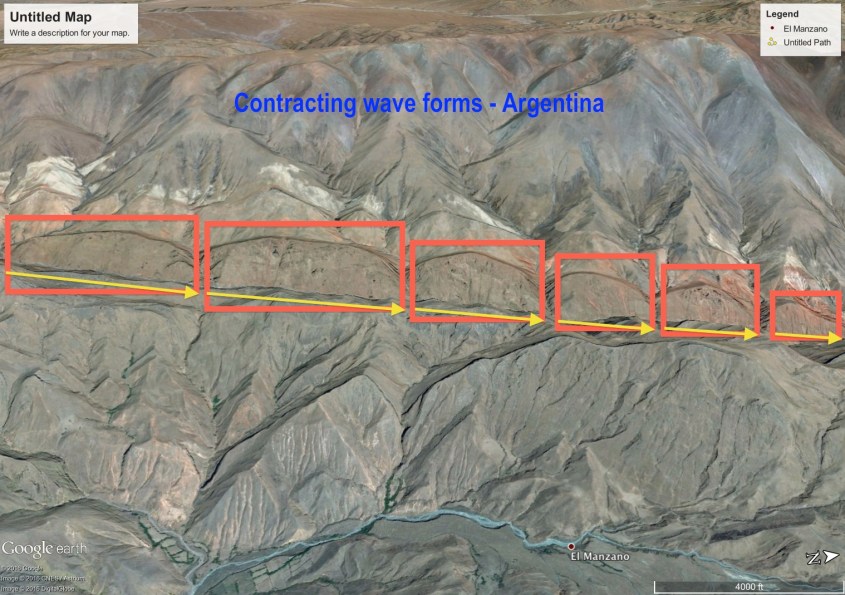
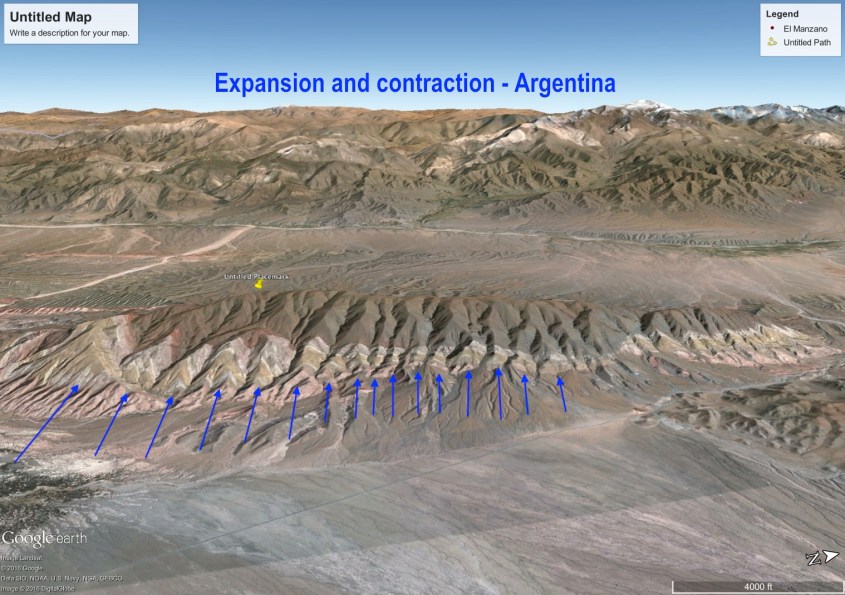
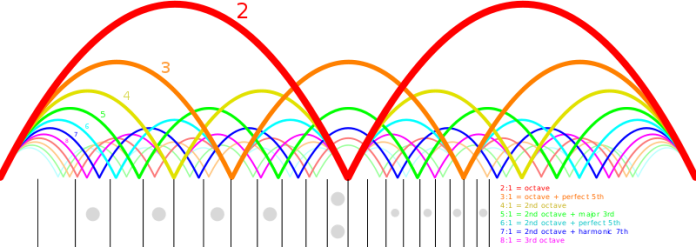

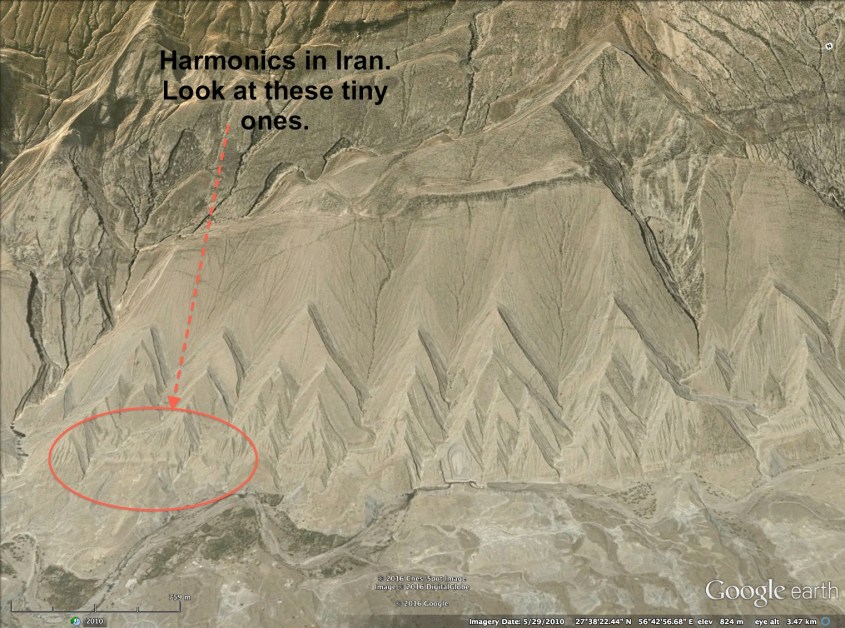
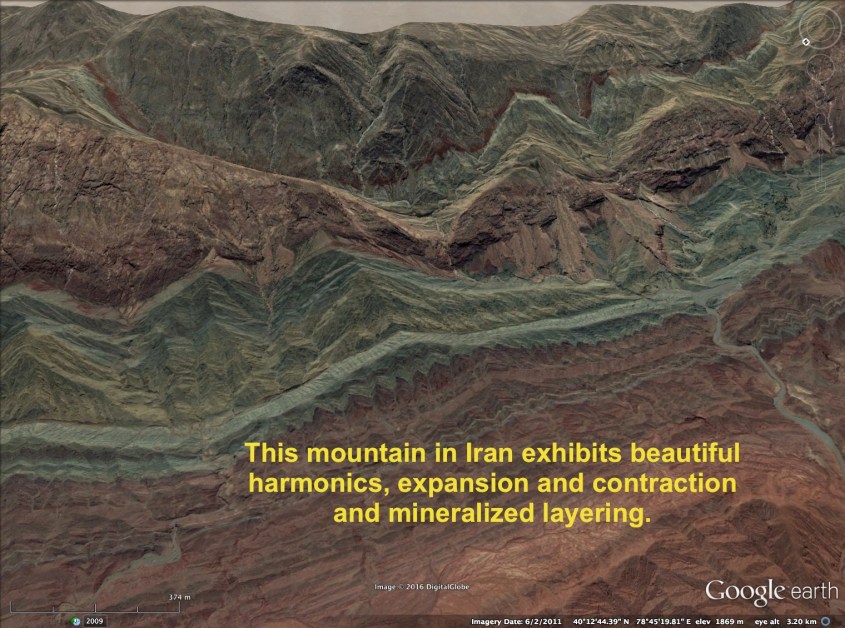
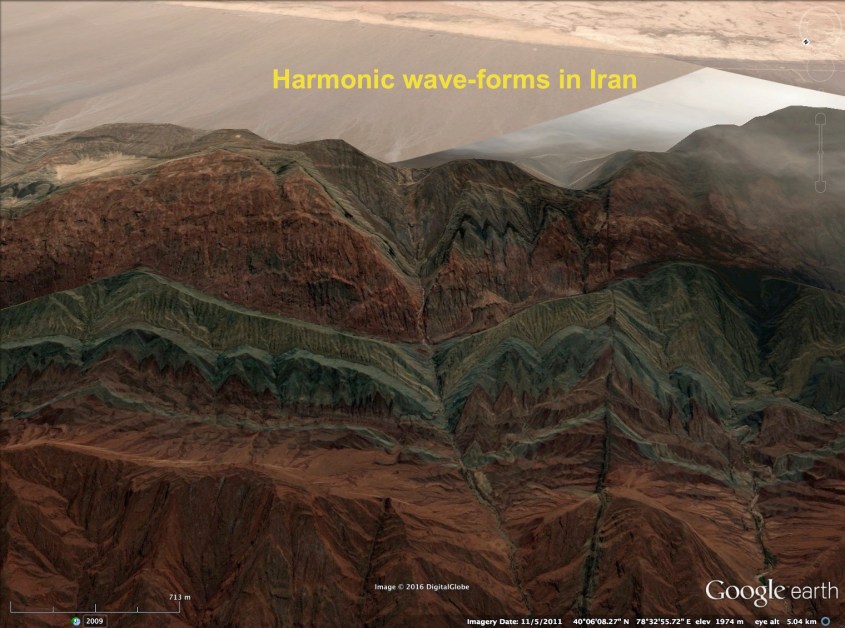
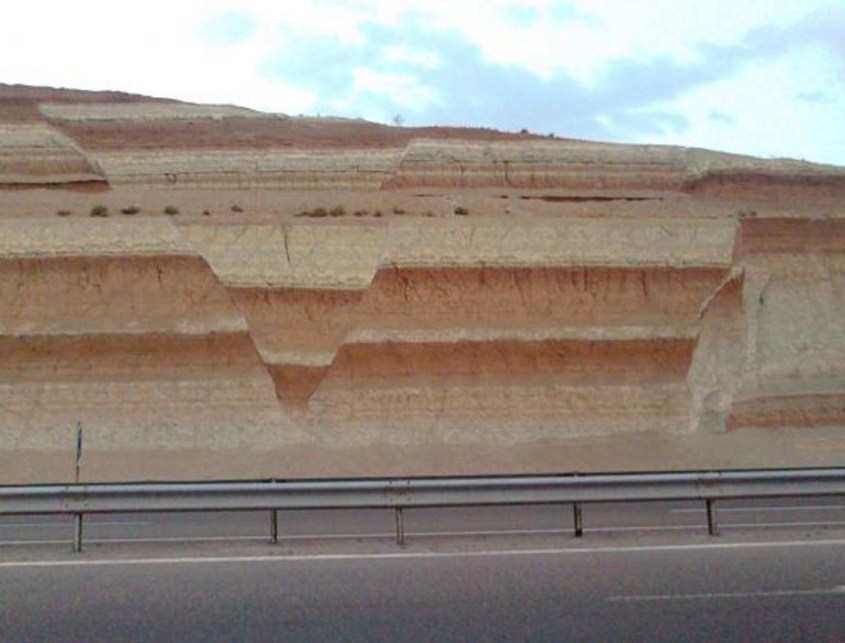
 As wave-forms compress, they squeeze and interfere with each other. Shock waves do not cross, but fold against each other, like a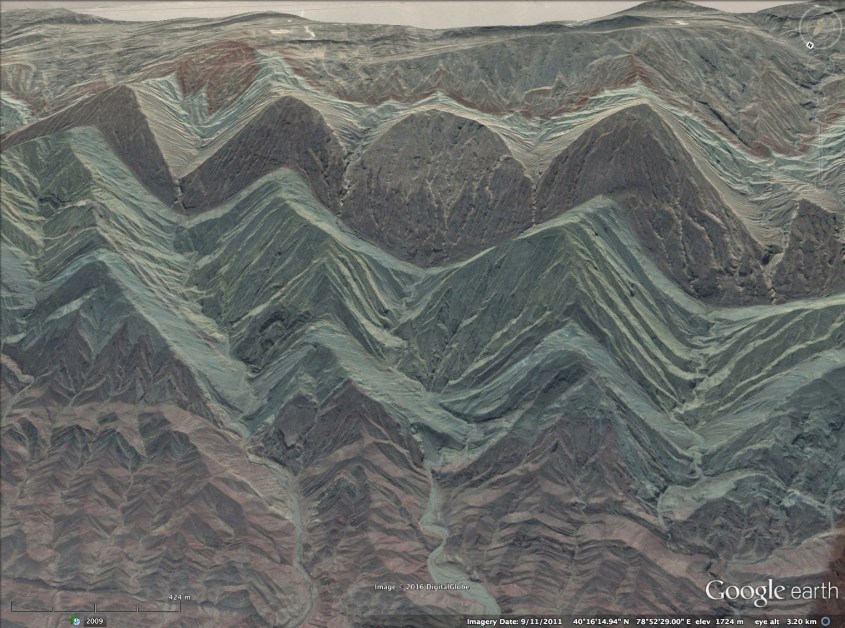


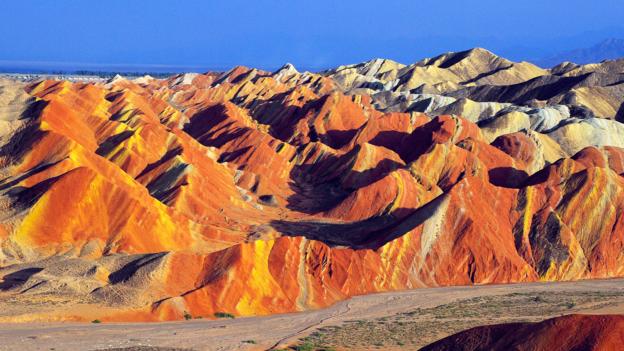
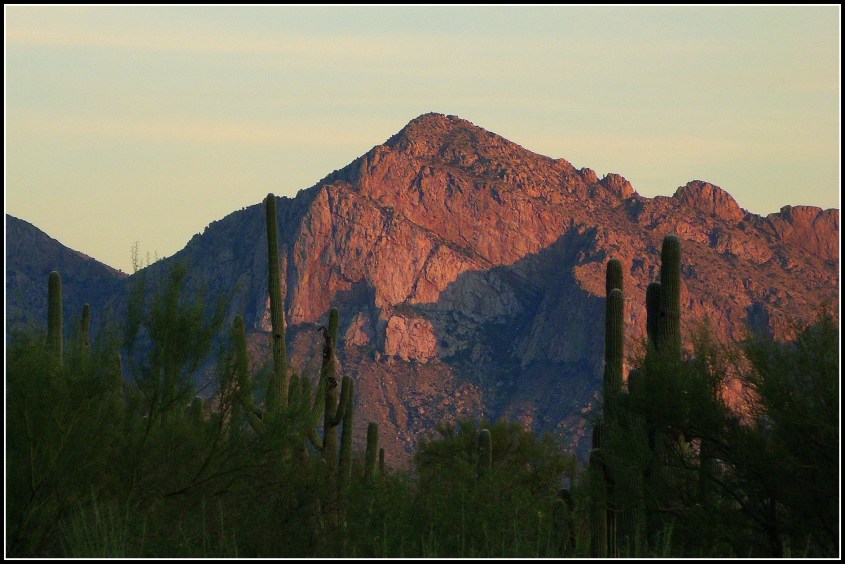
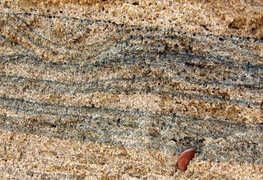
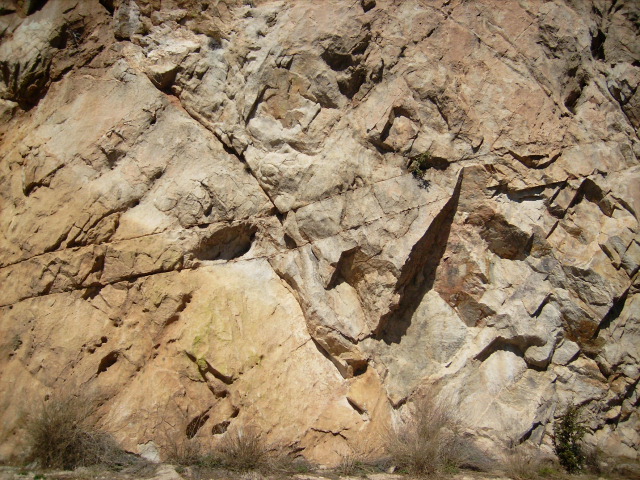
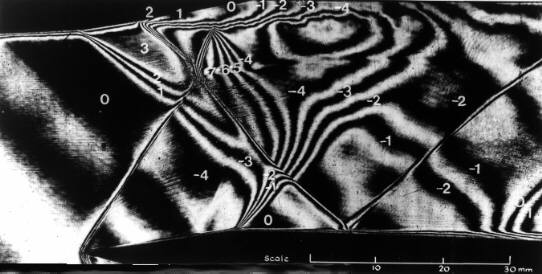 Complexity is found within the shock fronts, inside the triangles themselves, as minor shock fronts vibrate and jostle each other. Note the density variations form a circular feature near the top of this Schlieren image. The same feature is on the distorted triangular buttress found in Northern Arizona, shown below. Note how the edges of the triangle draw in towards the circle, just as the waves near the top in the Schlieren image do. The three small buttresses below the hole show a striking similarity to the size and location as the wave-forms in the same position in the Schlieren image.
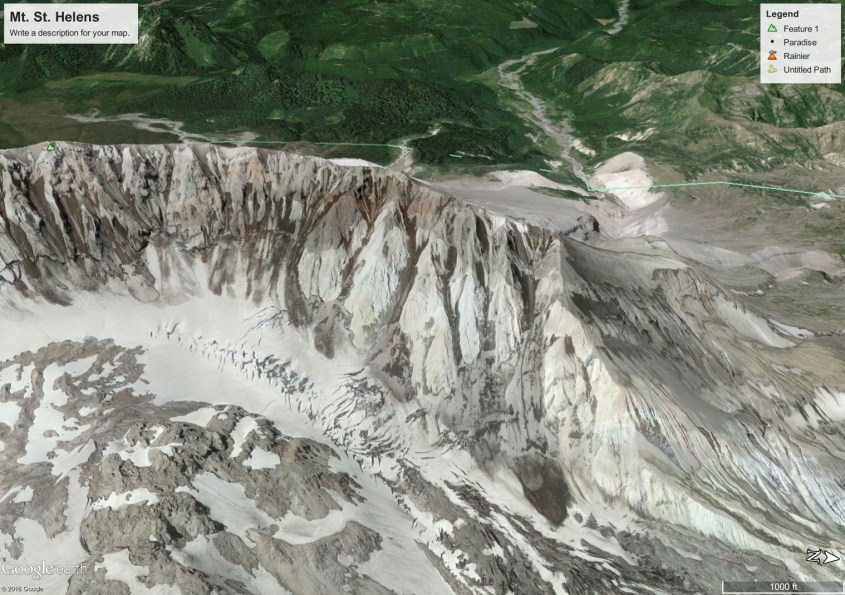
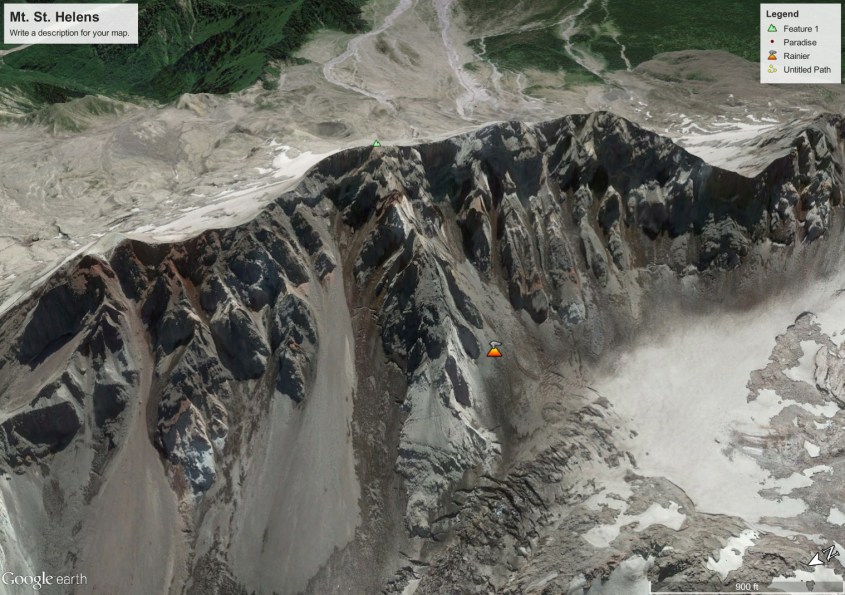

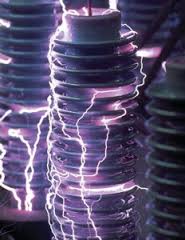
 An arcing fault discharges to ground along the path of least resistance the same way a lightning bolt does. It is conducted through plasma formed by ionized air. Like a lightning bolt, it can be a single spark, or it can fork into a sheet of filaments that jump across gaps and craze across surfaces. The reason arcs tend to craze a surface has to do with a thing called surface conductivity.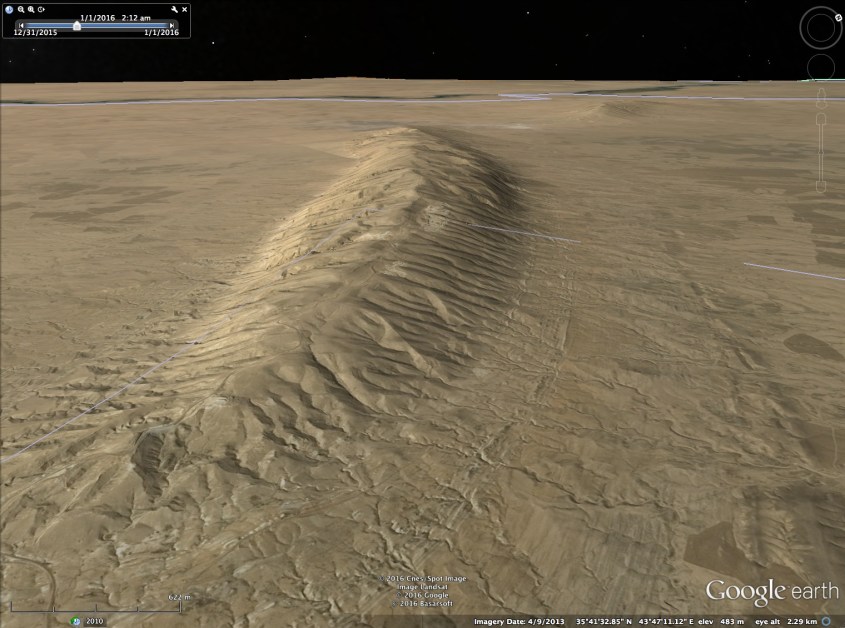
 The astrobleme characteristics, and in particular, the distinctive triangular buttress features that distinguish them, is explained by rogue geophisicist, “Craterhunter,” in this well written article,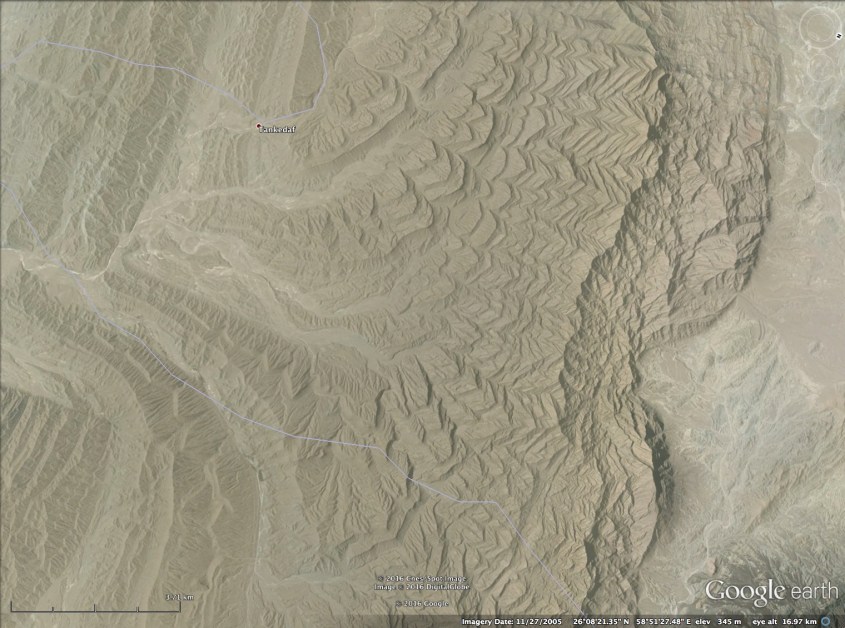
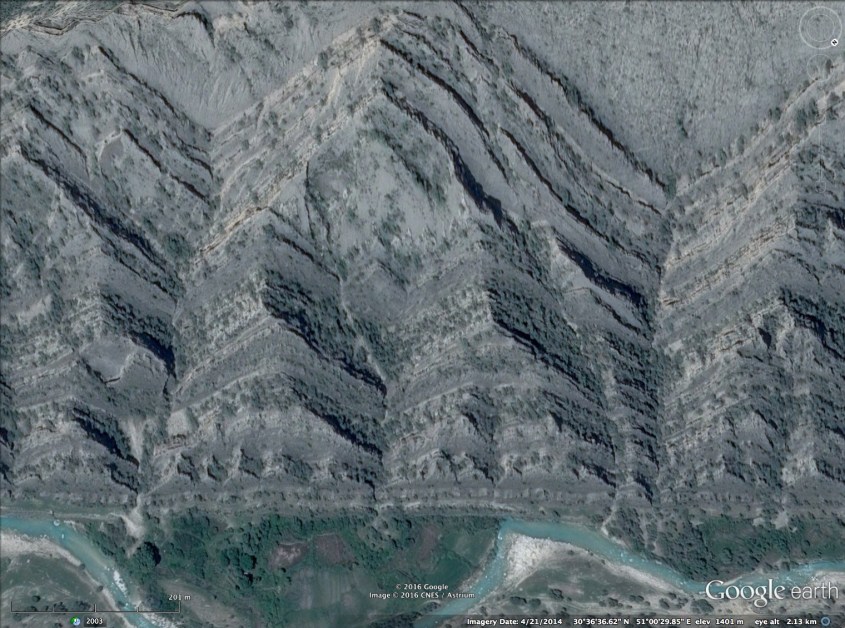
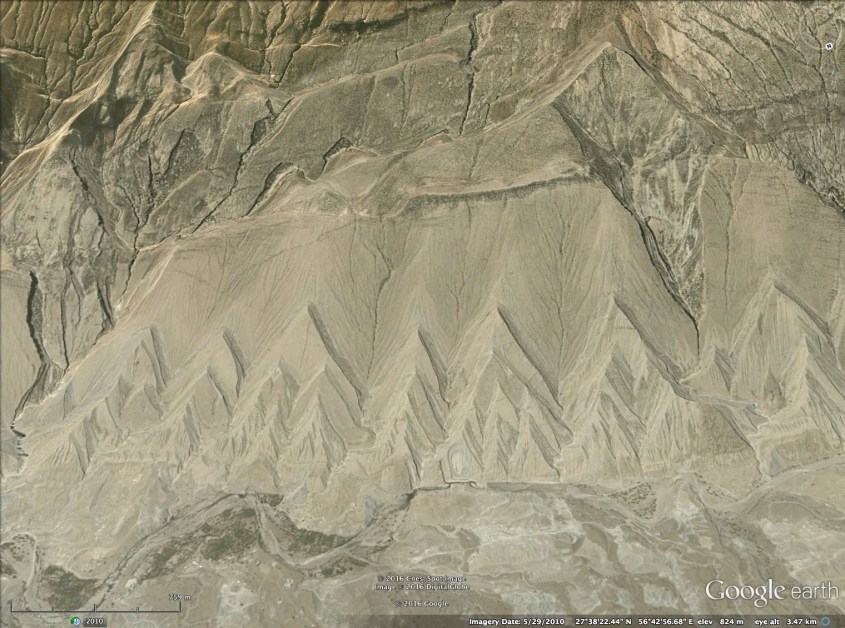
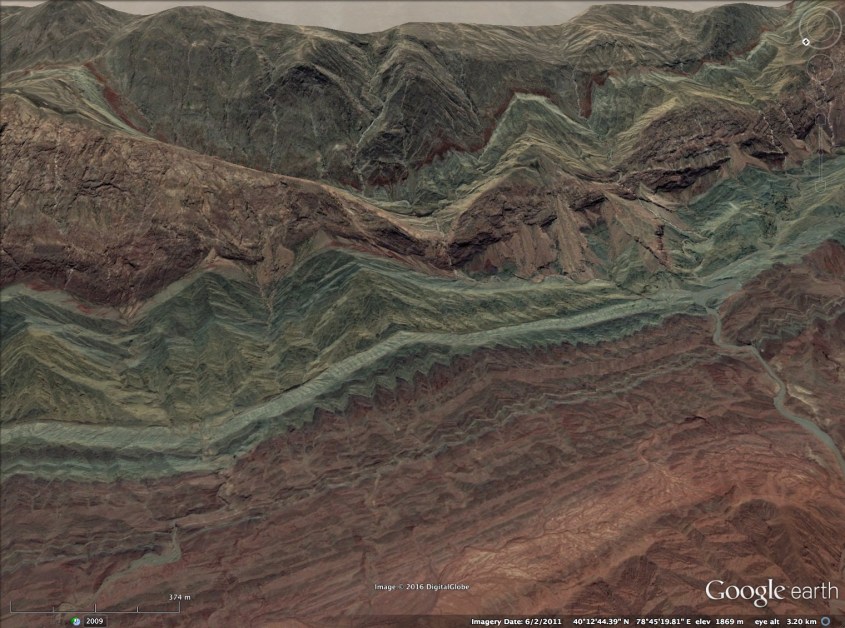
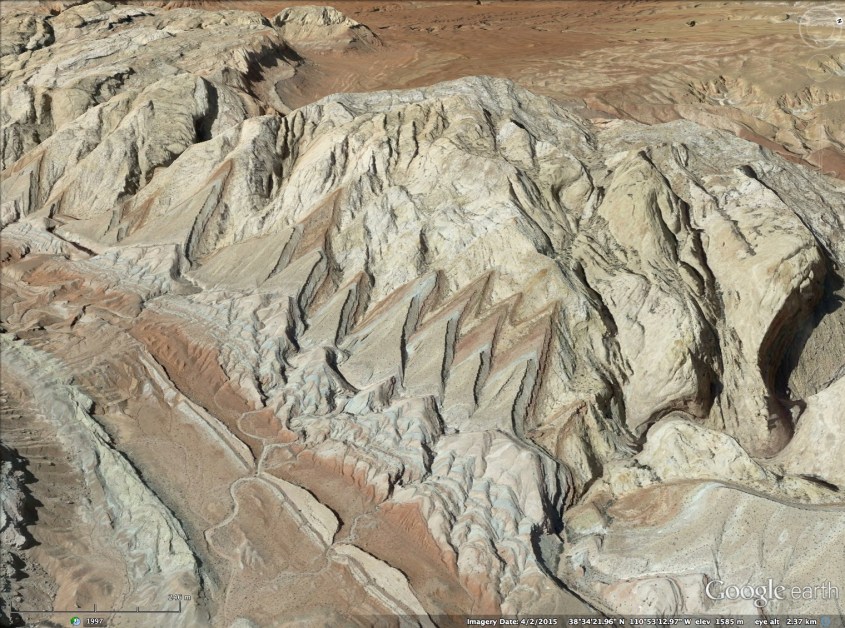
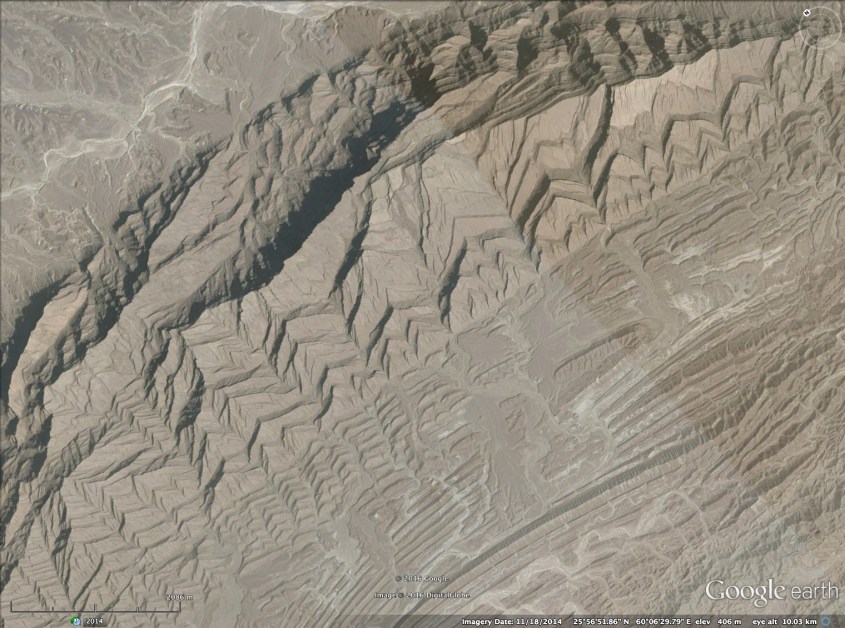
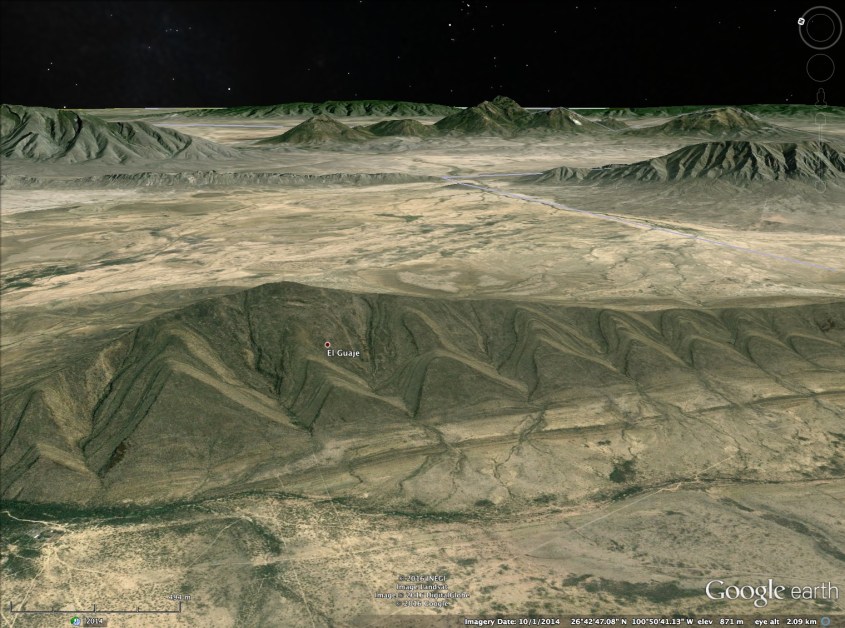
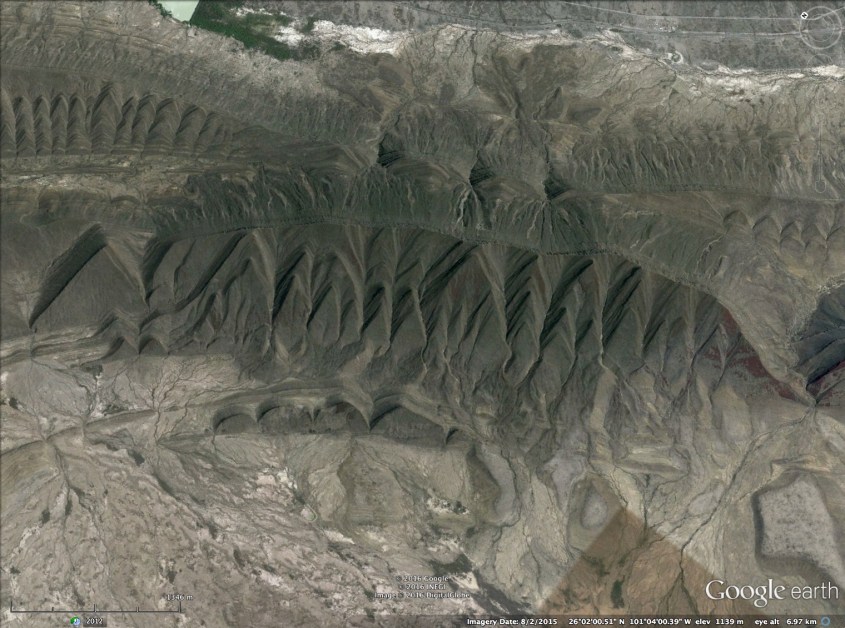
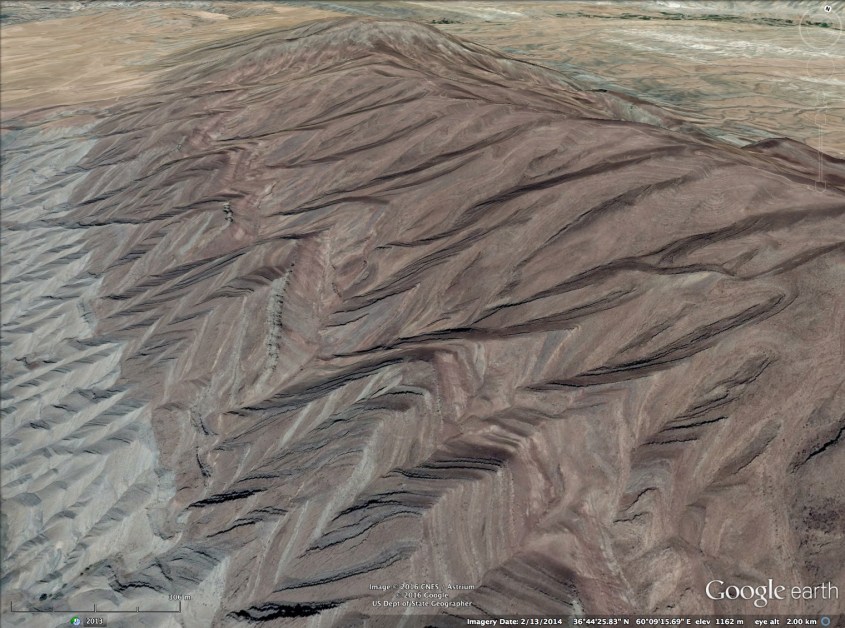
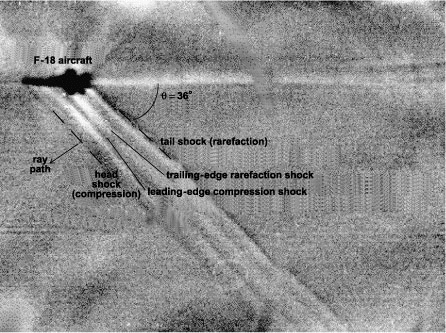


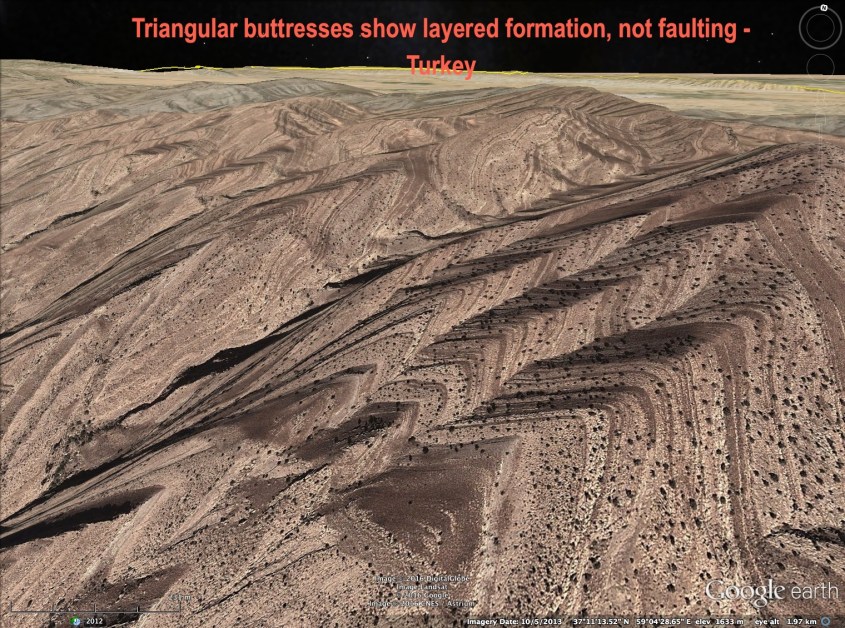
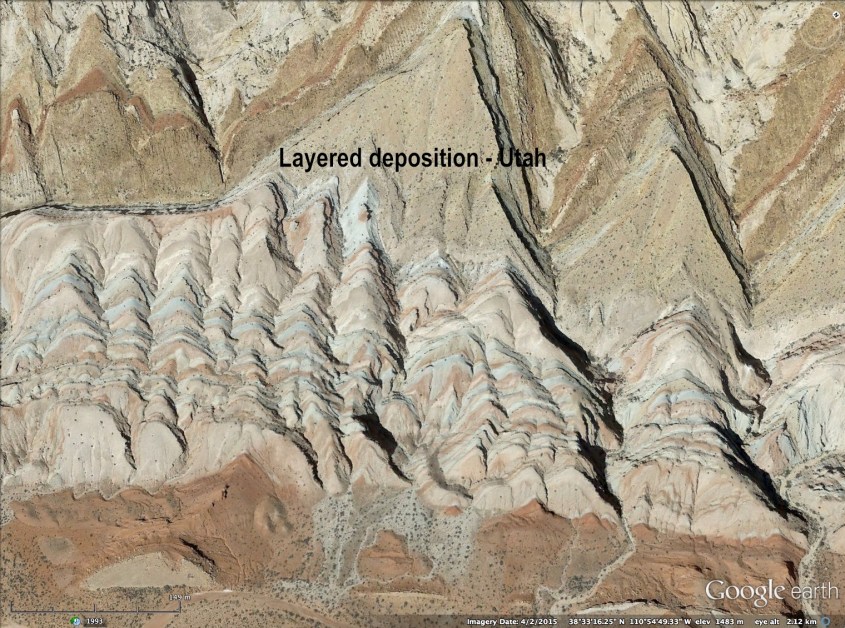
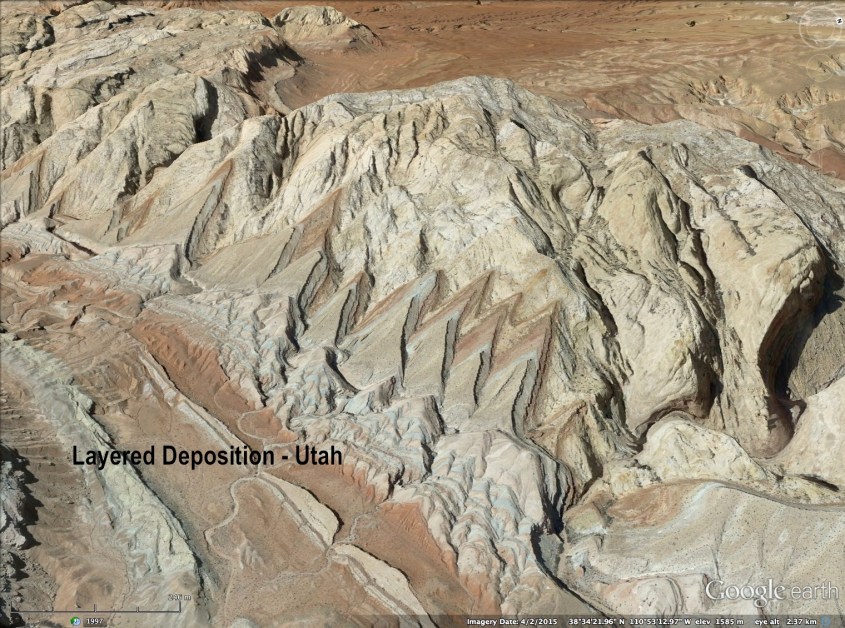
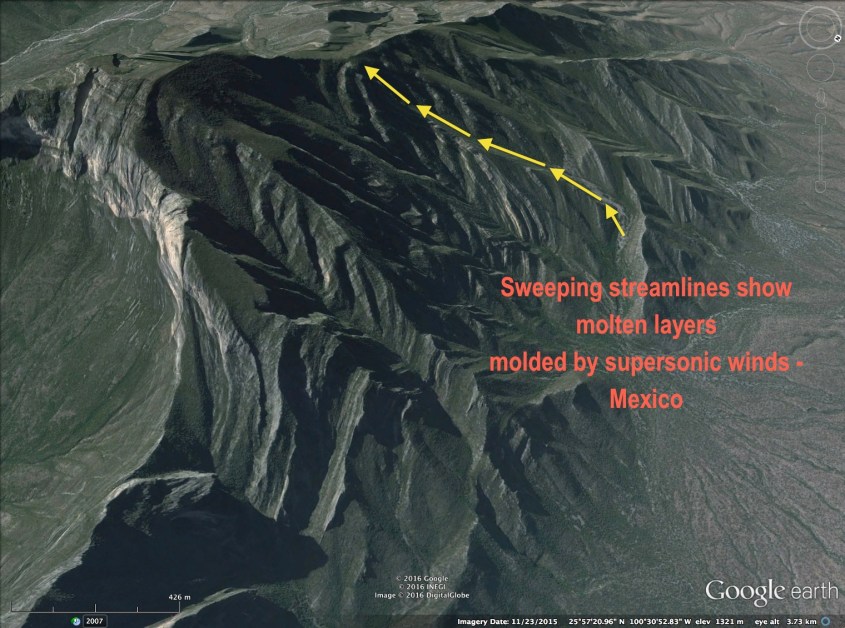
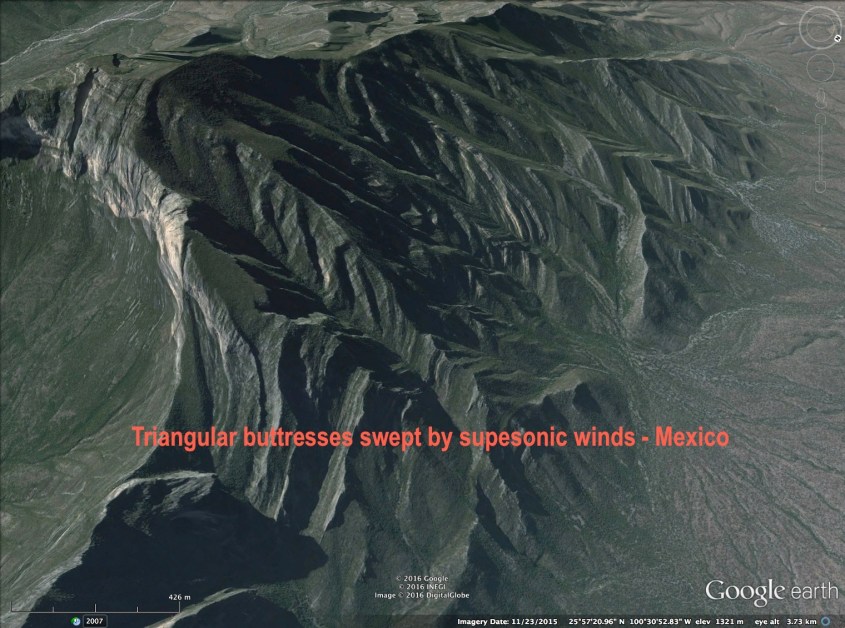
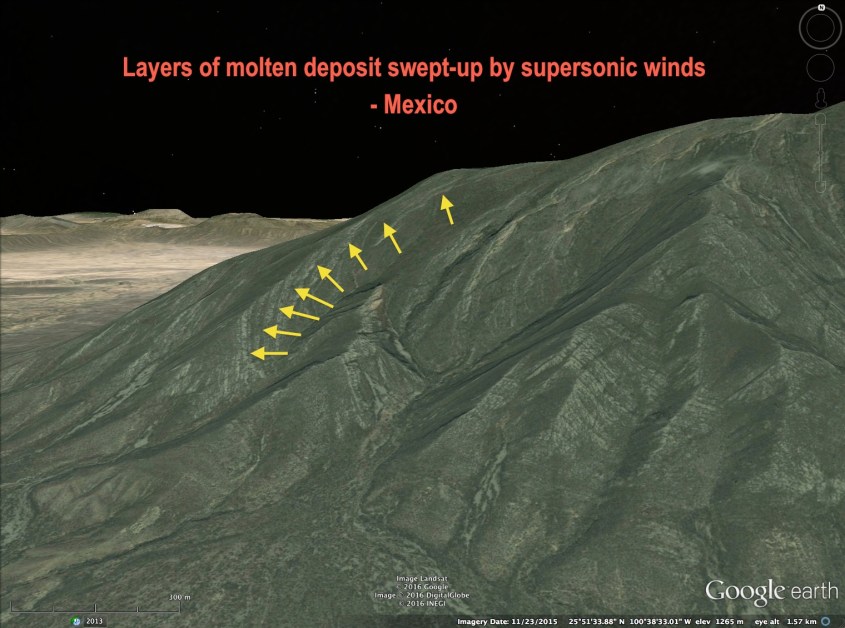
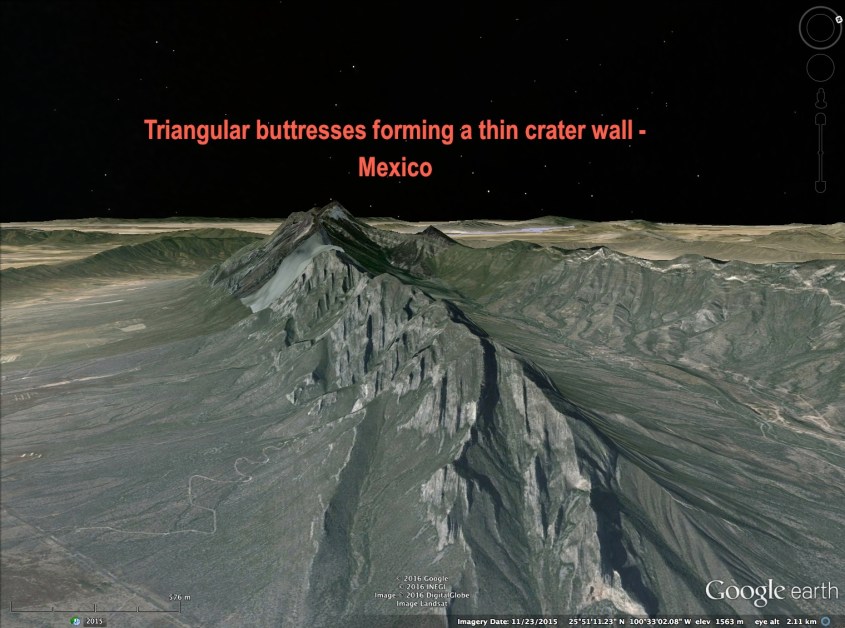
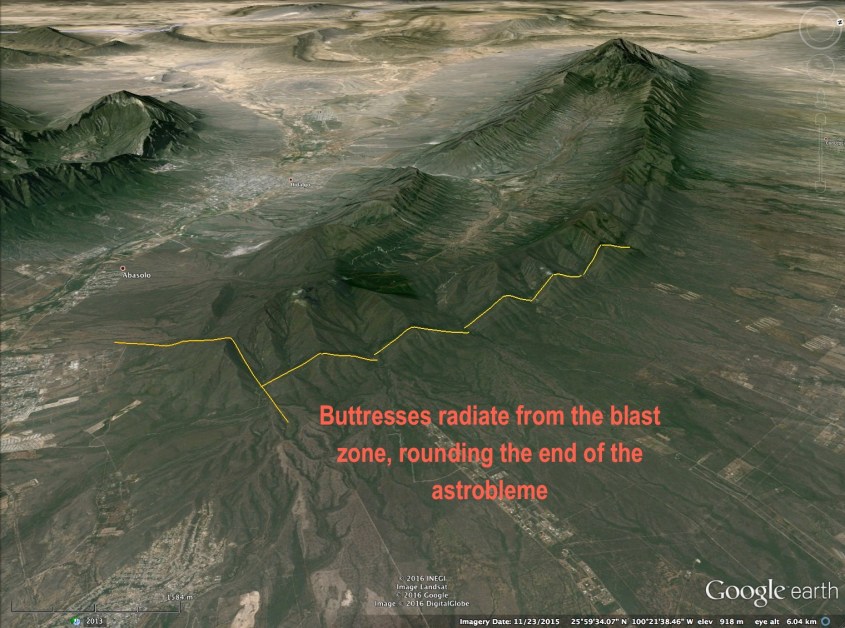
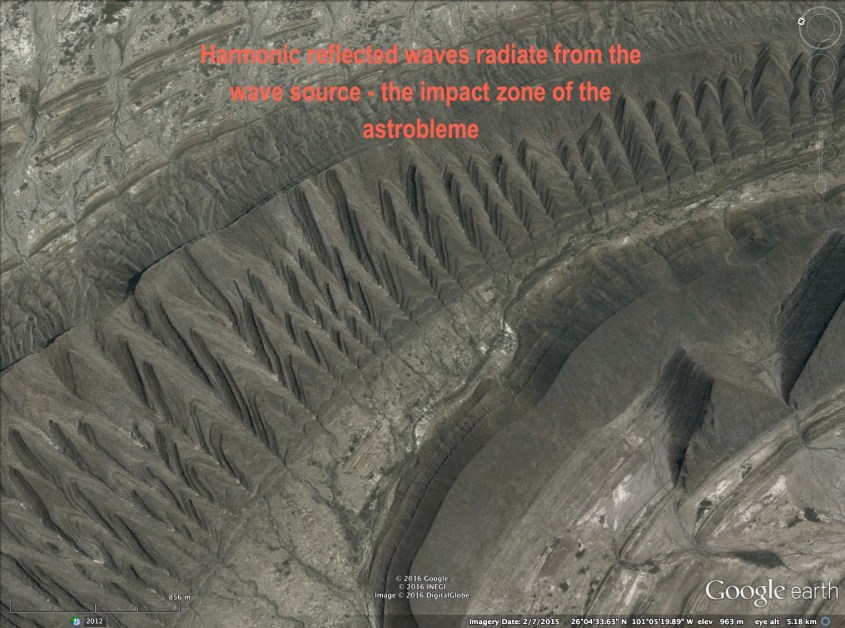
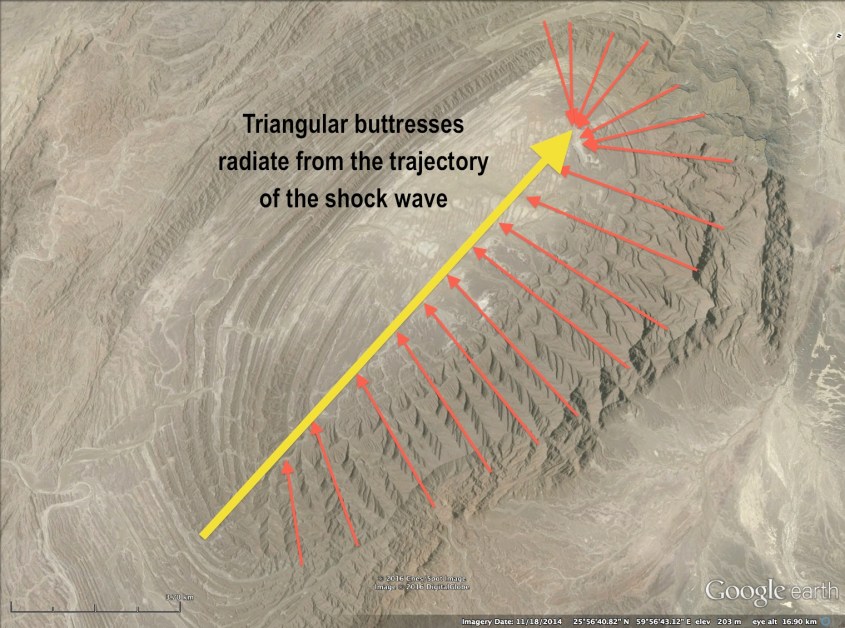
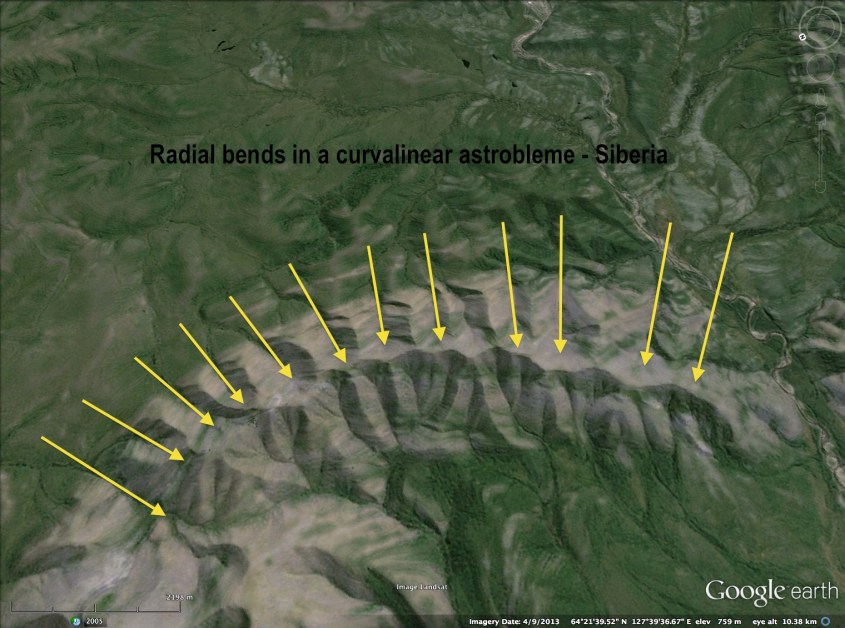
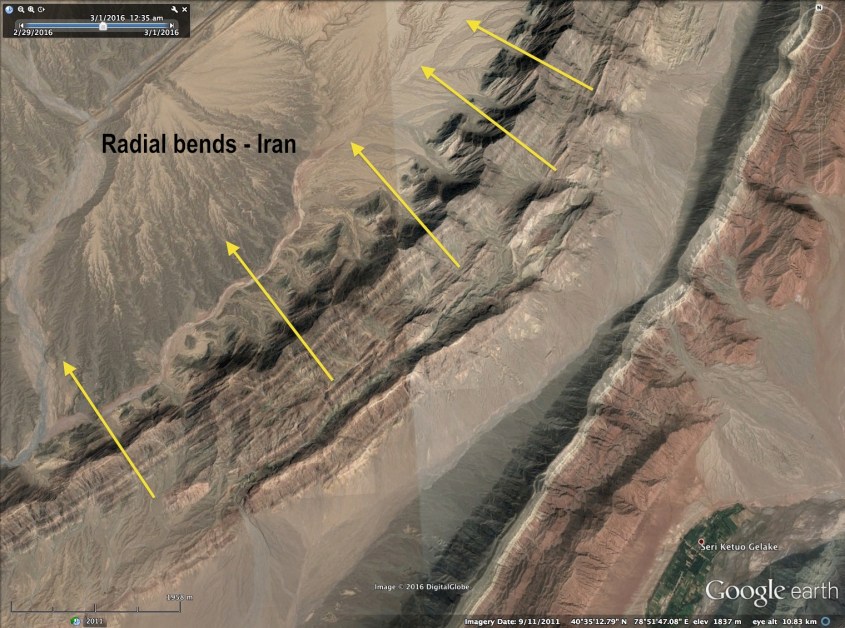
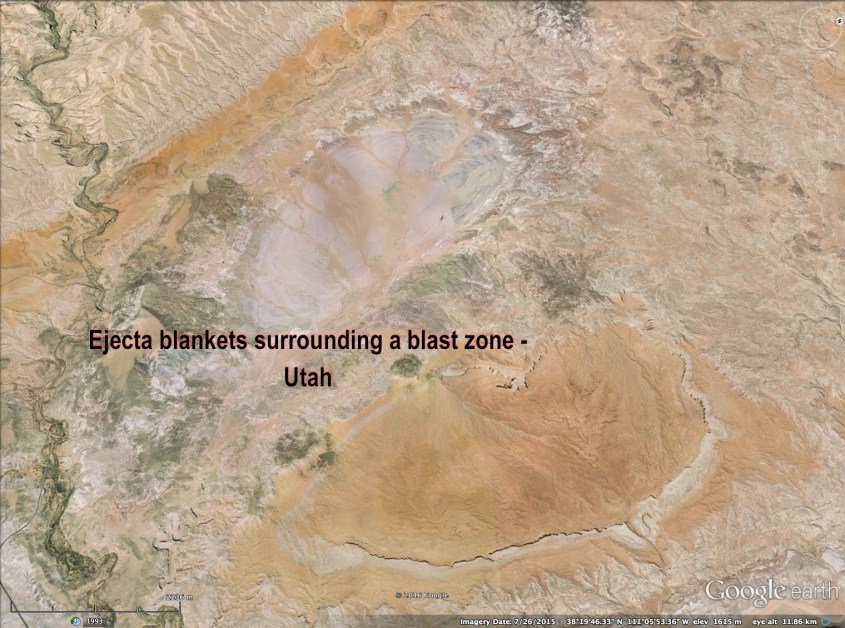
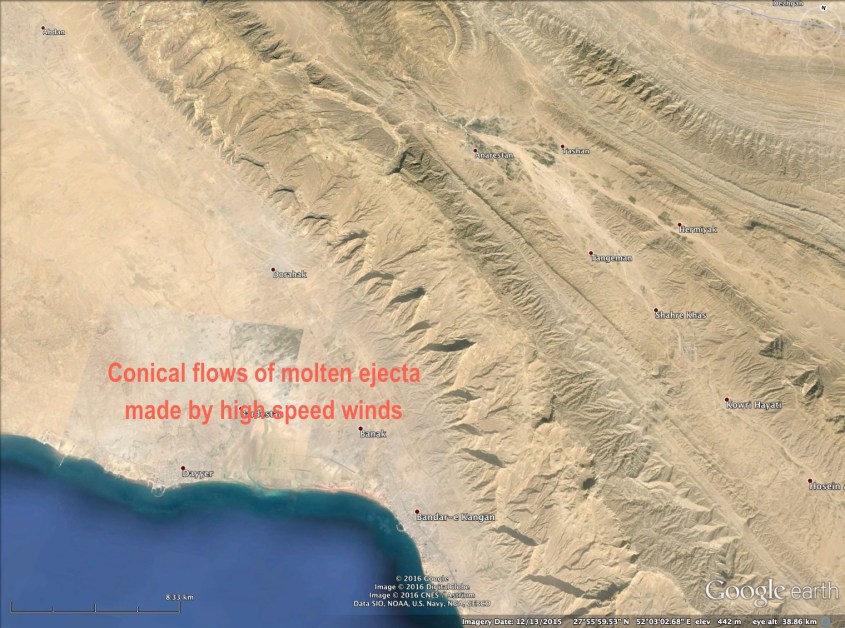
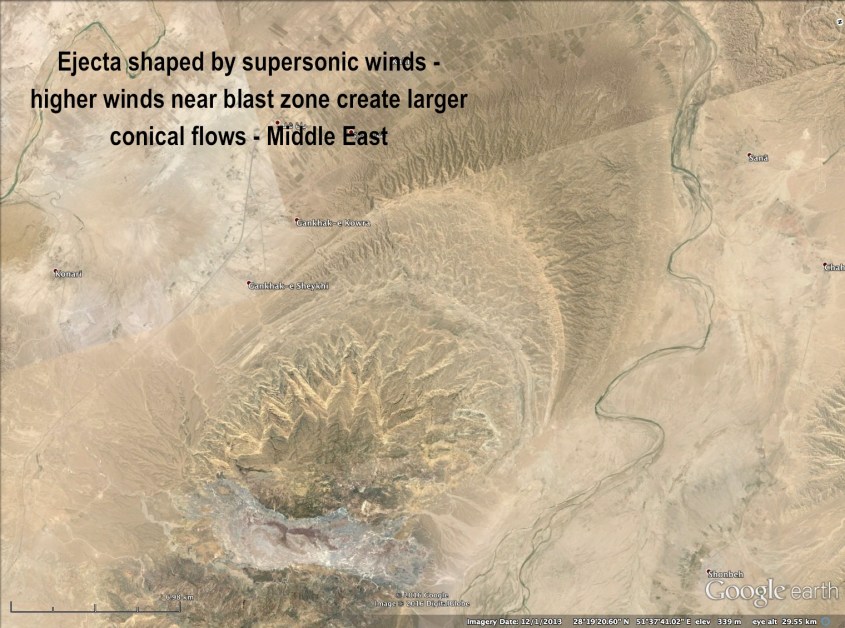
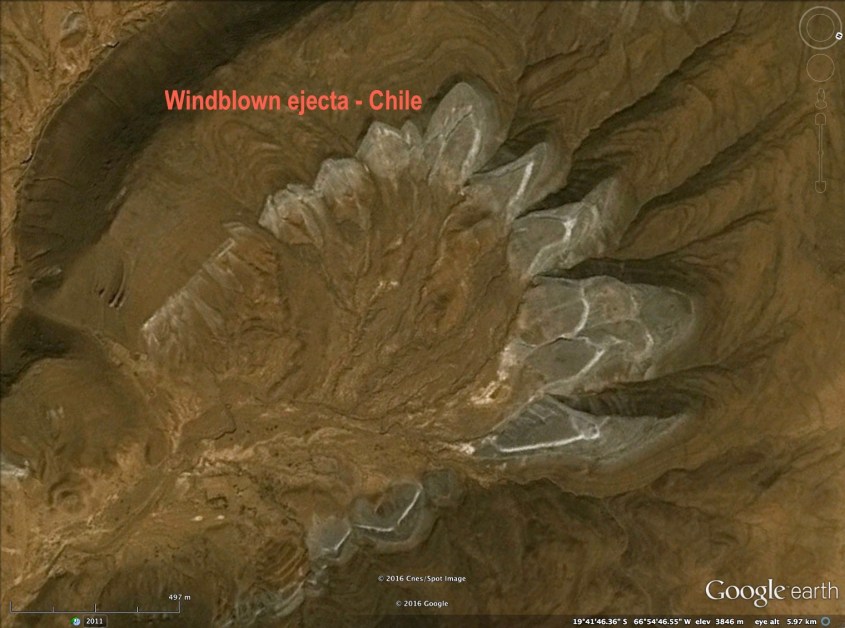
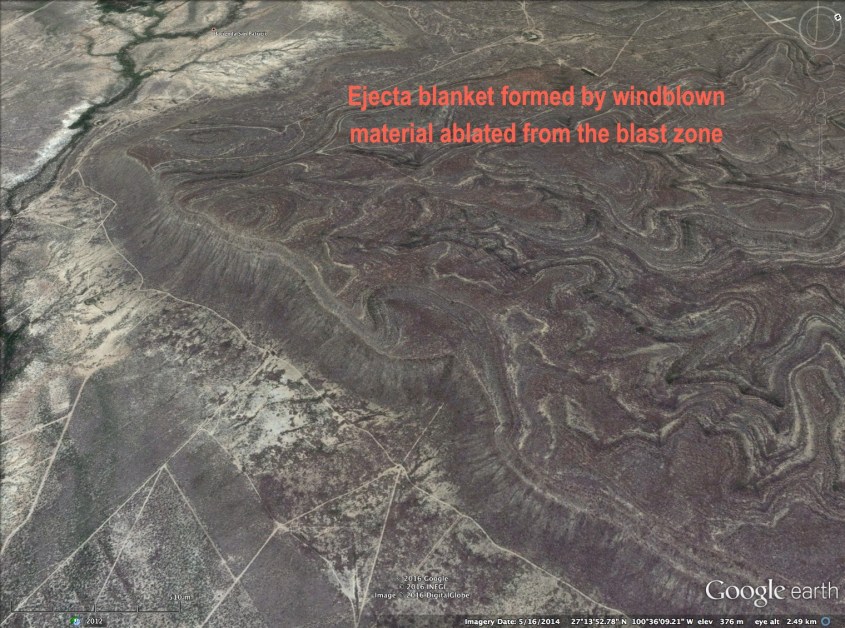
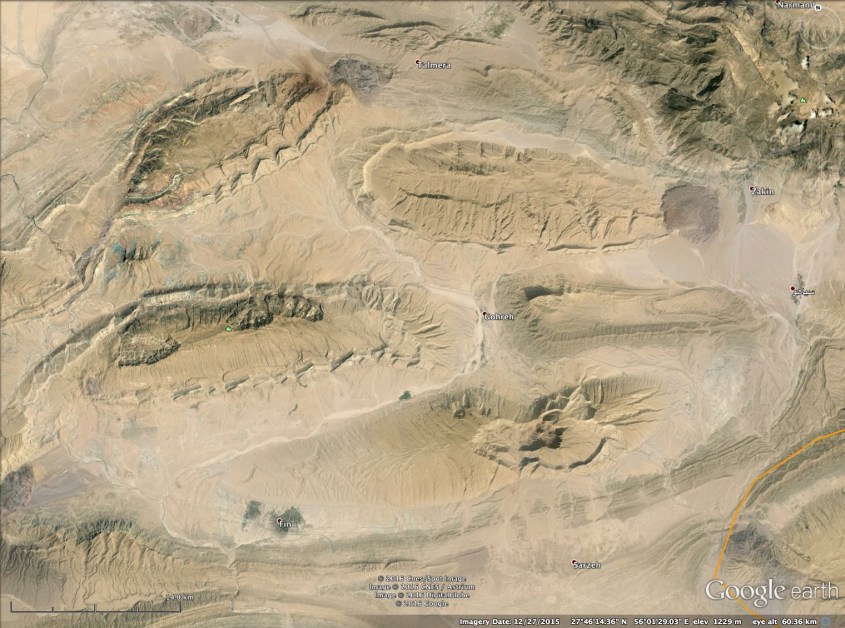
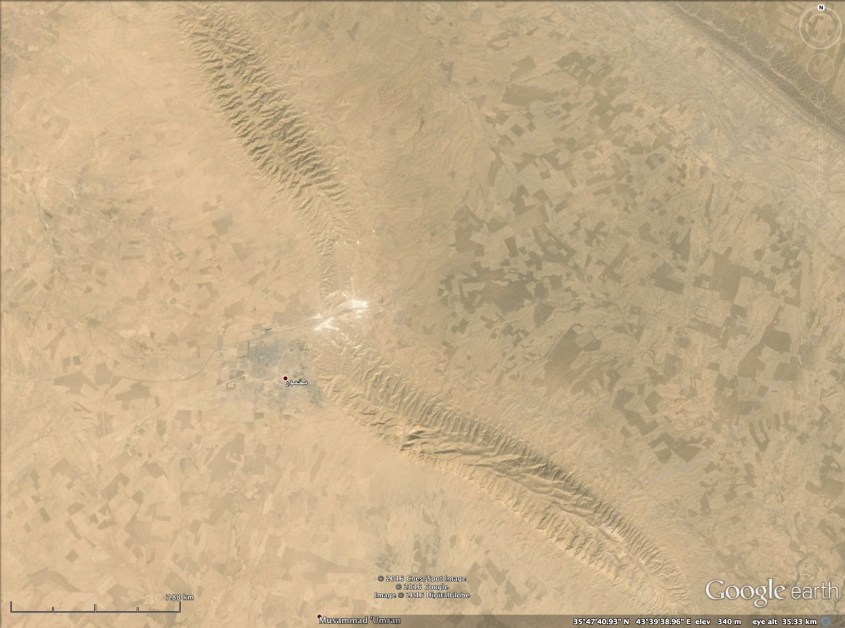
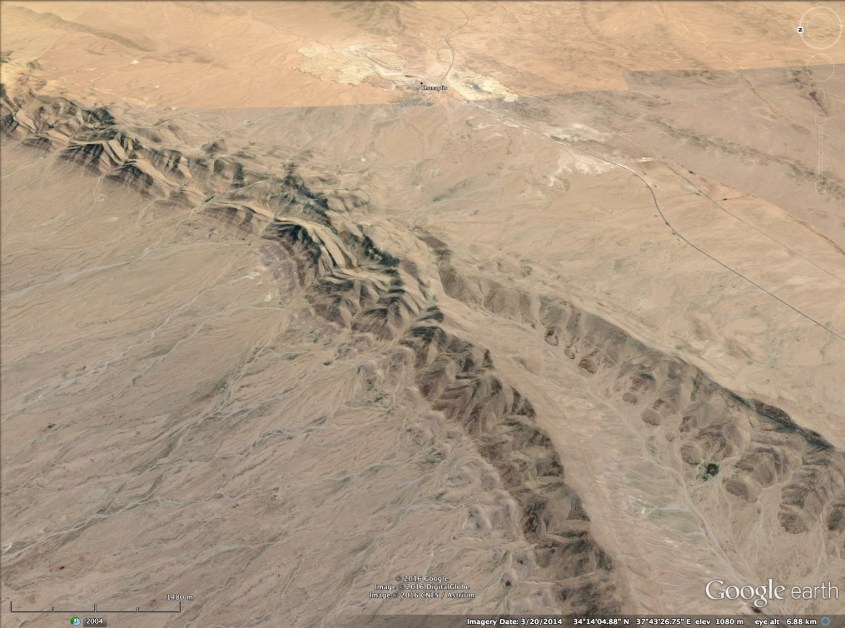
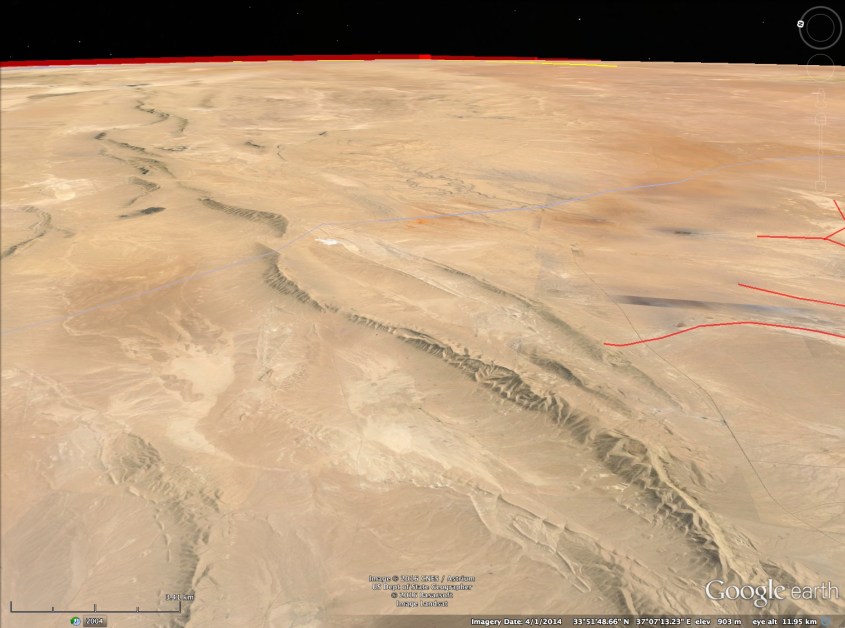
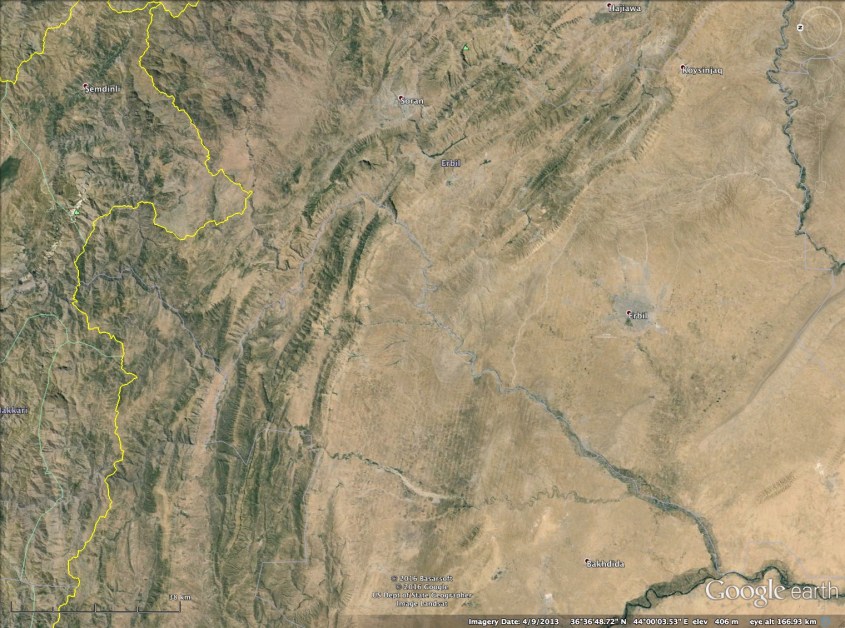
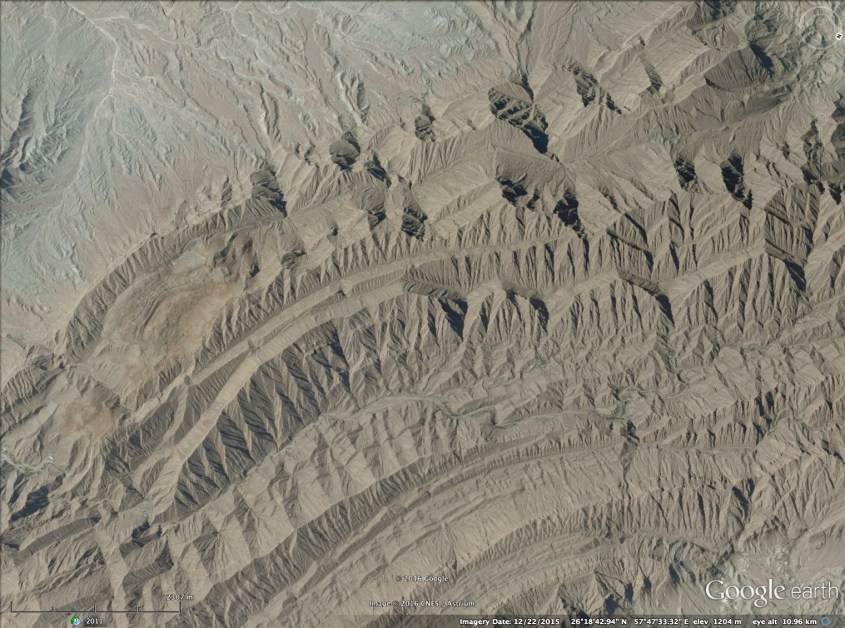
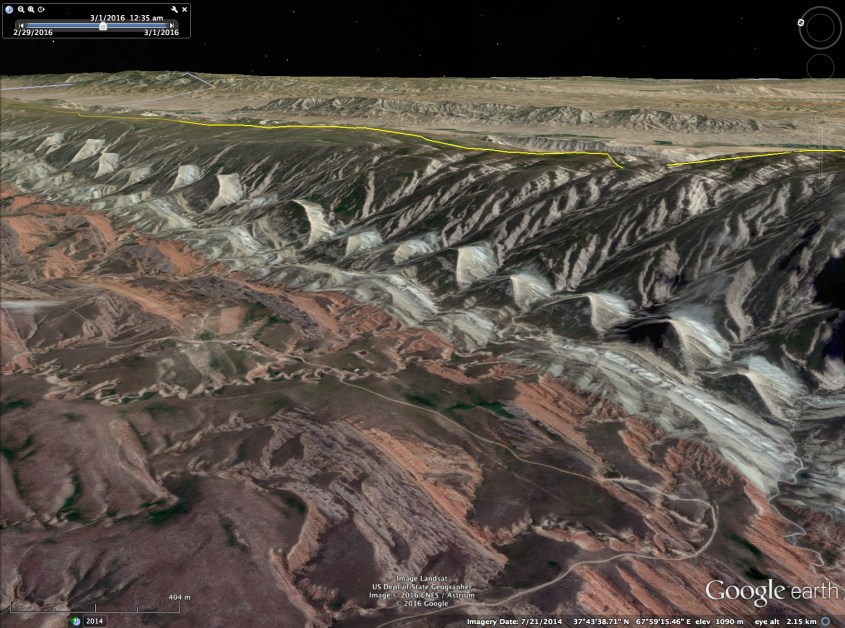
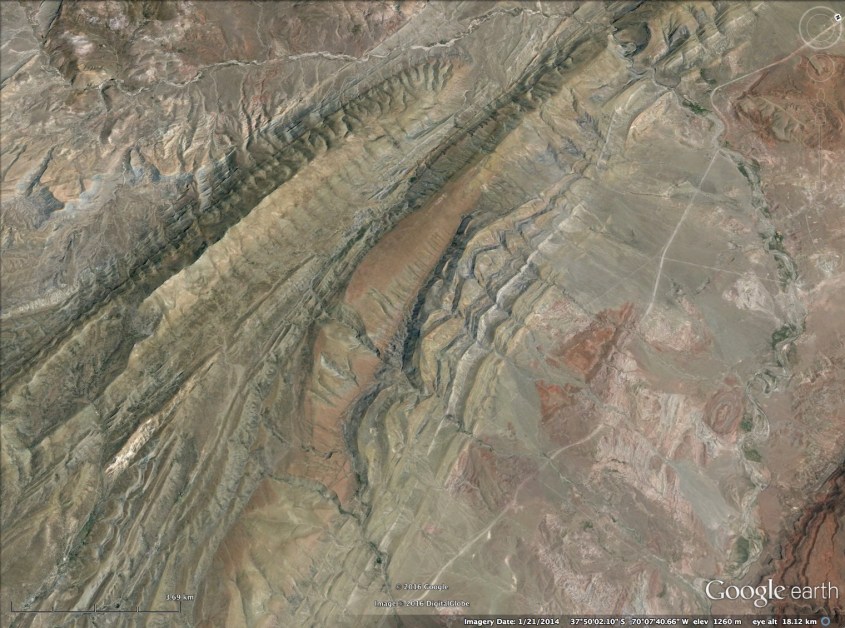
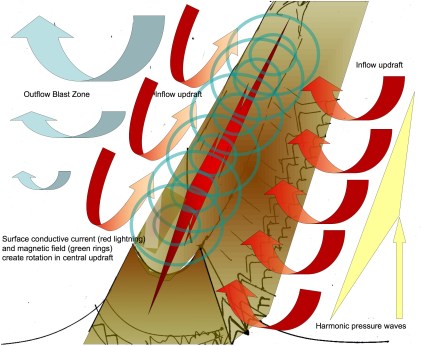
 To understand more about how the Earth’s internal currents are induced by the electromagnetic environment of the solar system, see EU 2015 speakers
  Catastrophists commonly attribute cometary impacts, or supervolcano eruptions as the destructive forces behind the stories. These are phenomena consistent with the mainstream scientific view since they are phenomena science acknowledges has occurred in Earth’s past. Their ideas primarily depart from the mainstream over the notion any such events occurred in Mankind’s experience.
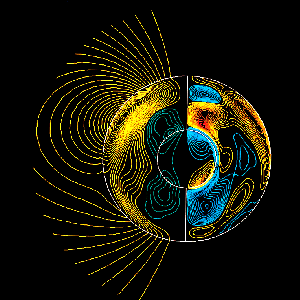 What caused them may have happened in a number of ways and it may have happened a number of times. A Langmuir sheath like that surrounding the Earth – the magnetosphere – forms a double layer of magnetic fields with plasma current sheets sandwiched between. The sheath protects Earth from direct electrical interactions, shielding us from cosmic radiation and solar flares. However, if a foreign body such as a planet, or comet with a different electrical charge penetrates the double layer, electrical discharge will occur.
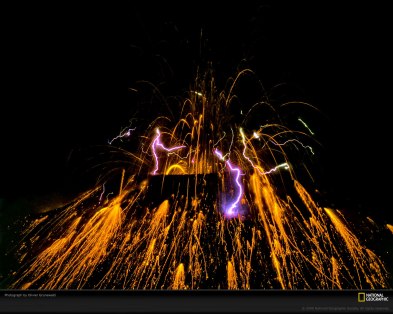 Current enters at the polar cusps (the magnetic poles) and is also induced by currents in the magnetosphere. Increased current in the magnetosphere will increase current within the Earth as well – it’s all connected circuitry.
 In solids, conductivity is greatest in solid metals like silver and copper, because they feature an atomic lattice structure with an abundance of free electrons. In ionic material, like water containing salts, ionized gases, or compounds of molten fluid metals, a net motion of charged ions can occur. This is electric current by ionic conduction – also known as plasma.
 To begin, note that earthquakes and volcanoes congregate along the seams of Earth’s tectonic plates.

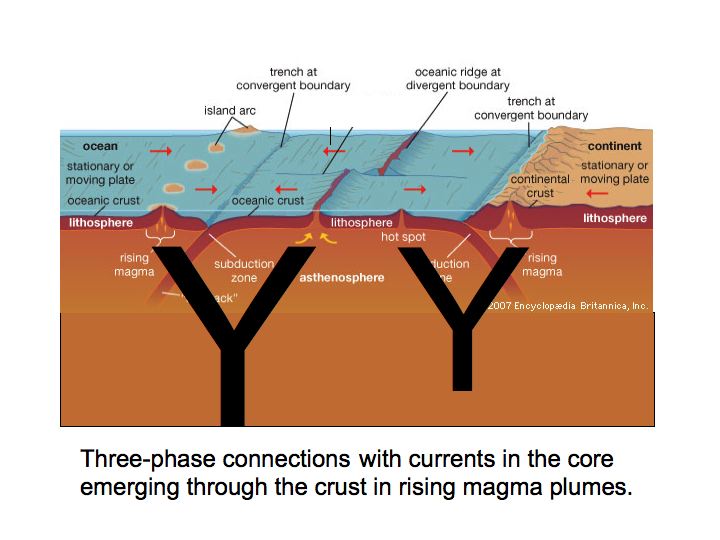

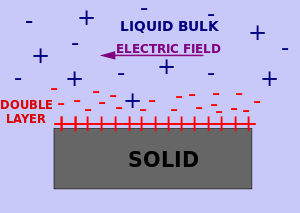 Surface conductivity is a highly conductive path in the vicinity of solid surfaces where a layer of


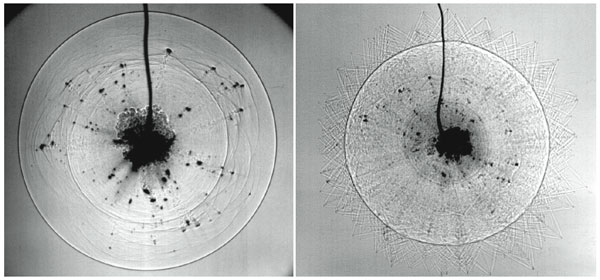
 Reflected shock waves create the chevrons, plain and simple. Supersonic flow produces harmonic reflected shock patterns as the waves reverberate the medium in interference patterns of temperature, pressure and density. No random process of geologic faulting, rain and wind, over millions of years, could possibly produce these nearly identical harmonic chevron patterns in the diverse variety of climates and rock strata they are found on around the world. Dragon’s teeth can only be the result of a violent supersonic blast event. The idea they are created by meteors from space doesn’t hold-up, either.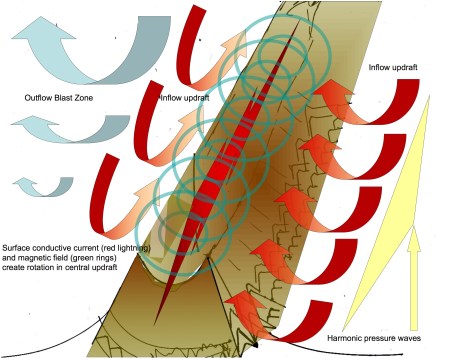
 Idumea lies between the Gaza strip and the Dead Sea, stretching south to the Negev desert.
 The psychology of near extinction; the profound sorrow, fear and guilt of the survivors that resonates through history and shapes our minds today, derives from these events. The history of the Bible and other ancient mythology should be taken seriously. It tells the historical context of real events to those capable of removing the blinders of convention. Because there is profound truth within reach, quite obvious proof, when one sees the universe is electric.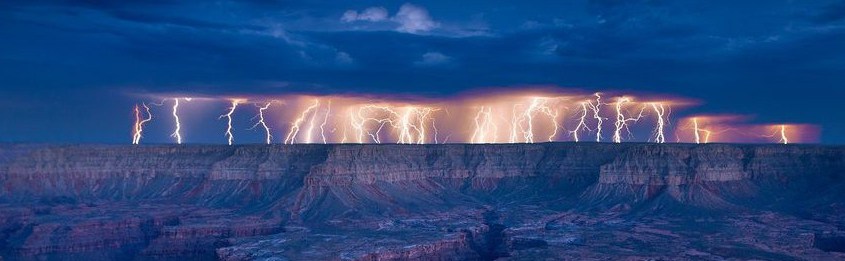
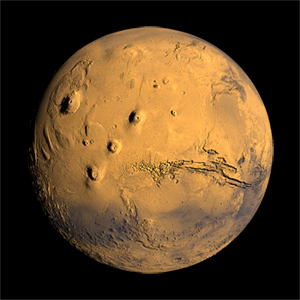
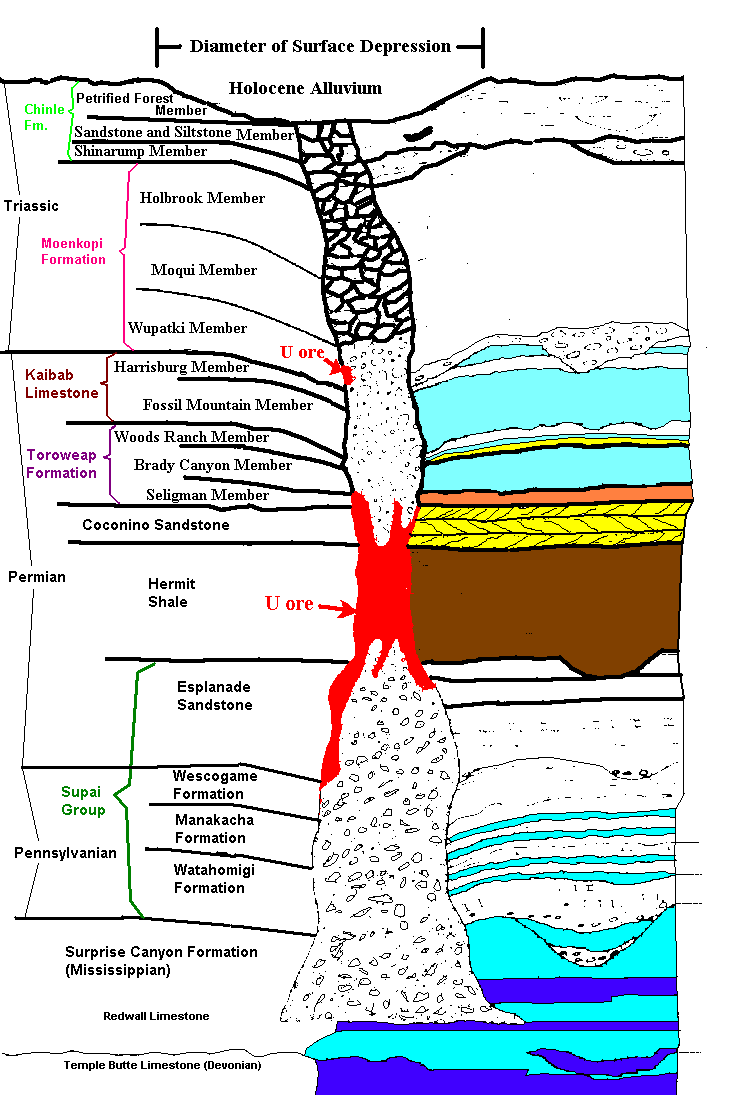



 The examiner reported her death to be caused by impact from a large force that caused multiple, bilateral rib fractures that impinged on her heart and caused internal bleeding. Her chest cavity contained one and a half liters of blood.
 Zolotorev, found in the ravine, also had his chest caved in. His eyes and some flesh had decomposed. He was found to wear several tattoos.
 Like Dubinina, the #2, 3, 4, 5 and 6 ribs had two fracture lines and he exhibited no outward tissue damage associated with the mortal chest wound.
 Thibault-Brignolle’s death was caused by impact of a large force to the roof and base of the skull. It created a multi-splintered fracture, but no exterior tissue damage, although decomposition was evident.
 Slabodin suffered a severe head injury, also. His body was found making his way back to the tent. The head injury didn’t kill him, however. He died from exposure, aggravated by the injury.
 There was internal bleeding, indicating he lived with the injury for some time before freezing to death.
 It appears to have been taken in a hurry, since the focus is very poor.





![Dyatloff_group_115_Kriv[1]](https://thecloakedhedgehog.files.wordpress.com/2013/06/dyatloff_group_115_kriv1.jpg)

![Dyatloff_group_115_Dor[1]](https://thecloakedhedgehog.files.wordpress.com/2013/06/dyatloff_group_115_dor1.jpg)


![Dyatloff_group_115_Sl[1]](https://thecloakedhedgehog.files.wordpress.com/2013/06/dyatloff_group_115_sl1.jpg)

![0_50713_afe7198b_M[1]](https://thecloakedhedgehog.files.wordpress.com/2013/06/0_50713_afe7198b_m1.gif)


![Dyatloff_group_115_Kolev[1]](https://thecloakedhedgehog.files.wordpress.com/2013/06/dyatloff_group_115_kolev1.jpg)

![i_010[1]](https://thecloakedhedgehog.files.wordpress.com/2013/06/i_0101.jpg)


 The Daily Plasma